
Cyber security in accounting isn’t just about IT support anymore—it’s the essential practice of weaving strong digital safeguards directly into your financial workflows. This is how you protect sensitive client data, shut down fraud before it starts, and stay on the right side of compliance. It’s a proactive defense built for the unique threats targeting financial information, and for any modern accounting firm, it’s completely non-negotiable.
The days of seeing cybersecurity as a separate, siloed IT problem are long gone. For accounting firms, the digital threat landscape has completely merged with day-to-day operations. Cybercriminals don't just see a network anymore; they see a goldmine of tax records, payroll data, and client financial statements—all incredibly valuable on the dark web. The risks have become intensely personal and financially devastating.
Think about a sophisticated phishing email, one that perfectly mimics a legitimate client request, tricking a staff member into giving up their login credentials. Within minutes, a hacker could be inside your core accounting software. This isn't just a generic warning. It's a real-world scenario that plays out every single day, often leading to ransomware that locks down critical tax files just days before a major deadline.
The fallout from a breach goes way beyond just operational disruption. The financial services sector, which absolutely includes accounting firms, faces some of the highest breach costs on the planet.
In 2024, the average cost of a data breach hit $4.88 million worldwide. That number jumps to over $5.9 million for financial firms. Globally, cybercrime is projected to cause damages totaling a staggering $10.5 trillion by 2025. This isn't just about losing data; it's about protecting your firm's financial viability.
To truly grasp the impact on your firm's bottom line, you need a solid approach to cyber risk assessment in financial terms. It’s the only way to safeguard your firm’s future, maintain client trust, and protect your hard-earned reputation.
The massive shift to remote work, combined with the adoption of countless cloud applications, has exponentially increased your firm's attack surface. Every remote employee's home network and each third-party software integration is another potential door for attackers to walk through. This distributed environment makes a centralized, secure platform more critical than ever before.
A managed cloud environment acts as your first and most important line of defense. Instead of trying to juggle security updates and monitoring across dozens of different systems, a secure cloud solution delivers:
The core issue we see is firms focusing on internal office security while completely overlooking the risks from unsecured remote workspaces and third-party vendors. Your firm's security is only as strong as its weakest link.
Ultimately, proactive security is no longer an optional line item on your budget. It's a fundamental pillar of modern accounting. For a deeper dive into foundational security measures, you might find our guide on cybersecurity tips for small business helpful.
Strong security isn't about buying a single piece of software and calling it a day. It's about building a thoughtful, layered defense that protects your firm from the ground up. For accounting firms, this process starts with a hard look at what you need to protect and where your biggest weaknesses are.
The goal is to shift from a reactive, "what-if" mindset to a proactive one. Your framework is your strategic plan for managing risk. It’s built on the acknowledgment that while threats are inevitable, a catastrophic breach isn’t. By methodically identifying your most critical assets and vulnerabilities, you can spend your time and money where they’ll have the biggest impact.
Before you build your defenses, you need to map the terrain. A risk assessment for an accounting firm looks very different from one for a retail business. Your most valuable assets aren’t in a stockroom; they're digital files packed with client tax details, payroll records, and sensitive financial strategies.
Start by pinpointing your firm’s "crown jewels"—the data that would cause the most damage if it fell into the wrong hands. This almost always includes:
Once you have this list, ask a simple question for each item: What's the worst that could happen if this data were stolen, encrypted, or leaked? This exercise forces you to prioritize and focus your security efforts on what truly matters.
One of the most powerful security concepts is also one of the simplest: the principle of least privilege. It just means that every user should only have access to the information and systems they absolutely need to do their job—and nothing more.
Not everyone on your team needs access to every client file. A junior accountant working on corporate tax returns shouldn’t be able to open the payroll files for a different client. An administrative assistant doesn't need permissions to alter historical financial records in your accounting software. It’s common sense, but it’s rarely implemented systematically.
By tightly controlling who can access what, you drastically shrink your internal attack surface. Even if a cybercriminal compromises one employee's account, the potential damage is contained to that user's limited permissions, not your entire network.
Before we dive into more controls, let's summarize the foundational measures that every accounting firm should have in place. Think of this as your security starting line.
This table breaks down some of the most critical security measures, explaining their purpose and offering a practical way to implement them. These aren't just technical suggestions; they are operational necessities for protecting client data.
| Security Control | Primary Goal | Implementation Example |
|---|---|---|
| Risk Assessment | Identify and prioritize the most critical data and systems. | Create an inventory of all client data locations (servers, cloud apps, laptops) and rank them by sensitivity. |
| Access Control | Limit data access to only those who absolutely need it for their job. | Create user roles in your accounting software (e.g., "Tax Preparer," "Admin") with specific permissions for each. |
| Multi-Factor Auth. | Prevent unauthorized access even if a password is stolen. | Enable MFA on all email accounts, VPNs, and cloud accounting platforms using an authenticator app like Google Authenticator. |
| Data Encryption | Make data unreadable to unauthorized parties, both in transit and at rest. | Ensure laptops have full-disk encryption (like BitLocker) enabled and that your cloud provider encrypts stored data. |
| Regular Backups | Ensure data can be recovered quickly after a ransomware attack or system failure. | Use a "3-2-1" backup strategy: 3 copies of your data, on 2 different media types, with 1 copy kept off-site. |
These controls form the bedrock of a resilient security posture. Getting them right significantly reduces your firm's vulnerability to common cyber threats.
If you only implement one technical control from this guide, make it Multi-Factor Authentication (MFA). Requiring a second form of verification—like a code from a mobile app—in addition to a password is the single most effective step you can take to stop unauthorized access.
The vast majority of breaches that start with stolen credentials can be blocked by this simple layer. But don't just turn it on for one application; enforce it everywhere critical data lives:
Activating MFA immediately lowers your risk. While you build out the rest of your framework, this one action provides a massive and immediate security return.
For more advanced strategies on controlling access, our guide on how to implement zero trust security offers valuable insights. As technology evolves, it's also crucial to consider emerging challenges; understanding AI security compliance in finance and insurance can help you prepare for the next wave of regulatory and security demands.

Moving your firm's sensitive financial data to the cloud can feel like a big leap, but it’s one of the most significant security upgrades you can make. The old model of keeping everything on a server in the back office is loaded with risks that many firms underestimate. That single machine becomes a single point of failure, vulnerable to everything from physical theft and hardware malfunctions to targeted ransomware attacks.
A professionally managed cloud environment shifts the security burden from your team to dedicated experts. Instead of your staff worrying about server maintenance, patching software, and monitoring for threats, you’re partnering with a provider whose entire business revolves around keeping data safe. You get enterprise-grade security without the enterprise-level price tag.
When you manage your own server, you are personally on the hook for every single aspect of its security and uptime. This includes physical security for the server room, constant software updates, firewall configurations, and running your own backup protocols. It's a full-time job that falls far outside the expertise of most accounting professionals.
Migrating to a secure cloud host delegates these responsibilities to a team of specialists, delivering tangible advantages that directly boost your firm's resilience and efficiency.
A successful move to the cloud depends on a clear, methodical plan. Rushing the process can create new vulnerabilities, so it’s essential to approach the migration with a security-first mindset. The goal is to ensure data is protected at every single stage of the transition.
Your checklist should prioritize data integrity and confidentiality above all else. Start by identifying all the data that needs to be moved and classifying it by sensitivity. This helps ensure that your most critical client files receive the highest level of protection during the transfer.
The biggest mistake we see is treating a cloud migration like a simple file transfer. It's a security procedure first and a logistics project second. Prioritize encryption and access controls from the very beginning.
Make sure your migration plan includes robust encryption. Data must be encrypted in transit (as it moves from your local systems to the cloud) and at rest (once it's stored on the cloud servers). This dual-layer approach means that even if data were intercepted during the transfer, it would be completely unreadable.
One of the most powerful features of a cloud environment is the ability to automate backups and create a solid business continuity plan. This is your ultimate defense against data loss, whether it’s from a ransomware attack, a hardware failure, or simple human error. The key is to build redundancy into your strategy.
The gold standard for data protection is the 3-2-1 backup rule. It's a simple concept that provides powerful protection.
Automated daily backups mean that in a worst-case scenario, you can restore your data to its state from the previous day with minimal disruption. For an accounting firm staring down a tax deadline, this capability can be the difference between a minor hiccup and a catastrophic business failure. You can find more information about safeguarding your digital assets in our comprehensive guide on cloud data protection. This is the foundation of a modern cybersecurity accounting strategy.
Your security framework is only as strong as the people who use it. While firewalls and encryption are non-negotiable, they can’t stop a well-meaning employee from clicking a malicious link or a third-party vendor from suffering a data breach. The human element is the final, crucial layer in any serious cybersecurity strategy.
The reality is that your team and your partners create a wide, often unpredictable attack surface. An untrained employee can accidentally leave the digital door unlocked, and a vendor with sloppy security can become a backdoor into your entire network. This is why managing these risks proactively isn’t just an IT task—it’s a fundamental business responsibility.
A security-conscious culture doesn't happen by accident; you have to build it intentionally through consistent, relevant training. The goal isn’t to scare your team but to empower them to become the firm's first line of defense. A single, check-the-box training session once a year just doesn’t cut it anymore. Security education needs to be an ongoing conversation that evolves with the threats.
Instead of generic cybersecurity warnings, tailor your training to the real-world scenarios accountants actually face. Create specific, engaging modules that feel directly connected to their daily work.
The most successful training programs we've seen are the ones that turn security into a shared mission. When an employee spots and reports a phishing attempt, celebrate it. This positive reinforcement encourages vigilance far more effectively than any fear-based tactic.
Every piece of software you integrate and every service provider you hire can either strengthen or weaken your security. A breach originating from a third-party vendor is one of the most common—and most overlooked—attack vectors. Your firm’s security is directly tied to the security practices of your entire supply chain.
Before you integrate any new tool or bring on a new service, you have to conduct thorough due diligence. This means asking tough, specific questions about their security protocols. Don't just take their word for it; ask for documentation and proof to back up their claims.
This vetting process is even more critical as firms increasingly lean on outside experts to bridge the cyber skills gap. For a deeper dive, check out our article on IT vendor management best practices.
Here are the critical questions you should be asking every potential software vendor or service provider before you grant them access to your systems or data.
| Question Category | Key Questions to Ask |
|---|---|
| Data Encryption | Is our data encrypted both at rest and in transit? What specific encryption standards do you use? |
| Access Controls | How do you enforce the principle of least privilege for your own employees who might have access to our data? |
| Compliance | Can you provide a copy of your most recent SOC 2 report or other relevant compliance certifications? |
| Incident Response | What is your process for notifying us if there's a security breach affecting our data? What are your timelines? |
This rigorous vetting process ensures you aren't unknowingly inheriting another company's security risks. The surge in global cybersecurity spending, expected to hit $213 billion in 2025, is largely driven by sectors like finance finally recognizing these interconnected risks. As firms lean on security services to fill expertise gaps, this scrutiny becomes paramount. You can discover more insights about this global spending surge and its drivers on Seceon.com.
Let’s be honest: prevention is always the goal, but you can’t stop every single threat. Knowing exactly what to do the moment a cyberattack hits is what separates a manageable incident from a full-blown catastrophe. An incident response playbook is your firm's step-by-step guide for navigating a security crisis. It’s designed to turn panic into a methodical process, ensuring everyone knows their role and can act decisively to contain the damage.
Without a plan, a suspected breach quickly spirals out of control. Team members might inadvertently destroy crucial forensic evidence, or worse, communicate conflicting information to clients, amplifying both the financial and reputational harm. A well-rehearsed playbook isn't just a document; it's a core component of any serious cybersecurity strategy, providing clarity when you need it most.
A strong response plan is typically built around four distinct phases. Thinking in these stages helps structure your playbook logically so no critical step gets missed during a high-stress event. Each phase has a clear objective designed to move your firm from the initial alert all the way to a full recovery.
This structured approach ensures that all actions are deliberate, tracked, and effective, which minimizes business disruption and protects sensitive client data.
You don't need a huge, dedicated security department to manage an incident effectively. What you do need is to pre-assign key roles to specific individuals so there's no confusion when an alarm goes off.
Your core response team should, at a minimum, include:
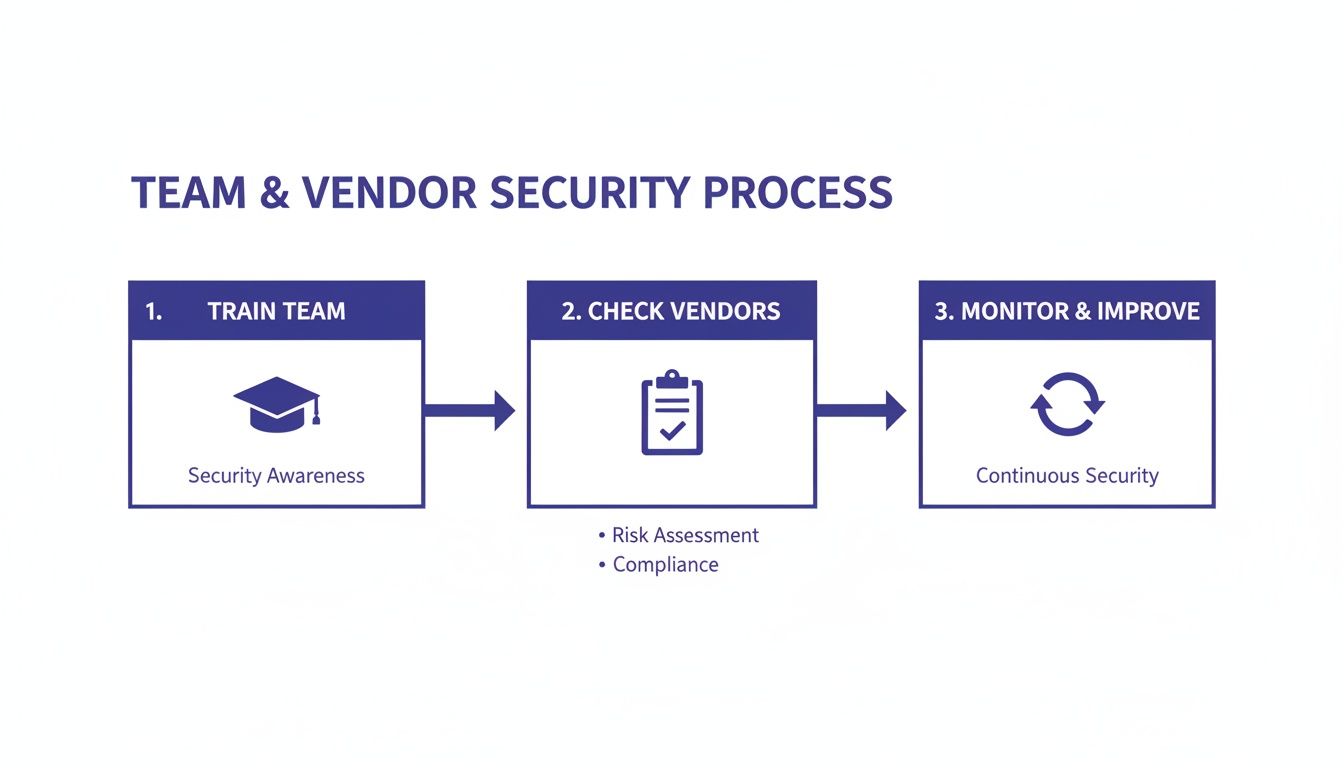
This process highlights a simple truth: a strong security posture, built on continuous team training and diligent vendor checks, makes incident response far more manageable when the time comes.
For any accounting firm, a data breach isn't just a technical problem—it's a potential compliance nightmare. Regulations like GDPR or state-level data breach notification laws have very strict reporting timelines and requirements. Your incident response playbook absolutely must include a section that clearly outlines your firm’s specific legal and regulatory obligations.
Your playbook should explicitly state who is responsible for contacting legal counsel and when that contact should be made. This decision shouldn't be left to guesswork in the middle of a crisis.
Understanding these rules beforehand is critical. The finance and accounting industries are already at the heart of cybersecurity spending, with global allocations skyrocketing. The pressure is immense, as finance dedicates 9.6% of its IT budget to cyber defenses. That’s happening against the backdrop of a global cybercrime toll projected to reach $10.5 trillion by 2025.
A well-documented plan demonstrates due diligence to regulators and clients alike, proving you take your data protection responsibilities seriously. To help build out your strategy, you might find our guide on creating a data breach response plan useful. Think of this playbook as your firm’s essential tool for turning a potential disaster into a managed event.
Diving into cybersecurity can bring up a lot of questions about where to start, how much it costs, and whether it’s even necessary. We hear these concerns all the time from accounting professionals. Here are some straightforward answers to the most common questions, designed to give you the clarity you need to protect your firm.
Absolutely. Thinking you’re “too small to be a target” is one of the most dangerous assumptions a firm can make. Cybercriminals often go after small and mid-sized firms for that exact reason—they bet your defenses are weaker.
Attackers know you’re sitting on a goldmine of client data: Social Security numbers, bank details, and sensitive financial records. A single breach can be devastating, both financially and to the trust you've built with your clients. A ransomware attack doesn't care about your firm's size, only about how badly you need your data back. Foundational security isn’t a luxury for big corporations; it’s a non-negotiable cost of doing business today.
If you do only one thing, make it Multi-Factor Authentication (MFA). While a layered defense is always the goal, activating MFA across all your critical systems—email, accounting software, cloud portals—is a total game-changer.
The overwhelming majority of breaches start with a stolen password. MFA stops those attacks in their tracks. It creates a simple but powerful barrier, demanding a second form of proof (usually a code on your phone) before granting access. So even if a criminal gets an employee's password, they can't get in. It’s a relatively small change that delivers a massive security payoff, instantly.
Yes, provided you partner with a reputable provider, it’s significantly safer than managing a server in-house. That server sitting in your office closet makes you personally responsible for everything: physical security, nonstop software patching, firewall configurations, and running perfect backups. That's a full-time IT job, and it’s a long way from an accountant's core expertise.
A specialized cloud hosting provider takes all of that off your plate and handles it in a high-security data center. They give you several huge advantages:
This level of protection is far beyond what most small firms can realistically manage on their own, shielding you from threats like ransomware and simple hardware failure.
The most common mistake we see is firms underestimating the full-time commitment required to properly secure an on-premise server. A secure cloud provider takes that entire burden off your shoulders, allowing you to focus on accounting, not IT.
The trick is to frame security as a shared responsibility that protects everyone—the firm, your colleagues, and your clients. Ditch the fear-based warnings, which just create anxiety, and focus on positive, empowering education instead. The goal is to build a "human firewall," where your team becomes your best line of defense.
Run short, engaging training sessions that use real-world examples they’ll actually encounter, like spotting a phishing email pretending to be from the IRS. Even more important is creating a culture where people feel safe reporting something suspicious without fear of blame. When an employee spots a phishing attempt and reports it, celebrate that. When security is seen as a tool for success and protecting client trust, your team will become your greatest security asset.
At Cloudvara, we specialize in providing secure, managed cloud hosting solutions tailored for accounting professionals. We take the complexity out of cybersecurity, so you can focus on what you do best. Discover how our dedicated support and robust infrastructure can protect your firm by visiting us at Cloudvara.