For any modern CPA firm, cybersecurity isn't just an IT problem—it's a fundamental business responsibility. It’s the ongoing practice of shielding your clients' sensitive financial data, your firm's private records, and your entire digital infrastructure from an ever-present storm of online threats. Think of it as the digital equivalent of locking the office doors at night, only the stakes are much, much higher.
You're safeguarding everything from tax filings and payroll details to the treasure trove of personally identifiable information (PII) that cybercriminals are desperate to get their hands on.
Picture all of your firm’s client files—the financial statements, tax returns, and confidential business plans—as a digital bank vault. This vault doesn't just hold numbers; it holds the trust your clients have placed in you. Every single day, sophisticated cyber threats like ransomware and targeted phishing attacks are testing the locks, looking for a way in.
A successful breach isn’t a minor inconvenience. It’s a catastrophic event that can send shockwaves through your practice, causing damage that's often difficult, if not impossible, to reverse.
The most immediate blow is always financial. The direct costs of an attack pile up quickly, from hiring forensic investigators and rebuilding compromised systems to potentially paying a hefty ransom just to get your data back. On top of that, firms can face staggering regulatory fines from bodies like the IRS and FTC for failing to protect client information adequately.
The global economic fallout from cybercrime is on track to hit an unbelievable $10.5 trillion annually by 2025. To put that in perspective, if cybercrime were a country, it would have the third-largest economy in the world, right behind the U.S. and China.
Today, the average cost of a single data breach has soared to $4.45 million, a number that should make any firm owner sit up and take notice. That cost gets even higher for firms that have embraced remote or hybrid work—a trend that's here to stay. As we've explored in our guide on post-pandemic remote work trends, this newfound flexibility also introduces new security holes that need to be plugged. Breaches at companies with remote workers cost, on average, over $173,000 more than those at fully on-site businesses.
As painful as the financial hit is, the erosion of client trust can be even more devastating. A data breach shatters the perception of your firm as a secure steward of sensitive information, often leading to a mass exodus of clients and long-term damage to your reputation that can take years to repair. That's why it is critical for firms to prioritize processes like secure automation for data acquisition to minimize manual vulnerabilities.
Your old-school security measures, like a basic firewall and antivirus software, just don't cut it anymore. That’s like putting a simple padlock on a bank vault while criminals are using advanced drills to tunnel right through the walls. This reality creates a clear and urgent need for a more comprehensive, multi-layered security strategy.
For accounting firms, compliance isn't just a box-ticking exercise—it's the very foundation of client trust. Get it wrong, and you're not just risking a fine. You're risking your reputation and the business you've worked so hard to build. The world of accounting cyber security is a maze of regulations, all designed to protect the sensitive client data you handle every day.
Think of these rules less as a burden and more as a roadmap. They provide a clear blueprint for protecting your firm from both cyber threats and legal headaches. They’re the "why" behind the security controls that should be part of your daily operations.
A major pillar of data protection for anyone in the financial world, including accounting and tax firms, is the FTC Safeguards Rule. This isn't a friendly suggestion; it's a federal mandate. It requires you to create, implement, and maintain a comprehensive written information security plan (WISP).
Your WISP is the official playbook detailing the administrative, technical, and physical safeguards you use to protect client information. The goal is simple: ensure confidentiality, defend against known threats, and prevent unauthorized access that could do real harm to your clients.
The updated rule has some specific demands:
Ignoring these requirements can lead to painful penalties and federal investigations. A solid WISP is simply non-negotiable for any modern accounting practice.
The IRS also weighs in with a critical set of recommendations they call the "Security Six." While it’s not a formal law like the FTC rule, these six controls are considered the absolute minimum standard for any tax professional. The IRS and its Security Summit partners are practically begging tax preparers to adopt them.
These foundational controls are the pillars of a strong security plan. Neglecting any one of them leaves a significant gap in your defenses, making your firm an attractive target for cybercriminals looking for the path of least resistance.
Think of the Security Six as your essential, day-to-day checklist:
Sticking to these frameworks is mission-critical. You can learn more about how certifications prove this commitment by exploring our detailed guide on SOC compliance and why it matters for service organizations like yours.

While industry regulations give you a security roadmap, cybercriminals are masters at finding the backroads. They don't just knock on the front door; they meticulously probe your digital walls for the weakest bricks. Getting to know these common weak points is the only way to reinforce them before an attacker shows up.
Many firms think their biggest threats are sophisticated hacking groups from overseas. The reality? Some of the most dangerous vulnerabilities are home-grown, stemming from aging hardware, simple human error, and risky daily habits that even an amateur attacker can exploit.
Keeping a server in-house might feel safer because you can physically see it, but this often creates a false sense of security. On-premise hardware actually introduces some major accounting cyber security risks that are all too easy to ignore.
Think of that server in your office closet like a classic car—it demands constant, expert maintenance. Miss just one software patch or security update, and you’ve left a known vulnerability wide open. It’s like leaving the keys in the ignition. A server running an old version of QuickBooks or Windows Server is one of the most common ways ransomware gets in.
And that’s not all. Physical security is another huge blind spot. An office server room simply doesn't have the Fort Knox-level protection of a commercial data center, leaving it vulnerable to theft, fire, or even just an accidental power surge.
Your team is your greatest asset, but without the right training, they can accidentally become your biggest security hole. Phishing attacks have moved way beyond the clunky, typo-filled emails of the past. Today's scams are slick, targeted, and psychologically manipulative.
All it takes is one employee clicking a malicious link in an email that looks perfectly legitimate to compromise your entire network. These attacks are a direct line to ransomware infections that can lock up every client file, tax return, and financial record you have.
Ransomware attacks are surging, with businesses bearing the brunt of these disruptive incidents. For accounting professionals, a breach means the potential loss of confidential ledgers, audit trails, and compliance documents, which can lead to severe regulatory fines and massive recovery costs. This risk is magnified for firms that haven't implemented robust, multi-layered security protocols. Discover more insights about the rise of global ransomware attacks on industrialcyber.co.
Practical, ongoing training is your best defense. For more concrete steps, check out our guide on how to prevent ransomware attacks.
The move to hybrid and remote work has opened up a whole new set of security headaches. When your team connects to the firm's network from home, they're often doing it over unsecured Wi-Fi or on personal devices that don't have the same tough security controls as a company-issued machine.
This creates a ton of weak points for attackers to slip through.
Without a strict remote work policy that requires VPNs, multi-factor authentication, and encrypted devices, your firm's data is at risk every single time someone logs on from outside the office. These issues rarely exist in isolation—they chain together, with one weakness exposing another, until you're facing a devastating data breach.
Knowing your firm’s weak spots is one thing, but building a real defense is what keeps you in business. It’s time to move from theory to action and construct a security posture that protects your accounting firm from the inside out. This isn't about abstract concepts for IT experts; it's about laying the foundational bricks of your digital fortress with practical, powerful security controls.
Think of these controls as layers of protection wrapped around your clients' most sensitive data. Each one serves a specific purpose, and together, they create a formidable barrier that turns away cyber threats.
One of the most effective security measures you can roll out is Multi-Factor Authentication (MFA). It's like a bank’s safe deposit box. Your password is the first key, but you still need a second form of ID from the teller to actually open the box. MFA works the same way for your digital accounts.
Even if a cybercriminal successfully steals an employee’s password through a phishing scam, MFA stops them cold. Without that second factor—usually a one-time code sent to a smartphone or an authenticator app—the stolen password is completely useless. This single control makes a massive difference in preventing unauthorized access to your firm's critical systems.
Encryption is just a fancy word for scrambling data so it becomes unreadable to anyone without the right key. Imagine writing a sensitive client letter in a secret code that only you and the recipient can understand. If someone intercepts the letter, all they see is a meaningless jumble of characters.
That’s exactly how data encryption works for your accounting firm. It protects data in two key states:
In today's environment, implementing encryption across every device that touches client information is non-negotiable.
"A password can be stolen, but an encrypted file remains a locked box. For accounting firms, where data is the most valuable asset, encryption isn't an option—it's the bedrock of client trust and regulatory compliance."
By combining strong access controls with comprehensive encryption, you create a powerful defense. For a deeper dive, you can learn more about these and other essential data security best practices in our 2025 guide.
What would you do if a ransomware attack locked up every single one of your files? Or if a server crash wiped out years of client data? Without a solid backup strategy, the answer is catastrophic. This is where automated, daily backups become your firm’s ultimate safety net.
Regularly backing up your data to a secure, off-site location means you can quickly restore your systems and get back to business with minimal disruption. It also completely neutralizes the threat of ransomware—why would you ever consider paying a ransom when you have a clean copy of your data stored safely elsewhere?
A strong fortress needs a solid foundation, which is why following modern network security best practices is so critical. Each of these controls—MFA, encryption, and backups—acts as a vital layer. While one might be bypassed, the combination of all three presents a huge challenge to even the most determined attackers. This layered approach is how you build a security framework that not only protects your firm today but also prepares it for whatever comes next.
The classic weak spots in an accounting firm—that aging server in the closet, the patchwork of remote access tools—aren’t just theoretical problems anymore. They're active threats, and they demand a modern solution. Secure cloud hosting cuts right to the heart of these challenges by changing the entire model for how your firm handles its data and critical software.
Instead of running QuickBooks, Sage, and your tax applications on local hardware, you move everything to a dedicated, high-security environment built and managed by experts. This is more than just shifting files online. It’s about offloading the enormous burden of IT infrastructure and security to a partner who lives and breathes it.
Think of it like this: you’re moving your firm’s digital vault out of the office and into a specialized, armored facility with 24/7 guards, advanced surveillance, and round-the-clock climate control.
One of the biggest drags on any firm’s accounting cyber security is outdated on-premise hardware. That server is expensive to buy, a headache to maintain, and has a limited lifespan. Secure cloud hosting takes this entire problem off your plate.
A specialized provider uses enterprise-grade servers housed in hardened data centers. This infrastructure is constantly monitored, patched, and optimized by a dedicated team of IT pros. You no longer have to worry about applying the latest Windows Server update or wondering if your hardware can handle the crush of another tax season.
This shift delivers a few immediate wins:
In short, you get access to a level of IT infrastructure that would be incredibly expensive for most individual firms to build and manage themselves. Your operational resilience gets an instant upgrade.
For many accounting firms, IT support is a constant headache. You’re either stretching a small internal team too thin or relying on a break-fix consultant who bills by the hour. A secure cloud provider changes that whole dynamic. They become a dedicated IT partner who actually understands the unique demands of your industry.
They provide 24/7/365 support, not just for server outages, but for the specific applications you use every day. This team handles the routine but critical tasks that often get pushed aside, like automated daily backups, system monitoring, and threat detection.
A secure cloud provider becomes an extension of your firm—a specialized security and IT department whose sole focus is to ensure your systems are protected, optimized, and always running. This frees you to concentrate on what you do best: serving your clients.
The escalating cost of cyber incidents really drives home the value of this partnership. As insurers get more nervous about data-heavy industries, global cyber insurance premiums are forecasted to double. The stakes are even higher for firms with remote teams; IBM data shows that breaches involving remote work cost an average of $173,074 more.
For a CPA, a single incident can mean stalled Sage operations, lost QuickBooks data, and a catastrophic breach of client trust. Secure cloud hosting directly tackles these risks with commercial-grade servers, constant support, and foundational security controls. You can explore the latest cybersecurity statistics on cobalt.io to get a clearer picture of the evolving threat landscape.
Getting remote and hybrid work right is one of the toughest challenges for modern accounting firms. Doing it wrong opens up massive security gaps. A secure cloud environment, however, is designed from the ground up to solve this very problem.
Your entire team connects to a centralized, secure virtual desktop where all your applications and data live. Everyone—whether they’re at home, in the office, or on the road—gets the exact same secure and consistent user experience. This approach provides a robust security framework right out of the box. You can also see how QuickBooks cloud hosting security is strengthened with this kind of dedicated approach.
This model closes the vulnerabilities that come with using local devices and unsecured networks because it centralizes all control. Data never needs to be stored on an employee’s personal laptop, and every connection is routed through an encrypted, protected gateway. It gives you a unified, secure platform for your entire firm, no matter where your team is.
Knowing the risks is one thing; doing something about them is another. This checklist isn’t about theory—it's your roadmap for turning awareness into action and immediately strengthening your firm’s defenses.
We’ve split this into two phases. Phase one is all about quick, high-impact wins you can tackle this week. Phase two outlines a more strategic move for long-term security. The goal is to leave you with a concrete plan, not just more information.
Think of these as the essential first-aid steps for your firm's digital health. Each one closes a common, and often dangerous, security gap. Start here to get the biggest security improvements for your time.
Launch Phishing Simulations: Don't just warn your team about phishing—show them what it looks like. Use a simulation service to send safe, controlled phishing emails. It’s the single most effective way to train your staff to spot and report threats before they do real damage.
Enforce Multi-Factor Authentication (MFA): If you only do one thing from this list, make it this one. Mandate MFA on every critical application, especially email, accounting software, and any remote access portals. A stolen password becomes worthless to a hacker if they can’t get past that second authentication step.
Conduct an Access Control Audit: It’s time to ask: who has access to what? You’d be surprised how often former employees still have access or current staff have permissions they don’t need. Apply the principle of least privilege—only grant people access to the data and systems they absolutely need to do their jobs. Nothing more.
Verify Your Backup and Recovery Process: A backup you haven’t tested is just a guess. Don't wait for a disaster to find out it doesn't work. Perform a test restoration of a non-critical file or folder to prove your data is actually recoverable. This simple check can be the difference between a minor headache and a business-ending catastrophe.
Once your immediate defenses are solid, it’s time to think bigger. A strategic shift to a secure cloud hosting environment like Cloudvara gets you out of the risky business of managing on-premise hardware and gives you access to enterprise-grade security.
Moving to a secure cloud isn't just an IT upgrade; it's a fundamental business strategy. It replaces the burden of managing complex security infrastructure with a partnership focused on protecting your most valuable asset—client data.
Follow this roadmap for a smooth and successful move:
Inventory Your Applications and Data: First, make a complete list of all the software your firm depends on, from QuickBooks and Sage to your specific tax prep tools. Be sure to note where all the associated data is currently stored.
Assess Your Team’s Needs: Take a close look at how your team actually works. Who needs remote access? What are the performance demands for your most critical applications? This information helps a provider like Cloudvara design a hosting environment that fits your workflow like a glove.
Plan the Transition: A good cloud partner will work with you to create a detailed migration plan. This should include a clear timeline, identify key people, and schedule the move during a slow period to keep disruption to an absolute minimum.
Test and Validate: Before you flip the switch, give the new cloud environment a thorough test drive. Have your team log in, open applications, and work with some sample files. The goal is to confirm everything functions exactly as it did before—only now, it's faster, more accessible, and profoundly more secure.
When you're thinking about moving away from that server humming in the closet, a lot of questions pop up. It’s only natural. Getting straight answers is the only way to feel confident you’re making the right move to protect your firm's data and future.
Let’s tackle some of the most common questions and concerns accounting professionals have when they consider secure cloud hosting.
For nearly every firm out there, the answer is a clear and confident yes.
Think of it like this: your on-premise server is like a high-quality safe in your office. It’s pretty good, but a determined thief with the right tools and enough time can eventually get in. A specialized cloud provider, on the other hand, is like a fortified bank vault. They’ve invested millions in enterprise-grade security that’s just not feasible for a single accounting firm to replicate.
This isn't just about software firewalls. It’s a completely different league of protection that includes:
Simply put, the layers of defense built into a professional cloud environment far exceed what an office server can offer.
The following visual shows a simple, three-step action plan to start strengthening your firm's security posture today.
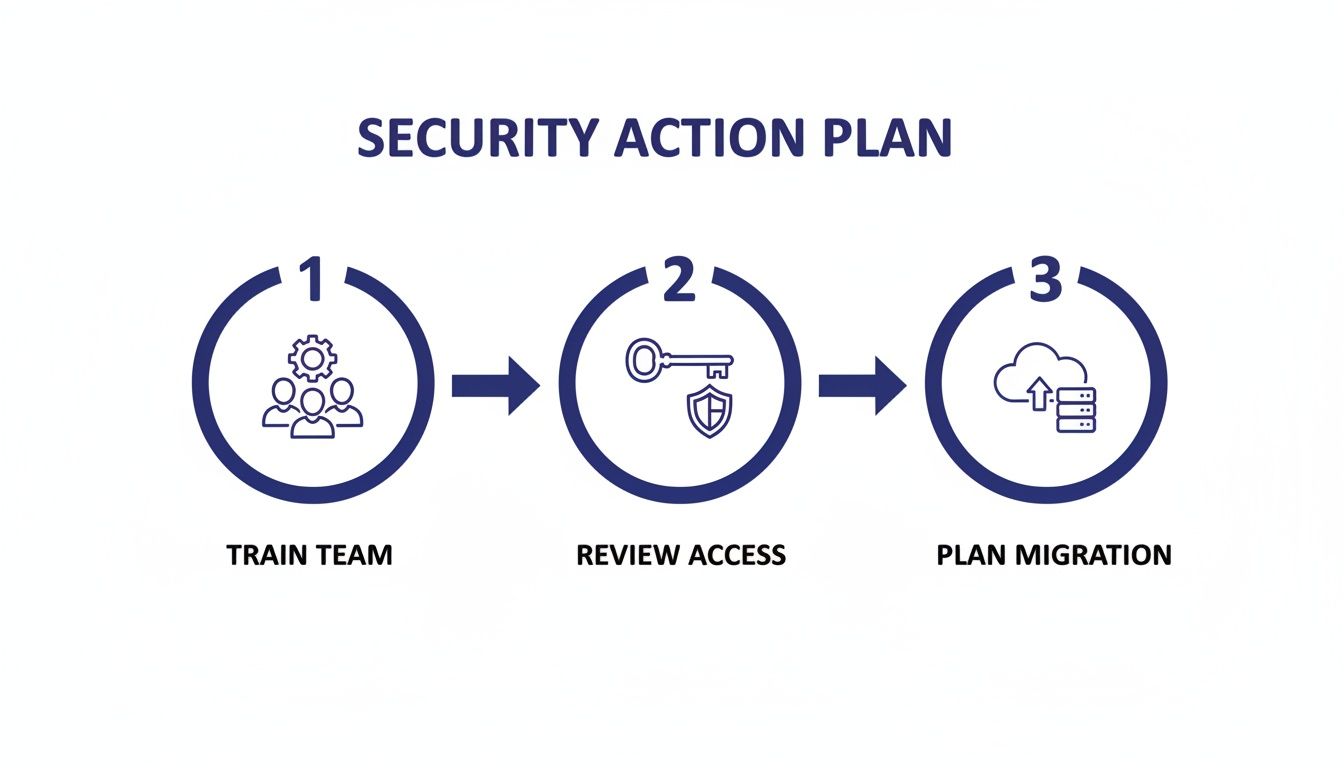
This process really drives home that great security is a combination of people, smart processes, and finally, the right technology to tie it all together.
The goal of moving your accounting software to the cloud isn't to disrupt your workflow—it's to make it better. Your team suddenly gains the ability to work securely and efficiently from any device, anywhere they have an internet connection. Collaboration becomes seamless, and you can finally stop worrying if everyone is working on the most recent version of a file.
Your day-to-day experience with essential tools like QuickBooks or Sage stays the same. The interface, the features, the reports—it's all familiar. The only real difference is that the software is no longer tethered to a specific computer in your office. It becomes more flexible, reliable, and accessible.
A good cloud provider won’t just hand you the keys and wish you luck. They should offer a fully supported, white-glove migration. This means their expert team handles all the technical heavy lifting, ensuring a smooth and seamless transition with as little downtime as possible for your firm.
Think of it as a professional moving service for your digital operations. They carefully pack up your data and applications, transport them securely, and set everything up in your new, fortified environment. The goal is for you to walk in on day one and get right back to work, no stress involved.
Ready to secure your firm's future without the IT headaches? Cloudvara centralizes your critical applications on a dedicated, high-security cloud platform, managed by experts 24/7. Schedule a free consultation today and discover how simple and secure your IT can be.