Ever heard of SOC compliance? Think of it as a background check for the tech companies you rely on.
SOC, which stands for System and Organization Controls, is a framework created by the American Institute of Certified Public Accountants (AICPA). It's designed to verify that a service organization is handling your data securely and reliably. In short, a SOC report is the gold standard for proving a company’s systems and controls are trustworthy.
Let's use an analogy. Imagine you're hiring a contractor to build an addition to your house. You wouldn't just take their word for it; you'd want to see their credentials, proof of insurance, and examples of past work to trust they'll do the job right.
In the business world, a SOC report serves that exact purpose. It’s a detailed, third-party audited account of a company's internal controls, giving clients and partners the assurance they need. This isn't a one-size-fits-all checklist. Instead, it’s a structured way for organizations to report on their unique control environments after an independent Certified Public Accountant (CPA) has thoroughly examined their systems and processes.
This infographic breaks down how SOC compliance ties together data security, operational reliability, and—most importantly—customer trust.
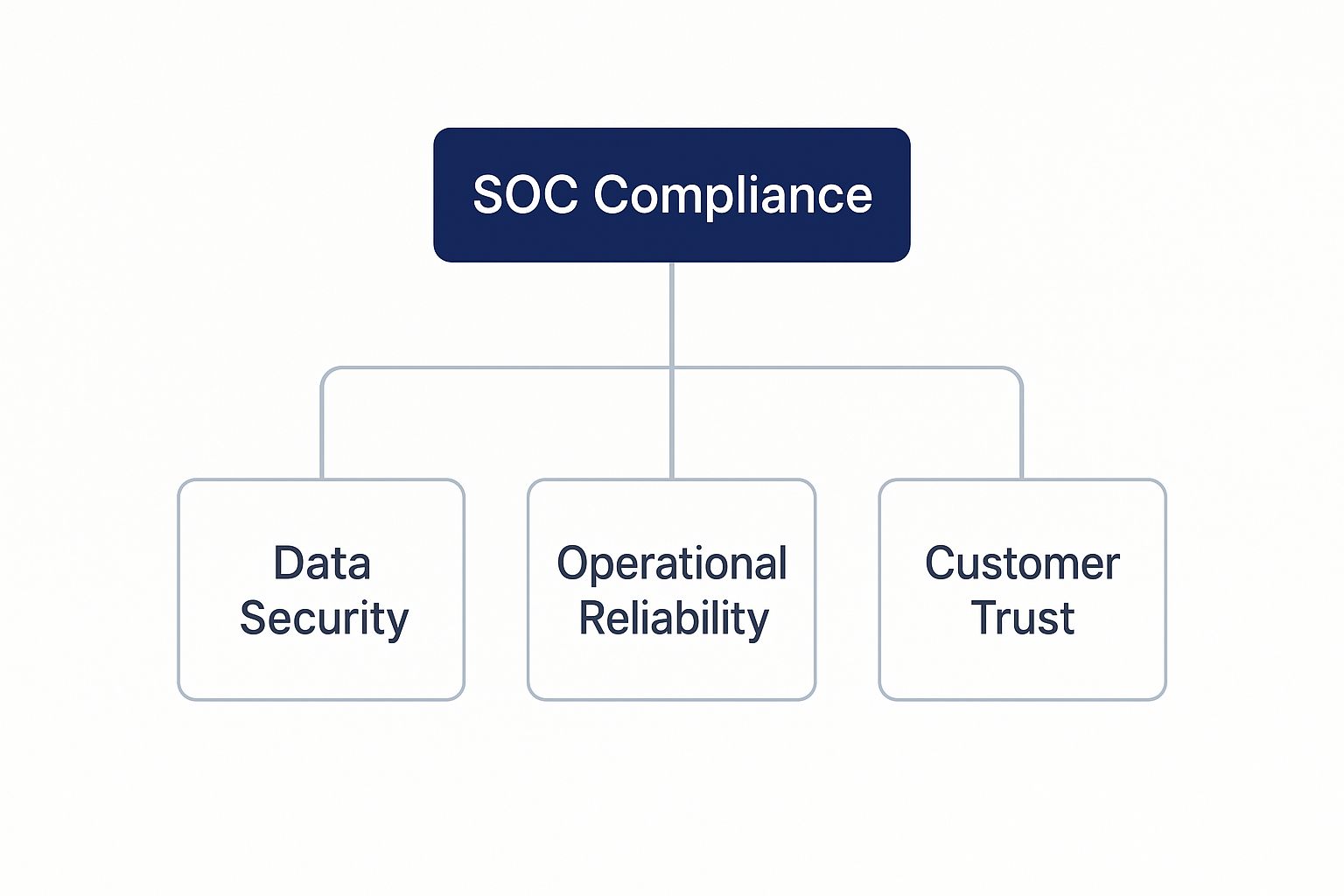
As you can see, getting compliant isn't just about bolstering security. It's about building a foundation of reliability that directly fosters customer confidence.
Businesses today lean heavily on third-party vendors for everything from cloud hosting to payroll processing. That makes verifying a partner's security absolutely essential. A data breach at one of your vendors can have devastating ripple effects on your own company, making due diligence more critical than ever.
The first step in any compliance journey is understanding how to spot and manage potential threats. You can learn more in this a complete guide to risk management.
SOC compliance has become the common language for communicating trust between service organizations and their customers. It replaces lengthy security questionnaires and subjective assessments with a standardized, audited report that provides objective proof of a company's security and operational integrity.
Ultimately, understanding SOC compliance helps you make smarter decisions when choosing vendors. For example, SOC 2 is a voluntary but vital framework built around five Trust Services Criteria: Security, Availability, Confidentiality, Processing Integrity, and Privacy. When a company meets these criteria, it demonstrates it can properly safeguard customer information—something that’s non-negotiable for cloud-based services.
For businesses navigating these requirements, professional compliance management solutions can provide a clear path forward.
To make it easier to understand the different types of SOC reports, here’s a quick summary table. It breaks down what each report focuses on and who it's designed for.
| SOC Report Type | Primary Focus | Target Audience |
|---|---|---|
| SOC 1 | Internal controls over financial reporting (ICFR) | User entities and their financial auditors |
| SOC 2 | Controls over security, availability, confidentiality, processing integrity, and privacy | Customers, partners, and regulators needing assurance |
| SOC 3 | Same as SOC 2, but a general-use, public-facing report | Anyone; often used for marketing and public trust |
This table helps clarify the distinct roles each report plays. SOC 1 is all about financial integrity, while SOC 2 and SOC 3 focus on broader operational and security controls, with SOC 3 being the version you can share publicly.
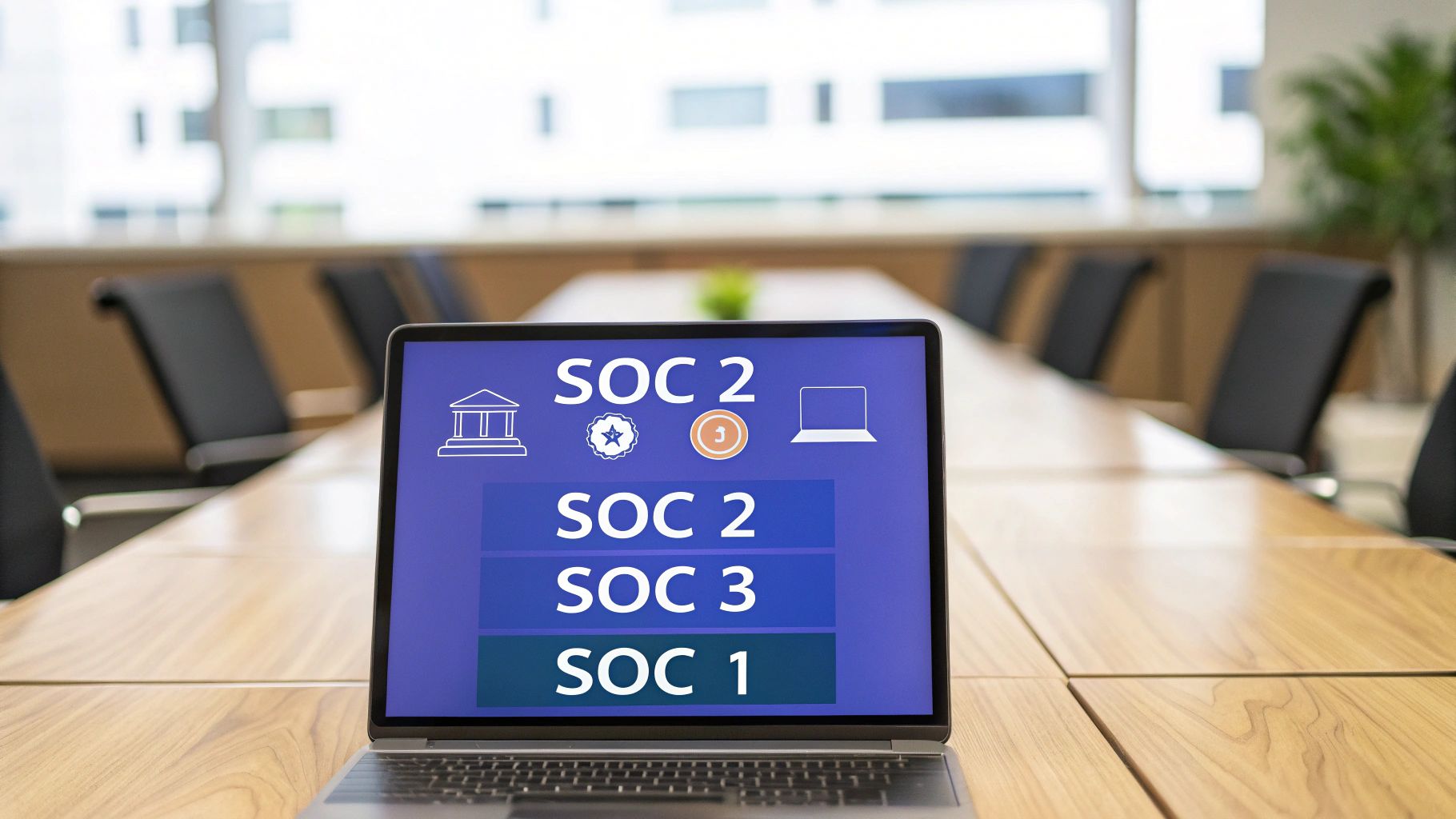
Understanding the different SOC reports is critical because they are not interchangeable. Each one answers a completely different question about a company’s controls, so choosing the right one depends entirely on the service you provide and the assurances your customers need.
Think of it like this: if SOC compliance is a home inspection, then SOC 1, 2, and 3 are specialized reports for different parts of the house. One might inspect the plumbing and electrical systems (financial controls), another the foundation and structural integrity (security), and a third provides a simple certificate of occupancy for anyone to see.
This distinction isn't just academic; it has real-world consequences. A company that processes financial transactions needs a very different kind of audit than a cloud storage provider.
A SOC 1 report is all about Internal Control over Financial Reporting (ICFR). This report is specifically for service organizations whose operations could directly affect their clients' financial statements. In short, it provides assurance that your vendor’s controls won't cause errors in your company's own financial records.
Imagine you use a third-party payroll processor. If their system has a bug and miscalculates paychecks, it directly impacts your financial reporting. A SOC 1 report, audited by a CPA, gives your financial auditors the confidence that the payroll provider has effective controls in place to stop that from happening.
This report is highly specific and meant for a limited audience: the management of the client company and their financial auditors. It isn’t meant to provide general assurance about security or operational practices outside of that financial scope.
The SOC 2 report is arguably the most well-known and is the focus for most tech companies, SaaS providers, and data centers. Unlike SOC 1's narrow financial lens, SOC 2 evaluates a company's controls based on the AICPA's five Trust Services Criteria (TSCs): Security, Availability, Processing Integrity, Confidentiality, and Privacy.
The Security criterion is the mandatory foundation for every SOC 2 report. From there, organizations can add any of the other four criteria that are relevant to the services they offer. For example, a cloud hosting provider would almost certainly include Availability to prove its uptime commitments.
A SOC 2 report is a detailed, restricted-use document. It contains sensitive information about a company's security architecture, control tests, and audit results. It's the comprehensive proof that customers and partners need to see during their due diligence, but it’s never intended for public distribution.
Properly assessing vendors is a cornerstone of any robust security program. For more guidance, exploring some IT vendor management best practices can provide a solid foundation for your own internal processes.
Finally, we have the SOC 3 report. This report covers the same subject matter as a SOC 2—the Trust Services Criteria—but it's a completely different kind of document. A SOC 3 is a general-use report that gives a high-level summary of the SOC 2 audit findings.
It doesn’t include the nitty-gritty details of tests and results found in a SOC 2. Instead, it offers a simple pass/fail opinion from the auditor, confirming that the organization maintains effective controls related to the chosen TSCs.
Because it contains no sensitive details, a SOC 3 report is perfect for public display. Companies often post it right on their website as a marketing tool, using it as a readily available seal of trust for potential customers. It’s the public-facing certificate that says, "We passed our rigorous security audit, and here's the proof."
To make these differences crystal clear, here’s a side-by-side breakdown of what sets each SOC report apart.
This table summarizes the core purpose, audience, and content of each report to help you quickly identify which one meets your needs.
| Attribute | SOC 1 | SOC 2 | SOC 3 |
|---|---|---|---|
| Primary Focus | Financial Controls (ICFR) | Security & Operations (TSCs) | Security & Operations (TSCs) |
| Audience | User entities & their auditors | Customers & partners (NDA) | Public & prospective customers |
| Content Detail | Highly detailed, restricted | Highly detailed, restricted | High-level summary |
| Common Use Case | Payroll, financial processors | SaaS, cloud hosting, data centers | Marketing, public trust |
Choosing which report to pursue for your own company—or which to request from a vendor—is a critical first step on your SOC compliance journey. This decision frames the entire audit process and ensures the final report delivers the specific assurances your stakeholders require.
At the heart of every SOC 2 audit are the Trust Services Criteria (TSCs), a set of five principles developed by the AICPA. Think of them as the pillars supporting your company's entire approach to data security and operational reliability. To really understand what SOC compliance is, you have to get to know these five areas, since they define exactly what an auditor is going to be testing.
While there are five criteria, they aren't all required. The framework is designed to be flexible, allowing you to choose the criteria that are most relevant to the services you provide and the promises you make to your customers.
The Security criterion is the one non-negotiable part of every SOC 2 report. It’s the foundation that all the other criteria are built on. Often called the "common criteria," it’s all about protecting systems and data against unauthorized access, use, or modification.
This goes way beyond just having strong passwords. An auditor will dig into a wide range of controls designed to create a genuinely secure environment. For a cloud provider, this might involve:
Ultimately, the Security criterion answers the big question: "Are your systems protected from breaches and shady activities?" Building robust security is a tough but essential job. For a closer look, exploring these 12 essential cloud security practices for businesses can give you valuable insights for strengthening your defenses.
The Availability criterion focuses on one simple thing: making sure a system is accessible and usable just as you promised your customers it would be. This is especially critical for services like cloud hosting or SaaS platforms, where any downtime directly hurts a customer's ability to do business.
This isn’t just about keeping the servers running. A SOC 2 audit that includes Availability will scrutinize controls related to performance monitoring, disaster recovery, and how you respond to incidents.
An organization that includes Availability in its SOC 2 report is making a verifiable promise to its clients that the service will be there when they need it. This criterion is about proving operational resilience and readiness for unexpected events.
Examples of controls for Availability include:
The Confidentiality criterion is all about protecting information that’s been designated as confidential. This is different from Privacy; Confidentiality applies to any sensitive business data—like strategic plans, intellectual property, or financial records—that is protected by an agreement or company policy.
A company that handles sensitive client contracts or proprietary code would almost certainly include this criterion in its audit. Auditors would look for controls that restrict access to this information on a strict need-to-know basis and protect it from creation to deletion.
Specific controls for Confidentiality might include:
The Processing Integrity criterion is about making sure that system processing is complete, valid, accurate, timely, and authorized. Put simply, it verifies that a system does what it's supposed to do, without errors or manipulation. This is absolutely crucial for any application that handles transactions or performs critical calculations.
Think of an e-commerce platform or a financial processing system. Customers have to trust that when they place an order, it will be processed correctly, they’ll be charged the right amount, and the order will be fulfilled accurately. An audit against this criterion would test controls designed to maintain data integrity from input all the way to output. This includes things like quality assurance procedures and process monitoring to catch and fix errors on the fly.
Finally, the Privacy criterion deals with the collection, use, retention, disclosure, and disposal of Personal Identifiable Information (PII). While Confidentiality is about business data, Privacy is focused solely on the personal data of individuals—your customers, employees, and users.
This criterion lines up closely with regulations like GDPR and CCPA. An organization that collects names, addresses, or other personal details would include Privacy to show it’s committed to handling that information responsibly. The controls would cover everything from providing clear privacy notices to honoring user requests for data deletion, ensuring personal data is managed according to established privacy principles.

Once you've wrapped your head around the different SOC reports, another critical distinction comes into play: Type 1 versus Type 2. It's one of the most common points of confusion, yet it’s the difference between showing someone a blueprint and proving the building can withstand a storm.
Getting this right is essential because it tells you what a report truly proves.
At a high level, the difference is all about a single moment versus a sustained period. Think of it like this: a Type 1 report is a photograph. It captures your controls and processes at one specific point in time, showing an auditor that your security system is designed correctly on that particular day.
A Type 2 report, on the other hand, is like a video. It observes your controls over an extended period—usually six to twelve months—to verify they aren't just designed well but are also operating effectively day in and day out.
A Type 1 report attests to the design of a company’s controls on a specific date. The auditor reviews your documentation, policies, and system descriptions to make sure everything is suitably designed to meet the relevant security criteria. It’s a valuable first step in any compliance journey.
This type of report is almost always faster and less expensive to get. It's an excellent way for a company to establish a baseline and show its initial commitment to security.
But its value is limited. A Type 1 report doesn't provide any assurance that the controls are actually being followed consistently. For example, a company could have a perfectly written policy for reviewing user access rights every quarter. A Type 1 audit would confirm the policy looks good on paper, but it wouldn’t prove that anyone is actually performing those reviews.
This is where the Type 2 report really shines. It includes everything in a Type 1 report—the description of the system and the suitability of the control design—but adds a critical second layer: tests of operating effectiveness. The auditor digs in and selects samples of activities over the review period to confirm the controls worked as intended.
Going back to our user access example, a Type 2 auditor wouldn't just read the policy; they would demand evidence that those quarterly reviews actually happened. They might ask for meeting minutes, system logs, or signed-off reports from the specified review period, proving the policy wasn't just a document sitting on a shelf.
A Type 2 report provides a much higher level of assurance because it confirms that a company not only talks the talk but also walks the walk. For this reason, most enterprise clients and savvy customers will specifically demand a Type 2 report from their vendors.
The process for a SOC 2 Type 1 report can take one to three months. In contrast, SOC 2 Type 2 reports assess how those controls work over a period of six to twelve months. It’s also important to know that there is no official "SOC 2 certification"; instead, organizations receive an attestation report from a licensed CPA firm that verifies their compliance.
Choosing between a Type 1 and a Type 2 report really depends on your goals, maturity, and what your customers are asking for. A Type 1 can be a strategic starting point for organizations new to SOC compliance, but the ultimate goal for most is the Type 2.
A strong Type 2 report is also deeply connected to your operational resilience. The controls tested, especially for the Availability criterion, often overlap with the principles of effective business continuity. For more on this, check out our guide on mastering business continuity plan testing. Ultimately, a Type 2 report is the most credible way to build trust and demonstrate a mature security posture.

Getting a SOC report is much more than a technical hurdle or another box to check on a security questionnaire. It’s a business move that turns your security posture from a cost center into a real strategic asset. The whole process delivers tangible value that ripples through your entire organization, from sales right through to operations.
Instead of being a roadblock, a SOC 2 report becomes one of your best sales tools. It answers security objections before they're even raised, building instant trust with potential customers. In a crowded market, that kind of verified assurance is a massive competitive advantage that makes you stand out.
In today's world, security is top of mind for any company choosing a new partner or vendor. A SOC 2 report cuts through the noise and eliminates the need for long, drawn-out security reviews during the sales process. You're no longer just saying you have strong security; you’re showing up with independently verified proof.
This completely changes the conversation. It shifts from "Can we trust you with our data?" to "How fast can we get started?" It signals a serious commitment to security that enterprise clients don't just appreciate—they often demand it, which helps shorten deal cycles and boost your win rates.
This is especially true in industries like data centers and financial services. Having SOC 2 compliance on hand can dramatically speed up sales cycles and build stakeholder confidence by proving you have your operational house in order. For a deeper dive, check out these insights on the importance of SOC 2 for data center compliance.
That trust isn't just for new clients, either. It reinforces your existing customers' decision to work with you, leading to better retention and stronger, more resilient relationships.
The journey to compliance forces a tough, top-to-bottom look at all your internal controls and processes. This isn't just about passing an audit. It’s about fundamentally improving your company's discipline and making it more resilient against threats.
Getting ready for the audit shines a spotlight on weak spots you might have otherwise missed, pushing you to:
This disciplined approach naturally lowers the risk of data breaches and expensive operational mistakes. It fortifies your entire infrastructure, which is a huge plus for organizations looking to optimize their IT. In fact, many companies find that exploring the benefits of cloud migration goes hand-in-hand with their goals for tighter security and operational excellence.
At the end of the day, SOC compliance is an investment that pays for itself over and over. It opens doors to new markets, strengthens client loyalty, and protects your brand’s most important asset: its reputation. By turning security into a proven strength, you build a more sustainable and trustworthy business from the inside out.
Getting into the world of SOC compliance always brings up a few practical questions. Most businesses want to know about the time, money, and real-world requirements before they dive in. Let's clear up some of the most common ones.
There’s no magic wand for SOC compliance; it’s a methodical process, and the timeline really depends on where your security stands today and which report you need.
A Type 1 report, which is basically a snapshot of your controls at a single point in time, usually takes about three to six months. That window covers everything from the initial readiness check and fixing any gaps to the audit itself.
A Type 2 report is a much bigger commitment, often taking nine to fifteen months. Why so long? Because it requires an observation period of at least six months to prove your controls actually work consistently over time. Your starting point is everything—a solid security posture can definitely speed things up.
Nope, SOC compliance isn't a government-mandated law like HIPAA or GDPR. It's a voluntary industry standard developed and managed by the AICPA. But don't let the word "voluntary" fool you—it has become an absolute must-have for doing business in many sectors.
While not technically required by law, a SOC 2 report has become the unofficial ticket to play for anyone selling to enterprise clients, especially in tech, finance, and healthcare. If you don't have one, you'll find a lot of doors closed.
If your growth plans involve working with larger companies, you can bet they’ll ask for a SOC 2 report during their vendor vetting process. It's simply the cost of entry.
Both SOC 2 and ISO 27001 are heavyweights in the world of information security standards, but they’re built for different jobs and deliver different results.
It’s pretty common for global companies to get both. They use ISO 27001 to show they have a robust, well-managed security program, and then hand over their SOC 2 report to give customers granular proof that their day-to-day controls are effective.
At Cloudvara, we provide a secure, audited cloud environment that helps you meet your compliance goals without the complexity. Our all-in-one hosting solutions centralize your critical applications on a platform built with security and reliability at its core. Discover how Cloudvara can simplify your compliance journey today.