
A new partner usually meets Circular 230 the hard way. A client wants a fast answer on a gray-area position. Staff already drafted the return. Someone in marketing wants to send a tax resolution mailer. Your firm moved files to the cloud last year, and now you're asking whether your controls are tight enough if the IRS or a state board ever looks closely.
That's when the question stops being academic. What is Circular 230? It's the operating framework that governs how tax professionals behave when they practice before the IRS. It affects the advice you give, the fees you charge, the way you supervise staff, the claims you make in marketing, and increasingly, how you handle digital records and client data.
If you're helping lead a tax practice, Circular 230 isn't background reading. It's part of firm governance. The firms that treat it as a live management issue usually build better review processes, cleaner engagement boundaries, and stronger documentation. The firms that treat it as a PDF on a compliance shelf usually discover its importance during a complaint, an audit file review, or an OPR inquiry.
Circular 230 matters most in ordinary moments. A client says, “Just take the position and we'll explain it later if the IRS asks.” A manager says, “The staff used last year's template.” A partner asks whether a success-based fee is acceptable for a representation matter. None of those questions feel dramatic. All of them can trigger Circular 230 issues.
Circular 230 is the standard of conduct for professionals who practice before the IRS. It's where tax practice shifts from technical correctness alone to professional responsibility. You're not just asking whether an argument can be made. You're asking whether the advice is competent, documented, appropriately communicated, and delivered in a way that meets federal practice standards.
Practical rule: If a decision would look weak when reconstructed from emails, workpapers, and client notes, it probably needs a better process before it needs a better memo.
For a new partner, the core value of Circular 230 is that it gives structure to judgment. It tells you where diligence is required, where judgment must be supported, and where shortcuts become disciplinary risk. That includes work done by staff under your supervision, not just work you personally sign.
It also protects the firm. A tax practice doesn't usually get into trouble because one rule was unknown. Trouble starts when review is inconsistent, engagement scope is fuzzy, marketing overpromises, or technology is adopted without clear controls over confidentiality and retention. Circular 230 speaks directly to those pressure points.
That's why experienced firms don't isolate Circular 230 inside legal or quality control. They build it into onboarding, review workflows, engagement letters, client communications, and system access. In practice, that's what keeps the rulebook from becoming a disciplinary file.
A partner approves a response strategy, a senior drafts the facts, an offshore team organizes documents in the cloud, and a client sends support through an unsecured personal email account. By the time anything reaches the IRS, several people and several systems have already touched the matter. Scope matters at that point. If the work is part of representing a taxpayer before the IRS, Circular 230 is already in the room.
Treasury Department Circular No. 230 sits in 31 C.F.R. Part 10. It governs practice before the IRS and reaches more than formal appearances or controversy hearings. In firm operations, the scope question is usually practical. You are asking which people, which tasks, and which systems fall inside a federal standard of conduct.

The clearest cases are attorneys, certified public accountants, and enrolled agents acting for taxpayers in matters before the IRS. Appraisers can also be pulled in when their valuation work is submitted in connection with a tax matter. That is the formal starting point, but practice leaders should read scope more broadly when building controls.
The rule reaches ordinary representation work. It can apply to correspondence, claims, affidavits, protests, conferences, submissions, and advice that supports a taxpayer position presented to the IRS. A person does not need to view themselves as "appearing" before the IRS for their work to create Circular 230 risk.
That has real consequences for staffing. If a manager reviews a protest letter, a specialist prepares valuation support, or a contractor assembles records for an examination response, supervision and confidentiality controls matter. Firms using distributed teams often discover that the bigger risk is not the tax analysis itself. It is unclear review responsibility, weak permissions, and poor documentation across outsourced tax support and remote workflow structures.
Scope is not just about titles. It is also about function.
A firm can stay out of trouble on technical tax law and still create Circular 230 exposure through process failures. Common examples include shared inboxes with no ownership, cloud storage that allows broad access to taxpayer files, missing records of who revised a submission, and advice delivered by email without enough facts, assumptions, or limits. Those are practice-management issues, but they sit directly inside the compliance analysis because they affect diligence, supervision, confidentiality, and the defensibility of the firm's work.
This is one area where older summaries of Circular 230 can mislead firms. The rules have changed over time, including the rise and fall of the registered tax return preparer framework after Loving. Current proposed regulations also reflect a more modern view of practice standards, including the expectation that practitioners understand the benefits and risks of technology used in client service and record handling. For firms that rely on cloud systems, remote staff, and digital records, that point is no longer abstract.
For a partner, the scope question is a management question first. The useful test is simple: identify where IRS-facing work begins, who contributes to it, and what systems hold the underlying taxpayer data.
That usually means answering four questions clearly:
Firms that answer those questions early tend to have cleaner engagement terms, better access controls, and fewer surprises when an IRS inquiry forces the file to be reconstructed months later.
The fastest way to misunderstand Circular 230 is to treat it as a list of prohibitions. It also imposes affirmative duties. Those duties shape how a competent tax practice is built.

Circular 230 includes technical provisions that affect the economics and process design of tax practices. Practitioners must exercise due diligence in preparing returns or other federal tax documents, avoid false or deceptive communications, comply with fee and solicitation restrictions, and retain copies of certain broadcast or direct-mail communications for at least 36 months, with recent IRS proposals also clarifying that competence includes understanding the benefits and risks of technology used to store or transmit confidential tax information, as discussed in The Tax Adviser's analysis of Circular 230 rules.
That one paragraph contains more practical workload than many firms admit. It means your systems, templates, review habits, and communication tools all sit inside the compliance picture.
Due diligence isn't satisfied by good intentions. It shows up in the file.
A common failure point is overreliance on prior-year treatment. Last year's return can be a starting point. It is not evidence that this year's treatment is still supportable.
Many firms still separate “tax work” from “IT decisions.” Circular 230 doesn't support that separation very well anymore. If your team stores or transmits confidential tax information digitally, competence increasingly includes knowing the risk trade-offs in the tools you use.
That includes:
| Practice area | Weak approach | Better approach |
|---|---|---|
| Client file exchange | Email attachments sent ad hoc | Controlled portal or encrypted exchange workflow |
| Workpaper storage | Local desktop copies across multiple devices | Centralized document management with permissions |
| Remote work | Shared credentials or unmanaged access | Role-based access and documented authentication controls |
| Review notes | Scattered email threads | Standardized review logs and file-level audit trails |
A secure exchange process matters just as much as technical tax accuracy. Firms that still pass sensitive files through ordinary inbox traffic often end up patching around risk instead of reducing it. Using tools designed for secure file sharing for accountants is usually the cleaner control.
Good compliance files answer two questions quickly: what did we know, and what did we do about it?
Partners sometimes focus on personal conduct and overlook supervisory responsibility. That's a mistake. If your firm delegates data gathering, draft preparation, research, or client communication, you need a process that makes quality visible.
Useful controls include:
What works is boring, repeatable process. What doesn't work is assuming experienced staff will absorb expectations by osmosis.
A strong Circular 230 program isn't only about what your firm should do well. It's also about what your firm must avoid, especially in areas where business pressure tends to distort judgment.
Three problem areas show up repeatedly in practice management discussions.
First, fees. Circular 230 prohibits unconscionable fees and generally bars contingent fees for representing a client before the IRS. That changes engagement design in audit and controversy matters. If a pricing idea would look aggressive in a billing meeting, test it before it reaches the engagement letter.
Second, communications. Marketing copy, proposal language, and client emails can become compliance issues when they overpromise results, imply certainty that doesn't exist, or describe services loosely enough that clients misunderstand the scope.
Third, written advice. The old habit of relying on disclaimer-heavy writing as a shield is weak practice. Advice still needs a basis in facts and law, and it needs to fit the client's actual situation.
| What You Must Do (Duties) | What You Must Not Do (Prohibitions) |
|---|---|
| Exercise diligence when preparing returns and federal tax documents | Use false or deceptive communications |
| Maintain competence in the subject matter and the tools used in handling confidential data | Charge unconscionable fees |
| Keep required records for certain solicitations and communications | Structure prohibited contingent fee arrangements in IRS representation matters |
| Supervise workflows so advice, filings, and client communications are supportable | Treat vague disclaimers as a substitute for factual and legal analysis |
A practical written-advice standard usually comes down to four questions:
If one of those is missing, the advice is fragile.
Software can help or hurt. A cloud-based research and document environment can improve version control, centralize final advice, and preserve supporting files. But if your team stores drafts in too many places, copies text across systems, or loses track of the final approved version, your technology stack creates risk instead of reducing it. Firms moving core workpapers and tax applications into cloud-based tax software environments should pay close attention to document control, permissions, and final-version governance.
The cleanest tax memo is still a problem if the facts changed and nobody updated the file.
The commercial side of practice pushes for speed, persuasive proposals, and flexible pricing. Circular 230 pushes for defensible process, honest framing, and fee discipline. Neither side disappears. The partner's job is to prevent growth tactics from rewriting compliance standards.
That usually means saying no to a few things:
Those decisions can feel conservative in the moment. They usually look smart later.
When Circular 230 issues become formal, the stakes go beyond a bad client experience. The IRS Office of Professional Responsibility can investigate conduct that falls within its jurisdiction, and the outcome can affect a practitioner's ability to continue practicing before the IRS.

From the practitioner's perspective, a disciplinary matter usually starts with records, communications, and work quality becoming reviewable by someone outside the engagement team. That's why preventive documentation matters so much. If the file is incomplete, contradictory, or informal, your defense becomes harder before any legal argument even begins.
Potential sanctions can include public censure, suspension, or disbarment from practice before the IRS, and those consequences carry both income and reputation effects. Even when a matter doesn't end at the most severe level, the process itself can consume leadership time, client trust, and internal morale.
A useful outside example of how tax business conduct can escalate into serious legal exposure appears in this report from Miles Hansford Law Firm about felony charges tied to a tax business matter. It isn't a Circular 230 case summary, but it's a good reminder that weak controls around tax practice can spill into broader enforcement problems.
Most firms don't need a dramatic ethics overhaul. They need stronger operational habits.
For firms formalizing those controls, a structured approach to managing compliance risk is usually more effective than handling issues one engagement at a time.
A short overview can also help partners explain the stakes internally before annual training or policy updates.
The true cost of non-compliance isn't just the sanction on paper. It's the loss of professional credibility. Once a practitioner's judgment becomes suspect, every client file, internal review, and future representation matter becomes harder.
A partner approves tax advice from home, a manager uploads support to a shared drive, and a client sends corrected facts through personal email after hours. By the next morning, the firm has three versions of the same file in three places, no clear audit trail, and no easy way to show which facts supported the final advice. That is now a Circular 230 problem, not just an IT problem.
The firms that handle this well treat technology, supervision, and documentation as one control environment. Cloud access, retention settings, portal use, device policies, and review workflows all affect whether the firm can protect taxpayer information, issue defensible advice, and show reasonable oversight if questions arise.
Many older explanations of what is Circular 230 still spend too much time on the registered tax return preparer framework. A recent tax-law update explains that proposed regulations would remove sections 10.3 through 10.6 and related references because the Loving decision and injunction left the 2011 registered preparer amendments unenforceable. It also explains that the current issue is less about a standalone preparer license and more about which return activities count as practice before the IRS when tied to client representation, as noted in a Current Federal Tax Developments update on the proposed Circular 230 changes.
For firm leaders, that shifts the operational question. The risk sits in how the firm separates return preparation, tax advice, and representation in practice, and whether the records support those distinctions when an engagement is reviewed months later.
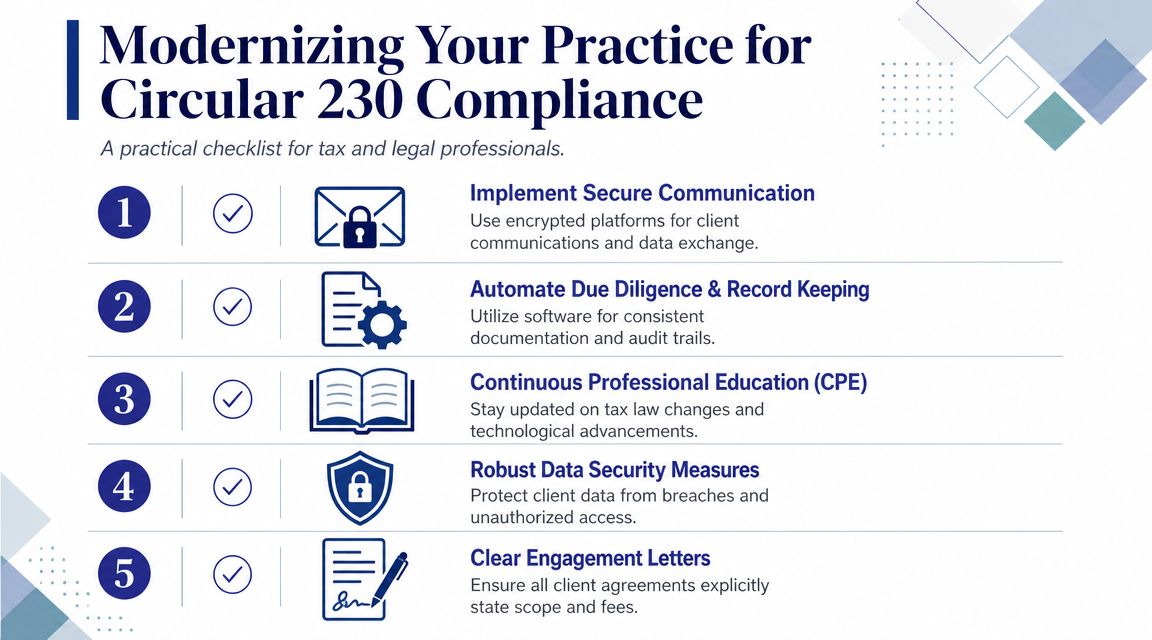
A workable modernization plan usually has five parts.
Tax data should move through approved channels only. Use encrypted portals, controlled file sharing, and written rules for client messaging. If staff can choose between the approved method and the convenient method, the convenient method usually wins, and that is how sensitive facts end up in inboxes and text threads the firm cannot supervise.
Good recordkeeping means more than saving PDFs. The file should show what the client provided, who reviewed it, what assumptions were used, which version became final, and what changed after draft advice went out. That level of discipline matters when a client later disputes advice or the IRS asks how the position was developed.
Hosting affects confidentiality, continuity, and reviewability. Firms use different models, including Microsoft environments, private hosting, and managed providers. For example, managed providers like Cloudvara host business applications used by accounting and legal firms, which can matter when a firm is evaluating secure remote access, backups, and permission controls for tax software and document systems. The right choice depends on where client data resides, how access is limited, how logs are retained, and how quickly the firm can recover if a system fails.
A tax practice cannot separate technical competence from information security anymore. If the team handling returns, advice, or representation does not understand the risks in remote access, file sharing, phishing, and account permissions, the firm is exposed in ways that directly affect confidentiality and supervision. Firms tightening those controls often review practical cybersecurity standards for accounting firms handling tax data as part of the compliance process.
The engagement letter should match the actual work. Internal routing should also match it. If a matter starts as return preparation and turns into substantive advice or a response to the IRS, the file should reflect that shift, the review standard should change, and the supervising partner should know it happened.
Modern compliance depends on systems that support consistent judgment, controlled access, and a clean record of who did what.
What works is standardization with enough flexibility for real client work. Approved tools. Defined access roles. Review steps tied to risk. Retention rules that staff can follow without guessing. Training built around actual workflows, not generic annual slides.
What fails is partial adoption. A firm adds a portal but still circulates drafts by personal email. It stores returns in the cloud but lets staff download uncontrolled local copies. It requires multifactor authentication for one application while leaving shared folders loosely permissioned. Those gaps are where confidentiality, supervision, and written advice problems usually start.
The practical goal is simple. Make the compliant path the easiest path.
It carries regulatory force because it sits within the federal regulatory framework governing practice before the IRS. It's not casual guidance that firms can treat as optional.
No. The IRS describes it as applying to tax professionals acting on behalf of taxpayers, especially attorneys, CPAs, and enrolled agents, and it can also affect others involved in covered practice activities.
Yes, if your work connects to representation, advice, or other covered conduct before the IRS. The practical question is not just what service label you use. It's what the engagement involves.
For many firms, Circular 230 sits alongside state board rules, licensing requirements, and professional conduct codes. You don't choose one over the other. You manage the engagement so all applicable standards are met.
Because confidentiality, competence, supervision, and recordkeeping now depend heavily on digital systems. Weak access control or poor file governance can create the same kind of practice risk as weak technical review.
If your firm is reworking tax workflows, remote access, or document controls, Cloudvara can be part of that evaluation. It provides cloud hosting for accounting and business applications, which is useful when you need a more structured environment for secure access, centralized records, and continuity planning tied to Circular 230 compliance.