Picture your entire office desktop—every single file, every critical application—securely available on any device, anywhere in the world. That’s the simple, powerful promise behind desktop and app virtualization. This technology basically turns your software and data into a secure, digital workspace that streams to your laptop, home PC, or tablet whenever you need it.

Think of it like a streaming service, but for your work. Instead of installing software and storing files directly on your computer's hard drive, everything runs from a secure, centralized data center. Your device just acts as a window into this high-powered remote environment, giving you the exact same experience whether you're in the office, at home, or on the road.
This approach completely separates your work environment from the physical machine you're using. If an employee’s laptop is lost or stolen, your sensitive client data remains untouched and secure in the data center, not on the missing device. For professional firms like accounting and law offices, where data security and client confidentiality are everything, this separation is a complete game-changer.
The massive shift toward more agile and remote-friendly work isn't just a trend; it's made desktop and app virtualization an essential strategy. It directly solves several key challenges that modern businesses, especially small and mid-sized firms, grapple with every single day.
The global market for this technology reflects the growing demand. Valued at US$27.6 billion, it's projected to skyrocket to US$111.6 billion by 2031. That explosive growth is happening for one reason: businesses are seeing clear, undeniable benefits.
By adopting this model, firms can finally achieve:
To really get how desktop and app virtualization can reshape a business, it helps to understand the core ideas of virtualization technology. This foundational knowledge makes it clear how software and hardware are decoupled to create such flexible work environments.
Ultimately, virtualization empowers professional firms to become more resilient, secure, and adaptable. It provides the technological backbone to support a modern workforce while protecting the sensitive information clients trust you with. This strategic move also lines up perfectly with broader trends in digital operations, which we cover in our guide on the benefits of cloud hosting.
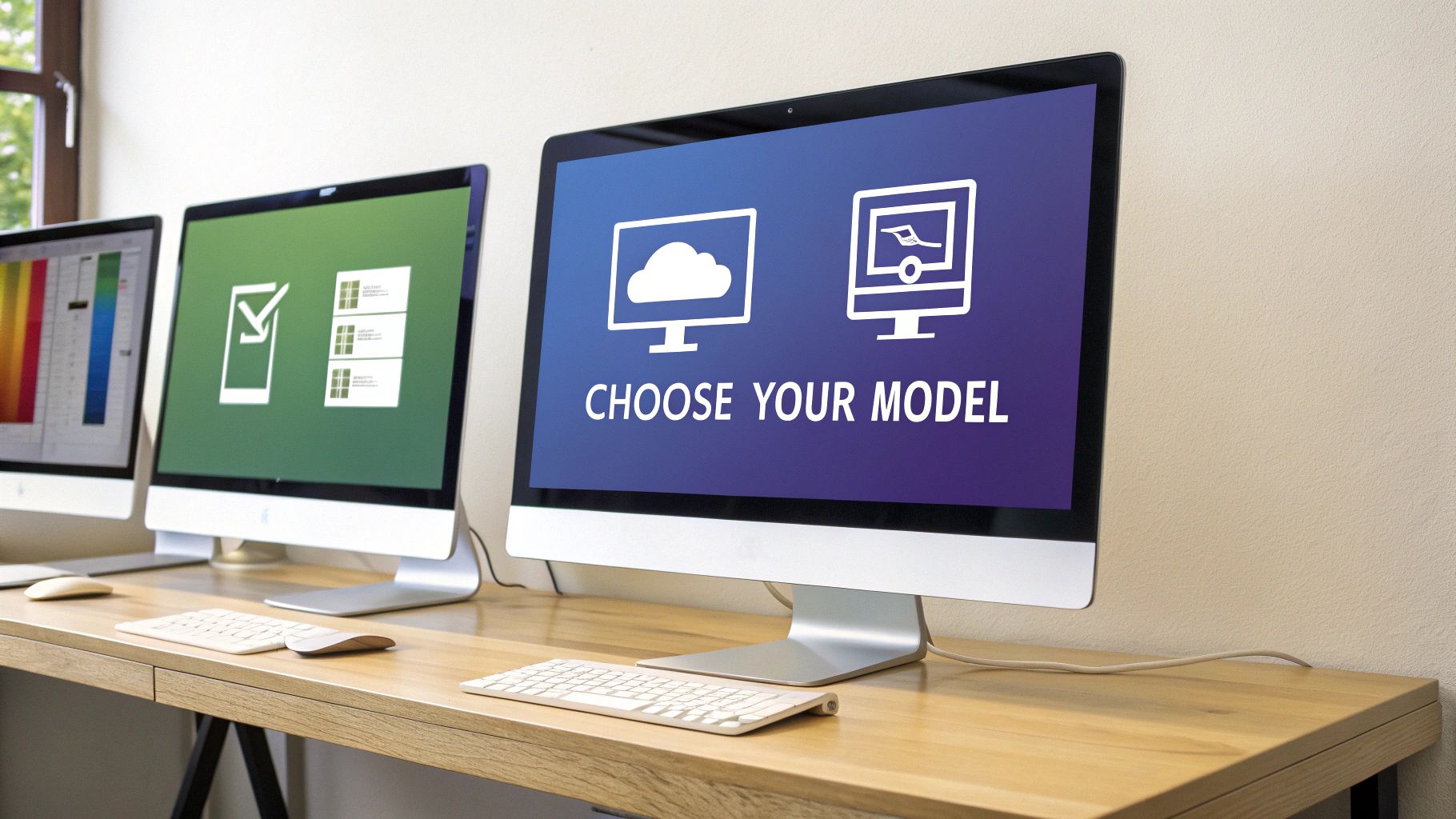
Once you see what desktop and app virtualization can do, the next step is picking the model that actually fits your business. They aren't all the same, and the right choice really comes down to your budget, IT resources, and what you’re trying to achieve long-term. Let's demystify the three main options to make that decision a whole lot clearer.
Think of it like getting a workspace. You could build your own office from the ground up, lease a fully managed suite, or just get a keycard for the few rooms you actually need. Each one serves a totally different purpose.
Virtual Desktop Infrastructure, or VDI, is like owning and managing your own custom-built office building. You control everything, from the foundation right up to the furniture. In this model, your company buys, hosts, and maintains all the server hardware, networking gear, and software needed to deliver virtual desktops to your team.
This approach gives you the absolute highest level of control and customization. You can fine-tune every little detail of performance, security, and user experience. But just like owning a commercial building, it comes with heavy responsibilities—namely, a huge upfront investment and the need for a skilled IT team to keep it all running. A deeper dive into Virtual Desktop Infrastructure (VDI) can help clarify its full architectural demands and benefits.
Key Takeaway: VDI provides maximum control but requires a substantial investment in hardware and IT expertise. It's often the go-to for larger enterprises with specific compliance needs and dedicated IT departments.
Desktop as a Service, or DaaS, is the equivalent of leasing a fully serviced, move-in-ready office space. Instead of buying and managing your own servers, you partner with a third-party provider like Cloudvara. We handle all the complex infrastructure, security, maintenance, and updates behind the scenes.
Your business pays a predictable monthly subscription per user, turning what would be a massive capital expense into a manageable operational cost. This model delivers all the perks of virtualization—secure remote access, business continuity, and centralized management—without the headache of maintaining the hardware. For a deeper look, check out our complete guide on what Desktop as a Service is and how it benefits businesses.
The DaaS market is growing fast for a reason, with projected growth of 11.52% CAGR through 2031. It just makes IT simpler for professional firms. With 60.44% of the market already on cloud deployments, DaaS lets firms host essential software like tax and document management on dedicated servers with consistent backups, dramatically cutting their operational burden.
Finally, you have application virtualization, often delivered through solutions like RemoteApp. This is the most straightforward model, a bit like having a keycard that only unlocks the specific rooms you need in a building. Instead of giving users a full desktop environment, you stream individual applications to their devices.
An employee could open QuickBooks or Sage directly from their local desktop, and to them, it would look and feel like it's running right on their machine. But in reality, it's running securely in the data center. This is a perfect solution when your team only needs remote access to a handful of key programs, not an entire virtual desktop.
Choosing the right model is a strategic decision that impacts your budget, IT workload, and flexibility. To make things easier, this table breaks down the core differences between VDI, DaaS, and RemoteApp across the factors that matter most.
| Feature | Virtual Desktop Infrastructure (VDI) | Desktop as a Service (DaaS) | Application Virtualization (RemoteApp) |
|---|---|---|---|
| Management & Maintenance | Managed entirely by your in-house IT team. | Managed by a third-party provider like Cloudvara. | Managed by a third-party provider, focused solely on apps. |
| Initial Cost | High. Requires significant upfront capital for servers and licenses. | Low. A predictable monthly subscription per user. | Lowest. Billed per user, often with a lower cost than a full desktop. |
| Scalability | Complex and slow; requires purchasing and configuring new hardware. | High. Easily add or remove users on demand. | High. Simple to scale user access to specific applications. |
| Best For | Large enterprises with dedicated IT staff and specific control needs. | SMBs and firms seeking security and flexibility without IT complexity. | Businesses needing secure remote access to a few key applications. |
By understanding these fundamental differences, you can match your business needs with the desktop and app virtualization model that gives you the right balance of cost, control, and convenience.
Let's move past the technical diagrams and talk about what desktop and app virtualization actually does for your business day-to-day. For small businesses and professional firms, the advantages hit right at the core challenges: security, keeping the lights on, and managing costs. This isn't just theory; it's a practical shift that changes how your team works and how your business handles the unexpected.
Instead of managing a patchwork of individual computers—each with its own risks and maintenance headaches—you create a single, secure, and incredibly resilient work environment. It’s a strategic move that pays off across your entire operation.
In any professional service firm, client data is your most valuable asset. Virtualization wraps that information in a digital fortress. By keeping all your data and applications inside a secure data center, you eliminate your biggest vulnerability: the laptops and PCs themselves.
If an employee's laptop is lost, stolen, or hit with malware, no sensitive data is ever actually on the device. That machine is just a window into the secure environment, and you can revoke its access in a heartbeat. This centralized approach also makes staying compliant with strict regulations much simpler.
What happens to your workflow if the office has a power outage, a flood, or a server crash? For most businesses, it means a full stop. With desktop and app virtualization, your business doesn’t miss a beat.
Since the entire work environment is hosted in a remote data center with backup power and redundant internet, your team can simply go home, log in from another device, and keep working as if nothing happened. This turns business continuity from a complex, expensive plan into an inherent feature of your IT.
This kind of resilience ensures you hit client deadlines and protect revenue, no matter what’s happening at your physical office. You can explore more of these advantages in our full guide on virtual desktop benefits.
Today's workforce is often spread out, and getting everyone to collaborate smoothly can be a real headache. Virtualization solves this by giving every employee—whether they’re in the office, at home, or on the road—the exact same secure access to the exact same tools and data.
This consistency gets rid of the common frustrations of remote work. No more dealing with software version conflicts between machines or insecurely emailing files back and forth. Everyone works from a single source of truth, which naturally leads to better teamwork and productivity. An accountant working from home has the same secure access to QuickBooks and client files as their colleague sitting in the office.
Managing a fleet of physical desktops means a constant cycle of expensive hardware upgrades, software license management, and time-sucking maintenance. Virtualization, especially a DaaS model, flips that script entirely.
It turns unpredictable capital expenses (CapEx) into a stable, predictable operational expense (OpEx). Instead of shelling out for powerful new computers every few years, you can extend the life of your current hardware or even switch to low-cost thin clients, since all the heavy lifting happens in the data center.
This creates a leaner, more efficient IT operation:
Moving to a virtualized environment can feel like a massive project, but it’s really a series of deliberate business decisions. A smart, strategic approach breaks the whole process into manageable steps. This roadmap will demystify the migration, giving you a high-level framework to move forward with confidence.
The journey starts not with technology, but with a deep dive into how your business actually runs today. With a clear plan, you can ensure the switch aligns with your goals, keeps disruption to a minimum, and sets your team up for success from day one.
Before you can build your future, you need a map of your present. This first step is the most critical one because it creates the blueprint for your entire desktop and app virtualization strategy. The goal here is simple: create a complete inventory of what your team uses every single day.
Start by listing all your essential applications. This means everything from core software like QuickBooks or Sage to your CRM, document management systems, and any specialized industry tools. Be sure to note the application versions and any specific configurations your team depends on.
Next, look at your data. Where does it live? Who needs to access it, and from where? Understanding these data flows and permissions is non-negotiable for planning a secure and efficient migration.
Once you have a clear picture of your needs, you can pick the right delivery model. As we’ve covered, the choice between VDI, DaaS, and RemoteApp really boils down to your goals for cost, control, and IT management. This is where that initial assessment pays off.
This decision shapes your budget and resource needs, so picking the model that fits your business reality is crucial. A well-defined cloud adoption strategy can also help guide this critical choice.
For most small and mid-sized firms, going with a DaaS or RemoteApp model means finding a great hosting partner. This isn’t just about picking a vendor; you’re trusting this team with your entire operational backbone. Their expertise and reliability are everything.
Look for a provider who offers more than just servers. Your checklist should include:
The demand for this kind of reliable remote access is exploding. The global desktop virtualization market is expected to grow by $23.5 billion by 2029, largely because SMEs need better ways to support remote work. For professionals in tax, accounting, and law, this means getting dependable access to legacy apps like Sage from anywhere, which is exactly what top-tier providers deliver.
With a model and a partner in place, the final phase is all about the practical details of the move. A smooth data migration is key to avoiding downtime. Your chosen partner should work hand-in-hand with you to create a detailed plan for securely transferring your data to the new virtual setup.
At the same time, get your team ready for the change. Good onboarding and training make all the difference. Communicate the benefits—like the freedom to work securely from home—and give them simple, clear instructions on how to log in and find their virtual desktop or apps. A team that’s prepared will embrace the new system and start reaping the benefits right away.
The infographic below shows the core business advantages that make this strategic shift so powerful.

As you can see, virtualization directly strengthens your security, guarantees operational continuity, and enables modern collaboration—making it a cornerstone of business resilience.

For professional firms, any conversation about technology inevitably lands on two non-negotiable pillars: security and compliance. Moving to desktop and app virtualization is more than just an operational upgrade—it's a fundamental shift in how you protect client data and satisfy regulators. These technical and legal hurdles have to be cleared with precision.
It means tackling tough questions head-on. Where is your data physically stored? How do you prove compliance to an auditor? What’s in place to stop someone from getting in who shouldn’t? A managed virtualization partner is built to provide clear, solid answers to these critical challenges.
For law and accounting firms, the physical location of your data isn't some minor detail; it’s a core compliance requirement. This concept, known as data residency, often dictates that sensitive client information must stay within specific geographic borders to comply with local laws. Getting this wrong can lead to serious penalties.
A specialized hosting partner solves this by operating data centers in specific jurisdictions, guaranteeing your data stays exactly where it needs to be. This is crucial for meeting tough standards like:
When you partner with an expert, you offload the massive burden of building and proving a compliant infrastructure. That lets you focus on client work instead of regulatory IT headaches.
Beyond compliance, the user experience has to be seamless. A laggy or unresponsive virtual desktop completely defeats the purpose. Performance really hinges on things like having enough bandwidth and working with a provider whose infrastructure is optimized for demanding applications, like QuickBooks or your legal case management software.
The real power of a managed virtualization solution is that it bundles performance optimization with multi-layered security protocols. It’s not just about giving you access; it’s about making that access fast, reliable, and incredibly secure.
This is where essential security features become standard, not optional add-ons. Robust protocols are baked right into the service, creating a hardened environment from day one. You can explore our complete guide on these protections and learn more about remote access security best practices.
Here are a few key security layers a managed provider handles for you:
Ultimately, a dedicated hosting partner removes all the guesswork. They manage the complex web of security, compliance, and performance, delivering a secure, high-performing virtual workspace that lets your firm operate with total confidence and efficiency.
Even with a clear understanding of the benefits, diving into desktop and app virtualization can bring up some specific questions. Getting these common concerns ironed out helps clarify the practical side of making the switch.
Here are straightforward answers to the questions we hear most often from professional firms.
Yes, and in most cases, it’s far more secure than a traditional IT setup. Think about it: with virtualization, your data isn't sitting on individual laptops or PCs that can be easily lost, stolen, or hit with malware. Instead, all your information lives in a centralized, professionally managed data center protected by enterprise-grade security.
This entire model is built to prevent data leakage. It wraps sensitive client information in multiple layers of security, like advanced firewalls and intrusion detection systems, that are often more robust than what a small business could implement on its own.
The right internet speed really comes down to what your team does day-to-day. For standard business tasks like running accounting software, managing email, and editing documents, a typical business-class broadband connection is usually more than enough. Modern virtualization technology is highly efficient and designed to deliver a smooth, responsive feel even over average connections.
However, if you have users who frequently work with graphics-heavy applications or massive files, a faster, more stable connection will definitely help. A good provider will work with you to assess your needs and make sure everyone on your team has the performance they need to be productive.
Absolutely. This is one of the biggest wins of desktop and app virtualization—it’s designed to fully support the licensed software you already own and use. A specialized hosting provider can migrate your most critical applications—including all versions of QuickBooks, Sage, Lacerte, and other industry-specific software—directly into the virtual environment.
This means your team keeps using the exact same tools they rely on every day, just with a whole lot more power behind them. They get secure remote access from anywhere, centralized updates, and reliable performance, all without having to learn a single new program.
The main difference boils down to who owns and manages the infrastructure. It’s a bit like the difference between leasing an apartment and buying a house.
Ready to see how a fully managed DaaS solution can simplify your IT and secure your data? The team at Cloudvara offers a platform designed for the needs of professional firms like yours. You can explore how it works with a free 15-day trial with no contract or credit card required.