
A solid data breach response plan isn't just a document; it's the strategic roadmap that guides your organization through the chaos of a security incident. Think of it as your operational playbook, outlining the exact actions needed to minimize damage, from the moment a threat is detected until you’re fully recovered. When sensitive data is at risk, this plan is the most critical asset you have.

When a data breach hits, every second counts. The first few hours are absolutely critical. Without a clear plan, teams spiral into confusion, wasting precious time while the threat digs deeper into your systems. A pre-built response plan transforms a potential catastrophe into a manageable, structured incident. It empowers your team to act decisively under extreme pressure, replacing panicked scrambles with coordinated, effective action.
This level of preparedness is vital because the stakes are incredibly high. The fallout from a poorly handled breach goes far beyond the initial technical problem. Customer trust can evaporate overnight, your brand's reputation may suffer irreparable damage, and the resulting operational downtime can cripple your business.
Let’s talk numbers. The financial consequences alone are staggering. The global cost of cybercrime is on track to hit $10.5 trillion by 2025, and data breaches make up a huge chunk of that. What’s really telling is that nearly 40% of breaches are first spotted by external parties—not internal security teams. This highlights a common and dangerous gap in detection that every business needs to address.
Beyond the direct costs, regulatory penalties from laws like GDPR and CCPA can add millions to the final bill. Having a well-documented response plan is often a key factor regulators look at when assessing fines, as it demonstrates due diligence and a serious commitment to protecting data.
A data breach response plan is like an emergency evacuation route for your business. You hope you never need it, but trying to draw the map during the fire is a recipe for disaster. Having it ready—and rehearsed—is the difference between a controlled exit and total chaos.
An effective plan brings structure to what feels like an entirely unstructured crisis. It empowers your team by taking the guesswork out of the equation. For organizations using secure cloud platforms like Cloudvara, the plan should integrate directly with your infrastructure, outlining specific steps for isolating affected systems and protecting your centralized data.
A great response plan always includes a few key components:
To help you get started, here’s a look at the essential roles you’ll need on your response team and what they’re responsible for.
This table breaks down the core roles and responsibilities necessary for a coordinated and effective reaction to a data breach. Having these roles clearly defined before an incident occurs is crucial for eliminating confusion and enabling swift action.
| Role | Primary Responsibility |
|---|---|
| Response Team Lead | Oversees the entire response effort, coordinates team activities, and makes key decisions. |
| Technical Lead | Manages the technical investigation, including containment, eradication, and system recovery. |
| Communications Manager | Handles all internal and external communications with employees, customers, and the media. |
| Legal Counsel | Advises on legal obligations, regulatory compliance, and potential liabilities. |
| HR Manager | Manages employee-related issues, including internal notifications and policy enforcement. |
| Customer Support Lead | Coordinates the front-line response to customer inquiries and concerns. |
With these roles filled, your team has a clear command structure to rely on when the pressure is on.
Ultimately, a data breach response plan is a cornerstone of business resilience. It’s a strategic asset that actively protects your finances, reputation, and customer loyalty. For a deeper look into preparing for unexpected events, check out our guide on the core principles of emergency management. In today's world, this level of preparation isn't just a good idea—it's non-negotiable.

A plan on paper is just theory. The real strength of your data breach response plan comes from the people who have to execute it under pressure. Building this framework is about more than just assigning names to roles; it's about creating a cohesive unit that knows exactly what to do when the worst happens.
The goal is to eliminate that panicked "what now?" moment that paralyzes so many unprepared companies. When every team member understands their specific responsibilities, they can act with speed and confidence. This clarity is especially critical when your applications are hosted on a secure platform like Cloudvara, as your team must know precisely who coordinates with your provider to isolate affected systems.
Your core team needs to be a cross-functional group with designated leaders and backups for every single position. You're not just looking for job titles here; you need people with the right temperament and the authority to make tough calls on the spot.
This structure prevents the chaotic, all-hands-on-deck approach that so often leads to costly mistakes. It ensures a measured, strategic response.
A common mistake I see is building a response team composed solely of IT staff. A breach is a business crisis, not just a technical one. Your framework must include legal, communications, and leadership stakeholders to manage the full scope of the fallout effectively.
The need for a prepared, multi-faceted team is constantly reinforced by real-world events. High-profile incidents in 2025 continue to show why an effective data breach response plan is critical for both cloud and financial sectors. For instance, the March 2025 Oracle Cloud breach hit over 140,000 tenants and exposed 6 million records. Events like this prove how quickly a breach can escalate, demanding a plan that integrates immediate containment with forensic analysis and regulatory compliance.
Here’s a scenario to consider: What happens if your primary communication tools, like email or Slack, are part of the breach or are taken offline? An essential part of your framework is having secure, out-of-band communication channels ready to go.
This could be a dedicated, encrypted messaging app like Signal, a simple phone tree, or a password-protected conference line. The tool itself is less important than the fact that everyone on the response team has it, has tested it, and knows how to use it. This backup channel ensures your team can coordinate its actions even when your main network is considered hostile territory.
Finally, a key component of your framework is a reliable recovery strategy. Your technical team must have immediate access to clean, verified data backups to restore operations once the threat is gone. You can learn more about setting up these critical safety nets by reviewing best practices for a cloud backup for small business. Integrating your backup plan directly into your response framework turns recovery into a planned process, not a desperate scramble.
The moment your monitoring system confirms a breach, the planning phase is officially over. This is now a live-fire exercise where every second counts, and your first priority is to stop the bleeding. The goal is containment—cutting the attacker off before they can move laterally across your network and inflict more damage.
This isn't the time to panic and pull every plug from the wall. A chaotic shutdown can be just as destructive as the breach itself, corrupting critical data and wiping away the very forensic evidence you need to understand what happened. Instead, think of containment as a precise, surgical strike. If you’ve pinpointed malicious activity on a specific server in your Cloudvara environment, the immediate goal is to isolate that machine from everything else.
This creates a digital quarantine, effectively trapping the attacker. It cuts off their access to other systems and buys your team precious time to assess the damage without the threat escalating.
The visualization below breaks down how these critical phases typically unfold, moving from the initial detection to isolating the threat and, finally, to removing it completely.
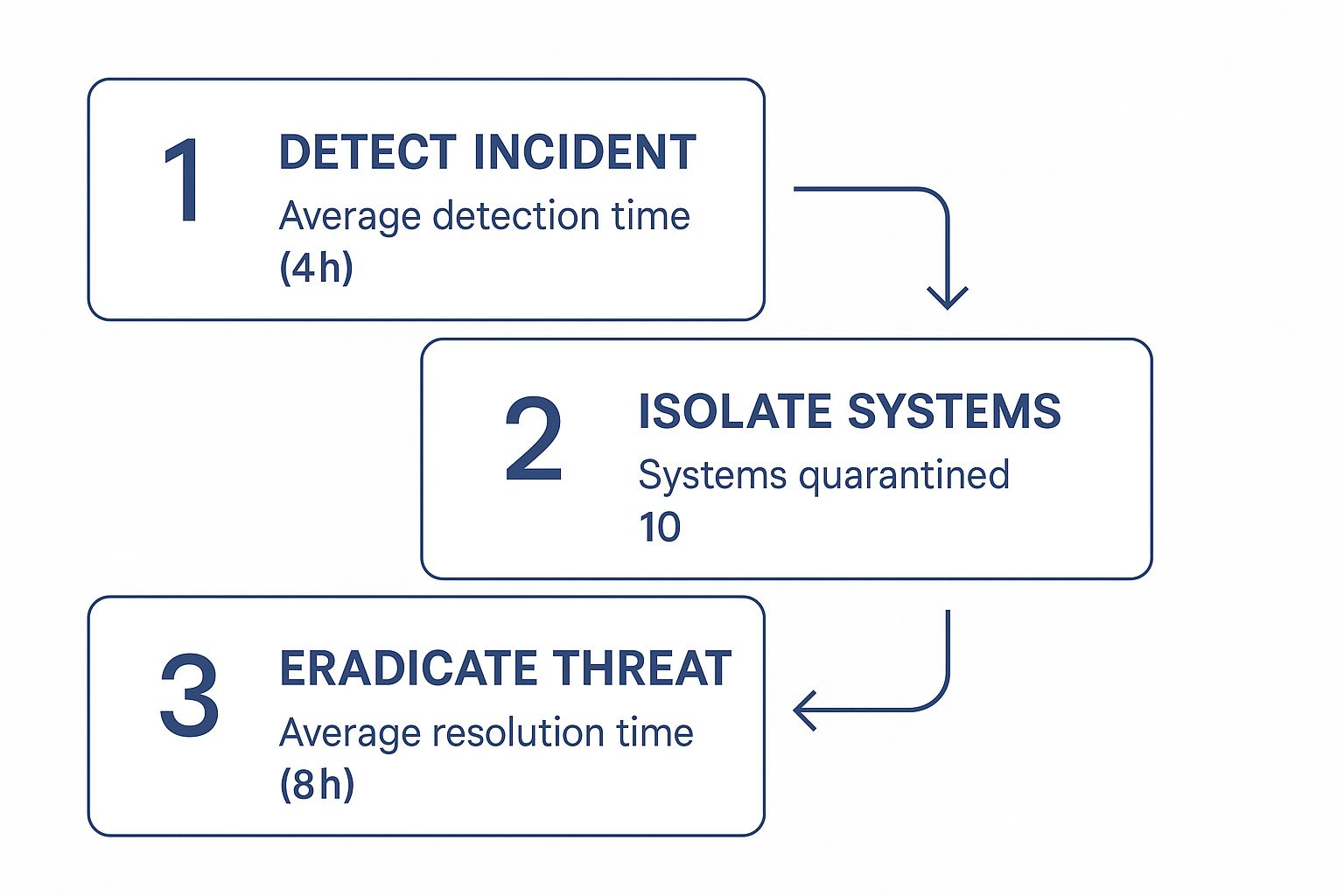
As you can see, containment isn't the final solution. It’s the essential intermediate step that creates a secure window for the methodical work of eradication to begin.
While your technical team is racing to contain the threat, another critical process has to run in parallel: evidence preservation. It’s tempting to wipe and restore an affected system immediately—it feels productive. But it's a huge mistake. You could be destroying the only clues that tell you how the attackers got in and what they touched.
This digital evidence is vital for a few key reasons:
The right way to do this is to create a forensic image—an exact, bit-for-bit copy—of the compromised system's drive. All analysis must happen on this copy, leaving the original machine untouched as a pristine piece of evidence. This preserves the chain of custody and ensures the data's integrity. To help prevent these intrusions in the first place, you can review a list of expert security recommendations to fortify your environment.
Never perform live analysis on a compromised machine. The moment you start running commands or opening files, you are altering timestamps and trampling over digital footprints. Always work from a forensic image to keep the evidence clean.
Containment often forces you into difficult, high-stakes decisions. Imagine an attacker has compromised your main e-commerce server during your busiest sales weekend. Do you take it offline immediately, sacrificing revenue and angering customers to guarantee containment? Or do you keep it online under intense monitoring to gather more intel on the attacker’s methods?
There’s no single right answer here. The decision comes down to the risk appetite you defined in your response plan.
Once the breach is contained and the evidence is safely preserved, the focus shifts to eradication. This is where you methodically hunt down and remove every trace of the attacker from your environment. It's not just about deleting a malicious file; it’s about making absolutely sure they have no way back in.
This phase is a comprehensive sweep of your systems. Your team will need to:
Only after you are 100% confident that the threat has been completely removed should you even consider moving to the recovery phase. I’ve seen teams rush this step, only to face a swift and embarrassing re-infection. Don’t make that mistake.
Once the threat is neutralized, it's tempting to breathe a sigh of relief and declare the crisis over. But the recovery phase is where the real work begins—it's what determines your organization's long-term resilience. This isn't a race to flip all the switches back on. Rushing things without careful verification can reintroduce the same vulnerabilities or, even worse, let a lurking attacker back into your systems. The goal is to restore operations methodically from a secure, trusted state.
This whole process hinges on your backups. Before any system comes back online, you must be certain your backups are clean and weren't tainted during the incident. For our clients on the Cloudvara platform, this means connecting with our support team to confirm the integrity of your data snapshots and archives. The restoration itself should be systematic, starting with the most critical systems while you monitor every move for anything unusual.
With operations stabilized, your data breach response plan moves into its most important stage: the post-incident analysis, often called a post-mortem. There's one unbreakable rule here: keep it blameless. The goal isn't to find someone to blame; it's to uncover the systemic weaknesses and process gaps that allowed the breach to happen in the first place.
A culture of blame only encourages people to hide mistakes, which is the last thing you want when you need complete honesty to fix the root cause. This analysis should bring everyone from the response team—technical, legal, communications, and leadership—to the table to dissect the entire event from start to finish.
Here are the key questions that should guide the conversation:
This exercise transforms a painful incident into a powerful lesson. Every answer you uncover helps fortify your defenses for the future.
Your last data breach should be the blueprint for preventing the next one. A thorough, honest post-mortem is the only way to ensure the lessons you just paid for in downtime and stress are actually learned and applied.
The insights you gain here are gold. They should be plugged directly back into your security strategy, creating a cycle of continuous improvement. This is absolutely critical, especially when you consider the sheer number of attacks happening daily. Data breaches are still climbing, with roughly 23.1 billion breached accounts recorded since 2004. This involves about 7.7 billion unique email addresses, meaning a single email has been breached an average of three times. You can see why a solid plan is so crucial to prevent repeat damage.
The outcome of your post-mortem can't be a report that just sits on a shelf. It must become a concrete action plan, complete with clear owners and firm deadlines.
This plan will likely include steps like:
For the individuals whose data was compromised, providing genuine support is also a key part of a full recovery. As people deal with the aftermath, offering them resources to protect their financial well-being is a vital step in rebuilding trust. This could include clear guidance on understanding what credit monitoring entails and other proactive measures they can take.
Ultimately, recovery is about more than restoring data—it's about restoring confidence. It's also deeply intertwined with your broader resilience strategy. Many of the principles in post-breach recovery overlap with wider continuity efforts. To make sure your organization is truly ready for any disruption, not just cyberattacks, it's worth exploring tools and strategies for a more holistic business continuity planning software. By turning incident analysis into tangible improvements, you make your organization stronger and better prepared for whatever comes next.

After you’ve contained a data breach, how you talk about it can be just as crucial as how you fixed it. The technical response is vital, of course, but your communication strategy is what will either preserve or shatter the trust you’ve built with your customers. A poorly worded email or a delayed announcement can easily turn a manageable incident into a full-blown public relations disaster.
This is why your data breach response plan absolutely must include a detailed communications playbook, ready to go at a moment's notice. This isn’t about spin; it’s about control, honesty, and empathy. The first words you share will set the tone for the entire recovery process, and you need to manage the narrative with every stakeholder—from the people whose data was exposed to the regulators scrutinizing your every move.
One size definitely does not fit all when it comes to breach notifications. Each audience needs a slightly different message, but the core principles never change: be clear, be honest, and be genuinely helpful. Generic, jargon-filled apologies will only make things worse. People want to know what happened, what it means for them, and what you’re doing to make things right.
Here’s a breakdown of how to approach different groups:
This multi-pronged approach ensures every group gets the information they need in a way that makes sense, helping you rebuild trust instead of destroying it.
The legal fallout from a data breach is no joke, and it’s a minefield for the unprepared. This is exactly why your legal team needs to be one of the first calls you make. Their involvement isn't just a good idea; it's non-negotiable from day one. They are essential for managing notification deadlines, which can be as short as 72 hours under regulations like GDPR.
A critical mistake I've seen organizations make is waiting to bring in legal counsel until after the "technical" work is done. By then, it’s often too late. You might have accidentally waived attorney-client privilege on internal communications or missed a crucial reporting deadline, exposing the business to much greater liability.
Your legal team’s first job is to create a protective bubble around the investigation. By directing the forensic analysis, they can often shield the findings under attorney-client privilege. This simple step can prevent candid internal discussions about security gaps from becoming discoverable evidence in a future lawsuit. A well-structured data breach response plan will explicitly state that legal counsel directs the entire incident response to establish this privilege from the get-go.
To keep your team from missing a critical step during the chaos that follows a breach, you need a clear, actionable checklist. Think of it as your roadmap for managing communications and regulatory duties when the pressure is on.
Here’s a simple table that outlines the core actions required.
| Action Item | Audience | Key Consideration |
|---|---|---|
| Draft Initial Notification | Affected Individuals | Focus on clarity and empathy. Avoid technical jargon. Provide actionable steps for self-protection. |
| Notify Regulatory Bodies | Government/Legal | Adhere strictly to legal deadlines and content requirements. This should be managed by legal counsel. |
| Prepare Internal Statement | Employees | Inform your team about the breach to prevent rumors and ensure they can direct inquiries properly. |
| Prepare Media Statement | Public/Media | If necessary, craft a single, unified message focused on responsibility and remediation. |
| Activate Support Channels | Affected Individuals | Scale up call centers and create a dedicated webpage or FAQ to handle the influx of inquiries. |
Following a structured checklist like this helps turn a potential PR nightmare into a demonstration of responsible leadership. It ensures your communications are timely, accurate, and legally sound.
Of course, a strong communication plan is just one part of a wider security posture. You can learn more about getting ahead of threats by exploring resources on cloud data loss prevention to better protect your sensitive information before an incident ever occurs.
Even with a solid guide in hand, putting together a data breach response plan always brings up a few more questions. It’s a complex process, and it's natural to have loose ends. This section tackles some of the most common things we hear from organizations as they fine-tune their strategies.
The goal here is to give you clear, direct answers to help you close any gaps and get your team truly ready.
A response plan that just sits on a shelf is worse than useless—it creates a false sense of security. At a minimum, you should be testing your data breach response plan at least once a year. But if you really want to be prepared, a better rhythm is to conduct smaller, more frequent tests quarterly.
These tests don’t always need to be full-blown, panic-inducing simulations. They can be more focused, like:
The key is consistency. Regular testing builds muscle memory. When a real incident hits, your team will react based on practice, not panic.
The most common—and most damaging—mistake we see is waiting too long to bring in legal counsel and the communications team. Too many companies treat a data breach as a purely technical problem for the IT department to solve first. This is a critical error.
When you delay legal involvement, you risk losing attorney-client privilege on your internal conversations about the breach. You also run a huge risk of missing tight regulatory notification deadlines, some of which can be as short as 72 hours. And by putting off communications planning, you end up with chaotic, reactive messaging that completely erodes customer trust and spirals into a PR nightmare.
Your response plan absolutely must treat a breach as a business-wide crisis from the very first moment, not just an IT incident. The second a breach is confirmed, your incident commander needs to loop in legal and communications leads to ensure every single action is coordinated and compliant.
This integrated approach means containment, legal duties, and public perception are all managed in parallel, not as a sequence of afterthoughts.
No, it absolutely does not. Cyber insurance is an essential financial safety net, but it is not a substitute for a well-rehearsed data breach response plan. In fact, the two are deeply connected. Most insurance carriers today actually require you to have a documented response plan just to get coverage.
Think of it this way: your response plan is what minimizes the damage in the first place, while your insurance policy helps pay for the damage that still occurs. Having a strong plan can even lower your premiums because it proves to the insurer that you’re a lower-risk client. Without a plan, you're looking at a much bigger financial and operational mess, which is exactly what insurance companies want to avoid.
Your policy might even dictate which breach coaches or forensic firms you're allowed to use. It’s far better to integrate these requirements directly into your plan before a crisis, so you aren't scrambling to find approved vendors while the clock is ticking. It ensures a smoother response that aligns with your coverage right from the start.
A resilient data breach response plan is your first and best line of defense when a security incident occurs. Making sure it’s robust, tested, and built on a secure infrastructure is paramount. With Cloudvara, you get a secure cloud platform with dedicated support and consistent backups, giving you a strong foundation for both your business continuity and your response strategies.
Explore how Cloudvara can secure your applications and data today.