
The shortage of CPAs is no longer a staffing inconvenience. It's an operating constraint.
The clearest signal is the scale of contraction. The U.S. accounting and auditing workforce has shrunk by over 17% since 2020, with more than 300,000 professionals leaving the field, even as the Bureau of Labor Statistics projects approximately 124,200 annual job openings through 2034 according to this shortage analysis. For firm leaders, that changes the conversation. This isn't just about recruiting harder. It's about redesigning how work gets delivered when experienced talent is harder to attract, slower to replace, and more selective about where they stay.
Many firms still treat the shortage of CPAs as a pure pipeline issue. That diagnosis is incomplete. Yes, the profession needs more entrants. But firms also need stronger operating models, better workflow design, and infrastructure that supports flexible delivery. A practice with outdated systems, fragmented applications, and manual handoffs will feel the shortage sooner and more painfully than a practice with modern tools and disciplined processes.
That distinction matters because the firms that cope best won't necessarily be the ones with the largest recruiting budgets. They'll be the ones that reduce unnecessary load on licensed professionals, create environments people want to work in, and use technology to widen access to talent instead of narrowing it.

Most accounting firms were built for a labor market that no longer exists. They assumed a steady flow of graduates, a reliable path to licensure, and enough bench depth to absorb seasonality, client growth, and partner succession. Those assumptions have broken down.
The shortage of CPAs now reaches into every part of firm operations. Recruiting takes longer. Managers spend more time covering production work. Partners get pulled back into review bottlenecks. Client deadlines become harder to protect. Advisory work gets delayed because compliance work consumes the available licensed capacity.
The deeper issue is that talent scarcity exposes operational weakness. When a firm has strong systems, clearly defined workflows, and a modern delivery environment, it can protect partner time and stretch experienced staff further. When it doesn't, every vacancy creates a chain reaction across tax, audit, CAS, and client service.
This problem lands differently depending on the practice, but the pattern is consistent:
Bottom line: The shortage of CPAs is a business continuity issue before it's a recruiting issue.
Leaders who respond only with more job postings usually find that demand outpaces their hiring effort. Leaders who pair hiring with process redesign, role clarity, and better technology usually build more resilience. That's where the practical opportunity sits. Not in pretending the market will normalize quickly, but in making the firm easier to run under strain.
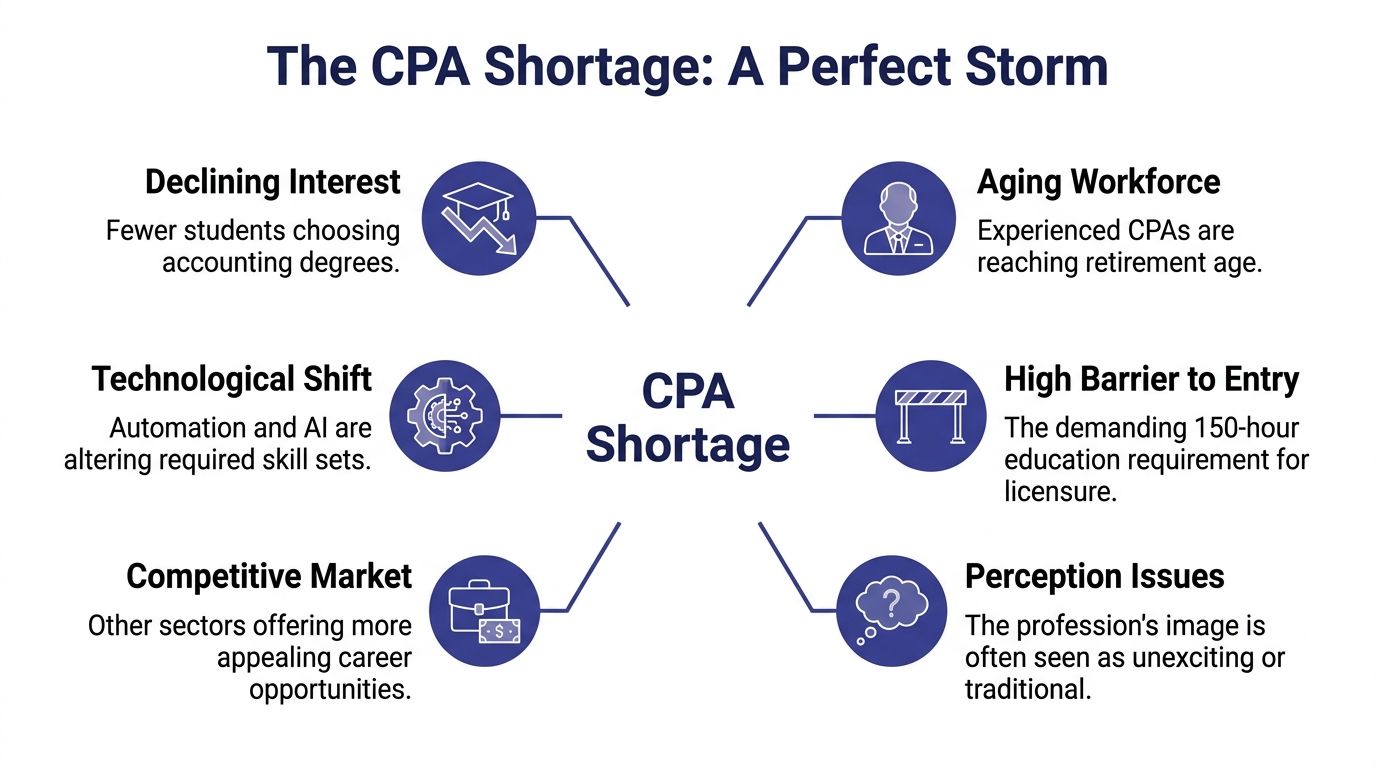
The CPA shortage is the product of several forces hitting the profession at once. Demographics, a narrower entry pipeline, stricter credential economics, and changing expectations around how accountants work now reinforce one another. The result is not only fewer licensed professionals. It is less slack in the operating model of many firms.
A large share of the profession is approaching retirement age, as noted earlier. For firms, that matters because experienced CPAs carry far more than billable capacity. They hold review judgment, client history, industry context, and informal process knowledge that often lives outside manuals and workflow systems.
That loss is hard to replace quickly.
A retiring tax partner may know which clients consistently create extension risk, where documentation issues tend to surface, and which staff members can handle ambiguous work without close supervision. An audit senior manager may be the person who spots quality issues before they reach partner review. When those professionals leave faster than firms can transfer their knowledge, the shortage becomes an execution problem, not just a staffing problem.
Fewer students are choosing accounting than they did a decade ago, as noted earlier, and licensure still requires time, money, and persistence. The 150-credit-hour requirement continues to shape that decision. For many candidates, accounting competes with finance, data, and technology roles that offer faster entry and, in some cases, more flexible working models.
That changes the economics of recruiting. Firms are no longer only competing with one another. They are competing with adjacent professions for analytically strong graduates who want optionality, faster skill growth, and work environments that feel current.
Passing the CPA exam narrows the pool further. So does attrition in the first few years of practice, when long hours, repetitive manual work, and inconsistent coaching can push capable staff toward other paths.
Younger accountants judge firms by how the work gets done. Pay still matters, but so do system quality, flexibility, training, and the amount of low-value administrative work built into a normal week.
That is why workplace design has become part of the shortage story. Firms that rely on office-bound files, fragmented communication, and manual handoffs make daily work harder than it needs to be. Firms that support hybrid delivery, secure remote access, and consistent digital workflows are better positioned to recruit and keep staff. For leaders assessing how flexibility now affects retention, this data on partly remote work after the pandemic adds useful context.
The broader lesson is operational. Technology has not reduced the need for CPA judgment. It has increased the penalty for wasting that judgment on tasks that could be standardized, routed automatically, or completed with better systems. In a tight labor market, every hour of licensed time spent chasing documents or rekeying data is a capacity decision.
The firms under the most pressure are often the ones asking scarce CPAs to compensate for weak processes.
These forces do not act independently. They compound.
| Pressure | Operational effect on firms |
|---|---|
| Aging workforce | Removes reviewers, mentors, and long-held client knowledge |
| Smaller graduate pipeline | Reduces the number of entry-level hires available to develop |
| Costly, slower licensure path | Delays the point at which staff can take on higher-value responsibility |
| Rising expectations for flexibility and tools | Shifts candidates toward firms with better work design |
| More digital client service demands | Increases the value of accountants who combine technical skill with technology fluency |
This is why the CPA shortage should be treated as an operational and technological challenge as much as a talent challenge. Hiring remains necessary, but hiring alone does not solve review bottlenecks, knowledge concentration, or inefficient workflow design. Firms that strengthen systems while they recruit usually protect margins and client service more effectively than firms that rely on headcount growth alone.
The labor market numbers become real when an engagement slips, a review queue builds up, or a client starts asking why the same deliverable is later than last year.
The most direct sign is hiring friction. CPA-required accounting roles take an average of 73 days to fill, which is 41% longer than non-CPA positions, and there are only 3 qualified active CPA candidates for every 5 open roles, based on Talentfoot's national benchmarks. That isn't a temporary inconvenience. It's enough delay to affect capacity planning, client onboarding, and partner workload for an entire quarter.
A mid-sized tax practice loses a senior manager in late summer. Recruiting starts immediately, but the role stays open through planning season. Managers absorb review work. Seniors get promoted into stretch assignments before they're fully ready. The partner spends more time in delivery and less time in origination. Existing staff log longer weeks, and the firm's tolerance for client exceptions drops.
An audit team faces a similar pattern. One vacancy doesn't stay isolated. It slows fieldwork, compresses review windows, and increases reliance on the most experienced people. That creates fatigue in exactly the employees the firm can least afford to lose.
A lot of firms try to patch these gaps manually. They add overtime, borrow staff across offices, or ask partners to review more work directly. Those responses can get you through a filing deadline. They don't create a stable model.
The shortage of CPAs affects more than recruiting metrics. It can show up in operational and client outcomes such as:
Firms often discover that their workflow is harder to manage than they thought. Work sits in inboxes. Source documents arrive through scattered channels. Review notes get tracked inconsistently. Internal IT becomes another bottleneck when applications aren't easy to access or maintain. For many practices, stronger IT support for accounting firms is part of stabilizing the operating model, not a side issue.
Practical rule: If a vacancy causes service degradation within weeks, the staffing issue is also a process issue.
Clients rarely describe the problem as a shortage of CPAs. They experience it as slower response times, less proactive advice, and reduced continuity. They may see more junior faces on the account and fewer senior conversations about planning, controls, or risk.
That erodes value perception. Clients don't just buy completed returns or clean financials. They buy confidence. When a firm's best people are overloaded, confidence gets harder to deliver consistently.
Leadership judgment matters. The firms that protect client experience during a talent crunch usually narrow scope where needed, standardize low-value tasks, and reserve licensed expertise for work that requires it.

Recruiting alone won't solve the shortage of CPAs. Firms need a talent system, not a hiring habit.
That starts with accepting the scale of replacement demand. The retirement of Baby Boomer CPAs is projected to create 136,400 annual job openings through 2034, while firms contend with longer hiring timelines and stronger candidate demands for signing bonuses and remote work options, as outlined in Athena Consulting's review of hiring conditions. In that market, firms that rely on generic job ads and informal onboarding will keep losing to competitors with clearer offers and smoother operating environments.
The strongest firms are widening the aperture without lowering standards. That means hiring for adjacent strengths where appropriate, then building a structured path into more complex work.
Consider these moves:
This short video offers a useful perspective on how firms are thinking about staffing and practice evolution:
Most firms still underinvest in retention because attrition feels less visible than an unfilled requisition. That's a mistake. Replacing a CPA is slow, and replacing judgment is slower.
Retention improves when firms reduce avoidable friction and make advancement legible. Staff don't stay because leadership says culture matters. They stay when they can see a workable career, access mentors, and do their jobs without fighting systems every day.
A practical retention model usually includes:
Defined progression paths
Staff should know what changes at each level, including technical expectations, client exposure, and review responsibility.
Intentional knowledge transfer
Pair later-career CPAs with rising seniors and managers before retirement timelines force the issue.
Better workload governance
Busy seasons are part of the profession. Chronic unpredictability doesn't have to be.
Flexible work backed by real systems
Hybrid policy without reliable application access is just theory.
For firms evaluating software and workflow together, this overview of CPA practice management software is a good starting point because retention often improves when everyday work becomes easier to coordinate.
Firms usually lose people for stated reasons like pay or flexibility. They often keep losing them because daily work is harder than it needs to be.
A useful first pass is to review every role through three questions:
| Question | Why it matters |
|---|---|
| What work truly requires a CPA? | Protects licensed capacity |
| Where is senior time being wasted? | Reveals redesign opportunities |
| Which employees carry critical client or process knowledge? | Identifies retention and succession risk |
That exercise usually surfaces the same truth. The shortage of CPAs is partly a market problem, but the damage gets amplified inside firms that haven't redesigned roles around today's labor reality.
Automation is often framed as a threat to accounting jobs. In practice, it's a capacity tool.
The better question isn't whether firms should automate. It's which work should stop consuming CPA attention. When licensed professionals spend hours on repetitive extraction, rekeying, reconciliation prep, or status chasing, the firm is using scarce expertise on tasks that underutilize their skills.
Many accounting processes still depend on avoidable handoffs. A staff member downloads statements, renames files, enters the same values into another system, then waits for someone else to review whether the transfer was accurate. That isn't technical work. It's operational drag.
Good automation targets that drag first:
For firms comparing tools, this guide to automated data entry software for accountants is useful because it focuses on the practical issue often experienced first, which is the amount of human effort tied up in moving data from one place to another.
The point isn't to remove judgment. It's to reserve judgment for work that deserves it.
When teams automate repetitive steps, several things become possible. Seniors spend more time reviewing exceptions instead of rebuilding support. Managers can focus on interpretation, client communication, and planning. Partners get more room for advisory conversations that deepen relationships and improve margins.
The firms that benefit most from automation don't use it to cut people. They use it to protect expert attention.
Don't start with the fanciest tool. Start with the messiest repeated process.
A straightforward prioritization model looks like this:
| Process type | Automate sooner when it is… |
|---|---|
| Data handling | Repetitive and rules-based |
| Review support | Standardized across clients |
| Internal routing | Dependent on too many emails or spreadsheets |
| Reporting | Built from recurring templates |
If leaders need a broader operating lens, this article on how to improve workflow efficiency helps connect process mapping, handoff reduction, and better system design.
The shortage of CPAs makes this urgent. Firms no longer have enough slack to tolerate manual work because that's how it has always been done.

Technology infrastructure rarely gets discussed in conversations about the shortage of CPAs. It should.
Most commentary focuses on the pipeline collapse, yet it often misses how cloud-based infrastructure and remote capability affect retention directly, especially when younger professionals prioritize modern work environments that reduce operational friction and burnout, as noted in this analysis of the broken accounting talent pipeline. That observation matters because a firm's technology stack shapes daily experience more than leadership teams often realize.
A firm can offer hybrid work on paper and still create a poor employee experience. If tax, audit, document management, email, and client files sit across disconnected environments, remote work becomes cumbersome. Staff waste time logging into multiple systems, waiting on local machines, or asking coworkers to retrieve files from office-bound setups.
Cloud infrastructure changes that operating model. It centralizes access to core applications, reduces dependence on local hardware, and makes collaboration more consistent across office, home, and travel settings. For accounting firms using QuickBooks, Sage, tax software, CRM platforms, and Microsoft tools, that centralization can remove a surprising amount of daily friction.
A resilient practice needs a delivery environment that supports three goals at the same time:
That is why cloud decisions belong in workforce planning discussions. The right infrastructure doesn't create CPAs, but it does make the available talent pool easier to attract, use, and retain.
For firms evaluating deployment models, cloud accounting solutions are worth reviewing because they show how hosted environments can support accounting and tax applications without relying on office-bound servers. One example is Cloudvara, which hosts accounting and business software in a centralized cloud environment with remote access, backups, and managed support. In a constrained labor market, those features are less about convenience and more about reducing operating friction.
A modern tech stack won't fix a weak culture. It will make a strong culture easier to sustain.
Accounting leaders are right to be cautious. Flexibility only helps if access is secure and recovery is reliable.
That means evaluating cloud infrastructure with the same discipline used for any client-sensitive system. Firms should understand permission controls, backup practices, authentication methods, vendor support models, and continuity planning. This primer on understanding cloud computing and security risks is a useful companion for partners who want a plain-English view of the security questions worth asking.
The firms handling talent pressure best usually share a few traits:
| Capability | Why it matters during a talent shortage |
|---|---|
| Centralized application access | Reduces dependence on office location |
| Reliable remote collaboration | Expands hiring geography and scheduling flexibility |
| Managed support | Keeps accountants focused on client work |
| Consistent backups and continuity planning | Protects service delivery when disruptions occur |
This is the practical shift. The shortage of CPAs is not only about finding people. It's about creating a firm that can function well with the people it has.
No. AI can handle parts of bookkeeping, data extraction, document classification, and first-pass analysis, but accounting firms still rely on licensed professionals for judgment, review, client communication, and accountability.
The better question is where AI changes the economics of the work. Firms that use it well reduce time spent on routine processing and free experienced staff to focus on exceptions, technical interpretation, and advisory work. That matters in a labor shortage because capacity often breaks first at the review level, not at data entry.
The pipeline matters, but it is only one variable.
The shortage is also shaped by how firms operate. Two firms can face the same hiring market and get different results because one has clearer roles, better training, fewer manual handoffs, and systems that waste less senior time. That is why the shortage should be treated as both a talent problem and a production problem.
Some states are considering alternative paths to licensure while keeping the exam and experience requirements in place. That could help over time, especially if it lowers entry barriers without weakening standards.
Firms should not base next year's capacity plan on regulatory change. A safer assumption is that supply will remain tight, candidate expectations will stay high, and client demand will still need to be served.
They should compete on the quality of the job.
Small firms often have an advantage in speed and clarity. They can define responsibilities more cleanly, give staff broader exposure, shorten decision cycles, and offer flexibility without layers of approval. If the work is organized well and the tools are reliable, many candidates will view that as a serious advantage over a higher salary attached to a chaotic environment.
Start by identifying where technical judgment, client history, and review authority sit with one person. Those concentration points create operational risk that goes beyond burnout. They can delay close processes, slow partner review, and make client service vulnerable when someone is out.
Reducing that risk takes deliberate cross-training, clearer review criteria, shared client ownership, and documented decision rules. Common systems and centralized records also make coverage more practical because the backup person is not rebuilding context from email threads and local files.
They should get more specific with their outside firm. Ask who owns filings, who reviews work before submission, what happens if the primary contact leaves, and how deadlines are tracked.
That conversation is less about vendor management and more about business continuity. The firms handling staffing pressure well can usually explain their coverage model clearly. If they cannot, the client is carrying more service risk than it may realize.
Watch a small set of internal signals before revenue suffers. Pay attention to review turnaround time, extension rates, write-ups caused by rework, overdue client requests, and the share of work concentrated with a few people.
Those indicators show whether the firm has a hiring problem or a capacity design problem, and often both. They also help partners decide where to intervene first. A spike in review delays points to a bottleneck in senior bandwidth. Rising rework points to training, workflow, or system issues. If client communication slows while hours rise, the firm may be protecting output at the cost of retention.
If your firm is dealing with the shortage of CPAs and needs a more flexible operating model, Cloudvara is worth evaluating. It provides cloud hosting for accounting, tax, document, and business applications, which can support remote access, centralized software delivery, backups, and managed IT support. For firms trying to protect capacity while improving retention, that kind of infrastructure can be part of a practical resilience plan.