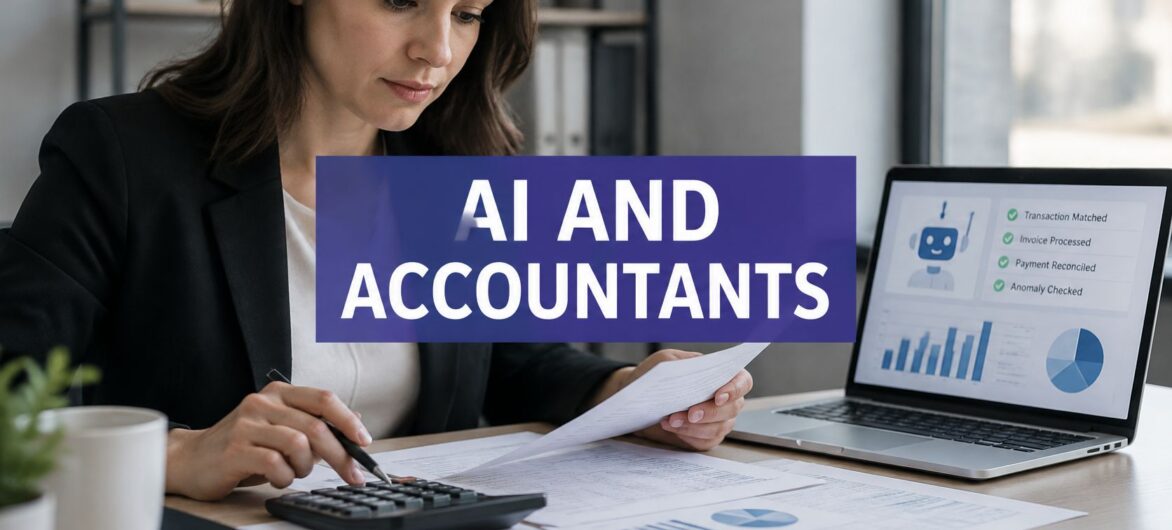
No, AI is unlikely to replace accountants wholesale in 2026, but it's already replacing specific tasks and reshaping entry-level roles. Employment for accountants and auditors is projected to grow 5% from 2024 to 2034, with about 124,200 openings per year, even as routine processing work shrinks.
That pairing confuses people because the popular advice treats this as a simple contest. You're told either to panic and abandon the profession or to relax because credentials protect you. Both responses miss what's happening inside firms. When people ask, is accounting going to be replaced by AI, they're usually picturing a job title disappearing overnight. The evidence points to something slower and more uneven. Work is moving between people and software, and the firms that struggle won't necessarily be using the weakest AI. They'll be the ones with no clear rules for who checks its work, secures client data, and answers for mistakes.
The winner-takes-all framing is the first problem. Accounting isn't one task, so it can't be automated as one task. Keying transactions, chasing missing invoices, interpreting a tax position, and explaining a cash problem to an owner require different kinds of judgment. Treating them as a single bundle produces dramatic headlines and poor career decisions.

The global picture is mixed, not apocalyptic. The World Economic Forum's Future of Jobs Report 2025 identifies accountants and auditors among roles expected to decline as businesses expand AI and automation, while estimating that AI and information-processing technologies could create approximately 11 million jobs and displace about 9 million globally, producing a net gain of roughly 2 million positions. A decline signal for a role category doesn't mean every accountant disappears. It means employers expect fewer hours devoted to the routine parts of that category.
Earlier software waves followed a similar pattern. Spreadsheets didn't end financial analysis, and cloud bookkeeping didn't end client accounting. They reduced the labor needed for repetitive procedures and raised the value of people who could supervise a system and explain its output. AI extends that pattern into transaction classification, document reading, reconciliation, and draft reporting.
Analyst's read: The useful question isn't who wins, AI or accountants. It's which minutes of your week move to software, and what a client will pay you to do with the minutes you get back.
That shift cuts hardest where work is standardized and volume is high. It cuts least where someone must assess evidence, apply changing rules, notice that a plausible answer is wrong for this client, and take responsibility for the conclusion. So don't ask whether your title is safe. Ask how much of your workload consists of routine processing versus interpretation, controls, and communication. That ratio, not your job title, is your real exposure.
Start with the hardest numbers available rather than vendor forecasts. The Bureau of Labor Statistics projection for accountants and auditors shows employment growing 5% from 2024 to 2034, faster than the average for all occupations, with approximately 124,200 openings per year and about 72,800 additional jobs over the period. That's a projection, not a guarantee, and it reflects retirements and occupational transfers as well as expansion. Still, it's difficult to reconcile with claims of wholesale replacement.
Growth at the top level can coexist with contraction underneath. Software can capture invoice data, suggest a code, match a payment, and reconcile a low-risk account with limited human touch. A firm may need fewer hours for that production work while needing more reviewers, controllers, tax specialists, and advisors. Headcount holds up, job content doesn't.
That dividing line explains much of the confusion. Clerical production is moving data from one place to another in a predictable format. Professional accountability is deciding whether the data is complete, whether a rule applies, whether evidence is persuasive, and whether you can sign off. AI compresses the first category. It doesn't assume liability for the second.
Labor shortages complicate the story further. Firms that can't hire enough experienced staff don't adopt automation only to cut heads. Many use it to serve work they'd otherwise turn away. The context behind the shortage of CPAs matters here because scarcity changes the economics. When qualified people are hard to find, software often substitutes for unfilled capacity before it substitutes for employed professionals. Aggregate demand isn't collapsing. It's being recomposed, and entry-level processing roles sit on the exposed side of that recomposition.
Task-level evidence is more actionable than profession-level predictions. The 2025 Intuit QuickBooks survey of accounting firms found that automation is most commonly used for payroll processing at 47%, accounts payable and receivable at 46%, and data entry or transaction processing at 43%, while 80% of firms still reported difficulty hiring experienced professionals and 75% had increased their emphasis on technology skills when hiring. Firms are automating and struggling to hire at the same time. That tells you where the scarcity sits.
| Task | Typical AI Role | Human Role |
|---|---|---|
| Payroll processing | Calculates, schedules, checks for anomalies | Resolves exceptions, confirms policy and compliance |
| Accounts payable and receivable | Extracts invoice data, matches payments, sends reminders | Approves payments, handles disputes and fraud concerns |
| Data entry and coding | Classifies transactions from patterns and documents | Reviews unusual items, sets coding policy |
| Bank reconciliation | Matches transactions, flags unmatched items | Investigates breaks, judges materiality |
| Tax and regulatory work | Researches, drafts, organizes source documents | Interprets rules, decides positions, represents the client |
| Advisory and review | Surfaces trends, drafts summaries | Explains implications, recommends action, owns the advice |
Tools already embedded in QuickBooks, Sage, and document platforms handle much of the left column. The pattern extends beyond accounting software, too. The Axia Energia automation case study from Applied is a useful outside example of how audit-adjacent manual work gets redesigned around automation, with humans retaining oversight rather than performing every check by hand.
Don't overread the table as a safe list and a doomed list. A task can be highly automatable and still need a person nearby because errors carry consequences. Payroll is the obvious example. The calculation is structured, but a wrong payment or filing creates real harm, so firms keep approvals and exception paths.
Exposure isn't determined by whether software can produce an output. It's determined by whether anyone can verify that output cheaply and accept the risk when it's wrong.
Practical data entry automation works the same way. It's valuable when confidence thresholds, review queues, and audit trails are defined in advance. Remove those controls and you've automated error production. The human-led core is judgment, client communication, regulatory interpretation, review, and ethical decisions. If your role contains little of that core today, that's the gap to close.
Field evidence beats speculation, so look at what happened inside real firms. The study described below gives a concrete picture of reallocation rather than disappearance.

A 2025 Stanford Graduate School of Business field study combining survey data from 277 accountants and transaction-level data from 79 small and midsized firms found that AI adoption was associated with a 55% increase in weekly client support, an 8.5% reallocation of accountant time from data entry toward communication and quality assurance, and a 7.5-day reduction in monthly close time. The study also reports roughly 12% greater general-ledger granularity in the same source. Accountants didn't vanish from those firms. Their time moved toward clients and checking.
Picture a typical small-firm close. Software classifies most transactions, reconciles routine activity, and produces a first pass at the ledger in more detail than a rushed manual process would capture. The accountant's day shifts to the items the system couldn't resolve, then to calling the client about what the numbers mean. That client conversation used to be squeezed out by production deadlines. Now it's the product.
The video below adds practitioner context on how these workflow changes feel from inside a firm.
Firms redesigning work this way usually write down three things. They define which transactions can be auto-posted, which unusual or material items require review, and how exceptions get escalated. The HireAccountants automation guide from HireAccountants walks through that kind of process mapping in practical terms, and it pairs well with a broader review of how to improve workflow efficiency before you buy more tools.
Measure the result properly. Track close-cycle time, review workload, error rates, exception rates, and client capacity. If close time falls but review queues explode, you haven't gained much. The Stanford pattern is encouraging precisely because time moved toward support and quality assurance, not just out of the business.
Capability isn't the bottleneck for most firms. Governance is. The checklist below summarizes the operational scaffolding many practices still lack.

Expectations have raced ahead of preparation. Thomson Reuters reporting on AI adoption challenges found that 79% of tax, accounting, and audit professionals expected AI to have a high or transformational industry impact, but only 14% said their firms had a defined AI strategy and only 25% had provided generative-AI training to employees. Read those figures together. Most professionals expect transformation, but few work somewhere that has decided how to manage it.
Talent and security sit behind those gaps. The verified research summarized earlier in this topic also notes finance leaders citing shortages of people, skills, and talent at 50%, security concerns at 47%, and doubts about technology maturity at 42% as adoption barriers. Those aren't abstract worries. A firm handling tax records and bank data can't improvise its way through them, which is why many practices lean on structured IT support for accounting firms instead of assigning AI governance to whoever has spare time.
Contrarian conclusion: Implementation readiness, not model capability, will decide most employment effects. Firms with weak controls will limit AI because they can't trust it. Firms with training, review, and secure systems will use it to expand advisory capacity.
That's why two firms using the same software get opposite outcomes. One bans the tool after a data scare. The other documents its review process, trains staff, and safely takes on more advisory work. The model didn't differ. The scaffolding did.
AI tools don't run in isolation. They need consistent data, controlled access, and reliable connections to the applications your firm already uses, including QuickBooks, Sage, tax software, document management systems, and Microsoft applications. If those systems sit on an aging office server that only works through a clunky remote connection, every AI integration becomes a special project.
The image below reflects the collaborative, always-accessible working pattern that cloud hosting supports.

Moving legacy applications into secure cloud accounting solutions gives you one controlled environment instead of scattered desktops and local files. Staff sign in from the office, home, or a client site and reach the same applications and data. That consistency matters for AI because automation fed by three versions of a file produces confident, conflicting answers.
Business continuity belongs on that list too. A hosted environment with consistent backups and support keeps client work moving when local hardware fails, which matters more as automated processes run on schedules rather than during office hours. Customizable hosting also lets a firm keep the desktop software its team knows instead of forcing a disruptive platform migration just to gain AI features.
Don't treat infrastructure as a boring preliminary. It's the layer that determines whether AI touches clean, permissioned, recoverable data or a tangle of local copies. Model selection gets the attention. The foundation decides whether the model can be trusted with client work.
Predictions fail when they ignore friction. Licensing rules, ethics standards, client trust, and firm governance all move slower than model releases. A phased view fits the evidence better than a single replacement date.
Now. Routine processing is already being automated in ordinary firms. Transaction classification, invoice capture, reconciliation support, and drafted reports are in production use, not pilot fantasy. If your day is dominated by that work, your timeline isn't theoretical. It's current.
One to three years. Entry-level bookkeeping roles get redesigned most visibly. Junior staff will spend less time keying data and more time clearing exception queues, checking AI output, and communicating with clients earlier in their careers. That creates a training problem firms haven't solved. Routine tasks used to teach pattern recognition. When software does them, firms must deliberately teach review skills through supervised exceptions, sample testing, and structured feedback, or they'll produce juniors who can operate tools but can't spot a wrong answer.
Three to five years. Advisory and review capacity expands where governance is in place. Firms that fixed their data, controls, and training can convert saved production hours into forecasting, cash flow conversations, and more frequent client contact. Firms that didn't will still be arguing about whether staff may use AI at all.
Beyond five years. The profession's long-term shape depends on how regulators, licensing bodies, and ethics frameworks treat AI-assisted work. Questions about who is responsible for an AI-influenced opinion, what must be disclosed, and how independence is preserved won't be settled by software vendors. Those institutional answers will set the ceiling on automation in audit and tax.
One more factor slows everything. Clients don't buy only accuracy. They buy confidence that a named professional understands their situation and will stand behind the advice. Until software can carry that accountability, and there's no credible path to it doing so, the human layer remains structural rather than sentimental. Expect continuous reshaping, periodic hype, and no single moment when accounting ends.
Act on the task map, not the headlines. The steps below work whether you're a solo practitioner, a firm leader, or an accountant early in your career wondering where you fit.
Build data literacy first. Learn to interrogate a dataset, spot an implausible classification, and explain a variance in plain language. Add AI supervision skills next, meaning you can set up a tool in QuickBooks or Sage, review its suggestions critically, and document your overrides. Then invest in advisory communication, because explaining what a client should do next is the work software hands back to you. Ethics runs through all three. Knowing when not to paste client data into a tool is now a professional competency.
Don't announce an AI strategy. Pick one workflow, govern it properly, measure it, and expand from evidence.
The accountants who come through this well won't be the ones who ignored AI or feared it most loudly. They'll be the ones who understood which tasks were leaving, governed the transition, and moved their value toward judgment clients can see.
If you're ready to give your AI tools a secure foundation, Cloudvara hosts QuickBooks, Sage, tax, and document applications on centralized cloud infrastructure with two-factor authentication, automated backups, and around-the-clock support. That means your team can automate routine work and review it from anywhere without scattering client data across local machines. Visit Cloudvara to start a free trial and see how your existing software runs in the cloud.