When you're trying to figure out which SOC report you need, the choice boils down to a single question: what kind of assurance are your clients really looking for? The core difference isn't about which report is "better" but which one is built for the job.
A SOC 1 report is all about controls that could affect a client's financial statements. A SOC 2 report, on the other hand, digs into operational controls related to security, privacy, and other trust-based principles. Your service dictates the report, not the other way around.
It’s easy to get lost in compliance jargon, but the distinction between SOC 1 and SOC 2 is actually quite practical. Each report serves a different audience and addresses a completely different set of risks. Getting this right is fundamental for building trust with your customers.
Think of a SOC 1 report as a financial assurance tool. If your services touch a client’s financial data—like processing payroll, managing claims, or servicing loans—then their auditors will want to see a SOC 1. It helps them understand how your controls impact their client’s Internal Control over Financial Reporting (ICFR).
In contrast, a SOC 2 report is squarely focused on technology and data protection. It’s based on the AICPA’s five Trust Services Criteria: Security, Availability, Processing Integrity, Confidentiality, and Privacy. This is the go-to report for SaaS companies, cloud hosting providers, and data centers whose clients need proof that their data is being handled securely.
For a deeper dive into the foundations of these reports, understanding what SOC compliance entails provides valuable context.
To see the differences at a glance, this table breaks down the main purpose, audience, and criteria for each report. It’s a handy reference for quickly identifying which path makes sense for your organization.
| Attribute | SOC 1 | SOC 2 |
|---|---|---|
| Primary Focus | Internal Controls over Financial Reporting (ICFR) | Data Security & Operational Controls |
| Guiding Criteria | Custom control objectives relevant to financial audits | AICPA's Trust Services Criteria |
| Primary Audience | Client's financial auditors and management | Client's security teams, management, and regulators |
| Typical Use Case | Payroll processors, claims administrators, loan servicers | Cloud hosting, SaaS platforms, data centers |
Ultimately, this quick comparison should point you in the right direction. Each report has a clear, defined role in the world of third-party assurance.
The simplest way to frame the difference is to ask: "Does my service affect my client's balance sheet, or does it primarily manage their operational data?" The answer directly points toward either a SOC 1 or a SOC 2.

While SOC 2 often grabs the spotlight in tech conversations, a SOC 1 report plays an irreplaceable role in financial oversight. Its purpose is laser-focused: to give assurance about the controls at a service organization that could impact a client's financial statements. This isn't about general cybersecurity; it's about the integrity of financial data and transactions.
Think about a third-party payroll provider your company uses. That provider's actions directly affect your financial statements, from payroll expenses to tax liabilities. Your own financial auditors need to trust that the provider's controls are strong enough to prevent errors or fraud. A SOC 1 report is the exact third-party validation they need.
The origins of SOC 1 are tied to major financial scandals of the early 2000s. After the Enron collapse in 2001 and the passage of the Sarbanes-Oxley Act (SOX) in 2002, the AICPA developed SOC 1 to specifically address Internal Controls over Financial Reporting (ICFR). This was a direct response to SOX Section 404, which forced public companies to assess their financial controls—including those of the vendors that touched their financial data.
Unlike the five pre-defined criteria of a SOC 2 audit, a SOC 1 audit is shaped by control objectives that the service organization and its auditor define together. These objectives are tailored to the specific services offered and the risks that could ripple through a client’s financial reporting.
Common examples of services that demand a SOC 1 report include:
In every case, the SOC 1 audit zeroes in on the controls related to these financial activities. For businesses outsourcing these functions, having a secure platform is non-negotiable; our guide to accounting cloud services offers more insight here.
A SOC 1 report answers a very precise question for a client's financial auditor: "Can we rely on the controls at this service organization when we audit our client's financial statements?" It's a foundational document for establishing trust in the financial supply chain.
Just like SOC 2, a SOC 1 report is available in two flavors, and the difference between them is massive. Knowing which one you’re looking at is essential for truly understanding your risk.
A SOC 1 Type I report is a snapshot in time. It describes a service organization's systems and confirms its controls are suitably designed to meet its objectives on a specific date. It essentially says the right policies and procedures exist on paper.
In contrast, a SOC 1 Type II report goes much, much further. It tests the operational effectiveness of those controls over a period of time, usually six to twelve months. This report provides hard evidence that the controls not only exist but have been working consistently as intended. For this reason, nearly all clients and their auditors will insist on seeing a Type II report, as it provides a far higher level of assurance.

While a SOC 1 report zooms in on financial oversight, a SOC 2 report casts a much wider net. It focuses squarely on a service organization’s controls around data security and operational technology, making it the gold standard for tech companies, SaaS providers, and cloud hosting services.
The entire framework is built on the Trust Services Criteria (TSC), a set of five principles established by the AICPA. Unlike the custom-built objectives of a SOC 1 audit, a SOC 2 audit measures an organization against these clearly defined criteria, giving everyone a standardized benchmark for data protection.
At the heart of every SOC 2 report is the Security criterion—it's mandatory. The other four are optional and can be added to the audit’s scope to address specific client concerns or service promises. This modular approach is what makes a SOC 2 report so relevant to the services being provided.
Here’s a quick breakdown of what each criterion covers:
A key difference between a SOC 1 and SOC 2 lies right here. A SOC 1 is customized around financial control objectives. A SOC 2 is built from a menu of standardized, security-focused criteria, making it a powerful tool for proving operational trustworthiness.
The flexibility to choose which TSCs to include makes a SOC 2 report a precise instrument. For instance, a data center provider like Cloudvara would almost certainly include Security and Availability to assure clients of robust protection and consistent uptime.
A healthcare data processing platform, on the other hand, might add Confidentiality and Privacy to address specific HIPAA-related concerns. This tailored approach keeps the audit relevant and provides meaningful assurance to customers. For a deeper look at the framework, this resource explaining What Is SOC 2 Compliance offers great context on how these criteria are applied in the real world.
The Type I vs. Type II distinction is just as critical here as it is with SOC 1. A SOC 2 Type I report verifies that controls are designed appropriately at a single point in time. But clients almost always demand a SOC 2 Type II report, which tests how well those controls actually worked over a sustained period—usually six to twelve months. This proves not just that you have good policies, but that you consistently follow them.
Ultimately, a strong SOC 2 report is a cornerstone of modern data governance. It shows a commitment to robust operational controls, which is a fundamental part of the 9 essential data security best practices for 2025. For any organization handling sensitive client data, a SOC 2 Type II isn't just a compliance document—it's a competitive advantage that builds lasting customer trust.
Getting the basic definitions down is the first step. But the real difference between a SOC 1 and SOC 2 report snaps into focus when you look at their audit scopes and how they actually play out in the real world.
The scope dictates everything—from the evidence an auditor needs to the expertise required for the audit itself. Ultimately, it shapes the kind of assurance the final report delivers. This isn't just theory; it's a distinction that directly impacts how your business proves its trustworthiness to different partners and clients.
A SOC 1 audit is a highly specific engagement. Its scope is built around control objectives that directly relate to a client's Internal Control over Financial Reporting (ICFR). This means the service organization works hand-in-hand with its auditor to pinpoint the exact processes—like transaction processing or revenue calculation—that could affect a user's financial statements. The controls tested are unique to that service.
On the other hand, a SOC 2 audit scope is drawn from a pre-existing framework: the AICPA's Trust Services Criteria (TSC). While there's flexibility in choosing which of the five criteria to include, the underlying controls are standardized. The audit isn't about custom financial processes; it's about whether the organization's systems meet established benchmarks for security, availability, and more.
The fundamental split in audit scope comes down to what's being measured. One is custom-built to ensure financial integrity, while the other is standardized for operational and security assurance.
This difference shows up clearly in the numbers. A SOC 1 Type II audit typically tests 20-40 custom controls related to financial processes over a 3-12 month period. In contrast, a SOC 2 Type II audit can rigorously evaluate between 60-100 standardized controls across the TSC framework in that same timeframe, often with a heavy focus on cybersecurity.
According to 2023 data, 65% of SOC 2 reports now cover all five TSC, a trend that helps satisfy compliance requirements in nearly 90% of cloud service deals. For more detail on these audit report differences, Linford & Co. offers some excellent insights into SOC 1 and SOC 2 audits.
So, a SOC 1 auditor might spend their time looking for evidence that payroll calculations are accurate and properly authorized. A SOC 2 auditor, however, would be digging into evidence of access controls, encryption protocols, and incident response plans to prove the system itself is secure.
The core divergence is simple but profound: SOC 1 validates the integrity of financial transactions flowing through a system. SOC 2 validates the operational integrity and security of the system itself.
To make the differences even clearer, let's break them down side-by-side. This table highlights how each report serves a distinct purpose, audience, and set of business needs.
| Feature | SOC 1 Report | SOC 2 Report |
|---|---|---|
| Primary Focus | Internal Controls over Financial Reporting (ICFR) | Security, Availability, Processing Integrity, Confidentiality, Privacy |
| Guiding Criteria | Custom Control Objectives | AICPA's Trust Services Criteria (TSC) |
| Typical Audience | User entity's financial auditors, CFOs, controllers | User entity's security teams, compliance officers, CIOs, prospective customers |
| Common Use Cases | Payroll processors, claims administrators, loan servicing companies | SaaS providers, cloud hosting services, data centers, managed IT services |
This comparison shows that your choice isn't just about compliance; it's about communicating the right kind of trust to the right audience.
The best way to grasp the SOC 1 vs. SOC 2 distinction is to see it in action. Imagine a FinTech platform that provides two different services: one for automated billing and invoicing, and another for advanced customer data analytics.
For the Billing Service: A customer's financial auditor is going to care deeply about this. They need to know that the revenue figures on their client's financial statements—which are generated by this platform—are accurate and reliable. Here, the platform would absolutely need a SOC 1 report with control objectives centered on transaction accuracy, authorization, and completeness.
For the Data Analytics Service: In this case, the main concern isn't financial reporting; it's data protection. Customers need solid proof that their sensitive business and client data is secure, kept confidential, and available when they need it. For this, the platform requires a SOC 2 report that covers, at a minimum, the Security and Confidentiality criteria.
In a situation like this, the FinTech company would almost certainly need both reports to satisfy the full spectrum of client demands. Securing both is a crucial part of effectively managing compliance risk when you offer services that touch different parts of a client's business.
This dual-report need is becoming more and more common. As service providers bundle solutions that affect both financial and operational areas, understanding the distinct purpose of each report allows a company to strategically pursue the right certifications, build comprehensive customer trust, and meet all its contractual obligations.
Figuring out if you need a SOC 1 or SOC 2 report can feel complicated, but the choice gets much simpler when you focus on what your clients really need to know about your services. The right report delivers the specific assurance they’re looking for, which builds trust and makes their own risk management easier.
The whole decision boils down to a couple of key questions about how your service works. Answering them will point you straight to the right compliance path.
This is the big one. It's the primary question that separates a SOC 1 from a SOC 2. If your service handles any process that could materially affect a client's financial data, their auditors will demand proof that your controls are solid.
Think about whether your platform performs functions like these:
If you answered yes to any of those, your clients will almost certainly need a SOC 1 report. Its scope is designed specifically to give their financial auditors confidence in your Internal Control over Financial Reporting (ICFR). Without one, your clients could hit major roadblocks during their own financial audits.
If your main job is hosting, storing, or processing your clients' operational data, the conversation shifts immediately to a SOC 2 report. This isn't about financial transactions; it's all about the security, availability, and integrity of your systems.
A SOC 2 is essential in common scenarios like these:
If your services fit this description, a SOC 2 report is the industry standard for showing your commitment to data protection. It tells clients you have strong controls in place based on the AICPA's Trust Services Criteria.
This decision tree helps visualize the choice. It all comes down to whether your client’s primary concern is financial impact or data security.
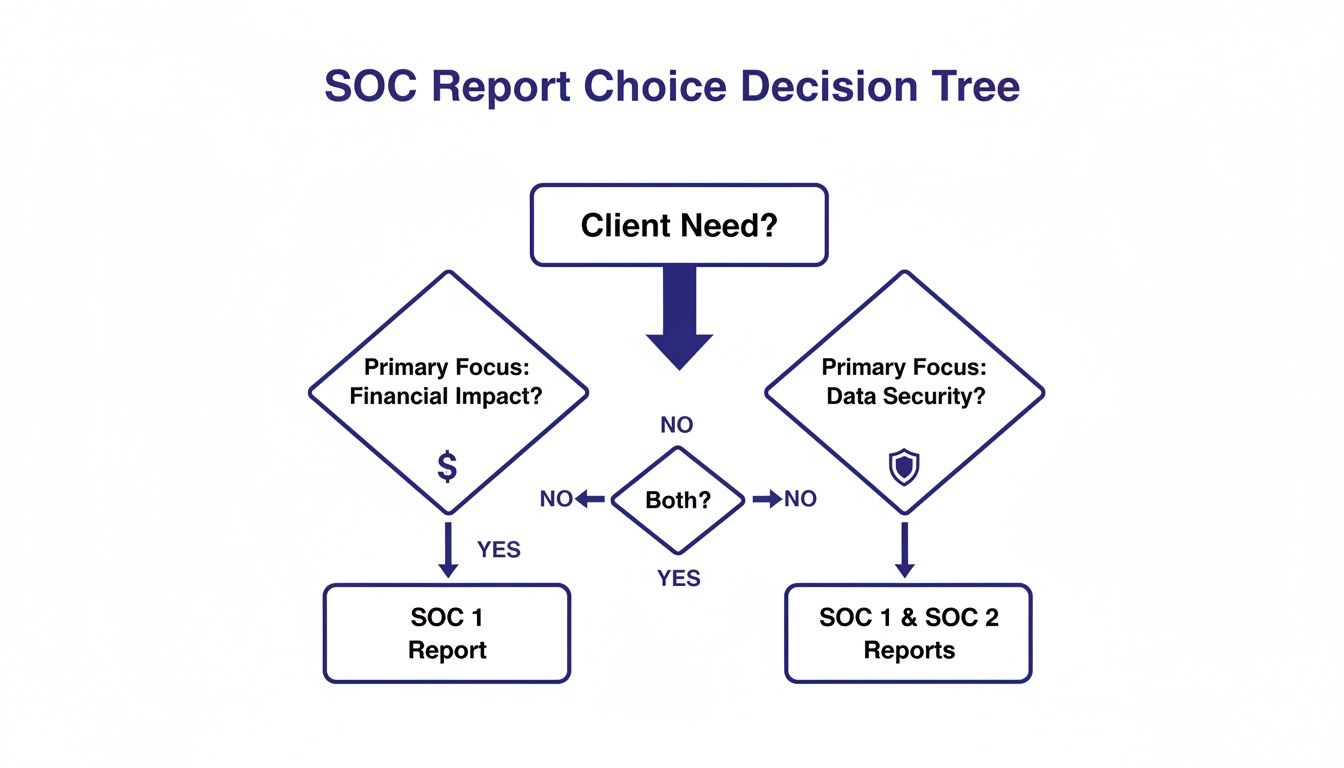
As you can see, the type of service you offer directly maps to the compliance report your clients will expect.
Your choice isn't about which report is "better"—it's about which report speaks the right language to the right audience. A SOC 1 speaks to financial auditors, while a SOC 2 speaks to security and compliance teams.
Market trends really drive this home. Industry analysis shows that around 60% of Fortune 500 companies now require SOC 2 Type II reports from their cloud and SaaS vendors, a huge jump fueled by cybersecurity worries. In comparison, SOC 1 reports are typically only requested by 20-25% of clients, mostly in the financial services world where SOX compliance is a major driver.
It’s actually pretty common for a service organization to need both a SOC 1 and a SOC 2 report. This usually happens when a company’s service has a foot in both worlds—impacting a client's financial reporting and their operational data security.
For example, a FinTech platform that automates customer billing (a financial function) while also storing sensitive customer data analytics (a security concern) would need both. The SOC 1 would satisfy the client's financial auditors, while the SOC 2 would give their security and IT teams the assurance they need.
Sorting out these overlapping requirements is a huge part of building a strong compliance program. Expert compliance management solutions can help clarify the most efficient path forward.
By thinking through your services with these questions in mind, you can confidently choose the report that fits your business model and meets your clients' specific demands. That’s how you turn compliance from an obligation into a real competitive advantage.
Once you get past the basic definitions, the practical questions start popping up. How much does this cost? How long does it take? And how does a SOC report fit in with other regulations like GDPR or HIPAA?
Let's dig into some of the most common questions we hear from businesses navigating the world of SOC compliance.
Yes, and it’s happening more and more. A company typically needs both reports when its services impact a client’s financial operations and their data security. This isn't about redundancy; each report serves a completely different audience and purpose.
Think about a FinTech company that provides a revenue management platform. Their service directly touches how clients process billing and collections, so it has a clear impact on their financial statements. Because of this, the clients' financial auditors will need a SOC 1 report to verify the platform’s internal controls over financial reporting (ICFR).
At the same time, that platform is storing sensitive customer data, sales figures, and maybe even intellectual property. To give security-conscious clients peace of mind, the company also needs a SOC 2 report. This assures customers that their confidential data is secure, available, and protected from unauthorized eyes. Getting both reports shows a mature, comprehensive control environment that addresses every major client concern.
Generally speaking, a SOC 2 report is more expensive and time-consuming. The biggest cost drivers for any SOC audit are the scope of the engagement and the complexity of the controls being tested. A SOC 2 audit almost always involves a larger number of controls, especially when multiple Trust Services Criteria (TSCs) are included.
The Security criterion alone can cover dozens of controls related to cybersecurity, incident response, and access management—all of which require extensive evidence gathering. While a complex SOC 1 Type II can certainly be a significant investment, a SOC 2 audit covering Security, Availability, and Confidentiality will almost always carry a higher price tag.
For both SOC 1 and SOC 2, a Type I report is always significantly cheaper than a Type II. This is because it only assesses the design of controls at a single point in time, whereas a Type II tests their operational effectiveness over a period of 6 to 12 months.
No, and this is a critical distinction. A SOC 2 report doesn't automatically make you compliant with legal frameworks like the General Data Protection Regulation (GDPR) or the Health Insurance Portability and Accountability Act (HIPAA). Those are laws with their own specific, prescriptive requirements.
However, a SOC 2 report is an incredibly powerful tool for demonstrating that you have the technical and organizational safeguards required by those laws. There’s a huge amount of overlap. The controls tested in a SOC 2 audit—especially under the Security, Privacy, and Confidentiality criteria—align directly with the safeguards mandated by GDPR and the HIPAA Security Rule.
Here are a few examples of that alignment:
Many companies will pursue a SOC 2 report that specifically includes the Privacy TSC or even a "SOC 2 + HIPAA" report to create a clear map between their controls and these regulatory demands.
The difference between a Type I and a Type II report boils down to timing and the level of assurance it provides. This distinction is crucial for both SOC 1 and SOC 2 audits. It’s the difference between saying you have a good plan and proving your plan actually works day in and day out.
A Type I report is a "point-in-time" assessment. The auditor evaluates your controls on a specific date to confirm they are suitably designed. It essentially answers the question: "Do you have the right controls in place on paper?"
A Type II report goes much further. It tests the operational effectiveness of those same controls over a period of time, usually six to twelve months. It confirms that the controls are not only designed correctly but have been functioning as intended, consistently. Because it provides a much higher level of assurance, a Type II report is the gold standard that most clients and their auditors expect to see.
Navigating compliance can be complex, but with the right partner, it doesn't have to be. Cloudvara provides secure and reliable cloud hosting solutions that help you build a strong foundation for your SOC compliance journey, ensuring your critical applications are protected and always available. Discover how our dedicated support and robust infrastructure can simplify your IT and compliance needs at https://cloudvara.com.