
For modern accounting professionals, cybersecurity isn't just an IT problem—it's a fundamental part of the job. Think of your firm as a digital vault. But instead of cash, you're protecting something far more valuable: your clients' financial data. A data breach is today's version of a bank heist, and it can shatter the trust you’ve spent years building in an instant.

The intersection of cybersecurity and accounting is no longer a niche concern. It’s the new standard for professional responsibility. Why? Because accounting firms are prime targets for cybercriminals. They are treasure troves of centralized, sensitive information—everything from tax records and financial statements to personally identifiable information (PII).
Attackers see accounting firms as a gateway. A single successful breach gives them the keys not just to the firm's assets, but to the sensitive data of its entire client base. That creates a devastating ripple effect, turning a technical issue into a core business risk with massive financial and reputational consequences.
In the past, security was often walled off in the IT department. Today, that mindset is dangerously outdated. A single security incident can bring your operations to a halt, trigger hefty regulatory fines, and destroy client confidence overnight. Integrating robust security measures is now non-negotiable for business continuity.
A proactive, well-documented approach to cybersecurity does more than just prevent attacks—it becomes a key differentiator. In a competitive market, proving that your firm handles client data with the highest level of care builds lasting trust and keeps clients loyal.
This proactive stance isn't just about technology; it demands a firm-wide culture of security awareness. Every team member who handles client data must understand their role in protecting it. For firms looking to build this culture, leaning on specialized IT support for accounting firms can provide the necessary expertise and guidance.
The duty to protect client information is deeply embedded in the accounting profession's ethical code. That responsibility now squarely extends into the digital realm, and regulators and clients are watching closely.
Failing to meet these expectations can lead to much more than lost business; it can result in legal liability and professional sanctions. Strong cybersecurity practices are a direct reflection of your firm's commitment to its ethical duties. This extends to how you manage client relationships, too. For instance, finding an efficient review collection for busy accountants is important, but that process must also be secured to protect the sensitive client information involved.

To really get a handle on cybersecurity in accounting, you first have to understand the specific attacks aimed directly at financial professionals. These aren't random, scattershot attempts; they are calculated schemes designed to exploit the daily workflows and trusted relationships that make the industry tick. Once you can recognize the attacker's playbook, your team can finally shift from a reactive to a proactive defense.
The threat environment has grown alarmingly hostile in recent years. Cyber attacks targeting accounting practices have skyrocketed, increasing by 300% since 2020. Business email compromise (BEC) has become the top driver of cybercrime-related losses, with one report noting over 87,400 incidents self-reported in a single year. That’s an average of one breach every six minutes in professional services, and accounting firms accounted for a staggering 13% of them.
Business Email Compromise (BEC) is arguably the most dangerous threat facing accounting firms today. It’s so effective because it bypasses technical defenses and preys on something much harder to patch: human trust. A BEC attack is a sophisticated form of phishing where a criminal impersonates a trusted figure—like a CEO, a key client, or a vendor—to trick an employee into sending money or sensitive data where it shouldn't go.
Imagine an accountant getting an email that looks like it’s from their managing partner. The message is urgent, marked "CONFIDENTIAL," and demands an immediate wire transfer to a new vendor to close a time-sensitive deal. The tone is convincing, the email signature looks right, and the pressure is on.
This is the classic BEC playbook. Attackers do their homework, researching your firm and its key people on social media to build a believable story. They’re not hacking your systems; they’re hacking your psychology.
A close cousin to BEC, invoice fraud zeros in on the accounts payable process. Here, cybercriminals either get into an employee's email account or quietly intercept communications between your firm and its vendors. They then find legitimate invoices and subtly change the bank account details before the invoice is sent to a client or paid by your firm.
What happens next is simple but devastating: the client pays what they believe is a valid invoice from you, but the money goes directly into the criminal's account.
These attacks can go unnoticed for weeks. The payment is made, the books appear balanced, and the fraud is only discovered when the real vendor follows up asking why their invoice is overdue.
The core danger of invoice fraud lies in its subtlety. A single altered digit in an account number on a PDF invoice can lead to the misdirection of tens or even hundreds of thousands of dollars, making vigilance in the accounts payable workflow a critical security control.
Modern ransomware has evolved far beyond simply locking your files. Today’s attacks are multi-stage extortion schemes. First, attackers breach your network and exfiltrate—or steal—huge volumes of sensitive client data. Only after they have a copy of your most valuable information do they deploy the ransomware to encrypt your systems, grinding your firm’s operations to a complete halt.
This creates a brutal, two-pronged threat:
For an accounting firm, this scenario is a complete nightmare. Restoring from backups is only part of the battle. You’re also facing a massive data breach, regulatory notification duties, and potentially catastrophic damage to your reputation. Knowing how to prevent ransomware attacks is no longer optional; it’s a foundational piece of a modern security strategy.
Protecting client data isn't just a good idea in the accounting world; it's a core professional and legal requirement. Think of it like a doctor’s oath to patient confidentiality. As an accountant, you have the same fundamental duty to protect the sensitive financial information clients trust you with. A failure to secure this data isn’t just a technical mistake—it's a compliance failure that can bring serious consequences.
This responsibility is written into multiple regulations that dictate how financial data must be handled, stored, and secured. These aren't just abstract legal ideas; they're strict rules with very real penalties. For any firm, understanding these duties is the first step toward building a cybersecurity defense that is both effective and compliant.
While the specific rules can change depending on your location and the kind of data you manage, several key frameworks set the standard for the industry. Ignoring them can lead to crippling fines, sanctions, and a total collapse of client trust.
These regulations shift cybersecurity from an internal IT decision to a public, legally binding duty. Proving you’re following the rules isn't just about dodging penalties; it's about showing that your firm is a trustworthy guardian of incredibly sensitive information.
Beyond the legal checkboxes lies a deeper, ethical responsibility. The accounting profession is built on a foundation of integrity and trust. When clients hand over the keys to their financial lives, they do so with the unspoken assumption that their information will be kept confidential and secure. A data breach shatters that trust in an instant.
In modern accounting, strong cybersecurity is the digital expression of your professional ethics. It's a tangible commitment to the principles of confidentiality and due care that define the entire profession.
Failing to put adequate security measures in place is a direct violation of this ethical contract. It exposes clients to the risk of financial fraud, identity theft, and immense personal stress. This is why investing in cybersecurity and accounting best practices is a direct investment in the ethical bedrock of your firm. It solidifies your reputation and tells clients that their trust is in the right hands. For organizations looking to prove their security controls, understanding what is SOC compliance provides a clear framework for demonstrating this commitment to clients and partners.
Holding this ethical high ground requires more than just installing a firewall. It means continuous education, vigilant monitoring, and building a firm-wide culture where every single person understands their role in protecting client data. Taking this proactive approach not only helps you meet regulatory demands but also cements your firm's position as a reliable and honorable partner in your clients' financial journey.

Now that you understand the threats knocking on your door and the responsibilities you carry, it’s time to build a secure foundation. For a long time, the go-to solution was an on-premise server humming away in a back office. The thinking was simple: physical possession equals better security. Today, that old model has become a major liability. It demands constant maintenance, manual updates, and a dedicated IT budget that most smaller firms just can’t justify.
Moving to a secure, managed cloud hosting environment is one of the smartest strategic moves a modern accounting firm can make. This isn't just about storing your data somewhere else. It’s about fundamentally upgrading your security by partnering with specialists who live and breathe digital protection.
Think of it this way: you’re moving your firm’s digital valuables from a simple safe in your office to a fortified, professionally guarded bank vault.
A specialized cloud host for accounting applications doesn’t just add security features; it builds them into the very fabric of the service. These protections work together as an integrated system, designed to shut down the exact threats we've been talking about.
Let's break down the "why" behind the most critical features.
1. Multi-Factor Authentication (MFA)
MFA is your digital bouncer. Even if a cybercriminal manages to steal a password—which is like getting a copy of your key—they still can't get past the front door without a second form of ID. This is usually a code sent to a trusted device, like your phone. This one simple layer is incredibly effective at stopping unauthorized access in its tracks.
2. End-to-End Encryption
Encryption is like sealing your data in an unbreakable code. From the moment information leaves your computer, while it’s traveling across the internet, and while it sits on the server, it’s scrambled into an unreadable format. This protects your data both in transit and at rest, making it completely useless to anyone who might intercept it without the right keys.
3. Automated Daily Backups
When a ransomware attack hits or a file gets corrupted, backups are your ultimate safety net. A managed cloud solution automates this entire process, creating a complete copy of your system every single day without you lifting a finger. What could be a catastrophe that takes weeks to fix becomes a manageable recovery process that often takes just a few hours.
The industry is clearly moving in this direction. The Cybersecurity in Accounting Systems market is expected to hit $8.2 billion by 2033, a huge leap from $3.6 billion in 2024. This growth is fueled by the widespread adoption of tools like MFA, which 83% of IT professionals now require for employee access, along with advanced encryption and routine security audits.
Understanding the shift in responsibility is key. Here's a look at what you manage with an in-house server versus what a specialized provider like Cloudvara handles for you.
| Security Feature | On-Premise Server (Firm's Responsibility) | Managed Cloud Hosting (Cloudvara's Responsibility) |
|---|---|---|
| Physical Security | Secure the server room, manage access, protect against theft/damage. | 24/7 monitoring, biometric access, redundant power in a secure data center. |
| Network Security | Configure and maintain firewalls, monitor for intrusions, manage patches. | Enterprise-grade firewalls, intrusion detection systems, proactive threat monitoring. |
| Data Backups | Purchase backup hardware/software, run backups manually, test restores. | Automated daily backups with multiple restore points, managed recovery. |
| Software Updates | Track and apply all security patches for OS and applications. | Managed patching and updates to ensure systems are never vulnerable. |
| Encryption | Implement and manage encryption for data both in transit and at rest. | End-to-end encryption is built-in and managed by default. |
| Access Controls | Set up and manage all user permissions and authentication methods. | Manages server-level access; provides tools for firm to set user permissions. |
| Disaster Recovery | Create and fund a separate disaster recovery site and plan. | Geographically redundant infrastructure ensures business continuity. |
As you can see, the managed cloud model doesn't just add security—it transfers the immense operational burden from your firm to a team of dedicated experts.
The biggest advantage of partnering with a specialized cloud hosting provider is offloading the enormous weight of security management. Instead of your team losing billable hours worrying about server patching, threat monitoring, and hardware failures, you hand those duties over to experts.
This strategic shift allows your firm to tap into enterprise-grade security—the kind typically reserved for massive corporations—without the enterprise-level cost or complexity. It frees up your team to do what they do best: high-value client work.
This proactive approach ensures your firm is always protected by the latest security protocols without you having to become a cybersecurity expert overnight. For firms ready to make the switch, it’s important to understand the practical steps involved. You can get a head start by checking out our guide on how to implement effective cloud security solutions in 2024. Adopting a managed cloud environment is the clearest path toward building a resilient firm that safeguards your data, your reputation, and your clients' trust.
Your firm’s technology is only as strong as the people who use it every day. Even the most advanced firewalls can be undone by a single, careless click. This is why building a culture of security awareness isn't just an IT initiative—it’s a core business function. Every person in your firm, from seasoned partners to new interns, has to become part of your human firewall.
Think of your team members as the frontline guards of your digital fortress. When you empower them with simple, non-technical security habits, you transform your weakest link into your strongest defense. These practices don't require deep technical knowledge, just consistent vigilance and a healthy dose of skepticism.
Phishing remains one of the most successful attacks because it targets human psychology, not just software. Cybercriminals craft emails that create a sense of urgency, authority, or curiosity to trick someone into clicking a malicious link or opening a dangerous attachment. Training your team to spot these attempts is a fundamental part of mixing cybersecurity and accounting.
Here is a simple checklist every team member should run through before acting on any email:
megabank_support@yahoo.com is a major red flag.Beyond email vigilance, a few other daily habits can dramatically improve your firm’s security. These practices are easy to adopt and make a huge difference in protecting both firm and client data.
A password manager is non-negotiable in the modern accounting firm. It eliminates the dangerous habit of reusing weak passwords by generating and storing unique, complex credentials for every single account, all secured behind one strong master password.
Working remotely or on the go also brings unique risks. Using public Wi-Fi at a coffee shop or airport for client work is an open invitation for trouble. These networks are often unsecured, allowing attackers to easily intercept any data you send or receive. Stick to a secure connection, like a firm-provided VPN or a mobile hotspot.
To protect sensitive client information and uphold professional integrity, accounting professionals must adopt essential security habits, including learning how to encrypt your phone calls.
Finally, it's time to end the risky practice of sending sensitive financial documents as email attachments. Email is not a secure way to transfer files; messages can be intercepted, and attachments can be downloaded by anyone who gains access to the recipient's inbox.
The vastly superior alternative is a secure client portal.
By making these simple but powerful habits standard operating procedure, every team member contributes directly to the firm's security. This collective effort builds a resilient defense that technology alone can never achieve, safeguarding your data, your clients, and your reputation.
Even with the best defenses, a security incident is always possible. When a breach hits, panic is the enemy. The real test isn’t just your preventative measures—it’s how you react in the moments that follow. That’s why having a pre-planned strategy isn’t a luxury; it’s a necessity.
Think of an Incident Response Plan (IRP) as your firm's fire drill. You don’t wait until you see smoke to figure out where the exits are. An IRP is a step-by-step guide that kicks in the second a security alarm goes off, turning chaos into a controlled, methodical process.
The financial stakes are staggering. The global cost of cybercrime is projected to hit $10.5 trillion annually by 2025, with the average data breach now costing a record $4.88 million. For accounting firms, these aren’t just abstract stats—they represent massive operational and reputational risks, where one corrupted client file can trigger regulatory fines and shatter client trust.
A strong incident response playbook breaks the crisis down into manageable stages. Each phase has a clear goal: minimize the damage and get back to normal as quickly and safely as possible. Having a solid data breach response plan is what walks your team through these steps.
Containment: Your first priority is to stop the bleeding. This means isolating the affected systems from the rest of your network to keep the threat from spreading. It's like shutting the fire doors to keep the flames in one area.
Eradication: Once contained, the next step is to find the root cause of the breach and get it out of your environment for good. This might involve wiping malware, patching vulnerabilities, and resetting every compromised password.
Recovery: With the threat gone, you can finally start restoring operations. This is where your automated daily backups become your most valuable asset, turning what could have been a catastrophe into a manageable recovery.
How you communicate during and after a crisis is just as important as your technical fix. Your IRP must have crystal-clear protocols for who to notify, when, and how.
Transparency is the cornerstone of trust. A well-managed crisis, handled with clear and honest communication, can preserve—and sometimes even strengthen—client relationships. Hiding a breach only makes the inevitable discovery far more damaging.
Your plan needs to spell out who contacts internal teams, who contacts clients, and who handles regulatory bodies. A calm, professional, and transparent approach shows everyone you are in control, even when things go wrong.
Of course, preventing incidents in the first place is the best strategy. That comes down to building good security habits across your entire team.
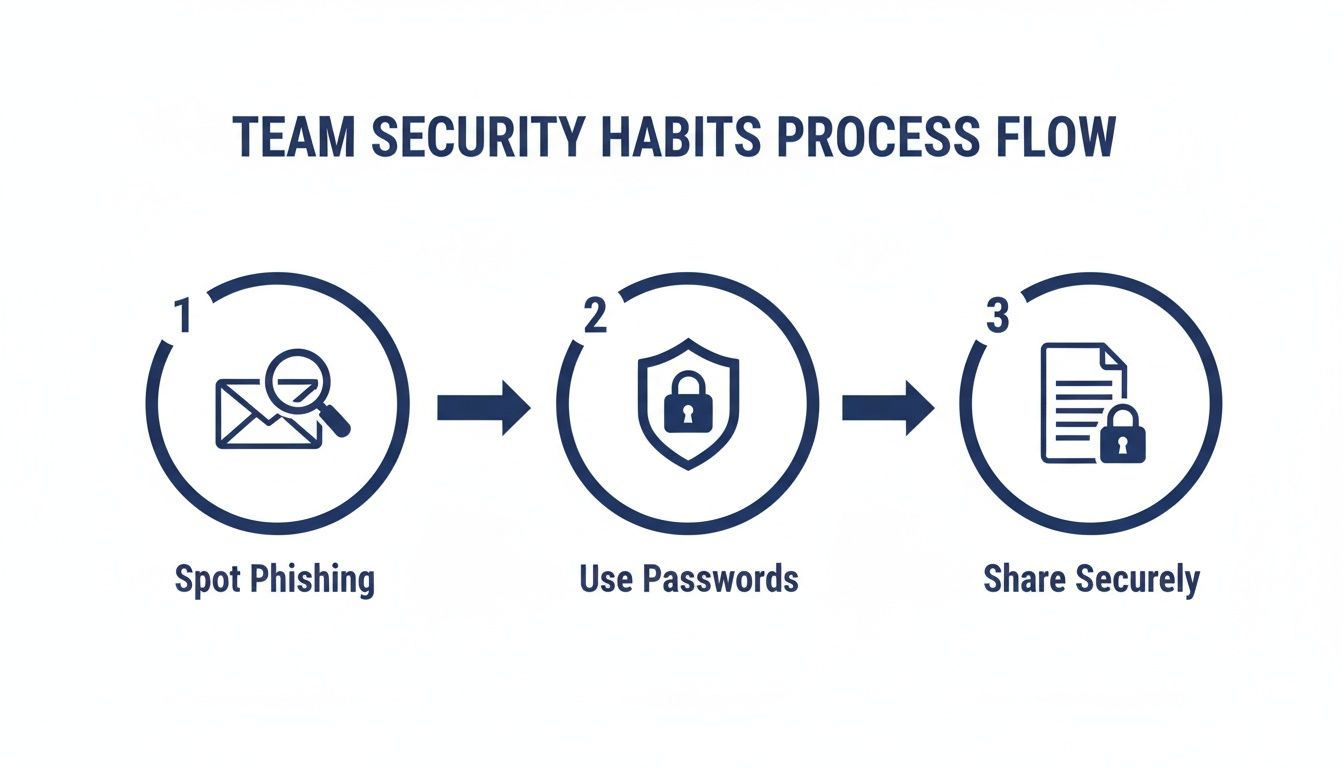
This process highlights the foundational pillars of a strong human firewall: teaching your team to spot phishing attempts, enforce strong password policies, and share sensitive files securely.
Many accounting professionals have practical questions about putting better security into practice. We’ve gathered a few of the most common ones to give you clear advice on applying these principles to your firm.
This is a familiar concern, but the answer is simpler than you might think. For smaller firms, building an in-house system with enterprise-level security is often financially out of reach. The cost of hardware, software licenses, and the specialized IT staff needed to manage it all can be staggering.
Managed cloud hosting completely flips this model on its head. Instead of a massive upfront investment, you pay a predictable monthly fee. This approach lets you tap into the provider's huge investment in infrastructure and expertise, giving you access to top-tier protection for a fraction of the cost. It’s all about gaining superior protection by sharing the expense.
While popular applications like QuickBooks Online have strong built-in security, that’s only one piece of the puzzle. The software itself might be secure, but that doesn't account for the devices and networks your team uses to access it.
Think of it like having a high-security lock on a bank vault door (your software) but leaving the windows and back entrances wide open. If an employee's computer is compromised with malware or they log in through an unsecured public Wi-Fi, attackers can simply walk around the software’s defenses. A secure hosting environment closes these critical gaps by protecting the entire ecosystem, not just the application itself.
Without a doubt, the most impactful security measure you can implement right away is Multi-Factor Authentication (MFA). MFA acts as a powerful second line of defense that stops attackers in their tracks, even if they manage to steal a user’s password.
By requiring a second verification step—typically a code sent to a trusted device like a smartphone—MFA effectively blocks 99.9% of automated cyberattacks. It is the single most effective way to prevent unauthorized account access.
Turning on MFA across all your critical systems and applications is a simple, low-cost action that delivers an enormous boost to your firm's security.
Ready to secure your firm's future? Cloudvara provides all-in-one cloud hosting that centralizes your applications on a secure, reliable platform. Reduce IT costs, ensure business continuity, and gain peace of mind with 24×7 support. Learn more about Cloudvara and start your free 15-day trial today.