
For years, running your own IT was like trying to power your office by building a private generator in the back room. It was expensive, clunky, and demanded constant attention. You had to buy, manage, and eventually replace bulky servers—a process that drained both your budget and your focus.
The cloud is like plugging into the national power grid. You get powerful, reliable resources on demand without the headache of maintaining the infrastructure yourself. This isn't just a tech upgrade; it’s a strategic shift that levels the playing field, allowing small businesses to operate with the muscle of their largest competitors.
Cloud computing gives you a ticket to the big leagues. It offers the same powerful software, robust security, and high-performance infrastructure that were once reserved for massive corporations. But instead of a huge upfront investment, you pay a predictable monthly fee. This means your technology can grow with you, not ahead of you.
This shift has a real, measurable impact. Small and medium-sized businesses (SMBs) using cloud services have posted 21% higher profits and seen 26% faster growth than those sticking with traditional IT. The numbers don't lie.
The infographic below neatly summarizes the core advantages we're about to dive into.
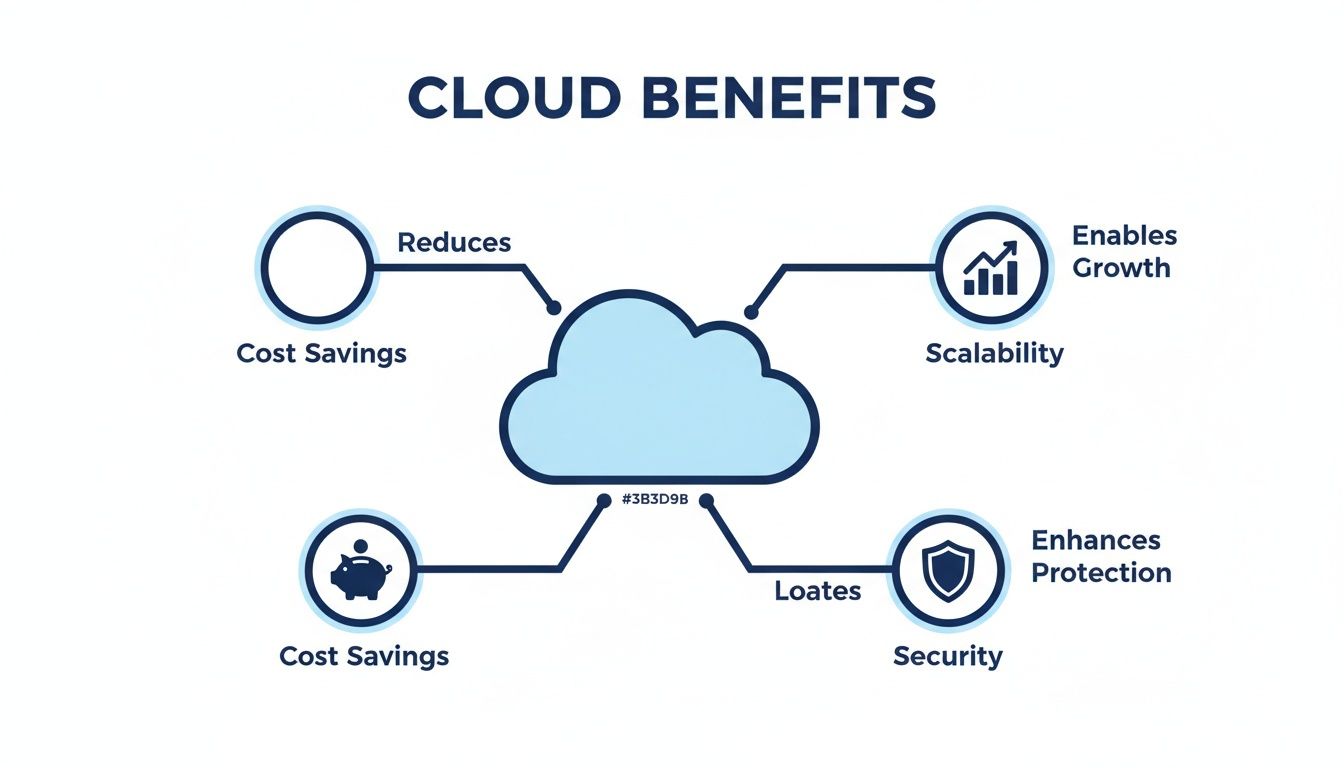
As you can see, it all boils down to saving money, paving the way for growth, and locking down your data. These three pillars form the foundation of the cloud's value to any small enterprise.
The real power of the cloud is turning IT from a capital-intensive cost center into a lean, operational expense that directly fuels your agility and innovation.
To give you a quick overview, the table below highlights the key benefits we'll cover in detail in the following sections. Think of these as the building blocks for a more modern, efficient, and resilient business.
| Benefit | Impact on Your Business |
|---|---|
| Cost Savings | Swap large, unpredictable capital expenses (CapEx) for a steady, manageable operational expense (OpEx). |
| Scalability & Performance | Instantly add or remove resources to match demand, all without touching a single piece of hardware. |
| Security & Compliance | Get enterprise-level security and make it far easier to adhere to industry rules like HIPAA or GDPR. |
| Collaboration | Centralize your apps and data so your team can work together seamlessly from any device, anywhere. |
| Business Continuity | Keep your data safe with automated backups and disaster recovery plans that actually work when you need them. |
Each of these points represents a significant opportunity to strengthen your operations. Our guide on https://cloudvara.com/small-business-cloud-solutions/ can help you apply them directly to your business. And for those ready to make the move, this practical guide on how to migrate to the cloud provides a clear roadmap for a smooth transition.
For decades, the playbook for business technology was simple but painfully expensive. If your business grew, you bought a new server. This locked small businesses into a cycle of large, upfront investments called Capital Expenditures (CapEx). It’s like buying a company car outright—you face a huge initial cost, and the asset starts losing value the second you own it.
This old model created a massive barrier to entry. Growing businesses had to sink thousands of dollars into hardware that would be obsolete in just a few years. And the sticker price was just the beginning. Hidden costs for maintenance, software licenses, and the electricity to run it all piled up, often forcing companies to delay critical IT upgrades and holding back growth.

Cloud computing completely flips this script. It introduces a much more flexible financial model based on Operational Expenditures (OpEx). Instead of buying the car, you're essentially leasing it, paying a predictable monthly fee for the exact resources you need, right when you need them.
This pay-as-you-go structure is a game-changer, turning IT from a capital-intensive burden into a manageable operating cost. With no massive hardware purchases on the horizon, you can redirect that cash toward what really matters—marketing, product development, or hiring new talent. One study found that companies moving to the cloud can slash their total IT costs by as much as 40%.
The financial perks of the cloud go far beyond just dodging the cost of a new server. The savings add up across several key areas, creating a leaner and more efficient budget.
Here’s a breakdown of where you’ll feel the biggest impact:
By adopting the cloud, small businesses are not just cutting costs; they are acquiring financial agility. This allows them to invest strategically and respond to market changes without being anchored by expensive, depreciating hardware.
The pay-as-you-go model is perhaps the most empowering part of this financial shift. Think of it like your utility bill—you only pay for what you actually use. If your business has a seasonal rush, you can instantly scale up your resources to meet demand. Once things quiet down, you can scale back down just as easily, guaranteeing you never waste money on idle capacity.
This level of control gives you complete budget transparency. You can track your spending precisely and make data-driven decisions about where to allocate resources. For any business managing tight margins, this predictability is invaluable.
Of course, getting the most out of this model means implementing smart strategies. You can learn more about how to refine your spending with our detailed guide on cloud cost optimization. By actively managing your cloud usage, you ensure every dollar spent on technology directly fuels your business goals.
What happens when your small business suddenly takes off? A marketing campaign goes viral, a new product flies off the shelves, or a seasonal rush triples your website traffic overnight. With traditional IT, this kind of success can quickly become a crippling problem. You’re stuck with the hardware you bought, and it just can't keep up.
Imagine a small accounting firm buying massive servers just to handle the chaos of tax season. For nine months of the year, that expensive equipment sits mostly idle, consuming power and gathering dust. This feast-or-famine cycle is wildly inefficient and costly, turning potential growth into an operational nightmare.
The cloud completely erases this limitation by introducing two powerful concepts: scalability and elasticity. Getting a handle on these ideas is key to understanding one of the biggest advantages the cloud offers a small business.
Scalability is your ability to add more resources to handle a bigger workload. Think of it like adding more lanes to a highway as rush hour approaches. Instead of a multi-week process to order and install a new server, the cloud lets you add more computing power, storage, or memory with just a few clicks.
Elasticity is the other side of that coin—it’s the ability to scale your resources down when demand subsides. After the tax deadline passes, the accounting firm’s cloud system can automatically shrink back to its normal size, ensuring they aren’t paying for capacity they no longer need. This agility transforms your IT from a barrier into a direct enabler of growth.
This capability is a game-changer for small businesses trying to seize opportunities without hesitation.
The cloud’s on-demand nature means you only pay for what you use, when you use it. This gives small businesses the firepower to compete with larger enterprises without being burdened by the same immense infrastructure costs.
This newfound agility has a direct impact on the bottom line. It’s no surprise that a remarkable 89% of companies report improvements in scalability after adopting the cloud. For small and mid-sized businesses, this translates into tangible results, as those on the cloud achieve 26% faster growth rates and see profit growth jump by 11.2% per year once they move a significant portion of their work.
This ability to scale isn't just a technical feature; it's a strategic advantage. It allows a law firm to quickly expand its document storage during a big case, or a nonprofit to manage a surge in online donations during a fundraising event. In each case, the business can respond instantly to demand, maximizing its potential without getting locked into long-term costs.
For a deeper dive into the mechanics, our detailed guide explains what cloud scalability is and how you can apply it to your specific business needs. This flexibility ensures your technology is always perfectly aligned with your business goals, never holding you back.
For many small business owners, the idea of managing data security is a constant headache. You're busy running your company, but the nonstop news about cyberattacks, data breaches, and ever-changing regulations adds a ton of pressure. It’s easy to think that keeping data on a server tucked away in your office is the safest bet.
In reality, that’s like storing your company’s life savings in a small office safe instead of a fortified bank vault.
Cloud computing gives your small business access to that bank vault. Leading providers like Amazon Web Services (AWS), Google Cloud, and Microsoft Azure pour billions of dollars into their security infrastructure every year. It’s a level of investment and expertise that’s simply impossible for a small or medium-sized business to match on its own.

When you move to the cloud, you're essentially handing over a huge chunk of your security responsibilities to a global team of experts who live and breathe this stuff. Their entire business model depends on keeping your data safe, and they use incredibly sophisticated measures to do it around the clock.
This isn't just about a firewall. It's a multi-layered defense designed to stop threats before they ever reach your business. For any small business looking to step up its defenses, learning more about small business cloud security is the first move toward building a truly resilient operation.
Key security features you gain almost immediately include:
The real security benefit of the cloud is moving from a reactive, underfunded security approach to a proactive, professionally managed one.
Meeting industry regulations like HIPAA for healthcare, GDPR for data privacy, or FINRA for financial services can feel like a full-time job. These standards demand specific controls, audit trails, and data protocols that are incredibly difficult and expensive to set up and maintain yourself.
Cloud providers take most of this burden off your shoulders. They offer infrastructure that is already certified to meet these strict requirements. Better yet, they provide the tools and paperwork you need to prove your compliance, saving you a world of time and legal risk.
Think about a law firm handling sensitive client files. By using a HIPAA-compliant cloud environment, they can securely store case information, protecting both their clients and the firm from huge legal and financial penalties. Likewise, an accounting firm can ensure its financial data storage meets industry standards without having to become compliance experts.
This simplified path to getting and staying compliant is one of the most powerful—and often overlooked—perks of the cloud.
When you’re juggling a flexible work environment, keeping your team connected and on the same page is everything. Traditional methods just don’t cut it anymore—they often lead to messy, disconnected workflows that create more problems than they solve. Have you ever had your sales team save different versions of a client spreadsheet on their local drives? It’s a classic recipe for confusion and costly errors. That's a perfect example of data silos, where critical information gets trapped on individual devices instead of being shared.
Cloud computing demolishes those barriers. It turns collaboration from a daily headache into a genuine business strength. By bringing your key applications and data into one central place, the cloud creates a single, unified workspace that everyone can access from anywhere, at any time.
The real magic of cloud collaboration goes way beyond simple file sharing. It’s about hosting your essential business software—like QuickBooks, your CRM, or project management tools—in a centralized environment where everyone works from the same playbook.
This means your entire team, whether they're in the office, at home, or visiting a client, is plugged into the exact same real-time information.
This unified approach locks in operational consistency and gives productivity a serious boost. And when you need to keep in touch with clients or team members on the go, integrating online text messaging services can make your business even more responsive and accessible.
This shift toward a central hub for data and applications delivers real, measurable improvements. For small businesses, the cloud ramps up operational efficiency and makes remote work truly effective, creating teams that are more nimble and productive. With 63% of SMB workloads and 62% of data already in the cloud, it's clear the shift is well underway. It’s no surprise that SMBs plan to allocate over 50% of their tech budgets to the cloud in 2025. You can dig into more insights on SMB cloud adoption from Spacelift.
By centralizing applications and data, the cloud ensures that every team member is working with the same information, at the same time. This simple shift eliminates friction, prevents mistakes, and empowers your team to work together more effectively, no matter where they are located.
This cohesive environment directly translates into a stronger, more agile business. It breaks down the walls between departments, encourages teamwork, and makes sure everyone is pulling in the same direction with the most current and accurate information available.

Let's imagine the unthinkable for a moment: your office server crashes, gets stolen, or is destroyed in a fire. If your only backup is an external hard drive sitting right next to it, you've just lost everything. For a small business, that’s not just an inconvenience—it's often a catastrophic event you can't recover from.
This is where one of the most vital benefits of cloud computing for small businesses shines: true business continuity. The cloud takes data backup from a manual, error-prone chore and turns it into an automated, reliable safety net. It fundamentally works by moving your critical data off-site, making it immune to local disasters.
Relying on physical backups is like keeping your company's life savings under a mattress. Cloud-based recovery is like having that money insured and stored in multiple secure bank vaults across the country.
Traditional backup methods depend on someone remembering to plug in a drive, run the software, and then take the backup to a safe, off-site location. That process is riddled with potential human error. Just one forgotten backup could mean losing weeks or even months of irreplaceable work.
Cloud systems eliminate this risk. They work silently in the background, automatically creating copies of your files and applications at regular intervals, day or night. This shift delivers more than just convenience; it provides genuine peace of mind. To ensure your systems are always protected, it's worth learning how to automate backups for maximum reliability.
This automated approach gives you several key advantages:
A study found that a staggering 93% of companies that suffer a major data disaster without a recovery plan are out of business within one year. The cloud provides an affordable and effective disaster recovery plan for businesses of any size.
Consider a small law firm whose main office server suffers a complete hardware failure. All their case files, client emails, and billing information are suddenly gone.
In a traditional setup, they'd be facing days—or even weeks—of downtime. They would need to buy a new server, reinstall all their software from scratch, and then cross their fingers that their latest manual backup was recent and not corrupted.
With a cloud-based backup and recovery system, the story is entirely different. The firm's IT partner can quickly spin up a virtual version of their old server in the cloud. Within hours, the team can log in from any computer and securely access all their files and applications, exactly as they were before the crash.
This rapid recovery doesn't just save time—it protects the firm’s revenue, helps them meet client deadlines, and preserves their professional reputation.
Thinking about moving your business to the cloud but still have a few questions? You’re not the only one. Many business owners are curious about what the transition actually looks like and what it means for their day-to-day operations.
Let’s tackle the big ones—from what it really costs and how your data gets moved, to who’s ultimately responsible for keeping it safe. Getting clear, straightforward answers will help you make a smart, confident decision for your company.
Cost is always at the top of the list. Unlike buying a server, which hits you with a massive upfront bill, cloud services work on a subscription model. This instantly turns a huge capital expense into a predictable, manageable operational cost.
Your final price tag will depend on a few key things:
A good provider gives you transparent, per-user pricing. You’ll know exactly what to expect on your bill each month, which makes budgeting a whole lot easier. No more surprise costs.
The thought of moving years of critical business files can definitely feel intimidating. The good news is, a specialized cloud provider handles the entire migration for you. The whole process is planned out to cause as little disruption as possible—most of the work happens quietly in the background.
Think of it like hiring a professional moving company for your office. Instead of you packing every box and hauling every desk, they handle all the heavy lifting. A dedicated team manages the transfer of your applications and data, making sure everything is set up and tested before you and your team go live.
The goal is a seamless switch. One day you’re working the old way, and the next, you’re logged into your new, faster cloud environment without missing a beat.
This is a huge one, and the answer is a partnership. It’s what the industry calls a shared responsibility model.
The cloud provider takes care of securing the physical infrastructure—the massive data centers, powerful servers, and complex networks. They spend billions on security measures that would be impossible for a small business to afford on its own.
Your role is to manage who has access. That means using strong passwords, turning on two-factor authentication (2FA), and making sure only the right employees can get into sensitive files. This combination of enterprise-grade security from the provider and smart access controls from you creates an incredibly secure environment for your business.
At Cloudvara, we make the transition to the cloud simple and secure, handling everything from migration to ongoing support so you can focus on running your business. Learn more about our tailored cloud hosting solutions at https://cloudvara.com.