An amended return usually takes up to 16 weeks to process, and you typically won't see anything in the IRS tracking system until about 3 weeks after submission. If you're checking every few days and seeing nothing yet, that doesn't automatically mean anything is wrong.
That waiting period is often a sticking point. You filed Form 1040-X because something needed to be corrected, maybe a missed form, a filing-status issue, or a schedule that changed the tax result. Then the original urgency is replaced by silence. Clients start asking whether the IRS received it. Individual filers wonder whether they used the right tool. Staff members in tax firms waste time checking the wrong system or calling too early.
The practical answer to “Where's my amended tax return?” is usually less dramatic than people think. Most of the work is expectation management, careful status checking, and avoiding the filing mistakes that create preventable delays in the first place.
A familiar situation plays out every filing season. An individual taxpayer finds a missed form after filing, or a firm discovers that a client's original return included the wrong filing status, omitted income, or left out a credit schedule. Form 1040-X goes in, the confirmation is saved, and then the silence starts.
That silence is normal.
Amended returns do not move through the IRS the way an original e-filed refund claim does. The practical mistake is treating the amendment like a standard refund check and expecting quick movement. That expectation creates unnecessary calls, duplicate status checks, and, in some cases, duplicate filings that only slow things down further.
The first job after filing is record control. Keep a copy of the signed Form 1040-X, the full amended return package, and proof of mailing or electronic submission. For individual filers, that means keeping the filing record somewhere easy to retrieve. For firms, it means putting the amendment into a documented follow-up process with a tickler date for the first status check and a note showing exactly what changed on the return.
I tell clients and new staff the same thing. Do not treat a lack of early updates as evidence of a problem. In the first part of the waiting period, the better use of time is confirming that the submission record is complete, the taxpayer address matches the filed return, and any supporting schedules or forms were included the first time.
This is also where professional workflow makes a real difference. A solo filer may only need a folder and a calendar reminder. A tax practice handling multiple amendments needs a repeatable process for intake, filing proof, client communication, and follow-up. Firms that want tighter control over amended-return status and client handoffs usually benefit from a standardized tax firm workflow system.
One common pitfall is checking the wrong IRS channel. Another is calling before the return has had time to post to the IRS system. A third is losing track of what was amended, which makes it harder to answer client questions later if the IRS sends a notice.
Good expectation-setting solves much of this. Tell the taxpayer or client what was corrected, what documents should be retained, and when it makes sense to start checking status. That keeps the waiting period organized instead of stressful.
A common client call goes like this: the amended return was filed, weeks have passed, and they typed “where's my amended tax” into a search bar expecting the standard refund tool to answer the question. It will not. For a federal amended individual return, the correct tool is Where's My Amended Return, or WMAR.
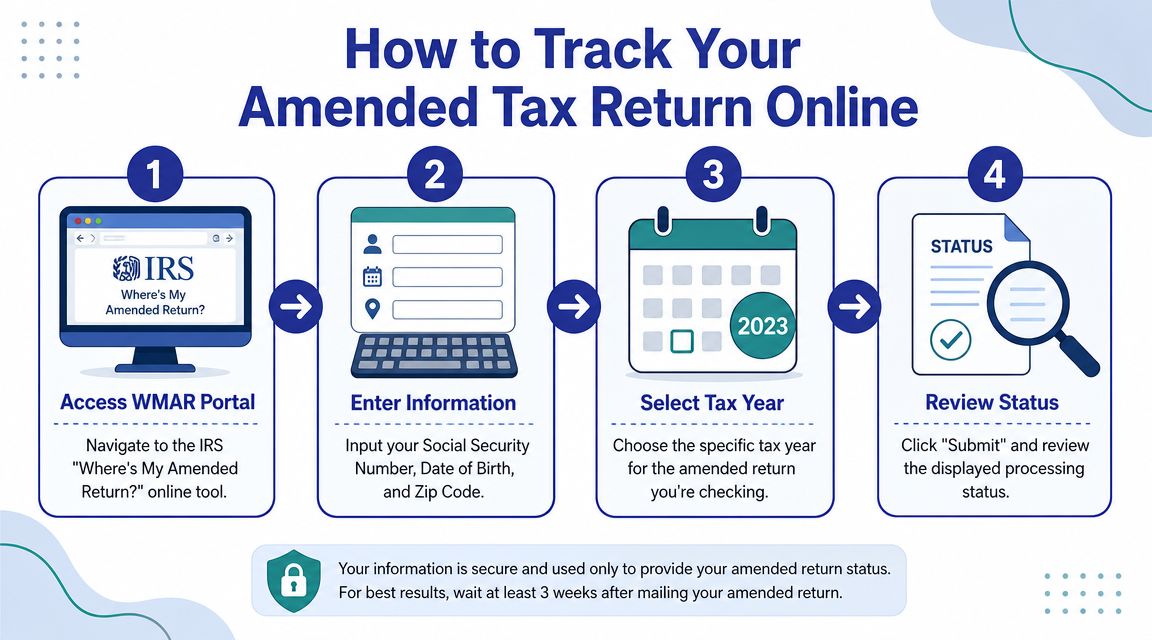
Have the taxpayer identifiers exactly as they appear in the filed record. WMAR generally covers the current tax year and several prior years, but failed lookups usually come from mismatched entry data, not from a system problem.
For a single filer, that means pulling out the filed copy before entering anything. For a practitioner, it means checking the client file instead of relying on intake notes or memory.
Use this quick file check:
Social Security number
Enter the taxpayer's number exactly as shown on the amended return record.
Date of birth
Use the date in the tax file. A simple transposition will stop the lookup.
ZIP code
Enter the ZIP code tied to the IRS record for that filing. This is a frequent problem after a move.
Correct tax year
Confirm the year that was amended. Firms with multiple open projects can easily pull up the wrong year if the workpapers are not labeled clearly.
Once the tool finds the return, the status is usually shown in one of three plain-language stages:
| WMAR status | What it generally means |
|---|---|
| Received | The IRS has the amended return in its system. |
| Adjusted | The IRS has updated the taxpayer's account. |
| Completed | The IRS finished processing the amendment. |
The practical point is knowing what the tool does not tell you. WMAR gives a processing stage. It does not give a full explanation of every internal review step, every notice in transit, or every reason a file is taking longer than expected.
“Received” often lasts the longest. That alone does not indicate an error.
Individual filers should check carefully and sparingly. Keep the filed Form 1040-X nearby, enter the identifiers exactly, and save a screenshot or note of the status so you are not relying on memory later.
For tax professionals, WMAR works best as part of a file management process. Record the filing date, tax year, amendment issue, first check date, and each later status update in one place. If a client calls six weeks later, staff should be able to see whether the amendment is still at “Received,” whether the account was already adjusted, and whether any follow-up is needed. Offices that track amended returns in cloud-based tax software usually handle handoffs better because the return, notes, and reminders stay attached to the same client record.
One caution for practitioners. WMAR is a status tool, not a substitute for reviewing the actual amendment. If the client asks whether the refund amount changed, whether penalties were affected, or whether the IRS accepted every position taken on the 1040-X, the answer usually comes from the filed documents and later correspondence, not from the status screen alone.
Sometimes the online tool isn't enough. A client may want confirmation from a person, or the WMAR result may not answer the practical question they're asking. In those cases, the phone becomes the backup path.

Calling can help, but it's not magic. The biggest mistake is picking up the phone without the file in front of you. Whether you're a taxpayer or a preparer, you need to be ready to identify the return and discuss what changed.
Bring the documents that let you answer factual questions without guessing:
Original return copy
Keep the filed Form 1040 available so you can compare the amendment against the baseline return.
Amended return copy
Have the Form 1040-X in front of you, including the explanation section and any changed schedules.
Submission details
Keep your proof of filing, internal notes, and any IRS correspondence in the same file.
Representative authorization if applicable
If you're a practitioner, make sure your authorization is in place before expecting case-specific discussion.
The practical reason is simple. IRS conversations are more efficient when you can answer directly instead of putting the agent on hold while you search for the return.
Here's a helpful explainer if you want a general walkthrough before you call:
Phone support is most useful when the status tool doesn't match the facts you have in your file, or when a mailed notice needs interpretation. It's less useful when someone wants a faster answer than the IRS has posted.
That distinction matters in practice. If the return is still moving through normal channels, a phone call often gives limited additional detail. If there's a mismatch, a notice, or a client who needs guided next steps, the call may be worth it.
For firms, build a repeatable support process around one owner per case. Random handoffs create confusion. Centralized tracking and a stable help routine, including access to technical support systems for tax operations, usually saves more time than repeated status-chasing.
Federal tracking is only part of the story. If a federal amendment changes income, deductions, credits, or filing status, there may also be a state amendment to file and monitor. Many taxpayers forget that the state won't automatically mirror the federal correction.
State tracking is less standardized than federal tracking. There isn't one universal portal like WMAR. Each state revenue department handles amended returns on its own terms, with its own status pages, login methods, and notice procedures.
Use a direct search pattern with the state name and the words “amended return status” or “department of revenue amended return.” Then confirm you're on the official state revenue site before entering taxpayer information.
A few examples make the point:
California
Search for California's franchise tax agency plus amended return status. California often uses different terminology than the IRS, so read the page carefully before assuming you're in the right place.
New York
New York's tax department generally organizes online services through taxpayer accounts. The amended-return path may sit inside a broader individual tax portal rather than a single public lookup page.
Texas
Texas doesn't impose personal state income tax, so an individual filer amending a federal Form 1040-X usually won't have a personal income tax amendment there. That's a useful reminder that state follow-up depends on the return type and the jurisdiction.
Don't assume “state amended return” means the same task in every state. It depends on the tax involved, the agency involved, and whether the federal change actually affects the state return.
For tax firms, the answer isn't memorizing every state portal. It's building a repeatable checklist by jurisdiction. Track the state filing requirement, the portal used, the account credentials or access method, and the person responsible for follow-up.
If your office already works across multiple systems, a hosted TaxWise tax software environment can make that coordination easier because staff can access the same return file and notes without relying on one local workstation.
A common call goes like this: the amended return was filed, the refund has not arrived, and the client wants to know whether the IRS lost it. Sometimes the answer is simple processing delay. Just as often, the return is sitting in manual review because something about the amendment requires a closer look.
Form 1040-X has a few repeat problem areas. Column A must match the return as originally filed. Column B should show only the net change. Column C should show the corrected amount after the change is applied. Part III also matters more than many filers expect. If the explanation is vague, incomplete, or disconnected from the changed lines, the reviewer has to stop and sort out what was intended.

Some delays are routine. Others are preventable.
The original return has not finished processing
Filing Form 1040-X before the IRS finishes with the original return can create mismatches in the account transcript and slow the amendment review.
The numbers do not reconcile across the three columns
I see this often with self-prepared amendments and rushed firm review. The tax result may be correct, but if the column presentation is off, the IRS may need to manually reconstruct the change.
Part III does not clearly explain the reason for the amendment
“Fixing income” or “correcting return” is not enough. A usable explanation names the item changed, the reason it changed, and which supporting form was updated.
Too much or too little support is attached
Sending unchanged schedules can bury the actual issue. Leaving out a revised form that supports the change creates a different problem.
The return triggers identity, income, or withholding verification
Certain changes naturally get more scrutiny, especially when the amendment changes refund amount, filing status, withholding, or reported income.
For an individual filer, start with the filing copy. Confirm that the amendment matches the original baseline, that the corrected figures flow through properly, and that every attachment relates to a changed item. If a notice has arrived, read the exact request before sending anything else. Sending duplicate material often adds confusion instead of speeding things up.
For tax professionals, use a tighter workflow. Review the amendment against the original return, the revised return, and the client support as three separate documents. That extra step takes a few minutes and prevents the common failure point where the math works but the story of the amendment does not.
A simple review table helps:
| Review point | What to confirm |
|---|---|
| Original baseline | Column A matches the originally filed return |
| Net change logic | Column B includes only the amount being changed |
| Corrected result | Column C agrees to the corrected return |
| Explanation quality | Part III states what changed and why |
| Support attached | Only revised forms and relevant support are included |
If the issue is documentation, send only what supports the changed item and keep a copy of exactly what was submitted. If the issue is poor internal coordination, centralize the file, the reviewer notes, and the status log. Firms that process amendments in volume usually get better results when staff work from one standardized file structure and shared return access, which is one reason some offices use UltraTax hosting for tax firms.
Client communication matters too. Amended returns tend to generate repeat calls because the timeline is less predictable than an original filing. Set expectations early. Tell the client what was changed, what proof supports it, when the case was filed, and what event would justify follow-up.
If signed statements or supporting records need to be resent, use a secure method. Many firms use online fax for secure tax forms when they need a documented transmission record without relying on standard email.
Clean amendments move faster. Messy amendments create questions, notices, and extra handling on both sides.
If you manage amended returns for clients, the challenge isn't just technical tax preparation. It's controlling the workflow around status checks, client communication, documentation, and escalation decisions.

The firms that handle amendments well usually do three things consistently.
Assign one staff member to own the amendment from filing through resolution. That person tracks submission, status checks, notices, and client updates. Without clear ownership, two people check the same return, nobody logs the result, and the client gets mixed messages.
For business filers, this matters even more because amended returns can affect bookkeeping, state compliance, and internal financial reporting. The tax return isn't the only moving part.
If you expect to communicate with the IRS on a client's behalf, get the proper authorization in place before the call becomes urgent. Then keep a single case file with the original return, the amended return, support for the change, filing proof, and every communication note.
One practical upgrade is secure document routing. If a client needs to send signed forms or supporting records quickly, a guide on online fax for secure tax forms is useful because it addresses a real tax-office problem without forcing clients into risky email habits.
Don't escalate a case just because a client is frustrated. Escalate when the file shows a real mismatch, missing notice, unresolved issue, or a status problem that doesn't line up with the return history.
Good amended-return service is usually quiet. The file is organized, the client knows what to expect, and every follow-up has a reason.
For accountants, that discipline separates useful advocacy from noise. It also protects staff time, which is often the scarcest resource in amendment season.
If your firm needs a more reliable way to keep tax software, client files, and staff access in one secure environment, Cloudvara provides cloud hosting built for accounting and tax workflows. It's a practical option when you want your team to work from the same systems, from any location, without piecing together local servers and inconsistent remote access.