System integration is the process of connecting different, separate software systems so they can operate together as a single, unified whole. It’s all about linking your various IT applications and databases, allowing them to share information and automate tasks without a hitch. This turns what were once isolated digital islands into a cohesive, well-oiled ecosystem.

Think of your business software as a talented orchestra. You have a powerful CRM for your sales team, a precise accounting program for finance, and an efficient inventory management tool for the warehouse. Each one is a master of its craft, but they're all playing from different sheet music. The result? Disjointed noise instead of a powerful symphony.
System integration is the conductor. It brings all these individual instruments together, making sure they play in perfect harmony. When your CRM updates a customer sale, integration automatically tells your inventory system to adjust stock levels and your accounting software to generate an invoice. No tedious manual data entry, no miscommunication—just a smooth, automated workflow.
At its core, the main purpose of system integration is to make separate pieces of software "talk" to each other. This breaks down data silos, which are frustrating pockets of information trapped within a single department or application. In short, system integration is all about streamlining business processes to boost efficiency and drive growth.
While it's related to connecting individual apps, the focus is broader—creating a cohesive IT infrastructure that works as one. You can dive deeper into the specifics of connecting software in our guide to what is application integration.
The demand for this kind of connectivity is exploding. The global system integration market was valued at around USD 461.36 billion and is expected to nearly double by 2033, a surge driven by the urgent need for automation and cloud services. This growth highlights a critical business reality:
A business is only as efficient as its ability to make its technology work together. Integration transforms a collection of tools into a strategic asset, providing a unified view of operations and customers.
To help break it down, here’s a quick look at the core ideas behind system integration.
| Concept | Simple Explanation | Business Goal |
|---|---|---|
| Data Silos | Information trapped in one system, invisible to others. | Break down barriers for a unified view of data. |
| APIs | "Messengers" that let different software applications talk. | Enable seamless communication between systems. |
| Middleware | A software layer that acts as a translator between systems. | Bridge gaps between applications with different "languages." |
| Automation | Triggering actions in one system based on an event in another. | Eliminate manual tasks and reduce human error. |
| Single Source of Truth | A central, trusted location for all critical business data. | Ensure everyone works with the same accurate information. |
By bringing these concepts together, businesses can create a single source of truth, make smarter decisions, improve productivity, and ultimately deliver a far superior customer experience.

Imagine your sales, marketing, and inventory teams are all firing on all cylinders—but in separate rooms, with the doors shut. Sales has no idea what marketing is promoting, and neither team has a clue what’s actually in stock. This isn't just a minor hiccup; it's a direct path to frustrating customers and leaving money on the table.
This all-too-common scenario gets to the heart of data silos—isolated islands of information that keep you from seeing the full picture of your business. When your systems can't talk to each other, your teams are left making decisions with incomplete, outdated data. The result? Guesswork, confusion, and costly mistakes.
One of the most immediate pains of disconnected systems is the endless cycle of manual data entry. Your people spend hours copying and pasting information from one app to another, a mind-numbing task that’s a massive drain on productivity. It’s no surprise that some analyses show businesses lose up to 30% of their revenue each year simply due to inefficient processes.
This manual grind isn't just slow; it's a breeding ground for human error. A single typo in an address, an incorrect product number, or a misplaced decimal on an invoice can snowball into shipping delays, billing disputes, and seriously damaged customer trust. To learn more about sidestepping these issues, check out our guide on how to improve workflow efficiency.
Disconnected systems force your team to work harder, not smarter. System integration flips this script by creating a single source of truth, where accurate, up-to-date information is available to everyone, everywhere, instantly.
Let’s make this real. A retail company integrates its e-commerce site with its inventory management system. Now, when a customer places an order online, the stock levels update automatically, in real-time.
This simple connection solves the classic problem of selling out-of-stock items, giving customer satisfaction an immediate boost. But the benefits don’t stop there:
By linking these crucial functions, the business gains a seamless, end-to-end view of both its operations and the customer’s journey. This isn’t just a technical fix; it’s a powerful business strategy that gives you a serious competitive edge. Without integration, you're not just managing separate systems—you're running separate, disconnected businesses under one roof.
Once you realize your systems need to talk to each other, the next big question is how. Different business needs call for different blueprints, or architectures. Getting this choice right from the start is crucial—it saves you from a world of headaches and costly reworks down the road.
Think of it like planning a city's road network. You wouldn't use the same layout for a quiet suburban street as you would for a major national highway. Each approach has its place, its strengths, and its trade-offs.
The most basic method is Point-to-Point integration. Imagine you just need to connect your CRM to your email marketing tool. A point-to-point connection is like building a single, dedicated bridge directly between them. It’s fast, straightforward, and gets the job done for a handful of systems.
But that simplicity is also its biggest weakness. What happens when you add a third, fourth, or fifth application? If you have five systems that all need to communicate, you'd suddenly need to build and maintain ten separate bridges. This quickly creates a tangled, messy web often called "spaghetti architecture," where one small change can cause a chain reaction of failures.
A much cleaner approach is the Hub-and-Spoke model. Picture an airport hub. Instead of small towns having direct flights to every other small town, all flights pass through a central airport. In the integration world, a central middleware platform acts as this hub, and each of your applications (the "spokes") connects directly to it.
This is a massive step up from point-to-point. Adding a new application means building just one connection to the hub, not one to every other system. This centralized setup makes it far easier to manage, monitor, and transform data, which is why it's a go-to for businesses connecting several key systems. When you look at different cloud solutions for business, many can be configured to act as this powerful central hub.
For large organizations with complex needs, the Enterprise Service Bus (ESB) is the most powerful and scalable option. Think of an ESB as a city’s main power grid. It’s a smart, robust backbone that every building, house, and streetlight plugs into. It doesn't just pass messages along; it can also translate data formats, enforce security rules, and orchestrate complicated business processes.
An ESB completely decouples your systems. This means an application doesn't need to know anything about the other systems it’s talking to—it just sends its data to the ESB, and the ESB handles the rest. This architecture is perfect for enterprises juggling a mix of old legacy systems and modern applications that need a rock-solid, flexible integration framework.
To make the choice clearer, here’s a quick breakdown of these three architectures.
| Architecture Type | Best For | Key Advantage | Main Disadvantage |
|---|---|---|---|
| Point-to-Point | Simple integrations between 2-3 systems. | Quick and easy to set up for a single connection. | Becomes unmanageable and chaotic at scale ("spaghetti"). |
| Hub-and-Spoke | Businesses connecting a moderate number of applications. | Centralized management simplifies adding new systems. | The central hub can become a bottleneck if not managed well. |
| Enterprise Service Bus (ESB) | Large enterprises with diverse and complex systems. | Highly scalable, flexible, and decouples systems. | Can be complex and costly to implement and maintain. |
Each model offers a different balance of simplicity, cost, and scalability, so it’s important to match the architecture to your long-term business goals.
Choosing the right integration architecture isn't just a technical decision—it's a strategic one. Your choice will directly impact your company's ability to adapt, scale, and respond to future business demands.
The infographic below shows how the complexity of these approaches shifts as your needs grow.
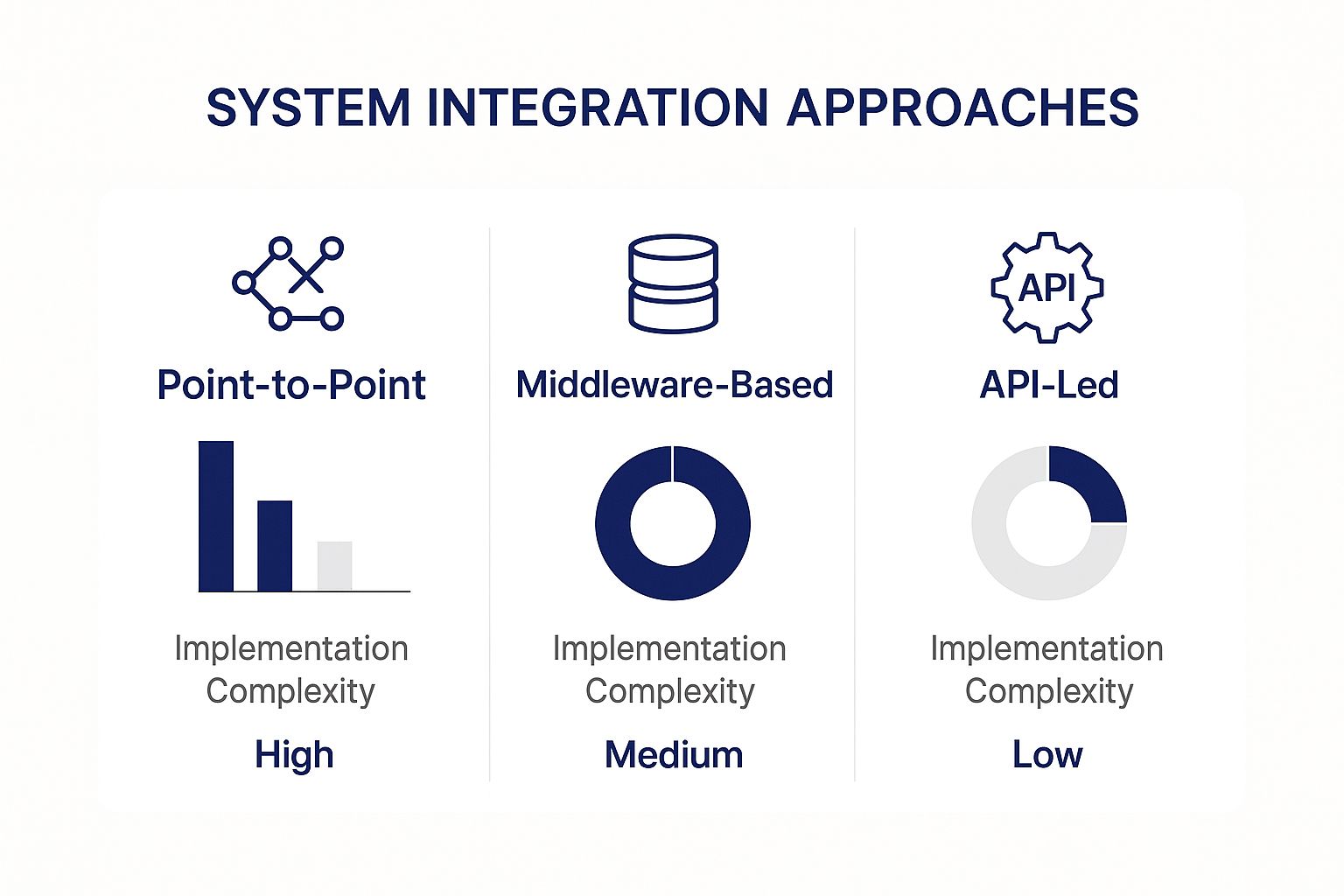
As you can see, what starts as the simplest option (direct connections) quickly becomes the most complex to manage as you scale up, while more modern, structured approaches offer a better balance.
It’s one thing to talk about system integration in theory, but seeing it in the real world is where its impact really clicks. Across every industry, leading companies use integration as more than just a tech fix—it’s a core strategy for solving tough problems, delighting customers, and driving real growth.
From the hospital floor to the factory line, connected systems are the engine behind modern business. Let’s look at a few examples of how different sectors are making integration pay off.
In healthcare, scattered information isn’t just inefficient; it can be dangerous. System integration connects all the disparate sources of patient data—electronic health records (EHRs), lab results, billing platforms, and pharmacy databases—into a single, coherent whole.
Think about it: when a doctor updates a prescription in the EHR, an integrated system can instantly zap that order to the pharmacy. At the same time, it can tell the billing department to prep an invoice and notify the insurance provider. This smooth flow of information leads to huge wins:
By creating a single source of truth for each patient, healthcare organizations can deliver safer, more coordinated care while making their operations run a whole lot smoother.
Today’s factory floor is swimming in data from sensors, machinery, and supply chain software. System integration is the magic that turns all that raw data into smart decisions, a crucial part of any good digital transformation roadmap.
For instance, when a sensor on a machine detects odd vibrations, it can automatically log a maintenance ticket. That same alert can check the supply chain software to make sure a replacement part is ordered before the machine actually breaks down. That’s predictive maintenance in action, and it saves a fortune by preventing costly downtime.
The banking, financial services, and insurance (BFSI) industry is a massive adopter of integration. In fact, the North American system integration market holds the largest share at about 36%, largely because financial institutions are racing to connect their old-school core systems with modern digital apps. With 70% of Bank of America’s clients now using digital services, the need for flawless connectivity is crystal clear.
Every time you use a mobile banking app to deposit a check, you’re seeing system integration at work. The app talks securely to the bank’s core transaction system, updates your balance instantly, and files a digital image of the check. It's this behind-the-scenes work that lets banks deliver the secure, on-demand services we all expect today.
While the benefits of a fully connected business are huge, the path to get there is rarely a straight line. Successful integration projects aren't just about picking the right software; they’re about anticipating the real-world hurdles that can trip you up. Knowing what’s coming is the first step to clearing the path.
One of the biggest and most common roadblocks is the legacy system. So many businesses run on older, on-premise software that’s absolutely critical to their operations but was never built to talk to modern, cloud-based apps. These systems are often rigid and lack the APIs needed for a simple connection, making any integration attempt difficult and expensive.
Trying to integrate with these older platforms can feel like plugging a smartphone into a rotary phone. They just don't speak the same language. This mismatch often forces you to use specialized connectors or middleware to act as a translator, which only adds another layer of complexity. If this sounds familiar, exploring legacy system modernization strategies is a smart move before you dive headfirst into a larger integration project.
Beyond the technical puzzles, data security is non-negotiable. As you start piping information between systems, you’re also creating more potential entry points for security threats. Every connection is a potential vulnerability that needs to be locked down tight.
A single weak link in your integration chain can put your entire data ecosystem at risk. This means robust security protocols, data encryption, and strict access controls aren't just best practices—they're essential for protecting your company and your customers.
Another major challenge is planning for the future. An integration that works perfectly today might start to crack under the pressure of more data or more systems tomorrow. You have to build scalability into the architecture from day one, ensuring your setup can grow with your business without needing a total rebuild.
Finally, never underestimate the people side of the equation. New automated workflows will change how your team gets things done. Managing this organizational shift is every bit as important as managing the technology.
You'll need to think through:
Jumping into a system integration project without a clear plan is like building a house without a blueprint. The final result is usually unstable, expensive, and definitely not what you had in mind. A winning strategy always starts with one simple question: What business problem are we actually trying to solve?
Before you even think about technology, you have to define your goals. Are you trying to automate your order-to-cash process? Do you need a single, unified view of your customer? Or is your main goal to improve inventory accuracy across warehouses? Pinpointing these objectives gives you the North Star needed to guide every decision that follows. Only then should you start looking at platforms and partners.
When you’re vetting an integration platform or provider, you need to look past the slick sales pitch. There are a few crucial factors that will make or break your long-term success.
This kind of proactive thinking is vital in a market that’s expanding so quickly. For example, the Asia Pacific system integration market is on track to hit USD 347.25 billion by 2033, all driven by the massive push for digital transformation. This growth highlights the global trend toward connected technologies and just how important it is to pick a solution built for the future. You can learn more about the global push for system integration to see the bigger picture.
Finally, remember that integration isn't a one-and-done setup—it's an ongoing process. A data-first mindset is essential. That means prioritizing data quality, consistency, and governance right from the very beginning. Garbage in, garbage out. If your source data is a mess, your integrated system will only amplify those problems across the board.
A successful integration isn’t just about connecting systems; it’s about creating a reliable, agile, and secure data ecosystem that empowers your entire organization to make smarter decisions and operate more efficiently.
Once your integrations go live, the work isn't over. You'll need to implement thorough testing procedures and set up continuous monitoring to catch issues before they can impact your operations. This is how you ensure your newly connected ecosystem remains a powerful asset that delivers real, lasting value.
Even with a clear strategy, a few questions always pop up during system integration discussions. Getting these sorted out helps clarify what’s what and sets the right expectations before a project kicks off.
People often use these terms interchangeably, but they operate on different scales.
Think of system integration as designing the entire electrical grid for a new city. It’s the master plan connecting the power plants, substations, and every neighborhood into one massive, functional whole. In IT terms, it’s the broad process of linking all your components—hardware, software, and networks—so they operate as a unified system.
Application integration, on the other hand, is a focused part of that bigger picture. It’s like making sure all the appliances within a single house can plug into the outlets and work together. It specifically deals with getting different software programs to talk to each other and share data without a hitch.
This is the classic "it depends" answer, but for good reason. The timeline for an integration project can swing wildly based on its complexity. A simple job, like connecting two cloud apps with a pre-built connector, might be done in a few weeks.
A large-scale enterprise integration, especially one involving old legacy systems, custom business logic, and multiple departments, could easily take six months to over a year. The big variables are always the number of systems involved, the quality of the data, and how complex the workflows need to be.
Absolutely. System integration isn’t just a game for big corporations. Small businesses are often juggling a mix of essential applications for different jobs:
Hooking these platforms together automates the tedious-but-critical tasks, like syncing customer orders with inventory and pushing sales data into your financial records. This automation saves an incredible amount of time, slashes costly manual errors, and frees you up to focus on growing the business. Modern tools have made this kind of power far more accessible and affordable for companies of any size.
Ready to unify your business applications without the complexity? Cloudvara provides secure, reliable cloud hosting that brings all your essential software together in one accessible platform. Explore our solutions and start your free trial today.