So, what exactly is network monitoring? At its core, it’s the process of keeping a constant, watchful eye on your computer network. We're talking about a systematic effort to catch slow-downs, component failures, and even potential security threats before they can cause real trouble for your business.
It’s all about being proactive. Instead of waiting for a system to crash and then scrambling to fix it, network monitoring helps you spot the warning signs and resolve issues before your users or customers even notice a problem.
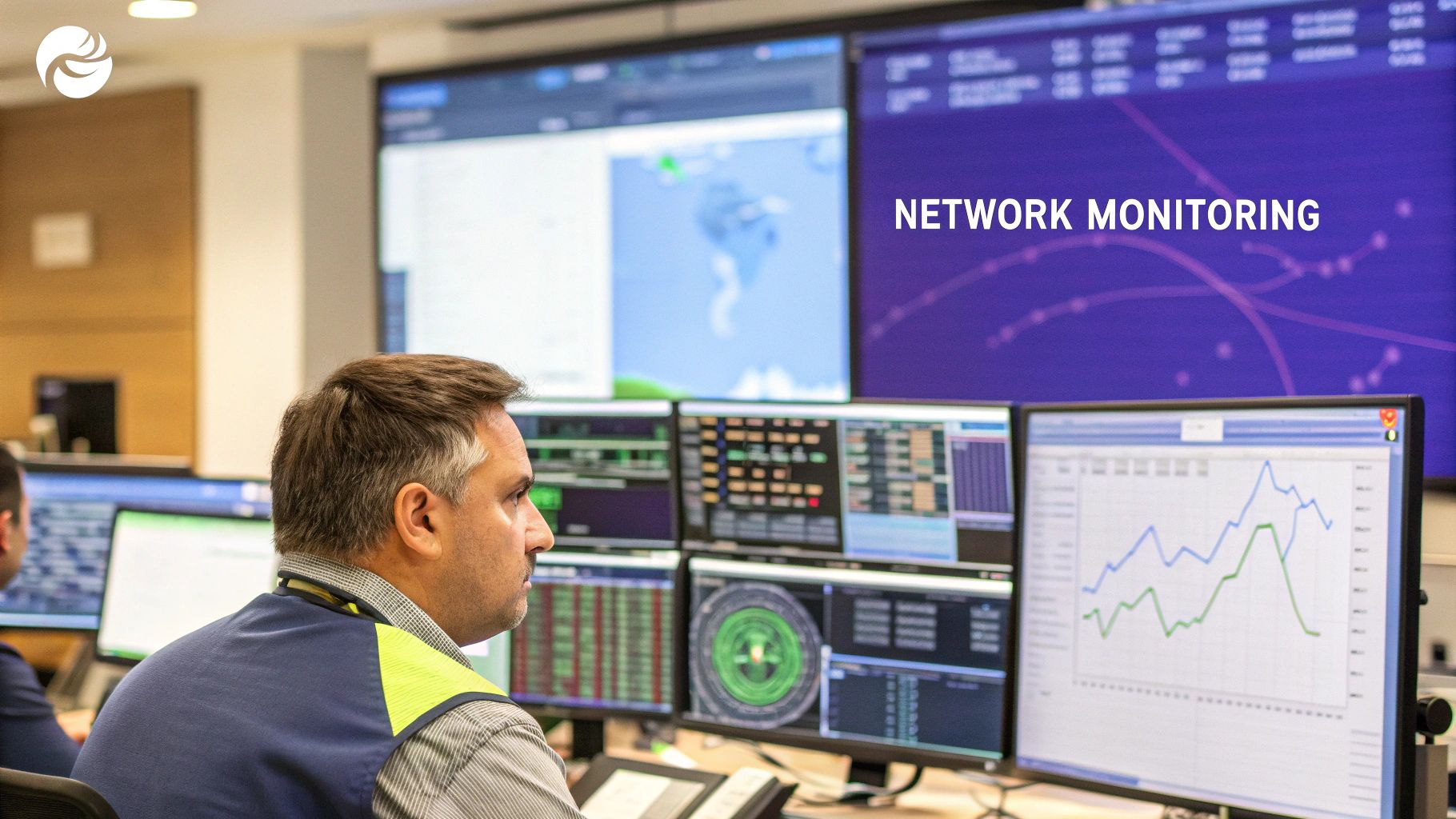
Think of your business network as its central nervous system. It's the critical infrastructure that carries data between your team, your customers, and all the applications that keep your operations running. Just like a doctor checks a patient's vital signs, network monitoring is how you check the health and performance of this digital backbone.
This isn't just a one-and-done checkup. It’s a continuous, vigilant process. Using specialized tools, you can track key performance metrics across every device, connection, and pathway in your network, giving you a live view of how everything is performing.
Good network monitoring goes way beyond a simple "is it on or off?" check. It dives deep to build a comprehensive picture of your network's health by keeping tabs on several key areas.
By keeping a close eye on these elements, you can finally get ahead of problems. It’s a complete shift from the old "break-fix" cycle to a much smarter, proactive strategy.
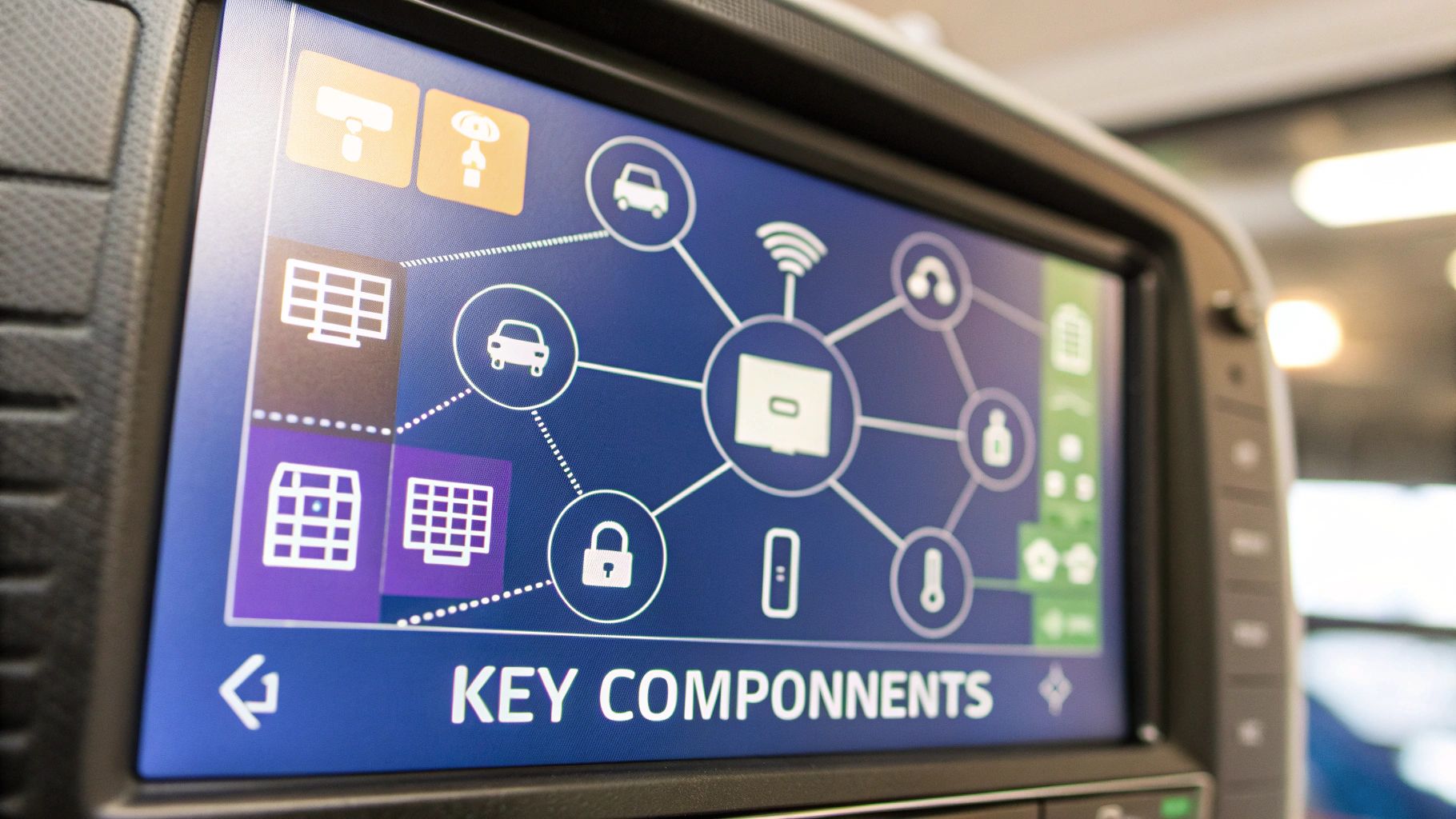
To make this crystal clear, here’s a quick breakdown of the core components.
| Component | What It Involves | Primary Goal |
|---|---|---|
| Device Monitoring | Checking CPU, memory, and disk space on routers, switches, servers, and other hardware. | Prevent hardware failures and performance degradation. |
| Traffic Analysis | Analyzing the volume and type of data flowing through the network to identify patterns. | Optimize bandwidth usage and quickly identify bottlenecks or unusual activity. |
| Performance Metrics | Measuring latency, packet loss, and jitter to assess the quality of the network connection. | Ensure a smooth and reliable user experience for all applications. |
| Alerting System | Automatically notifying IT staff when predefined thresholds are breached or issues are detected. | Enable rapid response to problems before they impact the business. |
This table simplifies the main areas you’ll focus on, but each plays a vital role in maintaining a healthy and efficient network.
The bottom line is this: Network monitoring turns your IT team from firefighters into forward-thinkers. It’s about ensuring business continuity by catching and fixing issues before they turn into costly disasters.
This approach is so critical that the global network monitoring market is expected to grow from USD 3.12 billion to USD 5.02 billion by 2030. That growth isn't surprising. Businesses simply can't afford downtime. Plus, innovations in AIOps (AI for IT Operations) are making it possible to predict failures before they happen, further proving that constant oversight is what keeps your digital infrastructure a reliable asset, not a ticking time bomb.
Knowing what network monitoring is is one thing, but the real game-changer is understanding why it's so critical for your business. It fundamentally flips your IT strategy from reactive to proactive. Instead of scrambling to put out fires after something breaks, you get to see the smoke and stop the fire before it ever starts.
This isn't just a technical tweak; it's a core business advantage. It's the difference between finding out your website is down from an angry customer on social media versus getting an alert about an overloaded server and fixing it an hour before it could crash. This foresight is what protects your revenue, your reputation, and the trust you've built with your customers.
Think about what happens when you’re flying blind. A surprise network outage during your busiest sales hour could mean thousands of dollars lost with every passing minute. Even a slow, laggy application that doesn't fully crash can be just as damaging, frustrating users until they simply give up and go to a competitor. These aren't just IT hiccups—they're direct hits to your bottom line.
Every second your network is slow or completely offline, your business is leaking value. The cost of downtime is staggering; research often shows that even one hour of downtime can cost a small business thousands of dollars. But the damage goes far deeper than just the immediate financial hit.
Your reputation is one of your most valuable—and fragile—assets. Unreliable services erode customer confidence fast. In today's market, a bad digital experience is often all it takes to lose someone for good. Proactive monitoring acts as your first line of defense, ensuring the consistent, reliable performance that builds and maintains trust.
Proactive network monitoring isn't just about stopping things from breaking. It’s about guaranteeing the constant availability and solid performance that your entire business runs on.
To protect your business from the unexpected, having a well-defined strategy is essential. For more detailed guidance, our article on creating a small business disaster recovery plan offers practical steps to keep your operations secure.
Beyond just preventing disasters, great monitoring makes your entire operation run smoother. When your IT team isn't constantly chasing down mystery problems, they can finally focus on projects that actually move the business forward.
This newfound clarity brings a few immediate wins:
By tying the health of your network directly to real business results, it becomes obvious that proactive monitoring isn't just an IT function—it's the foundation of a successful modern company. It makes sure your digital infrastructure is strong enough to carry your ambitions.
So, how does this all happen? Let's pull back the curtain and look at the engine driving network monitoring. It’s not black magic; it's a logical, cyclical system designed to turn raw network chatter into intelligence you can actually use.
Think of it like a seasoned doctor diagnosing a patient. There's a clear, three-step process: gather the symptoms, analyze the data, and then present a clear diagnosis.
The entire process boils down to three core pillars:
By mastering these three stages, you get the visibility needed to keep your digital infrastructure healthy, efficient, and reliable.
First things first: you have to gather the data. Your network monitoring tools are like tiny sensors deployed across your entire IT environment, constantly collecting performance metrics from every connected device. This isn't just a random spot-check; it's a continuous stream of information that forms the bedrock for every decision you'll make.
These tools are looking for crucial "vital signs" that tell the story of your network's health. Key metrics include:
This relentless data gathering is non-negotiable. Without accurate and comprehensive data, any analysis is just pure guesswork.
Once the data is flowing in, the real intelligence of network monitoring kicks in. The system sifts through this massive stream of information in real-time, hunting for anything that looks out of place. It’s constantly comparing live data against a pre-established baseline—a snapshot of what your network looks like when it’s running smoothly.
When a metric veers too far from this baseline, the system flags it as a potential issue. For instance, if a server's CPU usage suddenly spikes to 95% and stays there, an alert gets triggered.
The whole point of analysis isn't just to see what’s happening, but to understand what it means. A brief spike in traffic might be normal, but sustained high latency points to a deeper problem that needs someone's attention right away.
This is where intelligent alerting becomes so important. A good system is designed to avoid "alert fatigue," where your IT team is so bombarded with minor notifications that they start tuning them out. Instead, you can configure smart thresholds and dependencies to ensure alerts are only sent for real, actionable problems. This lets your team focus on what truly matters. This analytical power is also central to managing modern IT setups, including the concepts behind what is cloud networking.
Let’s be honest, raw numbers and endless data logs are nearly impossible for a human to interpret quickly. That’s why the final, crucial step is to transform all that complex data into simple, visual formats. This is where dashboards, graphs, and reports come in, turning abstract metrics into a clear picture of your network's health.
This visual approach empowers your team to make faster, more informed decisions. Instead of digging through spreadsheets, they can glance at a dashboard and immediately get the lay of the land.

As you can see, this systematic approach leads directly to tangible benefits like higher uptime, faster problem resolution, and just plain better performance. This clarity is why the global network monitoring market, valued at USD 3.71 billion in 2024, is projected to hit USD 8.24 billion by 2032. As our IT environments get more complicated, the need for clear visibility has never been more critical.

Alright, now that we’ve covered the fundamentals of why we monitor, it’s time to get into the how. This is where you roll up your sleeves and pick the actual technologies that make it all happen. You’ll need to choose the right protocols—the languages your devices use to talk to each other—and the software tools that turn all that chatter into something you can actually use.
Think of protocols as the standardized rules of the road for your network’s data. They ensure that every device, from a server to a switch, reports its status in a way your monitoring system can understand. Without them, it would be total chaos.
To get a full picture of network health, you can't rely on just one protocol. Different protocols are designed to answer different questions, and using them together gives you a complete, multi-layered view of your infrastructure.
Here are the heavy hitters you’ll almost certainly encounter:
These protocols provide the raw data, but you need a system to collect, interpret, and visualize it all. That’s where a Network Management System (NMS) comes in.
Think of an NMS as your network’s command center. It’s the software that gathers all the data from your devices, looks for signs of trouble, shoots off alerts when things go wrong, and displays everything on easy-to-read dashboards.
These systems aren't just a "nice-to-have"; they're mission-critical. The global market for NMS solutions was valued at USD 10.02 billion in 2024 and is projected to skyrocket to nearly USD 25.94 billion by 2034. That explosive growth shows just how vital these tools have become for modern businesses. For a closer look at the market dynamics, you can explore the full research on network management systems.
When you start shopping for monitoring tools, you'll find everything from free, do-it-yourself software to high-end commercial suites. The best choice for you really boils down to your team's expertise, your budget, and exactly what you need to monitor.
To help you navigate the options, let's break down the main categories of tools you'll encounter.
The table below offers a quick comparison of the different types of monitoring solutions available, highlighting what they're best at and who they're for.
| Tool Category | Primary Function | Common Examples | Best For |
|---|---|---|---|
| Open-Source | Provides a flexible, highly customizable monitoring framework. | Nagios, Zabbix | Teams with strong technical skills and a desire for deep customization without the high licensing costs. |
| Commercial (NMS) | Offers a comprehensive, all-in-one platform with a polished user experience. | SolarWinds, Paessler PRTG | Businesses that need a powerful, easy-to-deploy solution with dedicated support and a lower administrative burden. |
| Cloud-Based/SaaS | Delivers monitoring as a service, hosted by the vendor. | Datadog, New Relic | Organizations with hybrid or cloud-native environments that need scalability and want to avoid managing infrastructure. |
| Specialized Tools | Focuses on a specific area, like traffic analysis or application performance. | Wireshark, Grafana | Teams needing to solve a very specific problem or augment their primary NMS with deeper, specialized insights. |
Ultimately, open-source tools like Nagios and Zabbix offer incredible power and flexibility, but they demand a significant investment of time and technical know-how to configure and maintain properly. They’re a fantastic fit if you have a dedicated IT team that loves to tinker.
On the other hand, commercial platforms from vendors like SolarWinds or Paessler PRTG are built for convenience. They often feature automated device discovery, pre-configured alerts, and professional support, making them much faster to get up and running. The right tool is the one that strikes the perfect balance between power, price, and ease of use for your specific team.
Having powerful tools and understanding protocols is a great start, but the technology itself won't solve your problems. The real value comes from building a deliberate, thoughtful network monitoring strategy. Without a clear plan, even the most expensive software can become just another source of noise and frustration instead of providing real, actionable insight.
Think of it like building a house. You wouldn't just start throwing up walls and hoping for the best, right? You need a blueprint that outlines what you're building, why you're building it, and how all the pieces fit together. Your monitoring strategy is that exact blueprint for a resilient and healthy network.
Before you can spot a problem, you have to know what "normal" actually looks like for your network. This is where establishing a performance baseline comes in. A baseline is simply a detailed snapshot of your network’s typical performance over a given period, maybe a week or a month.
This data captures your everyday operational metrics—things like average bandwidth usage during business hours, typical server CPU load, and standard application response times. This baseline becomes your single source of truth. It’s the standard against which all future activity is measured, allowing your monitoring system to distinguish between a genuine crisis and a harmless hiccup.
Without a baseline, every alert is a guess. With one, you can configure your tools to only notify you about deviations that truly matter, dramatically reducing false positives and alert fatigue.
Once you know what your normal is, you can set intelligent alerting thresholds. These are the specific rules that tell your monitoring system when to raise a flag. A poorly configured alert system can honestly be worse than having none at all, burying your IT team in a constant flood of irrelevant notifications.
Effective alerting is all about finding the right balance.
An alert is only useful if your team knows exactly what to do when they get one. An incident response plan is a clear, step-by-step playbook that outlines how to handle different types of network issues. This plan gets rid of the guesswork and ensures a swift, coordinated response when things go wrong.
A solid plan should clearly define:
This kind of structured approach transforms chaotic fire-fighting into a calm, methodical process. It minimizes downtime and gets services restored much, much faster. Ultimately, a well-defined strategy is what turns network monitoring from a passive reporting tool into an active defense system for your business.
Network monitoring is changing. We're moving away from simply looking at dashboards and reacting to red lights. The future is all about prediction, and that future is being built on two massive pillars: Artificial Intelligence (AI) and the cloud.
This isn't just a small step forward; it's a complete reimagining of what monitoring can do. Instead of just telling you when a server has failed, the next wave of tools will warn you that it’s going to fail. This is the whole idea behind AIOps, or AI for IT Operations, which uses machine learning to get ahead of problems.
Think about it like this: what if your monitoring system noticed a tiny, almost imperceptible increase in server latency? On its own, that’s just noise. But an AIOps platform could connect that blip to a recent rise in user transactions and recognize the pattern as the first sign of an impending crash.
Before anyone notices a slowdown, the system could automatically spin up more resources to handle the load, completely sidestepping the outage. That's the real power here. It shifts network management from a reactive firefighting drill to a proactive, automated strategy.
Here’s what AIOps brings to the table:
By learning the unique rhythm of your network—what "normal" truly looks like—AIOps can spot the subtle deviations that signal trouble. It’s about solving problems before they ever become problems for your business.
This kind of intelligent, predictive monitoring simply wouldn't be possible without the cloud. Running sophisticated AI algorithms requires a massive amount of computing power and storage, which is exactly what modern cloud infrastructure was built for.
Beyond just raw power, cloud hosting is the ideal home for these advanced monitoring platforms. To get a better sense of where this is all heading, you can dive into the major future trends in cloud hosting and see how the technology is evolving.
Here's why the cloud is so critical:
When you put it all together, AI delivers the brains, and the cloud provides the muscle. This combination is paving the way for a future where network downtime is a rare exception, not an accepted part of doing business.
Let's wrap up by tackling some of the most common questions that pop up when people first dive into network monitoring.
That's a great question, and while the terms are often used together, they refer to two distinct jobs. The easiest way to think about it is this: network monitoring is about observation, while network management is about action.
Monitoring is the part that watches, gathers data, and flags problems. It's the system that alerts you, "Hey, the main server's memory is about to max out!" Management, on the other hand, is what you do with that information. It's the hands-on process of allocating more memory to that server, updating a router's configuration, or pushing out a security patch.
You can't have effective management without solid monitoring. You need the clear picture that monitoring provides to make smart, informed decisions.
In short, monitoring gives you the intelligence to see what's happening. Management gives you the tools to do something about it.
You definitely don't need a huge budget to get started. In fact, some of the most powerful and flexible monitoring tools are open-source, which means they're free to use.
A couple of fantastic options to look into are:
These tools do require a bit more hands-on setup compared to paid solutions, but they're a perfect way to get powerful monitoring in place without the hefty price tag. A good starting point is to monitor just your most critical hardware—like your main firewall and key servers—and then gradually expand as you get the hang of it.
Every network has its own quirks, but there are a handful of core metrics that will give you the best bang for your buck in terms of understanding network health. If you're just starting out, focus on these "big four."
Ready to gain complete visibility and ensure your applications are always available? Cloudvara provides a secure, high-performance cloud hosting environment with 99.5% guaranteed uptime. Let us handle the infrastructure so you can focus on your business. Discover the difference with a free 15-day trial.