Dedicated server hosting is a service where a business rents an entire physical server that isn’t shared with anyone else. Think of it as owning a standalone house instead of renting an apartment; all the resources—CPU, RAM, and storage—are 100% yours. This exclusive setup gives you the ultimate in performance, security, and control.
Imagine your business applications, like accounting software or a high-traffic website, are tenants in a building. In a shared hosting environment—the most common starting point for many businesses—your applications live in a large apartment complex. You share everything: the hallways (bandwidth), the electrical system (CPU power), and even the plumbing (memory). If a neighbor throws a loud party (experiences a traffic spike), your lights might flicker, and your water pressure could drop. Your performance is directly tied to the behavior of others.
A dedicated server, on the other hand, is your own private house. There are no noisy neighbors, no shared utilities, and you hold all the keys. This isolation means the server's full power is always available for your needs, ensuring consistent, predictable performance. For professionals like accountants and lawyers, this reliability is non-negotiable, especially when running critical software that can’t afford slowdowns.
To make things even clearer, here's a quick rundown of what a dedicated server offers.
| Attribute | Description |
|---|---|
| Tenancy | Single-Tenant—you are the only user on the physical machine. |
| Resources | Exclusive access to all CPU, RAM, storage, and bandwidth. |
| Performance | High and consistent, as resources are not shared. |
| Security | Enhanced, due to complete isolation from other users. |
| Control | Full administrative (root) access to customize software and settings. |
| Best For | High-traffic websites, resource-heavy applications, and sensitive data. |
This table highlights the core idea: exclusivity is the name of the game.
The real value of dedicated hosting is in its undivided resources and heightened security. Since you aren't sharing hardware with other tenants, you eliminate the "bad neighbor" effect, where another user's security mistake or resource hogging could drag down your operations. This single-tenant environment provides a secure, isolated foundation for handling sensitive client data.
This model has become a critical pillar for businesses that can't compromise on control. In fact, the global dedicated server hosting market was valued at USD 20.15 billion and is projected to hit USD 80.49 billion by 2032, growing at a rate of 18.9% annually. You can explore more data on this market growth to see how seriously businesses are investing in this technology.
A dedicated server gives you the ultimate freedom to customize your environment. You can install specific software, configure unique security protocols, and optimize the server's performance to match your exact business requirements—a level of control impossible in shared settings.
While it's a powerful solution, it's important to understand how it stacks up against other options. To see how it compares to a more flexible model, you can learn more about cloud hosting in our detailed guide.
Picking a hosting solution is a lot like choosing a place for your business to operate online. Each option comes with a different balance of privacy, resources, and cost, so it’s important to understand the landscape. To really get a handle on what a dedicated server brings to the table, it helps to see how it stacks up against the other choices out there.
Think of shared hosting as renting a room in a massive apartment building. It’s cheap and easy to move into, but you’re sharing everything—the plumbing, the electricity, the hallways—with hundreds of other tenants. If your neighbor decides to throw a huge party, the whole floor might feel the strain. In the same way, another website’s traffic spike on a shared server can slow your site down, a risk that most serious businesses can't afford to take.
A Virtual Private Server (VPS) is like upgrading to a townhouse. You’re still sharing the same property (the physical server) with a few other tenants, but your space is walled off. You get your own designated resources, which gives you much more privacy and better performance than a crowded apartment.
It’s a solid step up, but you still share the underlying hardware. This reality is reflected in market data; VPS hosting is a popular middle-ground, capturing 25.38% of the hosting market. However, dedicated hosting's strong 17.98% market share shows a clear preference among businesses that require total isolation and guaranteed power—a need that even a VPS can’t fully meet.
This diagram shows how a dedicated server provides complete control, enhanced security, and exclusive resources.
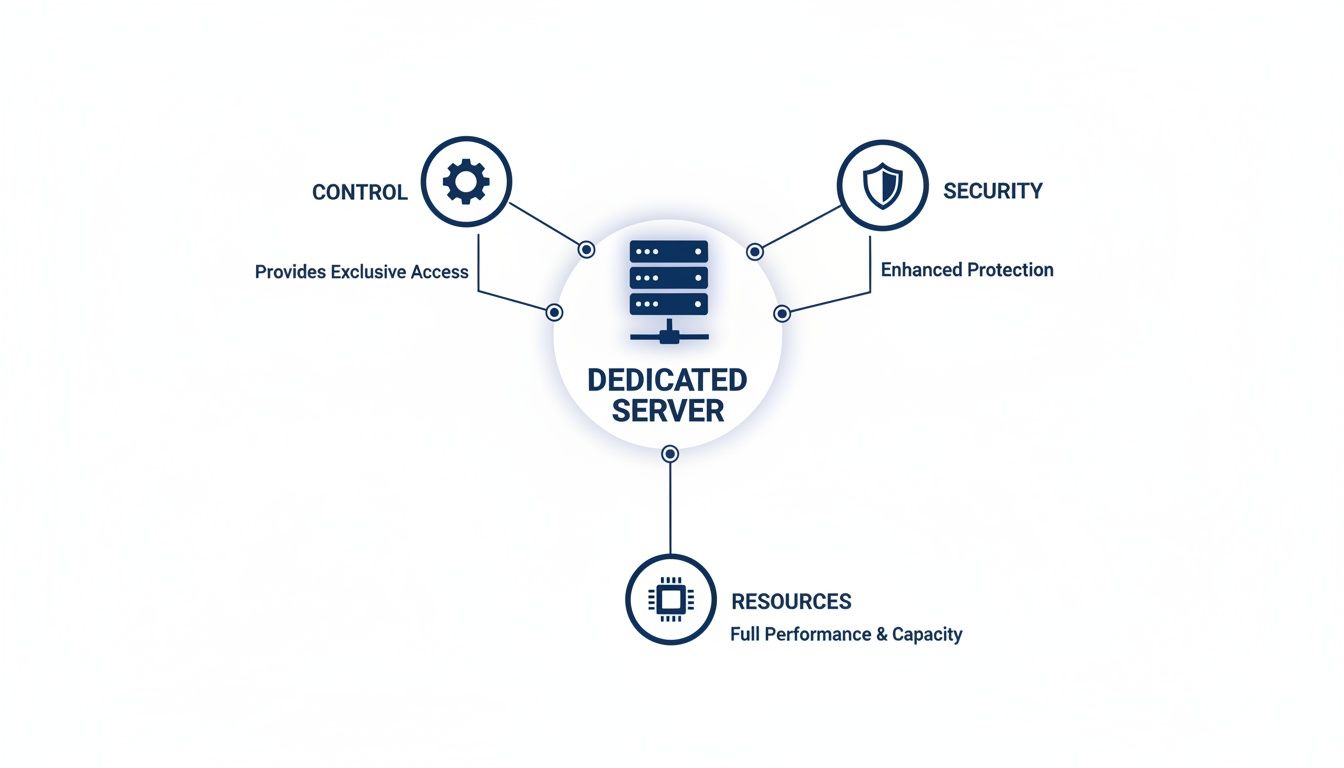
The key thing to see here is how these three pillars are connected. When you have full control over all your resources, you can build much stronger, customized security measures.
Finally, a dedicated server is the equivalent of owning a private, single-family house. The entire property—the land, the building, and all the utilities—is exclusively yours. No shared walls, no noisy neighbors, no compromises. You have complete and total control over every single aspect of your environment.
This total isolation delivers three huge advantages:
The biggest distinction lies between having your own physical hardware and operating in a virtualized environment like the cloud. For a deeper look at this, you can explore our guide comparing cloud and dedicated servers.
A dedicated server isn't just about more power; it's about predictable, guaranteed power. For a law firm processing sensitive e-discovery data or an accounting practice running tax software during filing season, this predictability is non-negotiable.
To help you visualize the differences more clearly, we’ve put together a simple comparison chart that breaks down each hosting solution side-by-side.
| Feature | Shared Hosting | VPS Hosting | Dedicated Hosting | Cloud Hosting |
|---|---|---|---|---|
| Resources | Shared with many users | Partitioned but shared hardware | 100% exclusive to one user | Pooled from multiple servers |
| Performance | Inconsistent; affected by others | More stable than shared | Highest and most predictable | Highly scalable but can be variable |
| Security | Lowest; risk of cross-contamination | Good; isolated virtual environment | Highest; fully isolated hardware | Strong, but shared infrastructure |
| Control | Very limited; provider-managed | Root access, but hardware is shared | Full root access and hardware control | High level of software control |
| Cost | Lowest; very affordable | Moderate; a step up from shared | Highest initial and ongoing cost | Pay-as-you-go; can be complex |
| Best For | Blogs, personal sites, startups | Growing sites needing more power | High-traffic sites, sensitive data | Apps with variable traffic, scaling |
This table makes it clear that each model serves a specific purpose. For an even more comprehensive look at how these solutions compare, delving into the specifics of Cloud Hosting vs Dedicated Server will help you understand which best fits your unique requirements. While every option has its place, only dedicated hosting provides the ultimate in resource exclusivity and control.
When your business starts to feel the squeeze of shared or VPS hosting, jumping to a dedicated server is more than just an upgrade—it's a strategic move. You're investing in three critical areas: performance, security, and control. These pillars create a rock-solid foundation for your most important operations, whether that's your client management system or resource-heavy accounting software.
The real game-changer? Having 100% of the server's resources all to yourself.
Imagine your mission-critical software, like QuickBooks or a legal case management app, running on a shared server. When other users get busy, their activity eats up CPU cycles and memory, which can slow your programs to a crawl or even crash them. A dedicated server completely eliminates that problem. All the processing power and RAM belong to you, and only you.
This exclusive access guarantees consistent, predictable speed. For an accounting firm in the middle of tax season or a law firm digging through massive e-discovery files, that kind of unwavering performance isn't just nice—it's non-negotiable. Slowdowns don't just cause frustration; they directly hit your team's productivity and hurt client service.
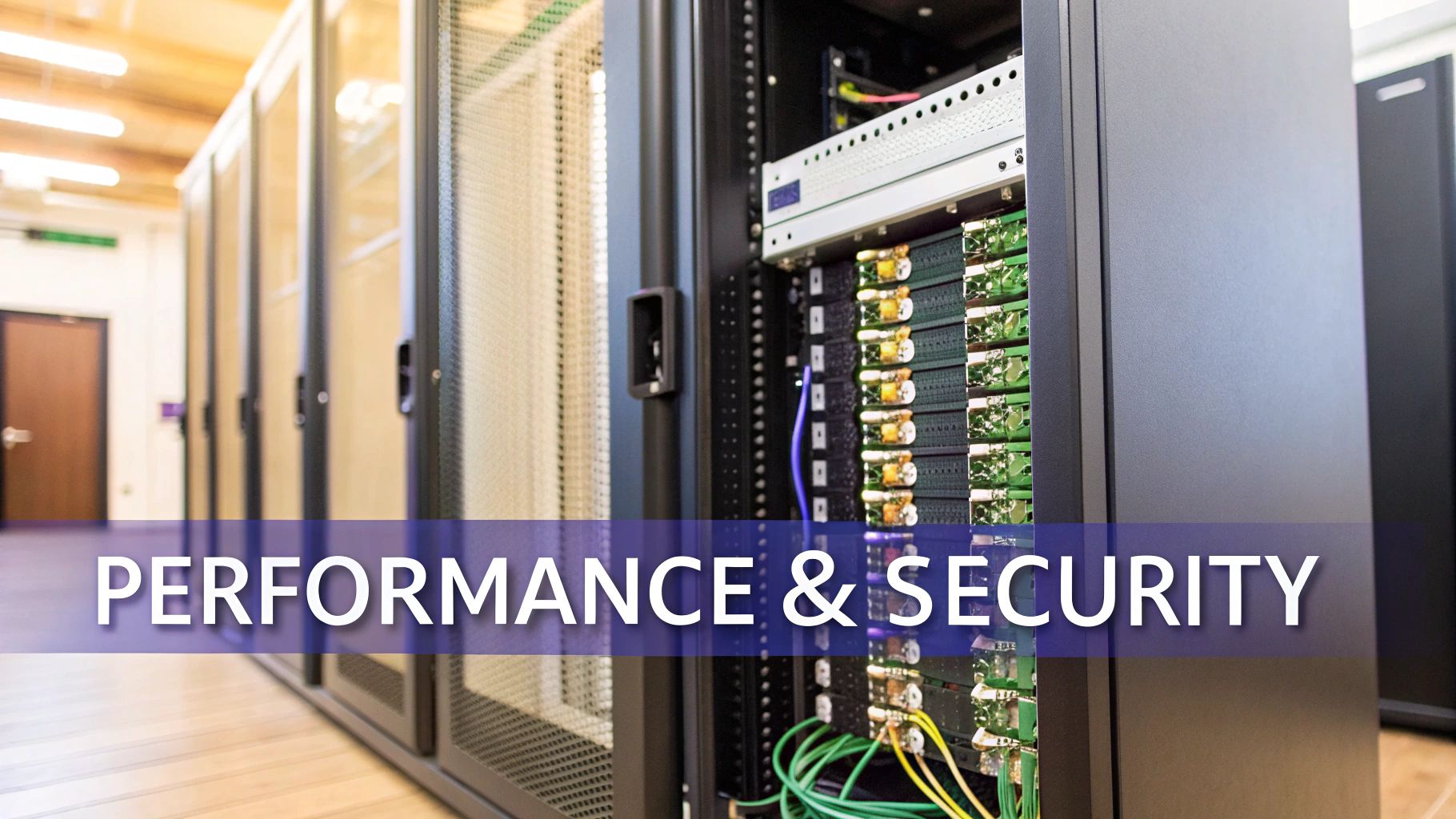
Beyond pure speed, a dedicated server gives you a fortress-like security environment. In a shared setup, you're exposed to the security habits of every other user on that machine. A single compromised website can open a backdoor for attackers to hit the entire server, putting your sensitive data at risk.
A dedicated server gets rid of this "bad neighbor" effect.
By physically isolating your data on its own hardware, you dramatically shrink the attack surface. This isolation is crucial for businesses like law firms and CPA practices that handle confidential client information and must meet strict regulatory compliance standards.
This private environment also means you can implement custom security measures. You get to configure firewalls, install specific intrusion detection systems, and harden the server to meet your exact compliance needs—a level of customization that's simply impossible in a shared hosting world.
The third major benefit is having absolute administrative control. A dedicated server gives you root access, which means you have the final say over every single aspect of its configuration. You can install any operating system you want, run specialized proprietary software, and tweak settings to squeeze every last drop of performance out of the hardware for your unique workloads.
This level of control is essential for any business with specific technical needs. For instance, you might need a particular version of a database or a custom software extension that a shared host won't allow. With a dedicated server, you're in the driver's seat, free to build an environment that's perfectly suited to your operational demands.
For a deeper dive into how this impacts your software, check out our guide on improving application performance. This freedom ensures your infrastructure works for you, not the other way around.
It's one thing to understand the tech specs of a dedicated server, but it’s another to see how it solves real-world business problems. This isn't just a solution for massive tech companies; it’s a strategic tool for professionals and businesses where performance, security, and reliability are non-negotiable. Let’s look at who really benefits from this kind of power.
For professionals in finance, like accountants and CPAs, a dedicated server is an absolute game-changer, especially when the pressure is on. Imagine it's the final week of tax season, and your entire team is deep in QuickBooks or Sage. On a shared server, a traffic spike from a neighboring user could slow your software to a crawl, creating bottlenecks and putting deadlines at risk.
A dedicated server sidesteps that problem entirely. With 100% of the server's resources at your firm's disposal, your essential tax and accounting software runs smoothly and predictably, no matter how intense the workload gets.
The legal industry is another perfect example. Law firms are responsible for massive amounts of sensitive client information, from confidential case files to e-discovery data. Here, security isn't just a best practice—it's an ethical and legal requirement. The isolated environment of a dedicated server acts as a fortress for this data, cutting down the risk of breaches that can happen in multi-tenant environments. It gives firms the freedom to install custom security protocols, maintain ironclad compliance, and protect attorney-client privilege.
Growing e-commerce businesses also hit the limits of other hosting types pretty quickly. A slow-loading product page or a crashed server during a big sale means lost revenue and a hit to your brand's reputation. A dedicated server delivers the raw power and stability needed to handle thousands of shoppers at once, process transactions without a hitch, and keep the store online 24/7.
The hosting infrastructure services market, which includes dedicated solutions, is projected to grow from USD 18.7 billion to USD 42.3 billion by 2035. This growth highlights the increasing reliance of businesses on robust hosting to manage critical applications without the burden of on-site data centers. For professionals handling sensitive data, this trend offers a path to enterprise-grade security and performance. Discover more insights on the future of hosting infrastructure.
Ultimately, the choice comes down to your daily operations. If your business depends on resource-hungry applications, manages sensitive data, or simply cannot afford downtime, then a dedicated server isn't an expense—it's a fundamental investment in your stability and growth. For a closer look at how these environments operate, you can learn more about servers in the cloud and see how they can be tailored to your specific industry.

When you start looking at a dedicated server, the conversation quickly turns to the investment. It’s important to see this as more than just a line item on an expense report; it's a strategic decision that shapes your team’s focus and your business’s stability. The price tag is tied directly to one big question: who’s handling the technical heavy lifting?
This brings you to a critical fork in the road every business must navigate: choosing between managed and unmanaged hosting. Each path comes with its own set of responsibilities and perks, and your choice will fundamentally define your day-to-day experience.
Unmanaged hosting is the ultimate do-it-yourself route. Think of it like leasing a commercial space—you get the four walls, but everything inside is up to you. You're responsible for all the technical work, including:
This path gives you maximum control and can have a lower upfront monthly cost, but it demands serious in-house technical expertise and time. It’s really only a good fit for businesses that already have a skilled IT department on the payroll.
On the other hand, managed hosting is the "we'll handle it for you" approach. A provider like Cloudvara steps in and takes care of all the complex, time-consuming server administration tasks.
With managed services, you get the enterprise-level power of a dedicated server without needing to become a server expert yourself. This frees you to focus on running your business, not troubleshooting your infrastructure.
This includes 24/7 monitoring, security hardening, proactive software updates, and daily backups. For professionals like accountants and lawyers, this model transforms a simple cost into a powerful investment in reliability and genuine peace of mind. If you're curious how these figures stack up against other options, our cloud hosting cost comparison breaks it down.
When you manage a dedicated server environment, it’s also wise to think about the entire lifecycle of the physical hardware, which eventually includes the data center decommissioning process once the equipment gets old.
Making the leap to a dedicated server might feel like a huge step, but a quality provider makes the whole process surprisingly straightforward. They should act as a true cloud partner, handling all the technical heavy lifting so you can stay focused on your business. The migration is designed to be a seamless bridge, moving you from your current setup to a more powerful and secure environment.
The process usually kicks off with a conversation to understand exactly what you need. They'll ask about your specific software, whether it’s QuickBooks, Sage, or your own CRM and document management systems. From there, they build a customized server environment perfectly suited for your applications. Then, they take care of centralizing and migrating your software onto the new platform, making sure everything runs smoothly from day one.
Finding the right provider is the single most critical step in this journey. A true partner does more than just hand you server access; they deliver a complete, managed solution built for business continuity. As you evaluate your options, there are a few non-negotiable features you should look for to guarantee reliability and peace of mind.
These essentials are what separate a basic host from a real IT ally:
A dedicated hosting provider should feel like an extension of your own IT department. Their job is to manage the infrastructure, security, and maintenance, freeing you to run your business with the confidence that your digital foundation is solid.
By prioritizing these key features, you ensure your transition to dedicated hosting isn't just an upgrade in performance—it's a massive step forward in operational stability and security.
Thinking about a dedicated server can bring up a lot of questions. We get it. Below, we’ve answered some of the most common ones we hear, helping you figure out if this powerful solution is the right move for your business.
This really comes down to whether you choose a managed or unmanaged server.
An unmanaged server is like being handed the keys to a high-performance race car but with no instructions. It assumes you’re the mechanic. You’re responsible for everything from installing software and applying security patches to troubleshooting and daily maintenance. This path is only for those with serious IT expertise.
On the other hand, a managed solution is like having a full-time pit crew on standby. Your provider handles all the complex, behind-the-scenes work. This means server setup, security monitoring, software updates, and daily backups are all taken care of, allowing you to focus on your business without needing a technical background.
Not at all. The decision should hinge on your business’s needs, not its size. For example, a two-person law firm handling sensitive client data has far greater security and compliance needs than a large hobby blog that gets thousands of visitors.
The right question isn't "Am I big enough?" but rather "Are my needs critical enough?" If your business relies on top-tier performance for essential software, requires fortress-like security for confidential information, or must meet strict compliance standards, then a dedicated server is the appropriate and strategic choice, regardless of your size.
The timeline for getting a dedicated server online can vary, but a good managed provider makes the process surprisingly fast. While setting up an unmanaged server can be a long, drawn-out project, a managed host streamlines everything for you.
They handle the entire provisioning process, which includes configuring the hardware, installing the necessary software, and hardening the server's security. A skilled provider will then migrate your existing applications and data, ensuring a smooth transition with minimal disruption. For most businesses, this means you can be fully up and running on your new, high-performance server in just a few business days.
Ready to unlock the full potential of your business applications with unmatched performance and security? Cloudvara centralizes your software on a secure, managed dedicated server with a 99.5% uptime guarantee and 24/7 expert support. Get started with a free 15-day trial today.