A SOC 2 audit is an independent, third-party look at your company's internal security controls to make sure you're handling client data the right way. Think of it as a comprehensive report card on your data protection practices. It tells customers that your systems aren't just designed securely but are actually working effectively to keep their sensitive information safe.
These days, this kind of audit has become a non-negotiable for any business that manages customer data.
You can think of a SOC 2 audit like a home inspection for your company's data security. A home inspector checks that the foundation, plumbing, and electrical systems are sound. In the same way, a SOC 2 auditor confirms that your security controls are properly designed and implemented. It’s not just about ticking a technical box; it’s a powerful way to build trust.
With data breaches making headlines almost daily, clients are more cautious than ever. A SOC 2 report gives them independent, verifiable proof that you're serious about protecting their data. Governed by the American Institute of Certified Public Accountants (AICPA), the audit process measures your systems against the five Trust Services Criteria: Security, Availability, Processing Integrity, Confidentiality, and Privacy.
This demand for assurance has turned the SOC 2 audit from a nice-to-have into a must-have, especially for SaaS and cloud service providers. Getting through the audit successfully gives you several key advantages:
A SOC 2 report is more than a compliance document; it is a statement about your company's culture of security. It shows partners and customers that you take their data protection seriously, making it a crucial asset for growth and retention.
The marketplace has clearly shifted. Recent data shows 58% of organizations now have a SOC 2 report, making it the most common security attestation in the tech world. And it's not just a one-way street; 42% of organizations now require a SOC 2 or ISO 27001 report from their vendors. This trend directly ties audit readiness to revenue, as many venture capital firms are now more likely to fund companies that have completed a SOC 2 audit.
This framework is a core part of modern data governance. You can dive deeper in our comprehensive guide to understanding SOC compliance. For any business managing client data—from accounting firms to software companies—a SOC 2 audit is no longer optional. It's the very foundation of a secure and trustworthy business relationship.
When you kick off your SOC 2 audit journey, one of the first big decisions you'll make is whether to pursue a Type I or a Type II report. They sound almost identical, but they tell very different stories to your clients and partners. Getting this choice right is fundamental to a successful audit.
Think of a Type I report as a detailed blueprint of your security controls. An auditor reviews your systems at a single point in time to confirm that everything is designed correctly. It’s a snapshot that verifies you have the right policies and procedures documented and in place on one specific day.
A Type II report, on the other hand, is more like security camera footage from the last six to twelve months. It goes much deeper, testing not just the design of your controls but also their operating effectiveness over that extended period. This report proves your security practices are actually being followed, day in and day out.
To make the distinction crystal clear, here’s a quick side-by-side look at what separates a Type I from a Type II audit. This table breaks down the core differences in scope, timing, and the level of assurance each report provides.
| Attribute | SOC 2 Type I | SOC 2 Type II |
|---|---|---|
| Primary Focus | Design of controls | Design and operating effectiveness of controls |
| Timeframe | A single point in time (a "snapshot") | A specific period (typically 6-12 months) |
| Level of Assurance | Moderate | High |
| Audit Duration | Shorter (weeks to a few months) | Longer (several months) |
| Best For | Companies new to SOC 2 or needing to show quick progress | Companies needing to prove ongoing security to enterprise clients |
| Client Perception | A good first step | The industry gold standard |
As you can see, the right choice really depends on your immediate business needs and your long-term goals for building customer trust.
A SOC 2 Type I report is often the perfect strategic starting point for companies just dipping their toes into the audit process. It’s faster and usually less expensive to complete, often taking just a few months from start to finish. This makes it a fantastic tool for organizations that need to show security readiness quickly to satisfy a contract or reassure a key client.
But it’s important to understand its limitations. A Type I report shows your controls are suitably designed, but it offers no proof that they’re actually working over time. It answers the question, "Do you have the right security systems in place?" but not, "Are those systems consistently effective?"
The SOC 2 Type II report has become the undisputed gold standard for proving an ongoing commitment to security. Because it covers a review period of at least six months, it gives your customers a much higher level of assurance. It confirms your controls aren't just theoretical policies sitting on a shelf—they are active, enforced, and working consistently.
This long-term verification is exactly why most enterprise clients and businesses in regulated industries will strongly prefer, or even demand, a Type II report. It signals a mature security posture and a deep-seated commitment to protecting customer data. While a Type II audit takes more time and resources, the trust it builds is invaluable. For a deeper look into how these reports compare with other compliance frameworks, you can explore the key differences between SOC 1 vs SOC 2 reports.
A Type I report says, "We designed a secure system." A Type II report says, "We designed a secure system, and we have the evidence to prove it works every single day." This distinction is critical for building long-term customer trust.
Ultimately, the choice comes down to your business goals. A Type I is a great first step on the compliance ladder, but a Type II is the definitive statement of your ongoing security excellence.
At the heart of every SOC 2 audit are the five Trust Services Criteria (TSC). Think of them as the five pillars of data protection that an auditor uses to evaluate your security controls. While they all contribute to a rock-solid security posture, you don't actually need to address every single one.
The real key to a smooth, successful audit is picking the criteria that match the promises you make to your customers. This focus keeps your audit relevant and cost-effective, saving you from spending time and money on criteria that just don't apply to your business. The whole point is to prove you can responsibly manage client data according to these established principles.
The Security criterion is the one non-negotiable part of any SOC 2 audit. It's often called the "common criteria" because it has to be included, no matter which other principles you choose to add. This criterion is all about protecting your systems and data against unauthorized access, unauthorized disclosure, and any damage that could compromise the other four criteria.
In short, it answers the fundamental question: are your systems protected? This includes controls like:
Without a strong security foundation, the other criteria don't mean much. It’s the bedrock on which everything else is built.
Beyond Security, you’ll need to choose one or more of the other four criteria. Your decision should directly reflect the commitments you've made to your clients. Mis-scoping your audit—either by including irrelevant criteria or, worse, leaving out essential ones—is a common and expensive mistake.
Here’s a look at the other four TSCs and when they usually come into play:
Availability: This one is crucial for any business whose customers rely on constant access to their service. It’s all about the performance and uptime of your systems. Ask yourself: do you offer a service level agreement (SLA) promising 99.9% uptime? If the answer is yes, Availability is a must. A cloud application provider, for example, would absolutely include this to prove their platform is always up and running for users.
Processing Integrity: This criterion is all about data accuracy and reliability. It checks whether your system processes are complete, valid, accurate, timely, and authorized. A company that handles financial transactions or provides critical data analytics would need this to assure clients that their data isn't being accidentally or intentionally messed with during processing.
Confidentiality: If your clients trust you with sensitive information that needs to be protected from prying eyes, this criterion is for you. This applies to data that isn't necessarily personal but is proprietary—think trade secrets, business plans, or intellectual property. A law firm using a cloud service to store sensitive case files would expect their provider to meet the Confidentiality criterion. Effective cloud data protection strategies are the name of the game here.
Privacy: While it sounds similar to Confidentiality, Privacy is specifically about protecting personally identifiable information (PII). We’re talking about names, addresses, Social Security numbers, and any other data linked to individuals. If your service collects, uses, retains, or disposes of personal data, the Privacy criterion is non-negotiable and aligns closely with regulations like GDPR and CCPA.
Choosing the right TSCs is about aligning your audit with your customer promises. An e-commerce platform needs Processing Integrity, a SaaS provider needs Availability, and a healthcare app needs Confidentiality and Privacy. Your audit scope tells the story of what your customers can trust you to do.
By carefully thinking through your services and what your clients expect, you can define a SOC 2 audit scope that is both meaningful and efficient. This strategic approach not only sets you up for a smoother audit but also produces a powerful report that directly answers the security questions your customers care about most.
Getting a SOC 2 audit on the calendar can feel like preparing for a major expedition. It takes careful planning, the right team, and a clear map to guide you. When you break the process down into manageable phases, though, this complex compliance challenge becomes a very achievable project.
The journey starts not with technology, but with strategy. The first—and most critical—step is to clearly define the scope of your audit. This means deciding which systems, data, and processes will be included. More importantly, it involves choosing the right Trust Services Criteria that align with the promises you make to your customers.
Once you’ve set the scope, the real work begins. A well-defined roadmap will guide you through assessment, remediation, and evidence collection, making sure you arrive at your audit date fully prepared.
The success of your entire SOC 2 audit really hinges on getting the scope right from day one. If it’s too broad, you’ll waste a ton of time and money on irrelevant controls. If it’s too narrow, you might fail to meet your customers’ expectations.
Start by mapping out everything that supports your service delivery—your infrastructure, software, key personnel, and any third-party vendors you rely on. From there, select the Trust Services Criteria (Availability, Processing Integrity, Confidentiality, and Privacy) that are directly relevant to your client commitments. This initial scoping is fundamental for managing compliance risk and keeping your audit focused and efficient.
Before you invite an auditor in, you need to perform your own internal review. This is what we call a readiness assessment or a gap analysis. Think of it as a dress rehearsal for the main event. Its sole purpose is to find any gaps between your current controls and what SOC 2 requires for your chosen criteria.
This assessment typically involves a few key activities:
The final output is a detailed report highlighting where your controls are strong and, more importantly, where they are weak or missing entirely. This document becomes your blueprint for the next phase.
With your gap analysis in hand, the next phase is all about remediation. This is where you roll up your sleeves and fix the issues you uncovered. You’ll be designing and implementing new controls, updating outdated policies, and training your team to make sure everyone understands their security responsibilities.
For example, if the assessment found you lack a formal employee offboarding process, you’d create a checklist to ensure system access is revoked immediately when someone leaves. To get this right, many organizations implement the Top 10 Internal Controls Best Practices. This stage is often the most time-consuming part of the whole process, but it’s absolutely essential for passing the final audit.
As you implement and fine-tune your controls, you have to start gathering proof that they’re working effectively. This evidence can include everything from system logs and screenshots of configurations to signed policy documents and meeting minutes from security reviews. Organization is key here—you’ll want to store all this evidence in a central spot where your auditor can easily access it.
At the same time, it’s time to choose a qualified CPA firm to conduct your SOC 2 audit. Look for a firm with experience in your industry and with companies your size. Don’t be shy about asking for references, inquiring about their audit methodology, and making sure their communication style is a good fit for your team.
A SOC 2 audit is more than a compliance hurdle; it's a strategic investment in trust. A successful audit can accelerate your sales cycle by as much as 30%, as it allows buyers to bypass lengthy security questionnaires and quickly validate your security posture.
This roadmap shows how a SOC 2 audit is built—it always starts with the mandatory Security criterion, you add others as needed, and then you head into the final audit.
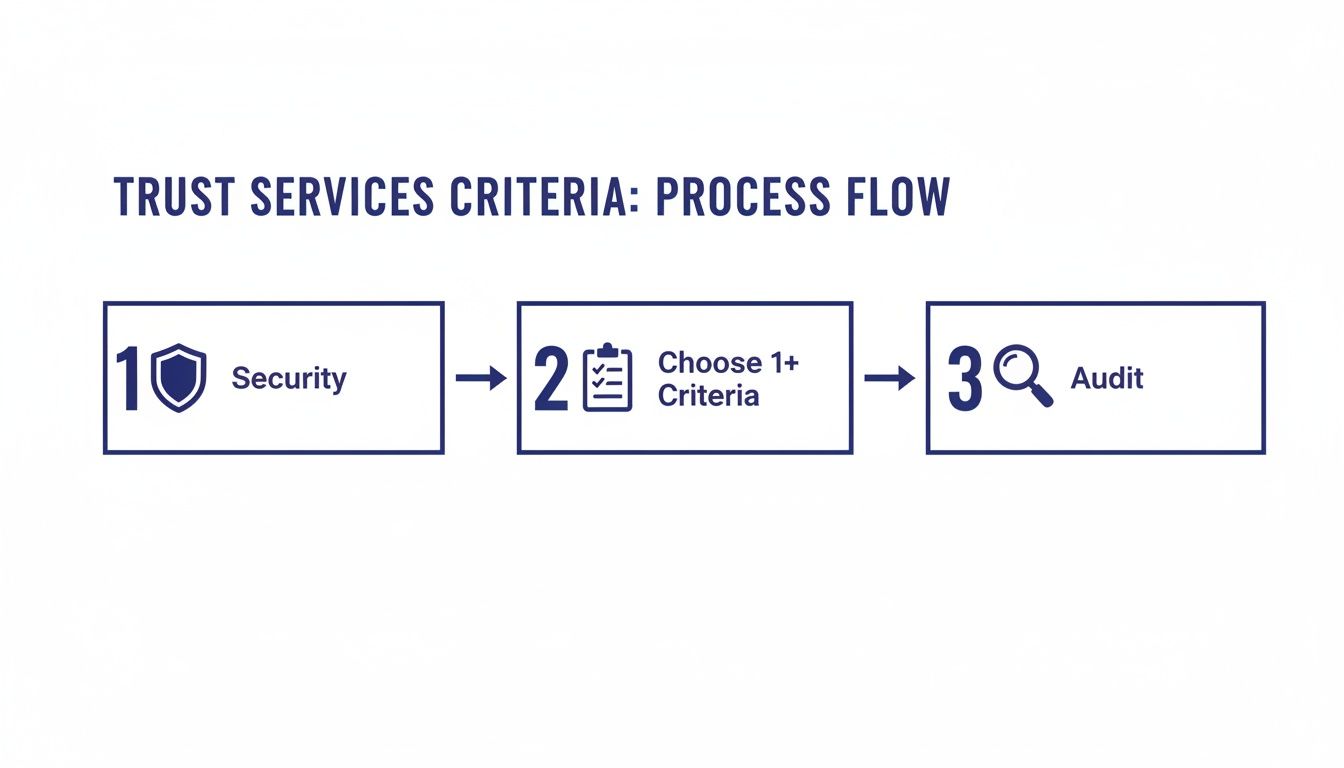
This simple flow has a measurable impact on business growth. Research consistently links SOC 2 compliance to faster sales cycles and increased revenue. In fact, after one cloud provider completed its audit, it generated an additional $20 million in revenue the following year by landing bigger, high-profile clients. This step-by-step approach transforms a daunting task into a series of clear, actionable steps, moving your organization confidently toward compliance.

Tackling a SOC 2 audit is rarely a solo mission, especially when your services live in the cloud. Your relationship with your cloud provider is a true partnership, built on what the industry calls the shared responsibility model. This isn't just jargon—it's a clear map that defines who's responsible for which security controls.
Think of it like renting a high-security bank vault. The bank is responsible for the building's concrete walls, the steel door, and the 24/7 guards. But you're responsible for what you put inside your safe deposit box and who you give the key to. Both parties play a distinct, vital role in keeping the contents secure.
When it comes to your SOC 2 audit, your cloud provider handles the security of the cloud, while you manage security in the cloud. Getting this distinction right is everything, because picking a SOC 2 compliant hosting partner gives you a massive head start.
A reputable cloud partner that has already passed its own SOC 2 audit is an incredible asset. They’ve already built and proven a set of foundational controls that you can effectively inherit, which radically simplifies your evidence collection and strengthens your security from day one.
For example, your provider almost always handles:
When your provider hands you their clean SOC 2 report, you can often use it as direct evidence for your own audit. Auditors call this the "carve-out" method. It means they'll rely on your provider's audit for those specific controls, saving you the headache of proving them all over again.
While your partner locks down the infrastructure, you’re still in the driver's seat for everything you build on top of it. Your auditor will zoom in on the controls you implement yourself. This is where your internal policies and procedures become the star of the show.
Your team will typically be responsible for:
Your cloud provider gives you a secure stage, but you are still the director of the play. Your SOC 2 audit will examine the script you wrote, the actors you cast, and how you manage everything that happens on that stage.
Choosing the right hosting environment isn't just a technical decision; it's a strategic one that can dramatically speed up your audit. A provider that builds compliance-friendly features directly into its services becomes a powerful ally. At Cloudvara, we provide specific tools and guarantees that map directly to the Trust Services Criteria.
Here’s how our managed cloud services help you get there faster:
These built-in features don't just make your systems safer—they make your SOC 2 audit simpler. By leaning on our compliant infrastructure, you can focus your time and energy on perfecting the internal controls that matter most.
Learn more about how our platform can support your compliance goals by exploring our managed cloud services.
Pursuing a SOC 2 audit is a serious investment, but figuring out the costs ahead of time can save you from budget surprises down the road. There’s no single price tag; the final cost really depends on the unique size and complexity of your business.
A few key factors will directly shape your budget: your company's size, how intricate your systems are, and which of the Trust Services Criteria (TSCs) you decide to include. A small startup with a simple tech stack focused only on the Security criterion will have a very different bill than a large enterprise with multiple locations auditing all five TSCs.
The total cost of a SOC 2 audit is more than just the auditor’s fee. A smart budget plans for the entire compliance journey, which usually involves a few different expenses.
When you're putting your budget together, remember that a SOC 2 audit is an investment in trust. The initial costs might feel steep, but the payoff—in the form of shorter sales cycles and access to enterprise clients—often delivers a quick and significant return.
Picking the right CPA firm is just as critical as the audit itself. Your auditor is really a partner in this process, and the right fit can make the whole experience smoother and far more valuable. You aren't just buying a report; you're buying their expertise and guidance.
As you vet potential firms, don't be shy about asking detailed questions. You want to be sure they get your business and can deliver what you need.
Here are a few essential questions to ask potential auditors:
Choosing a firm that communicates clearly and has relevant experience will turn your SOC 2 audit from a stressful chore into a real strategic advantage.
As you get closer to your audit, a few practical questions always seem to pop up. Getting these sorted out early builds the confidence you need to see the process through without any last-minute surprises. Let's walk through some of the most common ones we hear from organizations.
The timeline really depends on which report you’re going for. A Type I audit, which is just a snapshot to prove your controls are designed correctly at a single point in time, is relatively quick. You can usually get that done in one to three months.
A Type II audit, on the other hand, is a much bigger commitment. Your auditor needs to observe your controls in action over a period of at least three, and up to twelve, months to prove they actually work. When you factor in all the prep work and fixing any gaps, a first-time Type II audit can easily take six to 18 months from start to finish.
Nope. A SOC 2 report isn’t something you earn once and hang on the wall forever. Think of it as an annual check-up that’s typically only considered valid for 12 months.
A SOC 2 audit is an ongoing commitment to security, not a one-off project. Customers and partners will almost always require an updated report annually to ensure your security controls remain effective and are continuously monitored.
This yearly cycle is actually a good thing. It forces you to keep your security sharp as your business changes and new threats emerge, which is exactly what keeps your clients’ trust strong.
This is a huge misconception. Using a SOC 2 compliant provider like Cloudvara gives you a massive head start, but it absolutely does not make your organization compliant on its own. SOC 2 works on what’s called a shared responsibility model.
Your provider takes care of the security of the cloud—things like the physical data centers, the network gear, and the server hardware. But you are still 100% responsible for security in the cloud. This includes critical areas like:
The easiest way to think about it is that your provider builds a secure foundation, but you’re the one building the house on top of it. Your internal controls are what the SOC 2 audit is truly evaluating.
Partnering with a compliant provider is the smartest way to begin your SOC 2 journey. Cloudvara offers a secure hosting environment with features like 2FA and automated daily backups that give you a head start on your audit evidence. Start your free 15-day trial today to build your compliance on a trusted foundation.