The shift to remote work has transformed how businesses operate, but it has also introduced unprecedented security risks. For organizations handling sensitive client data, like accountants, law firms, and nonprofits, the stakes are even higher. A single compromised remote device can lead to a catastrophic data breach, regulatory fines, and irreparable reputational damage. The traditional office perimeter has vanished, replaced by a distributed network of home offices, personal devices, and public Wi-Fi networks, each representing a potential entry point for cyber threats.
This guide cuts through the noise to provide a definitive list of 10 actionable remote work security best practices. We'll move beyond generic advice to offer concrete implementation steps, real-world examples, and strategies tailored for securing your most critical applications, whether it's QuickBooks, Sage, or proprietary legal software. These measures are designed to protect your data integrity, ensure regulatory compliance, and maintain client trust.
Beyond implementing security software, the foundational reliability of the hardware your remote workforce uses can significantly impact their productivity and your organization's security posture. It's important to consider factors such as: Are Used iPhones Reliable For Remote Work, as device choice inherently influences overall risk. By the end of this list, you'll have a comprehensive blueprint for building a resilient, secure, and compliant remote work environment that protects your firm from the sophisticated threats targeting distributed teams.
Passwords alone are no longer sufficient to protect sensitive client and business data. Multi-Factor Authentication (MFA) adds a critical layer of security by requiring two or more verification methods to grant access to an application or system. This practice is a cornerstone of modern remote work security best practices, ensuring that even if a password is stolen, a cybercriminal cannot access your accounts without the additional factor.
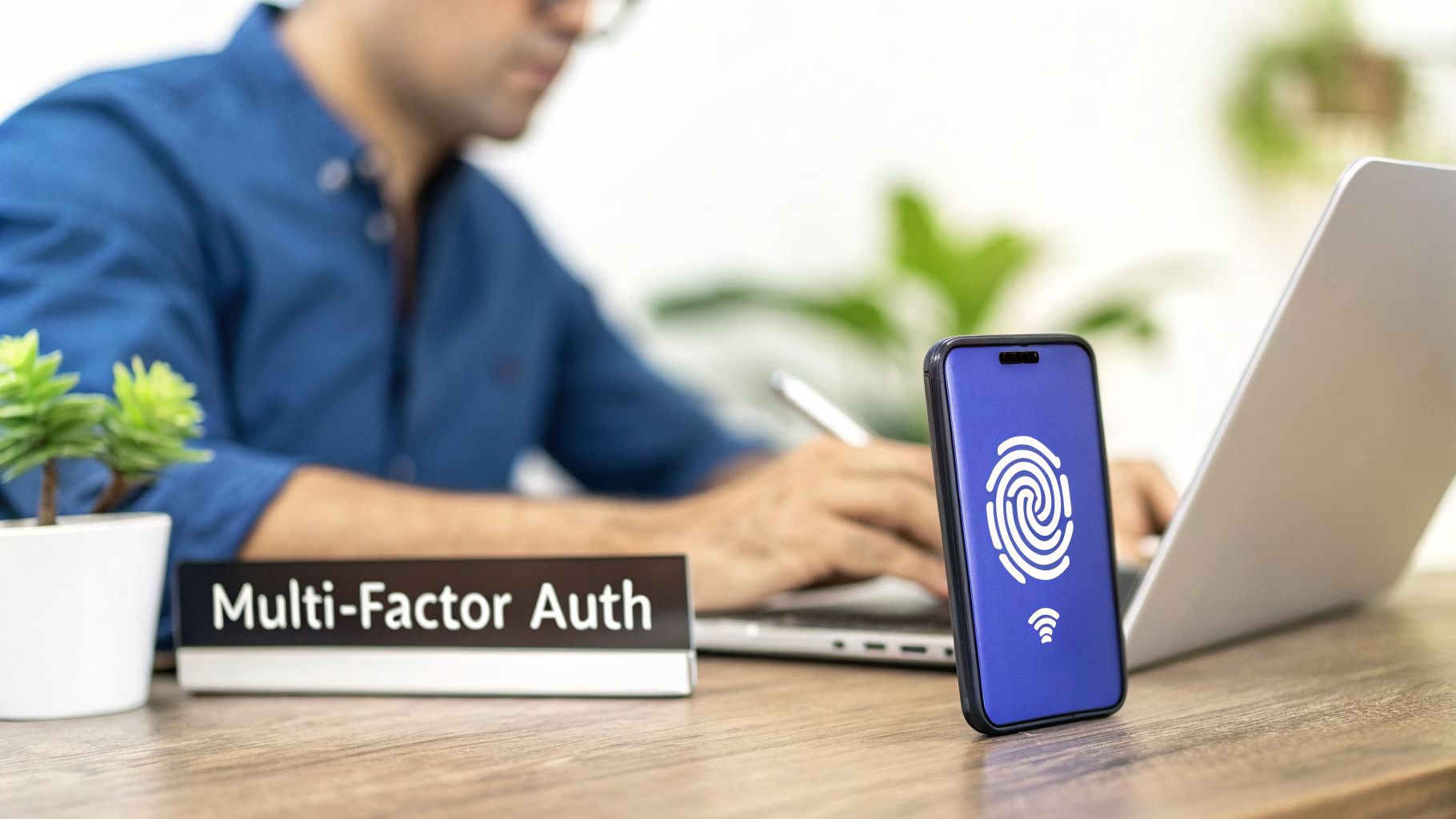
This method typically combines something you know (a password), something you have (a smartphone app or hardware token), and something you are (a fingerprint or face scan). For professionals handling confidential information like accountants using QuickBooks or law firms accessing case management software, MFA acts as a digital gatekeeper, dramatically reducing the risk of unauthorized access.
Successfully rolling out MFA involves more than just flipping a switch. It requires a strategic approach to ensure user adoption and maximum security.
Connecting to company resources from unsecured networks like public Wi-Fi or a home internet connection exposes sensitive data to significant risk. A Virtual Private Network (VPN) is an essential remote work security best practice that creates an encrypted, private tunnel between a remote employee's device and the organization's network. This technology protects all data in transit from being intercepted or monitored by unauthorized parties.

For professionals like accountants and lawyers, a VPN is non-negotiable. When an attorney accesses confidential case files from a client's office or a CPA remotely connects to hosted QuickBooks data, the VPN ensures these communications remain completely private and secure. It effectively extends the corporate network's security perimeter to wherever the employee is working, safeguarding client confidentiality and business integrity.
Deploying a VPN requires more than just installing software; it demands a comprehensive strategy to ensure consistent use and robust protection.
Weak or reused passwords are one of the most common entry points for cyberattacks. A strong password policy, combined with a centralized password management solution, is a fundamental remote work security best practice that removes the burden of password creation and recall from employees. This combination ensures that every access point is protected by a complex, unique credential, significantly minimizing the risk of a breach.
For professionals like accountants handling sensitive data in QuickBooks or law firms managing client portals, relying on employees to manually create and remember dozens of strong passwords is unrealistic and insecure. A password manager automates this process, generating and storing credentials in a secure, encrypted vault, which eliminates weak practices like writing passwords on sticky notes or reusing them across multiple services.
Effectively deploying a password management strategy involves setting clear standards and providing the right tools to ensure team-wide compliance and security.
In a remote work environment, the risk of data loss from ransomware, hardware failure, or accidental deletion is amplified. Maintaining regular, automated backups is not just a best practice; it is a fundamental component of business resilience. A robust backup and disaster recovery (BDR) strategy ensures that critical business data can be restored quickly, minimizing downtime and protecting against catastrophic losses.
This proactive approach provides a safety net, allowing organizations to recover from security incidents or system failures without severe operational disruption. For accounting firms relying on historical financial records or law firms protecting sensitive case files, the ability to restore data to a known good state is non-negotiable. It is a critical remote work security best practice that underpins business continuity.
A successful BDR strategy requires automation, redundancy, and regular testing to ensure its reliability when you need it most.
Traditional antivirus software is no longer enough to combat sophisticated cyber threats. Endpoint Detection and Response (EDR) solutions provide an essential layer of security by continuously monitoring remote devices for suspicious activity and potential threats in real time. This proactive approach is a critical component of modern remote work security best practices, protecting the entry points to your network: your employees' computers.
When an accounting firm's staff accesses Cloudvara-hosted applications from home, their laptops become part of the firm's security perimeter. An EDR solution like Microsoft Defender for Endpoint or CrowdStrike Falcon acts as a vigilant guard on each device, using behavioral analysis to spot signs of a breach, such as unauthorized file access or attempts at credential theft, enabling rapid response to contain the threat before it spreads.
Deploying an EDR solution requires more than just installation; it demands a strategic configuration to maximize its protective capabilities and ensure it aligns with your organization's security posture.
When employees access company resources from personal or company-issued devices outside the office, the attack surface expands significantly. Mobile Device Management (MDM) solutions are essential for enforcing security policies across all endpoints, ensuring that every phone, tablet, and laptop meets minimum security standards before connecting to sensitive networks and applications. This practice is a crucial component of remote work security best practices, providing centralized control over a distributed workforce.
For professionals like accountants handling financial statements or law firms managing client case files, MDM ensures that confidential data remains protected, regardless of the device used to access it. An MDM platform can enforce encryption, mandate strong passcodes, and even remotely wipe a lost or stolen device, containing a potential data breach before it escalates. This level of control is non-negotiable for organizations subject to compliance regulations like HIPAA or GDPR.
A successful MDM deployment requires a clear strategy that balances security with user privacy and productivity, especially in Bring-Your-Own-Device (BYOD) environments.
The traditional "castle-and-moat" security model, which trusts anyone inside the network perimeter, is obsolete in the remote work era. Zero Trust flips this model on its head by operating on the principle of "never trust, always verify." It assumes no user or device is trustworthy by default, requiring continuous verification for every access request, regardless of whether the user is inside or outside the corporate network. This is a critical component of modern remote work security best practices.

This approach combines strong identity verification, device health checks, and granular access policies to ensure that even if credentials are stolen, an attacker cannot move freely through your network. For a law firm, this means a remote paralegal accessing a specific case file is continuously authenticated, while an accounting firm can ensure a compromised remote laptop cannot access the entire client database. The principle of least privilege access is central, granting users only the minimum permissions necessary to perform their jobs.
Adopting a Zero Trust framework is a strategic shift that strengthens security from the inside out. It requires a layered approach focused on identity, endpoints, and access control.
Protecting sensitive client data, such as tax returns or confidential legal documents, goes beyond securing access points. Encryption scrambles data into an unreadable format, making it useless to anyone without the specific decryption key. This is a fundamental remote work security best practice that protects information both when it is stored on a server (at rest) and when it is being sent over the internet (in transit).
Strong encryption ensures that even if a server is breached or data is intercepted during transmission, the underlying information remains secure. For professionals like CPAs and attorneys, whose reputations are built on confidentiality, this is not just a best practice but a professional obligation. Implementing robust encryption safeguards client trust and mitigates the risk of a catastrophic data breach.
A comprehensive encryption strategy addresses data in all its states: stored, moving, and in use. This requires a multi-layered approach to ensure there are no gaps in your data protection defenses.
Even the most advanced technical defenses can be undermined by a single human error. Security awareness training is a fundamental remote work security best practice that transforms your employees from potential liabilities into a vigilant first line of defense. These programs educate remote workers on identifying and responding to cyber threats like phishing, social engineering, and malware, significantly reducing the risk of a breach caused by an unintentional mistake.
For professionals like accountants handling sensitive financial data or attorneys managing confidential client information, a well-informed team is crucial. Regular training instills a security-first mindset, ensuring that employees understand their role in protecting the organization’s assets, whether they are working from the office or a remote location. This continuous education is not a one-time event but an ongoing process that adapts to the evolving threat landscape.
A successful training program is engaging, continuous, and tailored to your organization's specific risks and roles. It should empower employees with the knowledge to make secure decisions every day.
Effective remote work security best practices extend beyond prevention to include detection and response. Simply having security tools is not enough; you must actively monitor what is happening across your network. A Security Information and Event Management (SIEM) system provides this visibility by aggregating, correlating, and analyzing log data from all your digital assets in real time, enabling you to detect threats that might otherwise go unnoticed.
This proactive monitoring, combined with a formal incident response plan and comprehensive cyber insurance, creates a powerful, three-pronged defense. For law firms handling sensitive case files or accounting professionals managing client financial data, this approach ensures that you can rapidly identify a breach, contain the damage, and recover financially and operationally. For instance, a CPA firm might use a SIEM to detect an unusual login attempt from a foreign country and trigger an immediate response, preventing a major data breach.
Building an effective detection and response capability requires integrating technology, planning, and financial protection into a cohesive strategy.
| Solution | Implementation complexity | Resource requirements | Expected outcomes | Ideal use cases | Key advantages | Key limitations |
|---|---|---|---|---|---|---|
| Implement Multi-Factor Authentication (MFA) and Two-Factor Authentication (2FA) | Low–Medium — straightforward with modern identity providers | Authenticator apps/tokens, integration effort, admin support | Strong reduction in account takeover; improved compliance | Remote access to financial/CRM systems and admin accounts | Prevents most account takeovers; audit trails; regulatory support | User training, recovery/lockout management, device dependency |
| Use a Virtual Private Network (VPN) for All Remote Connections | Medium — network configuration and client deployment | VPN servers/licenses, client software, network ops | Encrypted transit and secure access to on‑prem resources | Remote workers on public Wi‑Fi; accessing on‑prem systems | Protects data in transit; mitigates MITM; IP masking | Potential performance impact, management overhead, compatibility issues |
| Enforce Strong Password Policies and Implement Password Management Solutions | Low–Medium — policy rollout and manager deployment | Password manager licenses, policy enforcement, training | Fewer credential compromises; centralized rotation and audits | All user accounts, shared credentials, privileged access | Eliminates reuse; centralized auditing; reduces resets | User resistance, manager dependency as SPOF, licensing costs |
| Maintain Automatic Daily Backups and Implement a Disaster Recovery Plan | Medium — backup design and DR process development | Backup storage, backup software, testing resources | Rapid recovery from ransomware/loss; business continuity | Critical systems, financial records, legal documents | Ensures recoverability and compliance; reduces downtime | Storage and testing costs; recovery time variability; complexity |
| Deploy Endpoint Detection and Response (EDR) and Antivirus Solutions | Medium–High — deployment and tuning required | EDR licenses, skilled analysts, integration with SIEM | Real‑time threat detection, faster containment and forensics | Remote endpoints accessing sensitive systems and data | Detects advanced threats; prevents lateral movement; automated response | Higher cost, performance impact, alert fatigue, tuning needs |
| Establish Secure Device Management and Mobile Device Management (MDM) | Medium–High — device enrollment and policy configuration | MDM platform, support staff, enrollment workflows | Consistent device posture, remote wipe, enforced encryption | BYOD programs, mobile access to client data, regulated devices | Centralized control; automated compliance enforcement; remote wipe | Privacy concerns, compatibility issues, user resistance |
| Implement Zero Trust Network Architecture and Least Privilege Access | High — architectural changes and integrations required | Identity platforms, segmentation tools, policy engines, training | Minimized lateral movement; granular, continuous verification | High‑risk environments, hybrid cloud, privileged access scenarios | Strong breach containment; granular audit trails; scalability | Complex, costly, user friction, significant operational change |
| Enable Data Encryption at Rest and in Transit with End-to-End Encryption | Medium — key management and encryption rollout | KMS/HSM, TLS certs, encryption configs, key rotation processes | Data confidentiality preserved even if storage or transit is intercepted | Storage/transmission of financial, health, or legal data | Protects data confidentiality; regulatory alignment; transparent to users | Key management complexity, performance overhead, recovery risk |
| Conduct Regular Security Training and Implement Security Awareness Programs | Low–Medium — program creation and ongoing delivery | Training platform, content, time for employees, phishing tools | Reduced phishing/social engineering success; better reporting | All staff, especially client‑facing and high‑privilege roles | Cost‑effective risk reduction; builds security culture; supports compliance | Time investment, engagement challenges, measuring effectiveness |
| Monitor Security Logs, Implement SIEM, and Establish Incident Response with Cyber Insurance | High — SIEM deployment, process definition, and orchestration | SIEM platform/MSSP, analysts, retention storage, insurance premiums | Early detection, centralized forensics, financial/response support | Regulated organizations, large environments, high‑risk data hosts | Comprehensive visibility; faster IR; forensic and insurance support | High cost, alert fatigue, storage/ops burden, insurance exclusions |
Navigating the landscape of remote work can feel complex, but securing your distributed operations doesn't have to be an insurmountable challenge. This guide has detailed a comprehensive suite of remote work security best practices, moving beyond abstract concepts to provide a clear, actionable blueprint for organizations like yours. We’ve explored the non-negotiable layers of defense, from enforcing Multi-Factor Authentication (MFA) to establishing robust endpoint protection and creating a culture of security awareness through continuous training. The journey from a vulnerable, reactive posture to a resilient, proactive one is built on these foundational pillars.
The core theme connecting all these strategies is the principle of layered defense. A single control, whether it's a VPN or a strong password policy, is insufficient in today's threat environment. True security resilience emerges when these elements work in concert. Imagine your organization's data as a fortress; MFA and strong passwords guard the main gate, while a Zero Trust architecture acts as an internal patrol, constantly verifying that only authorized individuals access specific rooms. Meanwhile, encrypted data is the lockbox within those rooms, and your automated backups are the off-site blueprints to rebuild everything if the unthinkable happens. This multi-faceted approach transforms your security from a fragile chain into a durable, interwoven net.
The most critical takeaway is that implementing these remote work security best practices is not a one-time project but an ongoing commitment. It's about shifting your organizational mindset where security is not a barrier to productivity but an enabler of it. When employees understand the "why" behind security protocols, they become your first and most effective line of defense. A well-trained team that can spot a phishing attempt is just as valuable as the most advanced EDR solution.
To begin your journey, focus on a phased, manageable approach. You don’t need to implement everything overnight. Start with a self-audit using the points in this article as your guide:
Ultimately, mastering these security practices does more than just protect data; it builds trust with your clients, safeguards your firm’s reputation, and empowers your team to work effectively and securely from anywhere. For law firms, accountants, and nonprofits, where sensitive client and donor information is paramount, this trust is your most valuable currency. By proactively securing your remote infrastructure, you are not just mitigating risk, you are creating a competitive advantage. You are building a modern, flexible, and resilient organization poised for sustainable growth in an increasingly digital world. The future of work is here, and with the right security foundation, your organization will be ready to thrive in it.
Ready to implement these best practices without the complexity and overhead of managing the infrastructure yourself? Cloudvara provides a secure, fully-managed cloud environment with built-in safeguards like daily automated backups, 24/7 monitoring, and enterprise-grade security, allowing you to focus on your clients, not your IT. Discover how Cloudvara can simplify your transition to a secure and productive remote workforce today.