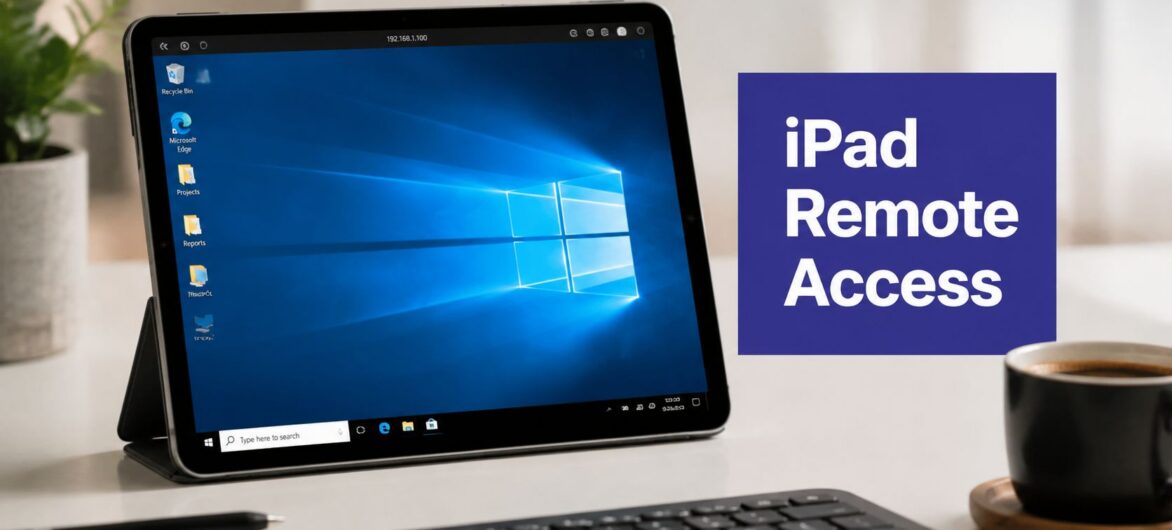
It's April 14, your child's soccer game is underway, and a client has just called about an urgent tax filing problem. Your laptop is at the office, the client files shouldn't be downloaded to your personal tablet, and the only device in reach is the iPad in your bag. With a properly designed remote desktop access iPad setup, you can connect to a controlled work environment, open the required accounting or legal application, complete the task, and leave the sensitive data on the hosted desktop.
That convenience only matters when security, identity, session management, and performance are designed for professional work. Accountants, lawyers, and small businesses need more than an app that displays a Windows screen. They need a remote endpoint that fits their access policy, protects client information, creates useful audit records, and remains usable with a touch interface.
An iPad is a practical remote endpoint because it's light, portable, and easy to keep available during travel, client visits, court preparation, or a busy filing season. It can give a professional access to familiar desktop software such as QuickBooks, tax applications, document management systems, CRM platforms, and Microsoft applications without requiring the full desktop environment to be installed locally.
The important distinction is where the applications and files run. A hosted desktop keeps the working environment in the organization's controlled infrastructure, while the iPad acts as the screen, keyboard, and pointer. That arrangement can reduce the need to store client records directly on a personal device, although it doesn't eliminate the need to secure the iPad itself.
For firms evaluating a broader hosted-workplace model, Cloudvara's digital workplace solutions describe an approach in which existing business applications are centralized and accessed remotely. The practical benefit is consistency. Staff members can reach the same configured applications and data rather than maintaining separate local copies across laptops and tablets.
Practical rule: Use the iPad as an access device, not as an ungoverned storage location for client work.
Remote access works particularly well for review, approval, administration, and short operational tasks. A CPA can check a ledger, approve a workflow, or retrieve a report. A lawyer can review a document, search a matter workspace, or make a controlled edit. A business owner can access a CRM record without carrying an office laptop everywhere.
It's less suitable for long drafting sessions, extensive spreadsheet manipulation, complex document comparison, or work that depends on multiple large monitors. Those jobs usually benefit from a full laptop or desktop, a physical keyboard, and more screen space. The right question isn't whether an iPad can display a desktop. It's whether the task remains accurate and comfortable when delivered through a tablet viewport.
Guest access deserves separate treatment. If clients, visitors, or temporary staff use a shared tablet, a guide to a secure iPad for guests can help administrators separate guest activity from professional sessions. A regulated firm shouldn't treat a shared device as automatically safe just because the remote desktop is hosted elsewhere.
The client determines how the iPad communicates with the hosted desktop, but it doesn't replace the security architecture behind that desktop. Start with the environment you already operate, the identity provider your firm trusts, and the applications users need. Choosing an app first often creates unnecessary rework.
Microsoft Remote Desktop is usually the natural fit for a Windows-based hosted environment. It handles familiar Windows session workflows and can align well with Microsoft identity controls, including Azure AD and Conditional Access where those controls are part of the organization's design. Citrix Workspace makes more sense when the firm already uses Citrix for application delivery, virtual desktops, policy enforcement, or centralized access management. VNC clients such as RealVNC or Screens are useful for Mac access and cross-platform administration, but they may require more deliberate security design around the host and gateway.
| Client | Best For | 2FA Support | Performance | Setup Complexity |
|---|---|---|---|---|
| Microsoft Remote Desktop | Windows desktops and Microsoft-centered environments | Depends on the gateway and identity configuration | Strong for standard Windows application work | Moderate |
| Citrix Workspace | Existing Citrix deployments and controlled application delivery | Depends on Citrix and identity-provider configuration | Strong when the Citrix environment is tuned for the workload | Higher |
| VNC clients | Mac-to-iPad access and cross-platform scenarios | Depends on the VNC server, gateway, and identity layer | Suitable for administrative and desktop access, with more variation by host | Moderate to high |
A solo CPA accessing QuickBooks from a managed hosted Windows desktop typically values simple sign-in, dependable keyboard input, and predictable reconnection. Microsoft Remote Desktop is often the straightforward starting point when the service provider supplies the required gateway and credentials.
A law firm with many attorneys, document-management integrations, and strict application entitlements may need Citrix Workspace if its infrastructure already depends on Citrix policies. In that setting, the client is one part of a larger delivery system. Switching clients without reviewing identity, access groups, and session controls can create gaps.
VNC is a different choice. It can be appropriate for a Mac workstation, technical administration, or a mixed-device environment, but it shouldn't be selected merely because it's familiar. Review encryption, authentication, gateway exposure, logging, and account permissions before approving it for client data.
Independent coverage also describes meaningful differences among iPad remote desktop options, including reported input latency around 47 ms for one option, stronger Azure AD and Conditional Access integration for another, and improved frame pacing on M2 and M3 iPads for some alternatives. Those observations are summarized in this iPad VNC comparison, but they shouldn't be treated as a universal ranking. Network policy, host configuration, and workload matter more than a single app label.
For a broader feature and deployment comparison, review remote desktop software options against your firm's requirements rather than choosing solely on app-store ratings.
A reliable setup begins with the hosted environment, not the iPad. Confirm the approved client, host or gateway name, account identifier, authentication method, and whether the firm requires a VPN. Don't ask users to improvise connection details or save shared credentials in a chat message.

Create an individual account for each professional. Shared logins make it difficult to determine who accessed a client file and complicate access removal when someone leaves the firm. Enable two-factor authentication through the approved service or identity provider, then verify that the second factor works from the iPad before the user needs it during a deadline.
Store credentials in an enterprise-approved password manager. Avoid saving passwords in browser notes, screenshots, email drafts, or an unsecured clipboard. If the iPad is personally owned, document what the firm permits, whether the device is enrolled in management, and whether remote access is allowed from it at all.
If the firm uses a VPN, install the approved profile and test it away from the office network. A VPN can provide an additional policy boundary, but it also adds another point of failure. Users need to know whether they should connect to the VPN before opening the remote desktop client and what to do when the VPN reconnects after a network change.
In Microsoft Remote Desktop, add a new workspace or PC using the host information supplied by the administrator. Enter the user account in the required format, then open the display settings and choose a resolution that fits the iPad viewport. Avoid forcing a large desktop layout that requires constant panning and zooming.
Configure the session for the firm's needs:
A saved profile improves consistency, but it shouldn't contain more access than the user needs. For iPad-specific connection guidance, the remote desktop access instructions for iPhone and iPad provide a useful reference point for the connection flow.
The accompanying video can help users recognize the basic client workflow before they configure a production connection.
Run a test using the same application and network conditions the user will face in practice. Open a representative document, enter non-production data, disconnect the iPad from Wi-Fi, reconnect, and confirm that the session behaves as expected. A test that only verifies login doesn't prove that keyboard input, clipboard restrictions, printing, file access, and reconnection work correctly.
A remote desktop session can protect data from casual local storage, but it doesn't make an unmanaged iPad compliant by itself. Accountants and lawyers should treat the tablet as a potentially sensitive endpoint because it can hold authentication tokens, cached connection information, screenshots, copied text, and notifications.
Start with the device. Require a passcode, automatic locking, current operating-system patches, and encryption controls supported by the iPad. Don't permit remote work from a device that family members use freely, especially when the same device receives personal notifications or stores unmanaged applications. If the firm allows personal tablets, establish written rules for enrollment, lost-device reporting, application control, and removal of business access.
Apple's security advisory for iPadOS 18.4 describes a condition in which an app could gain unauthorized access to the local network. That reinforces a point many remote-access guides miss: patching and application permissions belong in the remote desktop policy, not just in the help-desk checklist. Review Apple's iPadOS 18.4 security advisory when assessing patch expectations and local-network exposure.
Use least privilege at both the desktop and application layers. A bookkeeper who enters transactions may not need access to payroll exports. A junior associate may need document review but not matter administration. Separate permissions reduce the damage caused by a compromised account or an accidentally shared session.
Idle sessions require an explicit policy. Government guidance for iPad-based VDI and BYOD use warns that idle sessions can persist, unsaved data can be lost when users fail to log off properly, and one official environment uses automatic disconnect after 30 minutes with server-side logoff after 4 hours of idle time. Review the official VDI and BYOD iPad guidance and set timeouts that reflect your applications, client agreements, and risk tolerance.
Security rule: Disconnecting the iPad isn't the same as logging off the hosted desktop.
Keep audit records tied to individual identities. Administrators should be able to determine who connected, when the session began, what system received the connection, and whether unusual access occurred. Apple's Remote Desktop documentation states that user-history reporting retains only the last 30 days of accumulated client data and is enabled by default unless an older version was upgraded. That window may be useful for short-term review, but it shouldn't be mistaken for a complete long-term compliance archive. Export or preserve records according to the firm's retention policy.
If a tablet is lost, revoke sessions, change relevant credentials, remove device trust, and notify the person responsible for incident response. Firms that need a manual iOS VPN setup should use a controlled procedure such as this manual VPN configuration guide for iOS, then validate the profile with their own security team.
For a broader control checklist, align the deployment with remote access security best practices.

Performance problems usually come from a mismatch between the network, display settings, host encoding, and the task. A remote session that feels fine for reading an email may feel poor when scrolling through a financial statement or redlining a contract.
Put the host on wired Ethernet where possible, or on a Wi-Fi 6 or Wi-Fi 6E network. Pair the iPad with an external keyboard and trackpad, then match the remote resolution to the iPad viewport instead of streaming the full native desktop size. An independent setup guide recommends 1280×800 or 1920×1080 for responsiveness, with 1080p60 generally requiring 20–50 Mbps upstream and 1080p30 usually requiring 8–20 Mbps. Those figures come from the iPad remote desktop performance guide, so treat them as planning guidance rather than a guarantee for every client or network.

For QuickBooks or another accounting application, prioritize crisp text and reliable keyboard entry over visual effects. For Word-based contract review, reduce unnecessary animation and use an external pointer for selection. For document management, test scrolling, search, preview rendering, and opening attachments rather than judging performance from a static desktop.
Hardware video encoding on the host can reduce CPU pressure and improve frame-rate consistency. Common technologies include NVENC, Quick Sync, and AMF, but the administrator should validate the encoder against the actual hosted hardware and client software. If the host is busy with accounting databases, document indexing, or backups, streaming quality can suffer even when the iPad is powerful.
Modern iPads can deliver a smooth remote session when the host and network are well configured. M2 and M3 models may show better frame pacing in some remote desktop options, but the chip doesn't compensate for poor Wi-Fi, excessive resolution, or an overloaded host. An iPad Air can be perfectly adequate for review and administration, while intensive multi-window work may still call for a laptop.
Use Apple Pencil selectively. It can help with annotation or signature workflows where the remote application supports pointer or touch input properly, but it may not reproduce every desktop stylus behavior. Test signature capture with non-sensitive sample documents before deploying it for client execution.
For a practical settings checklist, use the guidance on settings for remote desktop and record the approved configuration so support staff can compare a failing session against a known baseline.
Start with the symptom, not the app's error wording. A connection timeout usually points to network reachability, firewall policy, VPN state, or an incorrect host setting. Confirm that the iPad has internet access, check whether the required VPN is connected, and test the same profile from an approved alternate network.
An authentication failure usually means the username, password, second factor, account status, or identity-provider policy needs attention. Re-enter the credentials rather than copying them from an old note, verify the device clock, and confirm that the account isn't locked. Don't repeatedly retry a failing account if the firm's policy triggers lockout controls.
A black screen often follows a display, graphics, or session-state problem. Disconnect the session, reopen the profile with a smaller viewport resolution, and ask the administrator to check the host graphics session. If the desktop appears but input lags, test the network first, then lower the display quality and confirm that host hardware encoding is available.
For keyboard shortcuts and trackpad gestures, check whether iPadOS or the remote client is consuming the command before Windows or macOS receives it. Disable unnecessary local redirection, reconnect the keyboard, and restart the client if it crashes. Keep a written escalation path for Cloudvara support and include the user, device, connection profile, time of failure, network type, and exact error message. Never send passwords or client documents in a support ticket.
A short preventive check before critical work should confirm the iPad is patched, the battery is sufficient, the approved network or VPN is active, the second factor is available, and the user has logged out of the previous session correctly.
Cloudvara provides hosted desktop access for business applications, including accounting, tax, document management, CRM, and Microsoft workloads, so professionals can reach a controlled work environment from an iPad instead of storing the full desktop locally. Review your firm's access, identity, and session requirements, then visit Cloudvara to evaluate a remote desktop setup that fits regulated professional work.