The entire on prem vs off prem debate boils down to one simple question: where does your IT infrastructure live, and who owns it? Think of it this way: on-premise means you buy, house, and manage all your servers right in your own building. Off-premise means you're essentially renting server space and power from a specialized provider.
Your answer to that question sets the stage for everything from your budget to your ability to grow.
Choosing between on-premise and off-premise infrastructure is one of those core business decisions that ripples through every department. This isn’t just a technical choice about server racks; it’s a strategic one that defines who’s on the hook for security, maintenance, and keeping the lights on.
Let's break these concepts down into real-world terms.
An on-premise setup—often just called “on prem”—is the traditional model where your company buys and manages all its IT hardware and software in-house. You have physical, hands-on control over the servers, storage, and network gear.
This approach gives you maximum control and customization, but it comes at a cost. You’ll need a significant upfront investment and a skilled IT team to keep it all running smoothly.
On the flip side, off-premise infrastructure means you outsource your IT hardware needs to an external provider. This could be a public cloud giant like AWS or a more specialized managed hosting service. Instead of buying servers, you pay a predictable fee to access their resources.
This model slashes capital expenses and shifts the heavy lifting of management and maintenance to the provider. If you want a deeper dive into how this works, our guide on what is cloud infrastructure is a great place to start.
The difference between these two paths creates a completely different set of responsibilities and advantages.
Key Takeaway: On-premise is an asset you own, making it a capital expense (CapEx). Off-premise is a service you subscribe to, turning it into an operational expense (OpEx). This financial distinction is often the first domino to fall when deciding which direction to take.
To get a clearer picture right away, here’s a quick breakdown of how each model stacks up.
| Factor | On-Premise (On Prem) | Off-Premise (Off Prem) |
|---|---|---|
| Location | Housed within your company's own facilities. | Hosted in a secure, third-party data center. |
| Ownership | You own all hardware and software licenses. | You lease resources from a service provider. |
| Control | Complete, direct control over the entire stack. | Control is shared with the provider. |
| Cost Model | High upfront CapEx, plus ongoing OpEx for maintenance. | Predictable OpEx subscription model with no surprise costs. |
| Management | Your internal IT team handles everything. | The provider manages hardware, maintenance, and security. |
Choosing between on-premise and off-premise infrastructure isn't just a technical decision—it's a business one. To make the right call, you have to dig into how each model really performs when it comes to costs, security, and the flexibility you'll need to grow. These aren't just minor trade-offs; they directly impact how your business operates day-to-day.
The global shift toward the cloud makes this conversation more urgent than ever. Right now, about 60% of organizations run more than half their workloads in the cloud, a huge leap from just 39% in 2022. Budgets are following suit, with companies planning to dedicate 80% of their IT hosting funds to cloud services. The trend is clear: businesses are moving away from the old-school dominance of on-premise setups. You can see more on this in these cloud computing statistics on cloudzero.com.
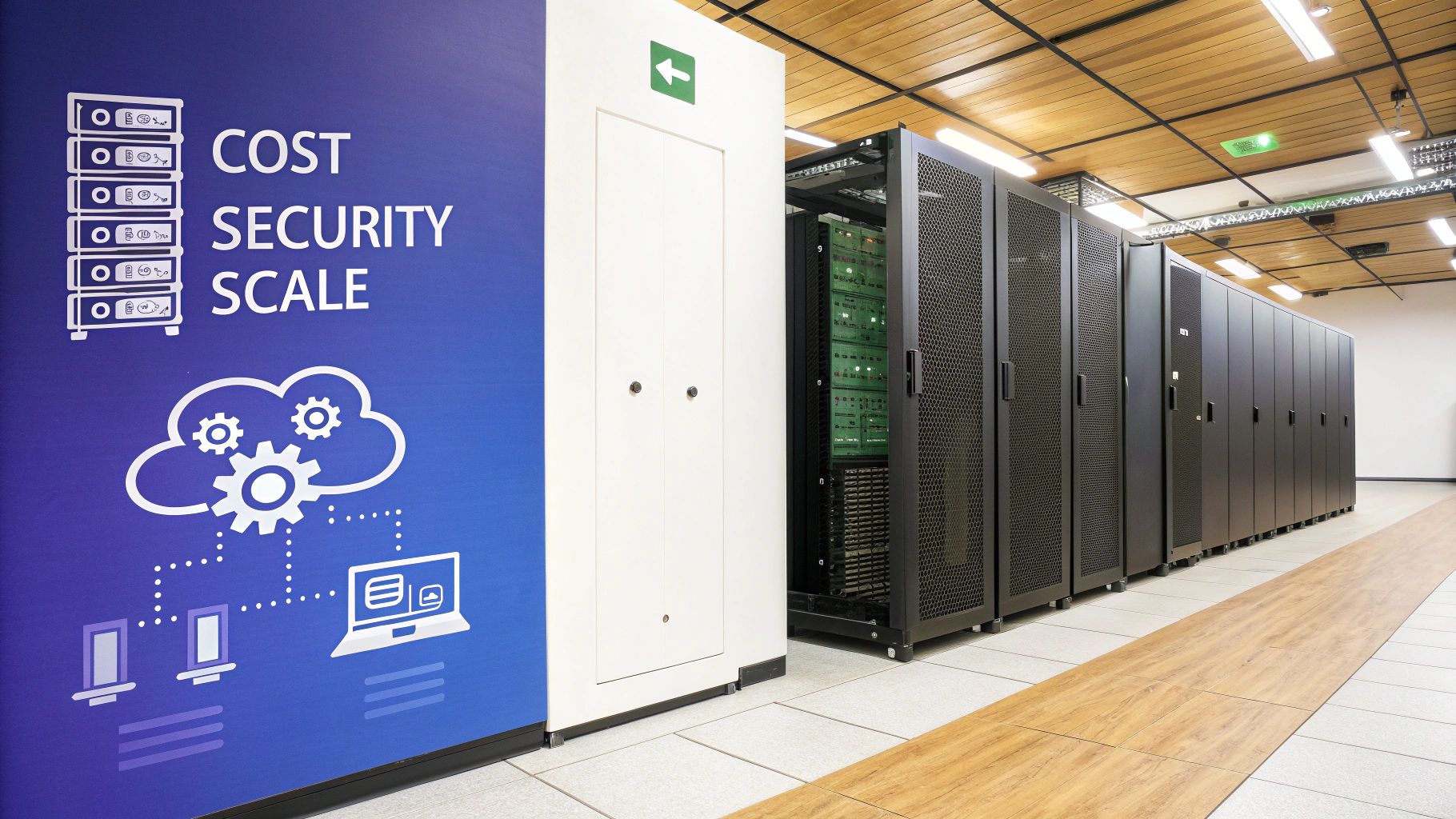
The most immediate difference between on-prem and off-prem is how you pay. On-premise solutions are all about Capital Expenditures (CapEx). That means a big, upfront investment in servers, software licenses, and the physical space to keep it all running.
Off-premise models, on the other hand, run on an Operational Expenditure (OpEx) basis. Instead of a massive initial outlay, you pay a predictable subscription fee. This approach frees up cash flow and makes budgeting a whole lot simpler. For a deeper dive into this financial dynamic, take a look at our guide comparing a cloud server vs in-house hosting.
Key Takeaway: The choice isn't just about the total cost but how you spend it. An OpEx model gives you financial agility, while a CapEx model gives you a physical asset that depreciates over time.
Security is another area where the two models diverge sharply. With an on-premise setup, you’re in the driver’s seat. Your team is responsible for everything—from locking the server room door to configuring firewalls and encrypting data.
This level of direct control is non-negotiable for businesses in highly regulated industries like healthcare or finance, where strict compliance rules dictate exactly how data must be handled.
Off-premise solutions work on a shared responsibility model. The provider secures the core infrastructure—their data centers, servers, and networks—while you secure your own applications and data within that environment. The upside? Top-tier providers offer enterprise-grade security that most small businesses could never afford to build themselves.
When it comes to scalability, the operational differences become crystal clear. Trying to expand an on-premise environment is a slow and expensive process.
It typically involves:
This whole process can take weeks, creating a frustrating lag between a business need and the capacity to meet it.
Off-premise solutions, in contrast, offer almost instant scalability. Need more power for a holiday sales rush? You can spin up new resources with a few clicks and scale back down just as easily when things quiet down. This agility lets you react to market changes in real time, without being held back by physical hardware.
To give you a clearer picture, here’s a side-by-side breakdown of the key features.
| Factor | On-Premise (On Prem) | Off-Premise (Off Prem) |
|---|---|---|
| Cost Structure | CapEx: High upfront investment in hardware and licenses. | OpEx: Predictable, recurring subscription fees. |
| Scalability | Slow & Manual: Requires hardware procurement and setup. | Rapid & On-Demand: Scale resources up or down in minutes. |
| Security | Full Control: You manage all security layers, from physical to digital. | Shared Responsibility: Provider secures infrastructure; you secure data. |
| Management | In-House Burden: Requires a dedicated IT team for maintenance. | Provider-Managed: Vendor handles hardware and infrastructure upkeep. |
| Accessibility | Limited: Access is often tied to the physical office network. | Global: Access from anywhere with an internet connection. |
This table highlights the fundamental trade-offs. On-premise gives you total control at the cost of flexibility, while off-premise delivers agility by outsourcing infrastructure management.
Finally, think about the day-to-day grind. An on-premise data center needs a dedicated IT team to handle routine maintenance, software updates, hardware repairs, and constant troubleshooting. This adds significant operational costs and demands specialized expertise on your payroll.
With an off-premise model, the provider handles all of that. They take care of hardware maintenance, security patches, and infrastructure upkeep behind the scenes. This frees up your IT staff to focus on projects that actually grow the business, instead of just keeping the lights on. It’s this shift—from tactical maintenance to strategic innovation—that drives so many businesses to choose an off-premise solution.
When you're weighing on prem vs off prem, it’s tempting to just compare a server's price tag against a monthly cloud subscription. But that’s a rookie mistake. To make a smart financial call, you have to look deeper at the Total Cost of Ownership (TCO), which covers every single dollar you'll spend over the life of the system.
A surface-level glance is misleading. The real story is in the hidden costs and long-term benefits of each model, which ultimately decide the true financial impact on your business.

On-premise infrastructure is all about massive upfront Capital Expenditures (CapEx). And that initial investment goes way beyond just the servers themselves.
Here's where the money goes from day one:
But the spending doesn’t stop there. The ongoing Operational Expenditures (OpEx) are a constant drain. Think IT staff salaries for management, routine maintenance contracts, software updates, and the ever-climbing utility bills for power and cooling.
Off-premise solutions completely flip the script, trading those huge CapEx hits for predictable OpEx. This pay-as-you-go approach is a huge draw for small and medium-sized enterprises (SMEs). In fact, in 2023, 63% of SME workloads were cloud-hosted, a jump from 57% the year before, primarily to sidestep those big upfront hardware costs.
However, the off-prem TCO isn't just the monthly subscription fee. To get the full picture, you need to implement effective cloud cost optimization best practices. You also have to keep an eye out for hidden costs that can sneak up and inflate your bill.
Key Takeaway: Watch out for "bill shock." Surprise expenses like data egress fees (what you pay to move data out of the cloud), premium support tiers, and overage charges for using more resources than planned can quickly eat away at your expected savings.
A true financial analysis means more than just adding up invoices. For a detailed guide on how to calculate and minimize these expenses, take a look at our article on reducing total cost of ownership. Understanding both the obvious and the hidden costs is the only way to make a financial decision that actually supports your business goals.
Choosing an off-premise solution means stepping into a massive, competitive marketplace. It’s a landscape largely defined by a few giant public cloud providers, each offering a distinct ecosystem of tools and services. Getting to know these key players is the first step in moving the on prem vs off prem debate from theory into practice.
The market is dominated by three platforms that have become practically synonymous with cloud computing.
A handful of tech titans control the vast majority of the off-premise market. These providers offer incredible scale, a global footprint, and a dizzying array of services that extend far beyond simple storage and computing power.
This concentration is only growing. As of mid-2023, AWS, Azure, and GCP collectively held about 67% of the worldwide cloud market, a significant climb from 61% just the year before.
Public clouds offer services across different models—Infrastructure as a Service (IaaS), Platform as a Service (PaaS), and Software as a Service (SaaS)—giving you granular control over your IT stack.
But the giants aren't the only game in town. For many businesses, a specialized managed hosting provider like Cloudvara offers a more focused and supportive alternative. This path is perfect for organizations that need dedicated performance for specific applications—like QuickBooks or Sage—without the overwhelming complexity of managing a public cloud environment.
Unlike the self-service model of the big three, managed providers become an extension of your IT team. They handle the infrastructure, security, and maintenance, freeing you up to focus on your core business. This approach blends the financial upsides of an off-premise model with the hands-on support many businesses need to thrive. Making the right choice is critical, and our guide on how to choose a cloud provider can help you weigh these options effectively.
The "on-prem vs. off-prem" debate isn't just about servers and software; it's a strategic decision that needs to align with your business model, industry, and long-term vision. Generic advice often misses the mark because the best path is entirely contextual. What works for a high-growth startup will almost certainly be the wrong fit for a mature financial firm.
To see this in action, let's step away from theory and look at two real-world scenarios.
Imagine a fast-growing e-commerce company gearing up for the holiday rush. An on-premise model would be a straightjacket. The need for sudden, massive scalability to handle traffic spikes makes an off-premise, cloud-based solution the only logical choice. It allows them to pay for a burst of computing power only when needed, avoiding the huge capital expense of buying servers that would sit idle for most of the year.
Now, consider a regional financial services firm operating under strict data sovereignty laws. Their priorities are completely different. The need to prove data is stored in a specific geographic location—and to maintain absolute control over every security protocol—often makes an on-premise or a tightly controlled hybrid model the only viable option. Here, compliance and control easily outweigh the benefits of elastic scalability.
To figure out the right fit for your organization, you need to ask the right questions. Your answers will paint a clear picture of which infrastructure model truly supports your goals. This isn't about finding a perfect solution, but rather the best-fit compromise for your unique operational reality.
Think through these critical areas to guide your decision:
Key Insight: The decision really boils down to what you value most. If your top priority is ultimate control and ironclad compliance, on-premise holds a strong advantage. If you prioritize agility, scalability, and focusing your team on innovation instead of maintenance, an off-premise model is the clear winner.
By carefully walking through these factors, you can make a confident, strategic decision that sets your business up for success. The goal is to ensure your IT infrastructure is a catalyst for growth, not a bottleneck holding you back.
For many businesses, the strict on-prem vs. off-prem debate feels like a false choice. The best solution often isn't about choosing between total control of your own hardware and the wide-open, self-service world of the public cloud. Managed hosting has emerged as a powerful middle ground, offering a practical path for companies that need both efficiency and reliability.
This approach gives you the performance and security of dedicated off-premise infrastructure but bundles it with expert support. That frees up your team from the complexities of day-to-day IT management. The infographic below simplifies the initial decision-making process, especially when data regulations are a factor.
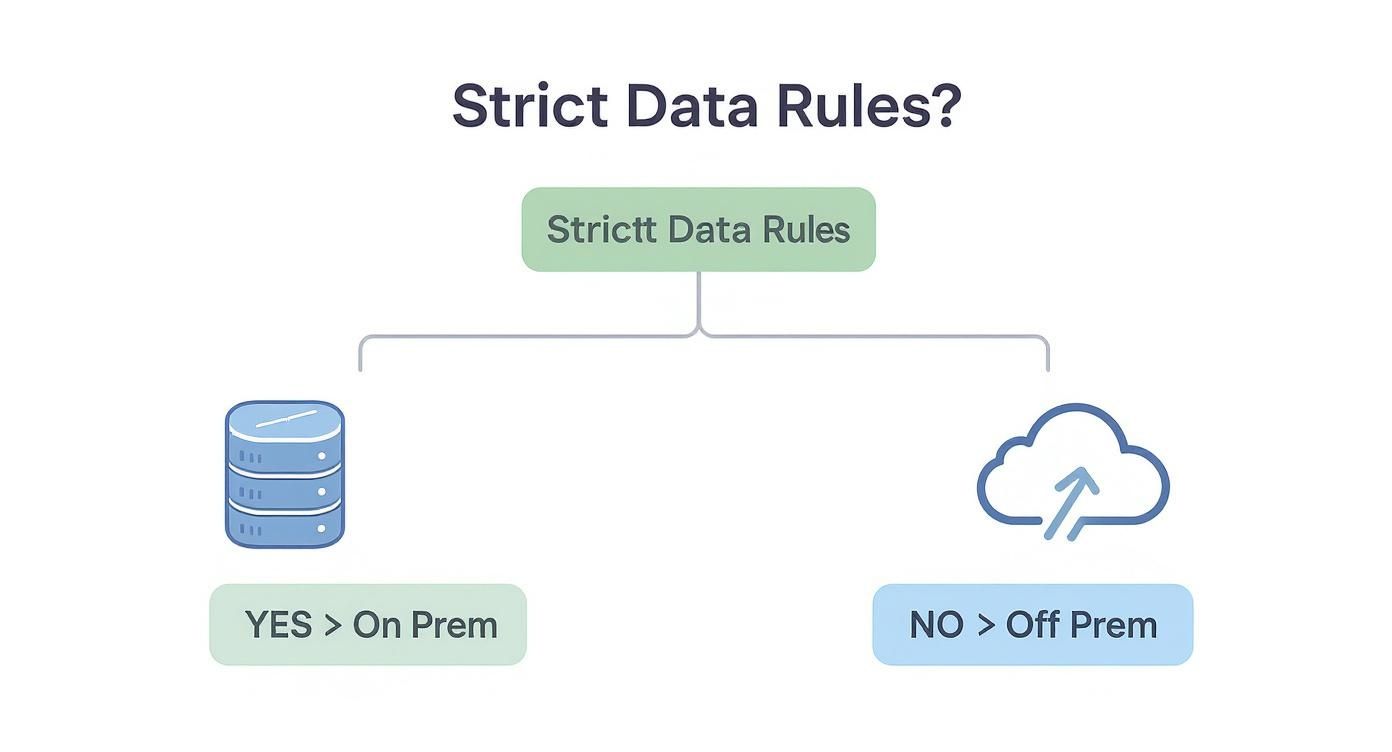
As you can see, compliance often steers the infrastructure choice, but managed hosting can satisfy even strict security needs without forcing you to buy and maintain in-house hardware.
By partnering with a provider, you solve common headaches like ensuring high uptime for critical software or getting specialized technical support without a massive capital investment. We explore this model in more detail in our overview of managed cloud services, which breaks down the operational advantages. For those exploring hybrid setups, understanding how specialized managed services work is key. For example, this A Practical Guide to Managed Flink offers great insights into how to reduce infrastructure burdens.
Making the leap between on-prem and off-prem often comes down to a few specific, practical questions. Let's tackle some of the most common ones that come up when businesses are weighing their options.
The two biggest hurdles are usually technical complexity and business disruption. A migration isn't just about copying files; it's a full-scale operation that involves reconfiguring applications, redesigning network paths, and ensuring every security protocol still holds up.
The real trick is moving everything without interrupting daily operations. This is why a phased approach almost always works best. You can start by moving less critical systems to iron out the process before you touch the core applications that run your business.
Not at all—its role is just getting more specialized. While the momentum is clearly toward off-prem solutions, on-premise hardware is still essential for companies in tightly regulated industries like finance or healthcare. For them, the absolute control over data is non-negotiable for meeting strict compliance rules.
Instead of disappearing, on-prem is finding its place as a crucial part of a hybrid strategy. It handles the most sensitive workloads, while the cloud takes care of everything else.
Key Insight: The future isn't a battle between on-prem and off-prem. It's about a hybrid model that blends the ironclad security of on-prem with the agility of the cloud, giving you the best of both worlds.
A great hybrid setup depends on two things: seamless integration and smart workload placement. The first step is to draw a clear line—what data and applications must stay on-prem for security or compliance reasons?
Once you've identified those, you can decide which operations would gain the most from the scale and cost-efficiency of an off-prem provider. The final piece is using tools that let you manage and sync data across both environments, so they operate like a single, unified system instead of two disconnected islands.
Ready to simplify your IT without giving up performance or security? Cloudvara offers managed hosting solutions that strike the perfect balance between control and convenience.
Explore our hosting services and start your free 15-day trial today.