Learning how to reduce operational costs is about so much more than just slashing budgets. It's about building a smarter, more resilient business from the inside out. The most effective way I've seen this done combines two powerful moves: optimizing your internal processes and modernizing your technology.
Forget the old slash-and-burn mindset. This is about surgically removing waste, not cutting into the muscle of your business.
Think of strategic cost management as the foundation for sustainable growth. It’s not a one-off project you tackle in a tough quarter; it's an ongoing discipline that gives you a serious competitive edge. When you constantly look for and eliminate the little inefficiencies that drain resources, you're not just cutting costs—you're freeing up capital.
That freed-up capital can then be poured back into things that actually drive revenue and make customers happy. Innovation, anyone?
The journey always starts with figuring out where your money is really going. Some costs, like payroll and rent, are obvious. But countless others are buried deep within clunky workflows, underused software subscriptions, and outdated team structures. Getting a clear view of these hidden expenses is the first real step toward making a meaningful change.
Most of your operational costs will fall into just a few major buckets. If you start digging into each one, you’ll quickly spot the biggest opportunities for savings. Look for areas where the spending feels completely out of sync with the value you're getting back, or where simple tasks seem to involve way too many steps.
Here are a few places I always tell clients to investigate first:
Technology and IT Infrastructure: Are you still paying for software licenses nobody has logged into for months? Or worse, are you maintaining expensive, power-hungry servers in a closet when a cloud solution would be cheaper and far more flexible?
Administrative and Overhead Costs: This is the land of a thousand small cuts—office supplies, professional service fees, travel expenses. Individually, they seem minor, but these recurring costs can add up to a staggering amount over a year.
Production and Service Delivery: Map out the entire journey of delivering your product or service. You'll almost certainly find redundant steps, manual data entry that could be automated, or supplier contracts that are long overdue for a renegotiation.
The smartest cost-reduction strategies I've seen always pair process optimization with a technology upgrade. When companies adopt methodologies to eliminate waste and use automation for repetitive tasks, the efficiency gains are massive.
Before we dive deeper, let's break down where these costs typically hide.
This table gives a bird's-eye view of the primary operational cost categories and pinpoints common areas ripe for savings. Use it as a checklist to start your own audit.
| Cost Category | Common Expenses | Key Savings Strategy |
|---|---|---|
| Administrative & Overhead | Office rent, utilities, supplies, insurance, professional fees | Renegotiate leases, switch to energy-efficient equipment, consolidate vendors, review service contracts annually. |
| Technology & IT | Software licenses, hardware maintenance, on-premise servers, data storage | Migrate to the cloud, audit and cancel unused software licenses, adopt SaaS models to reduce maintenance. |
| Sales & Marketing | Advertising spend, CRM subscriptions, commissions, travel | Optimize ad campaigns based on ROI, leverage marketing automation, consolidate sales tools. |
| Production & Operations | Raw materials, supplier costs, inventory management, shipping | Renegotiate supplier contracts, implement just-in-time inventory, automate manual production steps. |
| Human Resources & Payroll | Salaries, benefits, recruitment fees, training programs | Optimize staffing models, automate HR processes (like onboarding), reduce employee turnover through better engagement. |
Looking at your expenses through this lens helps you move from broad concerns to specific, actionable targets.
Thinking strategically means you're looking beyond the immediate cuts. The real goal is to build a leaner, more agile company that can pivot with the market without ever sacrificing quality. One of the most powerful ways to do this is by combining process refinement with technology upgrades.
This could mean simplifying a bloated management hierarchy to cut down on indirect costs or swapping out that ancient IT system for a scalable, cloud-based platform. If you're looking for a good starting point, exploring a range of strategies is key. For a solid overview of foundational approaches, check out these 10 Smart Ways to Reduce Operating Costs.
This forward-thinking approach doesn't just boost your profit margins today—it builds a durable, competitive advantage for the future. You can find more great insights on how top companies are tackling these challenges over at kaizen.com.
Before you can start cutting costs, you have to know exactly where your money is going. And I don't mean a quick glance at your P&L statement. A real operational cost audit means mapping your core business processes to find all the hidden redundancies and wasteful habits draining your budget.
This isn't just about looking at numbers on a spreadsheet. It's about creating a detailed "cost map" of your entire organization, connecting those numbers to specific actions, tools, and workflows. Only then can you see where the real fat is.

This process gives you a solid, data-backed foundation for your cost-reduction strategy. It ensures every change you make is targeted and smart.
First things first: categorize every single expense. Payroll is the obvious one, but it’s often the smaller, recurring charges that tell the most interesting stories about operational waste. Think software subscriptions, vendor contracts, and even utility bills.
I've seen so many businesses shocked to discover they're paying for dozens of software licenses that their employees barely touch. This "shelfware" can easily waste thousands of dollars every year. In another case, a client analyzed their utility bills and found a single piece of old server equipment was an energy hog, costing them hundreds extra each month.
A thorough audit isn't about finding fault; it's about finding opportunities. The goal is to identify every dollar that isn't actively contributing to your company's growth or customer value.
Once you've got a handle on what you're spending, the real work begins: linking those expenses to specific business activities. This is where you shift from simple accounting to true operational analysis. If you see a high cost for a particular piece of software, dig in. Who uses it? How often? And for what, exactly?
Vendor Contract Review: When was the last time you actually renegotiated with your suppliers? An audit will quickly flag contracts that haven't been touched in years, giving you a perfect reason to pick up the phone or look for more competitive pricing.
Technology Utilization: Are you paying for the premium tier of your CRM but only using the basic features? Or are you still maintaining expensive on-premise servers when a flexible cloud solution would be far more cost-effective? Getting this clear picture is a critical first step in any successful cloud cost optimization plan.
Workflow Inefficiencies: Take a key process—like customer onboarding—and walk it from start to finish. You might find manual data entry points that could be easily automated or redundant approval steps that cause expensive delays for no good reason.
This detailed mapping turns abstract expenses into tangible, fixable problems. It gives you the clarity you need to make strategic cuts, ensuring you trim the fat without ever touching the muscle of your business.
One of the biggest levers you can pull to slash operational costs is ditching expensive on-premise infrastructure for the cloud. When you run your own servers, you’re not just paying for the hardware. You’re also footing the bill for real estate, cooling, electricity, and the specialized IT team needed to keep it all running. A strategic shift to the cloud flips that entire model on its head.
Instead of a huge upfront capital expense for hardware that will eventually be outdated, you move to a pay-as-you-go model. This gives you predictable monthly operational expenses that can scale up or down right alongside your business needs. It’s a fundamental change from owning and maintaining to renting and scaling on demand.
To get the most savings, you need to understand the different cloud models out there. Each one offers a different level of management and a different cost structure, so you can pick what aligns best with your team's technical skills and business goals.
You'll generally run into three main types:
Infrastructure as a Service (IaaS): Think of this like renting the basic building blocks—virtual servers, networking, and storage—from providers such as Amazon Web Services (AWS) or Microsoft Azure. You still manage the operating systems and applications, giving you total control without the headache of hardware maintenance.
Platform as a Service (PaaS): This model gives you the hardware and an application software platform. Your team can focus completely on developing and running your applications without ever worrying about the underlying infrastructure, which cuts IT overhead even further.
Software as a Service (SaaS): This is the model most people are familiar with. You subscribe to software that’s ready to go, like Google Workspace or Microsoft Teams. The provider handles all the infrastructure, maintenance, and updates, removing the IT burden from your plate entirely.
To see the financial impact clearly, it helps to break down where the money goes. This table compares the typical costs of a traditional setup versus a cloud model.
| Cost Factor | On-Premise Infrastructure | Cloud-Based Model (e.g., AWS, Azure) |
|---|---|---|
| Initial Investment | High (Servers, networking gear, storage) | Low to None (No hardware to purchase) |
| Real Estate | Required (Server rooms, data center space) | None (Provider handles facilities) |
| Energy & Cooling | Significant (High electricity consumption) | Included in service fees |
| IT Staffing | Extensive (Hardware maintenance, setup, security) | Reduced (Focus shifts to management) |
| Maintenance | Ongoing (Component replacement, repairs) | None (Handled by the provider) |
| Scalability | Slow & Expensive (Requires new hardware) | Fast & Flexible (Adjust resources on demand) |
| Pricing Model | Capital Expenditure (CapEx) | Operational Expenditure (OpEx) |
As you can see, the cloud doesn't just eliminate hardware costs; it removes a whole cascade of related expenses that add up quickly.
Moving to the cloud isn’t just an IT project—it’s a business decision that unlocks efficiency across your entire company. A well-planned migration can seriously lower your technology's total cost of ownership.
By migrating, you’re not just saving money on servers. You’re redirecting your team's valuable time from routine maintenance and troubleshooting to high-impact activities that drive business growth.
This infographic shows how modernizing your tech is directly tied to streamlining core business functions, like supply chain management.
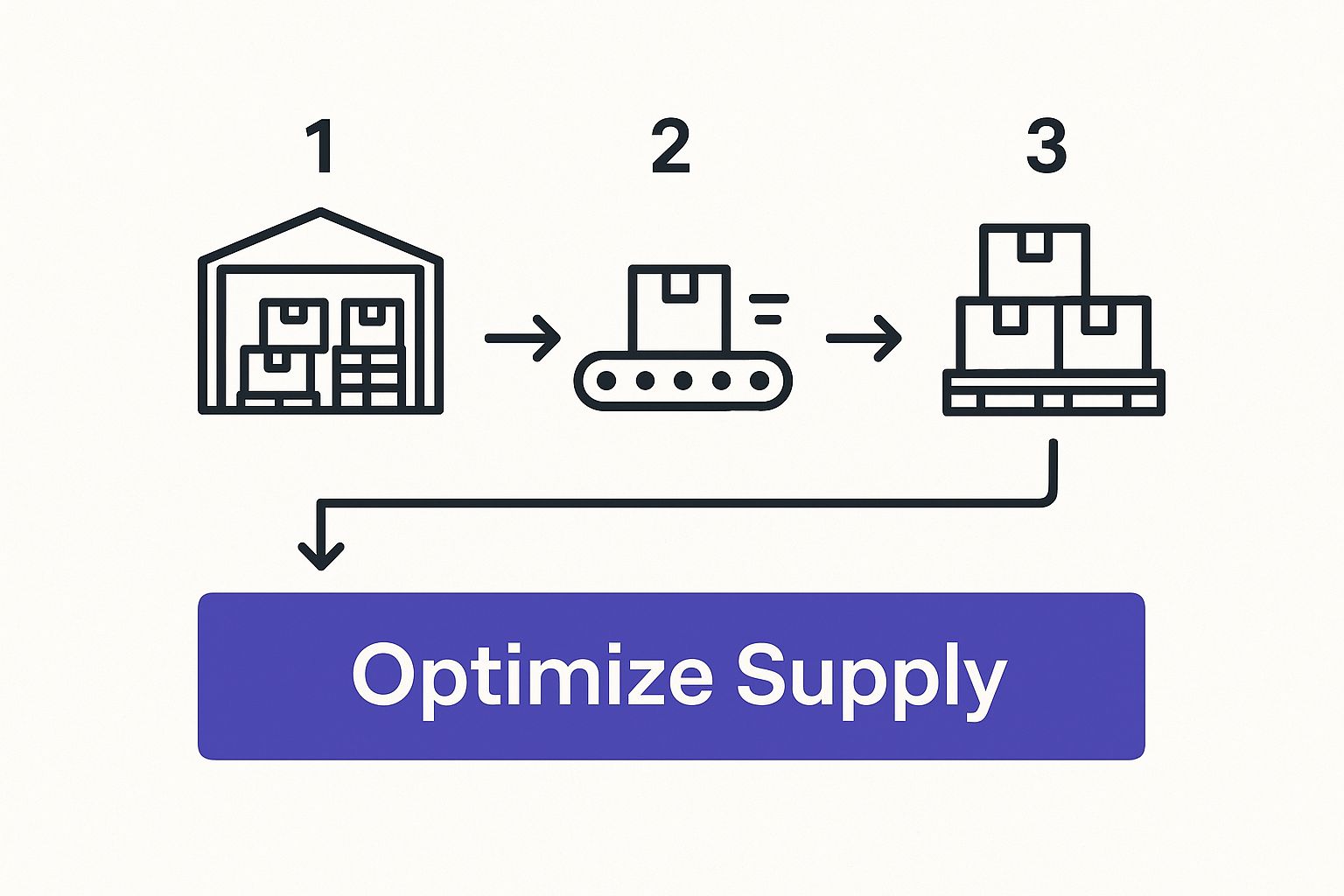
It’s a great visual reminder that technology upgrades aren’t isolated events. They are central to making your day-to-day operational workflows more efficient and profitable.
Making the switch to a scalable, secure, and cost-effective cloud environment is one of the most powerful moves any business can make. If you want to learn more about how a structured approach can guarantee a smooth transition, it’s worth exploring professional cloud migration services. This is the kind of strategic move that frees up capital and resources, letting you pour them back into innovation and growth where they belong.
When most people hear “outsourcing,” they picture massive call centers in another country. But that’s an outdated view. Today, the smartest way to cut operational costs is by tapping into high-skill expertise you either can’t afford or don’t need on a full-time basis. This is about forming strategic partnerships, not just offloading grunt work.
Forget entry-level tasks. Think bigger: outsourcing financial analysis, cybersecurity, or even complex software development. This gives you access to world-class talent without the eye-watering salary and benefits package of a full-time, in-house team. The goal isn’t just to find the cheapest hourly rate; it's to find the best value—expertise that actively drives your business forward.
The secret is to focus on your non-core business functions. These are the activities that are absolutely essential to keep the lights on but aren’t the thing your customers actually pay you for. They are perfect candidates for outsourcing because a specialized firm can almost always do them better, faster, and cheaper.
Here are a few areas where businesses see massive returns from outsourcing:
The real magic of strategic outsourcing is turning a fixed cost (an employee's salary) into a variable one. You can scale services up or down as your needs change, giving you an agility your competitors can only dream of.
Choosing the right partner is everything. Of course, cost is a factor, but it should never be the only one. A low-ball provider who delivers sloppy work will cost you far more in the long run through missed deadlines, costly errors, and a damaged reputation.
When you're evaluating potential partners, dig into their expertise, their track record, and their communication style. Ask for case studies from your industry and, more importantly, ask to speak with their current clients. Make sure they have a clear process for managing projects and reporting back to you. This diligence is what separates a simple cost-cut from a true strategic partnership.
This strategy isn't a niche trick—it's a global movement. The outsourcing market is on track to hit $450 billion by 2025. Companies that offload non-core functions like IT and accounting to specialized providers regularly see operational cost savings of 50-60%. It’s a powerful trend that more and more small businesses are using to punch above their weight.
Sustainable cost reduction isn’t a one-off project you can just check off a list. The most successful companies I've seen treat it as an ongoing mission, something woven right into their culture. It’s all about creating an environment where every single employee feels empowered to spot waste and suggest smarter ways of working.
When you make this shift, cost management stops being a top-down order and becomes a proactive, team-wide effort. The moment everyone starts looking for small ways to improve, the combined effect is massive. You're basically building a powerful feedback loop inside your own walls that constantly finds new ways to save money.

You don't need to be a manufacturing giant to get value out of frameworks like Lean or Kaizen. At their heart, these methodologies are about one simple idea: eliminating waste. In an office, "waste" isn't a pile of defective parts; it's wasted time, redundant processes, and people or tools that aren't being used to their full potential.
Let's make this practical. A marketing agency could map out its campaign launch process and find that three different people are doing the exact same data check. Or a tech startup might realize its developers spend hours on manual testing that could easily be automated. These are the everyday inefficiencies that create significant operational drag.
To get started, just encourage your teams to ask a few simple questions about their daily work:
Asking these questions is the first step toward a mindset of constant, small improvements. This cultural shift is absolutely foundational if you want to truly improve business efficiency for the long haul.
Your frontline employees often have the clearest view of where the real problems are. An accountant knows exactly which software feature is clunky and slow. A customer service rep knows which recurring issue drives up call times. The trick is creating a system to actually capture and act on their invaluable insights.
This doesn't have to be complicated. A simple digital suggestion box or a dedicated Slack channel can work wonders. The most critical part, though, is that management must actively review, acknowledge, and implement the good ideas. When people see their suggestions are taken seriously, they become far more engaged and proactive.
A culture of improvement thrives on recognition. When an employee's idea saves the company money, celebrate that win publicly. It reinforces the value of their contribution and encourages others to step up.
If you really want to make efficiency part of your company's DNA, think about creating a simple incentive program. Rewarding employees for cost-saving ideas makes them stakeholders in the company’s financial health. The reward doesn’t always have to be a big cash bonus; sometimes public recognition, a small gift card, or extra paid time off can be incredibly effective.
For example, you could offer a small percentage of the first year's savings back to the person or team who came up with the change. This directly connects their innovative thinking to a tangible reward, creating a powerful and self-sustaining cycle of improvement. It turns the abstract goal of "reducing costs" into a personal and engaging challenge for everyone.
Even with a great plan in hand, questions always pop up when it's time to trim operational costs. Let's tackle some of the most common hurdles and strategic concerns business leaders run into, so you can move forward with confidence.
The best place to begin is a thorough cost audit—but don’t just glance over an expense report. The real gold is found by mapping your key business processes from start to finish. This uncovers redundancies and wasteful steps that are completely invisible on a spreadsheet.
From there, focus on the "low-hanging fruit." These are the quick wins that build momentum for bigger projects. We often see this with clients who renegotiate vendor contracts that haven't been touched in years or finally cancel all those unused software licenses that quietly siphon off cash every month.
This is, without a doubt, one of the most critical parts to get right. It's all about framing. Present the initiative as a shared mission to boost efficiency and stamp out waste, not as a hint that jobs are on the line. Transparency is your most powerful tool.
Get your team involved directly. They're on the front lines and often have the best insights into workflow bottlenecks and tedious manual tasks that are ripe for an upgrade. Create a simple way for them to submit ideas, and then be sure to celebrate and reward the great cost-saving suggestions they bring to the table.
When people see the goal is to make the company stronger and their own work less frustrating, morale can actually improve.
The biggest mistake leaders make is cutting costs in a vacuum. When you make it a collaborative effort, you transform a potentially negative event into a positive, team-building exercise focused on innovation and stability.
For most businesses, the answer is a firm yes, but only with smart management. The primary win is shifting from large, unpredictable capital expenses (like buying new servers) to stable, predictable operational costs in the form of monthly fees. You also get huge savings on the hidden costs of maintenance, electricity, and cooling for on-site hardware.
However, costs can balloon without proper oversight. This is why you must implement cloud cost governance from day one. That means setting clear budgets, actively monitoring your usage, and choosing the right pricing models for your specific workloads.
A well-planned migration delivers massive savings; a reactive one can lead to some nasty surprise bills.
The single greatest danger is cutting the "muscle" of the business along with the "fat." Hasty, across-the-board cuts can easily degrade your product quality, frustrate loyal customers, and burn out your best employees. Slashing your marketing budget might save money this quarter but kill your growth next quarter, while underinvesting in technology just leaves you vulnerable.
The key is to be strategic, not reactive. Focus on non-essential overhead and process waste first. Every potential cut should be weighed against its potential impact on revenue, customer loyalty, and your long-term competitive position. For more ideas on how to approach this thoughtfully, you can explore these 9 proven cost reduction strategies.
At Cloudvara, we specialize in helping businesses migrate their essential applications to a secure, high-performance cloud environment. By centralizing your software on our platform, you can significantly reduce IT overhead, improve accessibility, and ensure business continuity—all with predictable, transparent pricing. Start your free 15-day trial today and see how a smarter cloud strategy can transform your operational costs.