Your office server is probably not where you spend your time thinking about strategy. It sits in a closet, under a desk, or in a back room. It hums all day, throws off heat, and adds to your electric bill. Then something goes wrong. A backup fails. A drive fills up. Remote access gets clunky during tax season or before a court filing.
For many small firms, that server is more than a machine. It is a source of hidden cost and daily low-grade worry. You pay for hardware, yes. But you also pay for cooling, maintenance, downtime risk, staff time, and the stress of keeping critical applications available.
That is why more businesses are paying attention to green data centers. Not because they want a trendy sustainability label, but because they want a hosting setup that runs cleaner, cooler, and more efficiently than an aging server room ever could.
A small accounting office I often think about had a setup many firms would recognize. One local server. A tangle of cables. A portable fan pointed at the rack in summer. Staff calling the IT person every time remote access slowed down. Nobody loved it, but nobody wanted to touch it because it still technically worked.
Then the bills started rising. Not just the utility bill. Replacement parts. Emergency support. Backup troubleshooting. Extra time spent dealing with a system that was supposed to sit in the background.

Many owners miss this part. The true cost of on-premise IT is not just the server purchase. It is the total burden of keeping that server alive and dependable. That includes heat, electricity, patching, physical security, and the risk that one failure can interrupt payroll, tax work, document access, or client service.
If you are still comparing local hardware to hosted infrastructure, this overview of the difference between cloud and on-premise helps frame the decision in practical business terms.
A server in your office often blends into the furniture until it causes trouble. That creates a false sense that it is inexpensive.
Common hidden costs include:
A green data center matters to a small business for the same reason an efficient office matters. Lower waste usually means lower cost and fewer interruptions.
Green data centers offer a different model. They are built to reduce waste in power, cooling, water, and hardware use. For a small business owner, that translates into simpler language: lower overhead, stronger resilience, and less dependence on a hot closet in the back office.
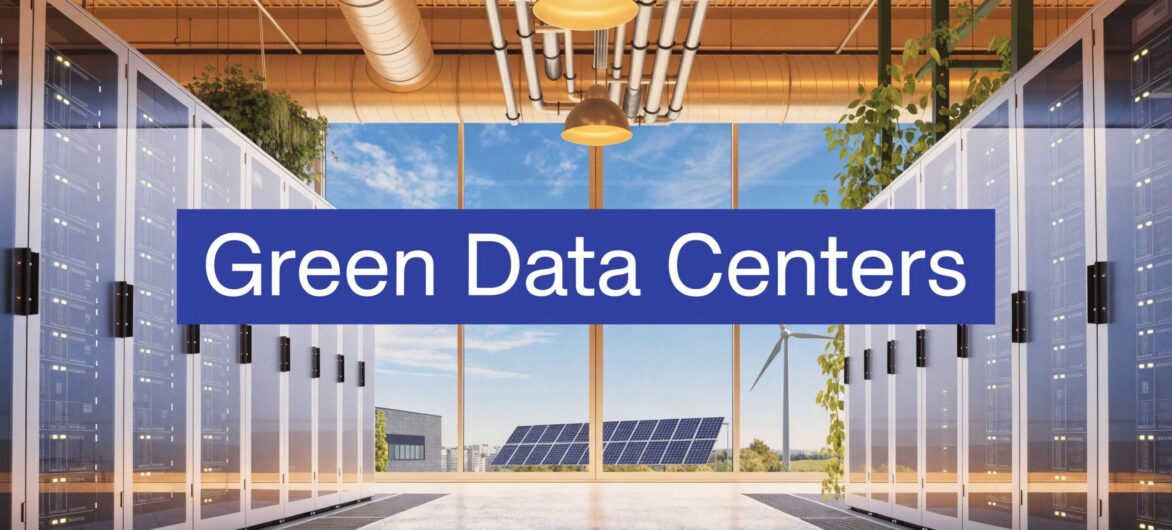
A green data center is not just a regular server building with a few solar panels. It is an IT facility designed to use energy, cooling, water, and hardware more efficiently.
The easiest way to understand it is to compare two buildings. One is an old office with drafty windows, uneven air conditioning, and outdated appliances. The other is a modern smart building with insulation, zoned cooling, efficient systems, and better monitoring. Both buildings can be used for work. One wastes far less while doing it.

The same idea applies to data centers. Instead of treating electricity and cooling as endless resources, green data centers are engineered to get more useful computing work from every unit of power and water.
Demand is not slowing down. The Future Market Insights green data center market forecast values the global market at USD 79.8 billion in 2025 and projects USD 295.8 billion by 2035, with 14.0% CAGR. The same forecast says North America holds over 39% market share in 2025.
That growth makes sense. Businesses keep adding cloud applications, digital files, remote access tools, AI workloads, and compliance requirements. At the same time, operators face pressure to reduce waste and manage energy more carefully.
If you want a broader primer on facility models, this guide to types of data centres gives useful context.
Servers produce heat. Cooling is not optional.
Old setups often cool the entire room whether the equipment needs it or not. A greener facility tries to cool only what needs cooling and only when it needs it. Think of the difference between blasting air conditioning through an entire empty house versus using zoned climate control in occupied rooms.
Examples of greener cooling approaches include:
A green data center also pays attention to where electricity comes from. Some facilities use on-site renewable generation. Others buy renewable energy through contracts or credits.
Readers often get confused about this distinction. Renewable energy claims are not all equal. A provider may use off-site renewable arrangements, on-site generation, or a combination. That does not automatically make the hosting bad. It means you should ask how the facility matches clean power claims to actual operations.
The gear matters. So does the way it is arranged.
A green facility typically uses more efficient power distribution, modern UPS systems, and hardware selected to reduce wasted electricity. It also designs the building so power and cooling travel shorter, cleaner paths. That is similar to choosing efficient appliances and then placing them in a well-insulated home.
You do not need to know every component name. You do need to understand the outcome. Better design reduces waste before the monthly bill ever reaches you.
Sustainability is not only about electricity. It also includes hardware lifecycle decisions.
Good operators think about:
The strongest green data centers are efficient by design, not just green by marketing language.
For a small business, all of this boils down to one useful question. Is your hosting provider using modern infrastructure that wastes less while delivering reliable performance? That is the practical heart of green data centers.
The word “green” gets vague fast unless you can measure it. Two terms matter more than most: PUE and WUE.
You do not need engineering training to understand either one. You only need a simple way to think about overhead.

Power Usage Effectiveness, or PUE, compares total facility energy to the energy used by the IT equipment itself.
A restaurant analogy helps. If the kitchen uses most of the power to cook meals, that is efficient. If the building burns nearly as much power on empty dining room lights, weak insulation, and overworked air conditioning as it does on cooking, the restaurant has an overhead problem.
A data center works the same way. The servers are the “useful work.” Cooling systems, lighting, and support equipment are the overhead. Lower PUE means less waste around the computing itself.
According to GBC Engineers on green data center requirements, achieving a PUE below 1.3 is a critical benchmark. The same source notes that each 0.1 PUE improvement can cut CO2 output by approximately 10g/kWh, and top-tier facilities can reach PUE under 1.2 by using advanced cooling and AI-driven management.
You may never see PUE on an invoice, but it affects what sits behind the invoice.
A provider with lower infrastructure waste is usually better positioned to control costs and run a more modern environment. That matters if your firm depends on QuickBooks, Sage, case management software, tax systems, document storage, or remote desktops every day.
A useful related lens is this explanation of operational efficiency metrics. It helps translate technical measures into business performance.
Water Usage Effectiveness, or WUE, measures how much water a data center uses for cooling relative to IT energy use.
Think of two cars that both get you to the same destination. One burns fuel efficiently. The other also leaks coolant every trip. Water in a data center works similarly. Some cooling methods rely heavily on water. Others reduce or avoid that need.
That distinction matters more in areas where water stress is a business and community concern. Providers that talk seriously about sustainability should be able to explain how they manage water use, not just power use.
A short video can make these efficiency ideas easier to picture:
Numbers help, but they do not replace judgment.
A provider can mention sustainability without giving useful detail. Ask what they measure, how they improve it, and whether they can explain the trade-offs in plain language. If the answer sounds polished but vague, keep asking.
If a host cannot explain PUE and WUE in business terms, they may not be managing them with much discipline either.
For a small business, green cloud hosting only matters if it improves the business. The strongest case is not abstract environmental language. It is better economics, steadier operations, and less risk.
Energy efficiency is not just a design preference. It changes the cost structure of the facility.
According to Technavio’s green data center market analysis, green data centers can consume 40% less power than traditional facilities. The same source says this can translate into lifecycle electricity bill savings of up to 30%, and notes that electricity can account for 40% of a data center’s total opex.
That matters even if you never own the servers yourself. Hosting providers operate inside those economics. A more efficient environment gives them a better foundation for predictable pricing and lower waste.
If you are reviewing the financial side of cloud decisions, this guide to cloud cost optimization is useful for framing the bigger picture.
A green data center is often modern by necessity. Efficient cooling, better power management, and tighter monitoring usually come with newer infrastructure choices.
That matters because resilience is not only about a backup generator or a backup copy. It is also about reducing the number of weak points in the environment. Old office server rooms fail in familiar ways. Heat builds up. Dust accumulates. Someone unplugs the wrong thing. The building loses power after hours.
Purpose-built hosting facilities are designed around continuity. For accounting firms, law offices, and nonprofits, that means fewer single points of failure sitting in the back office.
Some readers hear “ESG” and assume it only applies to large public companies. In practice, sustainability and infrastructure transparency are moving downstream. Clients ask questions. Procurement teams ask where data is hosted. Partners want cleaner reporting. Regulators and industry frameworks keep pushing organizations toward better documentation.
You may not need a formal sustainability report today. But choosing a provider that can answer basic questions about energy efficiency, water use, and facility standards puts you in a better position later.
Here is where green hosting becomes a business decision, not a branding exercise:
Clients may never ask your PUE target. They will notice if your systems are dependable, your remote access works, and your firm appears organized and modern.
Green data centers are part of that maturity story. They signal that the infrastructure supporting your business is being run with discipline. Not wastefully. Not casually. Not like a server closet held together by habit.
Many hosting pages use words like sustainable, energy-efficient, or eco-friendly. Those words are easy to print. Certifications are harder to fake.
The point of a certification is not perfection. It is independent structure. It gives you a way to separate a real operational standard from a vague marketing claim.
LEED is a broad building certification framework. It does not focus only on servers or electricity. It looks at the overall environmental performance of the facility.
One of the reasons LEED matters in the green data center conversation is water. According to Device42’s green data center guide, top-tier facilities can achieve WUE below 0.5 L/kWh using approaches such as direct-to-chip liquid cooling. The same source notes that LEED can allocate up to 12 of 110 points to water efficiency, and that these methods can reduce water consumption by over 90% compared to traditional cooling.
For a business owner, LEED tells you the operator is thinking beyond “cheap power” and looking at the facility as a system.
ENERGY STAR is easier for many people to recognize because they have seen it on appliances. In the data center context, it signals attention to energy performance and efficient equipment.
That does not mean every efficient provider will lean on ENERGY STAR branding in the same way. But if a host talks about efficient power systems, modern hardware, and lower energy waste, ENERGY STAR alignment is one useful clue that the claims may be grounded in something measurable.
BREEAM is another sustainability framework, especially common in discussions outside the US. If your provider operates internationally or references BREEAM-certified facilities, the key question is still the same. What does that certification cover, and how does it affect the reliability and efficiency of the environment you will use?
Certifications help. They do not answer everything.
Use them as one layer of due diligence, not the whole process.
Ask yourself:
A trustworthy host does not hide behind logos. They use certifications to support a clear explanation of how the facility runs.
If a provider waves at sustainability but cannot explain its standards, keep looking.
Small businesses often get stuck here. They understand the broad idea. They want lower waste, steadier performance, and a cleaner long-term setup. Then they land on a hosting website full of polished claims and very few specifics.
A good buying process fixes that. You do not need to become a data center auditor. You need a shortlist of practical questions and a sense of what a strong answer sounds like.
One caution matters right away. As noted in Goldman Sachs research on the push for the green data center, many green claims rely on offsite renewables, which still involve grid transmission losses. That does not mean offsite renewable sourcing is worthless. It means you should ask for specifics so you can tell the difference between real operating discipline and ESG optics.
If you want a broader buying framework, this guide on how to choose hosting provider is a useful companion.
Some hosting conversations stay too high-level. Bring them down to ground level.
Ask:
A good provider usually explains technical topics without trying to impress you with jargon.
Weak answer:
“We are committed to a sustainable future and use best-in-class green practices.”
Better answer:
“We track facility efficiency, use specific cooling methods to reduce waste, can explain how our power sourcing works, and can show you how your applications will run in the environment.”
That difference matters. The first is branding. The second is operations.
A small law office and a design studio may both want hosted infrastructure, but they care about different daily details.
For professional firms, ask how the provider handles:
A provider may have credible sustainability practices and still be a poor fit for your workflow. Green data centers are part of the decision, not the whole decision.
| Area of Inquiry | Key Question to Ask | What to Look For in a Good Answer |
|---|---|---|
| Energy efficiency | How do you measure and improve facility efficiency? | Clear mention of measurable metrics and ongoing improvement, explained in plain language |
| Cooling design | What cooling methods do you use to reduce waste? | Specific operational detail, not broad claims |
| Renewable power | Is your renewable energy on-site, off-site, or credit-based? | Transparency about the mix and limitations |
| Water management | How do you manage water used for cooling? | A direct explanation of water-aware cooling practices |
| Hardware lifecycle | What happens to old servers and equipment? | Responsible refresh, reuse, and recycling practices |
| Reliability | How do you support uptime, backups, and business continuity? | Concrete continuity processes tied to customer operations |
| Application fit | Can we test our real software before committing? | A hands-on trial or validation process |
| Support | Who helps if our team has issues during busy periods? | Named support model with clear availability |
| Security | What controls protect user access and hosted systems? | Practical controls explained clearly |
| Billing clarity | How is pricing structured, and what is included? | Simple, transparent pricing with limited surprises |
Some signs should slow you down.
If a provider says they are powered by clean energy, ask how. Offsite renewable contracts and credits may be part of a legitimate strategy, but you should know whether the claim refers to actual operations at the facility or accounting treatment around power procurement.
Real operators understand trade-offs. For example, a facility may make one choice to reduce energy waste and another to reduce water use. If the provider presents sustainability as effortless and perfect in every category, the conversation may be more marketing than engineering.
Even the cleanest facility is the wrong choice if your accounting platform, case management software, or internal workflow runs poorly in it. Always verify fit with your real tools and real users.
The best hosting decision is not “Who sounds the greenest?” It is “Who can prove efficient, reliable operations for our specific business?”
When you narrow the list, stop comparing slogans and start comparing evidence.
Use a simple scorecard based on:
That method works well for small firms because it balances sustainability with day-to-day function. A green hosting provider should not only reduce waste. They should reduce friction for your staff.
The goal is not to become an expert in chillers, power distribution units, or renewable contracts. The goal is to choose a hosting partner that runs infrastructure responsibly and supports your business reliably.
For a small business owner, that means fewer surprises, less IT drag, and a better answer to a simple question: can our team work without worrying about the server?
A green data center is easy to misunderstand if you only hear the buzzwords. It is a better-run facility. It uses power more carefully, handles cooling more intelligently, manages water more responsibly, and supports modern hosting with less waste.
That matters to small businesses because inefficient infrastructure is expensive in ways that do not always show up on a single invoice. It shows up in downtime, maintenance calls, overheated server rooms, and staff losing time to systems that should just work.
The practical takeaway is simple. If you are still relying on aging on-premise hardware or evaluating cloud providers, ask better questions. Ask how the provider measures efficiency. Ask how they source power. Ask how they manage cooling, resilience, and application performance. Ask for plain-English answers.
Green data centers are not only about sustainability goals. They are also about cost discipline, operational resilience, and choosing infrastructure that is more future-ready than the server closet you are trying to outgrow.
If you are ready to move away from office-server stress and into a more reliable hosted environment, Cloudvara offers secure cloud hosting for business applications, daily backups, 24×7 support, and a free 15-day trial with no contract or credit card required.