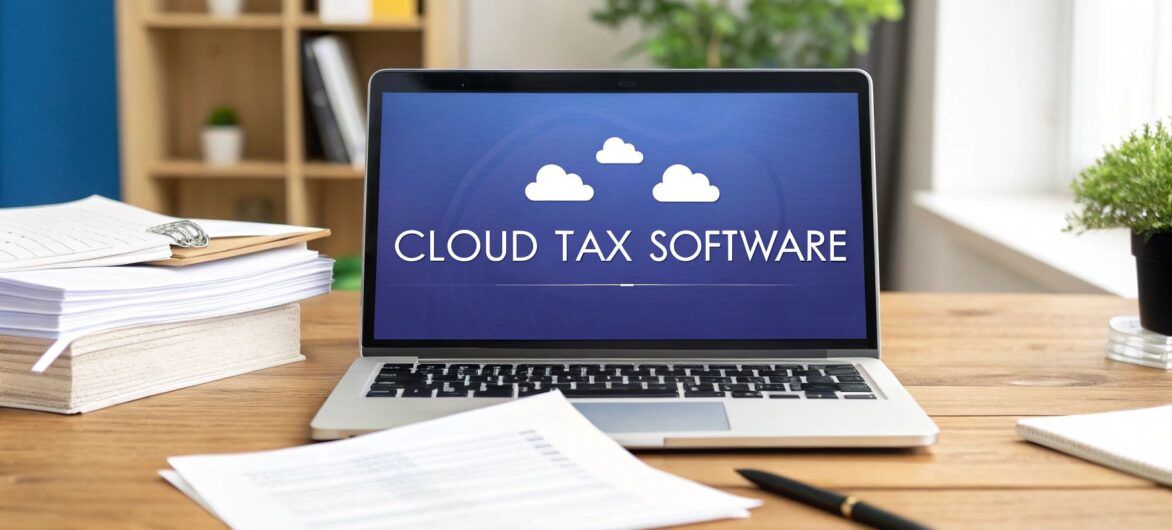
You're used to your trusted tax software—Drake, ProSeries, Lacerte. It lives on your office server, it works, and your team knows it inside and out. But that setup tethers you to the office. Cloud based tax software breaks that chain. It takes the exact same desktop software you use every day and moves it to a secure, remote data center.
This simple shift allows your team to access everything they need from any device with an internet connection. All the features you rely on are still there, but now with the game-changing flexibility to work from anywhere.
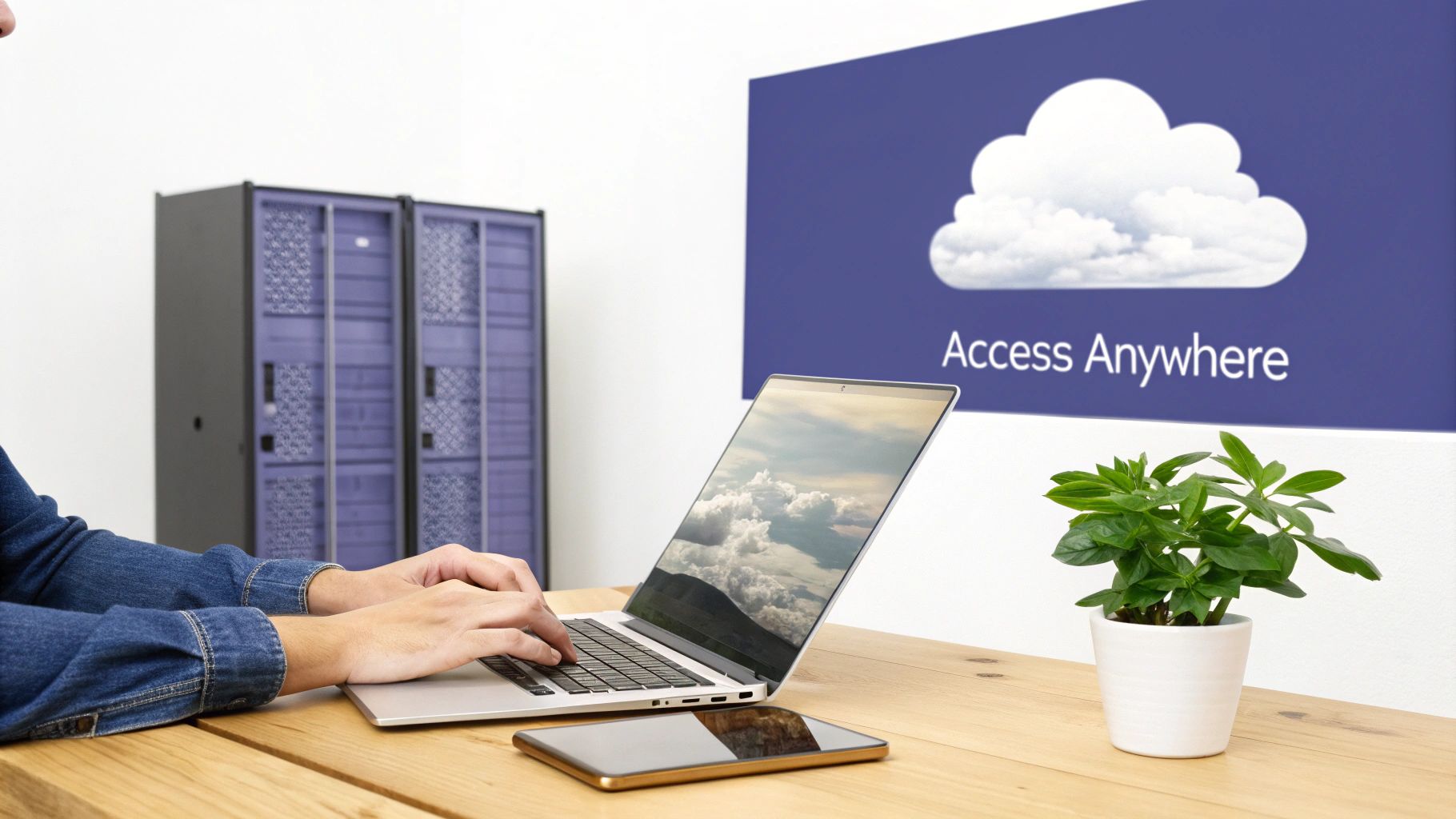
Think of your firm’s traditional setup like a physical library. To get a book—your data or an application—you and your team have to physically be in the building. It's a reliable model, but it’s restrictive. Your productivity is tied to a single location and a specific set of computers. It works, but it wasn't built for a modern, agile practice.
Now, imagine that library is digitized and available through a secure online portal. That’s the core idea behind cloud based tax software. Instead of being stuck in the office, you can access your entire collection of resources—every client file, tax form, and application—from anywhere, anytime. It’s a fundamental change in how and where you get work done.
It’s important to get specific about what we mean by "the cloud." Many people immediately think of purely web-based programs, like the leading cloud accounting software like Sage, Xero, and QuickBooks. While those tools are great, switching to them often means abandoning the desktop software you've spent years mastering.
Our approach is different. It's more practical. We provide a hosted desktop environment. This means we take the powerful, feature-rich tax applications you already own and know—like Lacerte, Drake, or ProSeries—and host them for you on our high-performance remote servers.
You get the same interface, the same shortcuts, and the same robust functionality you rely on. The only difference is that you now access it through a secure internet connection instead of a local network.
This hybrid model delivers the best of both worlds. Your team gets to skip the steep learning curve of a brand-new system, and your firm doesn't lose its investment in your existing software licenses.
We designed the process to be simple. We handle all the complicated IT grunt work—the server maintenance, security updates, data backups, and performance tuning—so you don't have to. Your firm connects to a dedicated virtual desktop that looks and feels just like your office computer.
This centralized environment gives your team a few immediate advantages:
Ultimately, this model takes the mystery out of the cloud and focuses on a practical outcome: empowering your firm with more flexibility, security, and efficiency without forcing you to change your trusted workflows. For a deeper look at similar solutions, check out our guide on cloud-based accounting software.
Moving your firm to the cloud isn't just a technical swap—it's a strategic shift that unlocks real, day-to-day advantages. Adopting cloud based tax software brings a level of efficiency, security, and resilience that a traditional on-premise server simply can't match.
This change overhauls how work gets done, turning your practice into a more nimble, responsive operation. It hits right at the most common pain points firms deal with every day: collaboration bottlenecks, access limitations, the constant burden of IT maintenance, and the looming threat of data loss.
Imagine your team spread across different cities during the height of tax season, all working on the same complex client file in perfect sync. That’s the reality in a cloud environment. No more hunting for the latest file version or waiting for someone to email an update.
With real-time collaboration, every change is instantly visible to the right people. This creates a single source of truth that cuts through the confusion and dramatically speeds up review cycles. A preparer can work on a return, and a partner can jump in to review it moments later from a completely different location, adding notes directly into the system.
Your office is no longer defined by four walls. With cloud hosting, your entire digital workspace—tax software, client files, and other critical apps—is accessible from any device with an internet connection. This empowers your team to be just as productive at a client's site or from a home office as they are at their desk.
This kind of flexibility brings huge benefits:
The global cloud-based tax software market has exploded precisely because of these efficiency gains. For instance, some accounting practices have seen their year-end processing time collapse from four hours down to just four minutes after switching to the cloud. It’s a stark example of the massive operational advantage of leaving outdated, localized systems behind. You can explore more about the tax software market's expansion and trends on Mordor Intelligence.
What would happen if your office server crashed tomorrow? Or if a fire, flood, or theft wiped out your local hardware? For many firms, it would be a catastrophe, leading to crippling downtime and potentially permanent data loss.
A cloud-based model is your built-in business continuity plan. Your data isn't sitting on a machine in the corner of your office; it's protected in a secure, commercial-grade data center.
Because your critical software and client files are stored off-site, local disasters no longer pose an existential threat to your operations. Your firm's data is shielded from hardware failure, theft, and physical damage.
If your physical office becomes inaccessible for any reason, your team can simply log in from another location and keep working without missing a beat. This resilience is a cornerstone of modern practice management, giving you and your clients ultimate peace of mind.
Let's be honest: managing an on-site server is a costly, time-consuming distraction. It means buying hardware, dealing with complex maintenance, running manual software updates, and constantly worrying about security. All of that diverts precious time and money away from what your firm does best—serving clients.
By moving to a hosted cloud environment, you offload all of that. There's no server hardware to buy or replace. All the software updates, security patches, and data backups are managed for you. This shift lets you redirect your budget and your team’s focus from IT headaches to revenue-generating activities and strategic growth.
When you start looking at cloud-based tax software, you’ll quickly find two main paths you can take. Each has its own strengths, and figuring out the difference is key to making the right call for your firm. The decision really comes down to this: Do you want a simple, standardized tool that runs in your web browser, or do you need to bring your powerful, familiar desktop applications into a modern, flexible cloud environment?
Let’s use an analogy. A native Software-as-a-Service (SaaS) application is like renting a fully furnished apartment. It's incredibly convenient, ready to go on day one, and the landlord handles all the maintenance. The catch? You’re stuck with the furniture and layout they provide. You can't bring in your own custom-built desk or specialized equipment you've used for years.
A hosted desktop solution, on the other hand, is like moving your own trusted furniture into a brand-new, high-tech building. You get top-of-the-line security, infrastructure, and maintenance services, but you get to keep the exact tools and workflows you've already perfected. It’s a way to preserve your investment while gaining all the benefits of the cloud.
SaaS tax applications are built from the ground up to run entirely in a web browser. These platforms are often praised for their simplicity and clean, modern interfaces. The provider handles everything behind the scenes—from software updates to security patches. It’s all automatic.
This model is a great fit for firms that are just starting out or are willing to completely change their processes to fit a new system. The trade-off, however, is a loss of control and the deep functionality that feature-rich desktop versions are known for. Many advanced features, complex calculation capabilities, or integrations with older desktop-only programs just aren't available.
A hosted desktop offers a completely different kind of cloud experience. Instead of forcing you into a new, and potentially less powerful, web application, this model takes your existing desktop software—like Drake, Lacerte, or ProSeries—and installs it on a secure remote server. You and your team then access everything through a virtual desktop.
Here’s why this is such a game-changer for established firms:
This decision path helps visualize how a firm that is ready for a modern workflow can unlock major benefits.
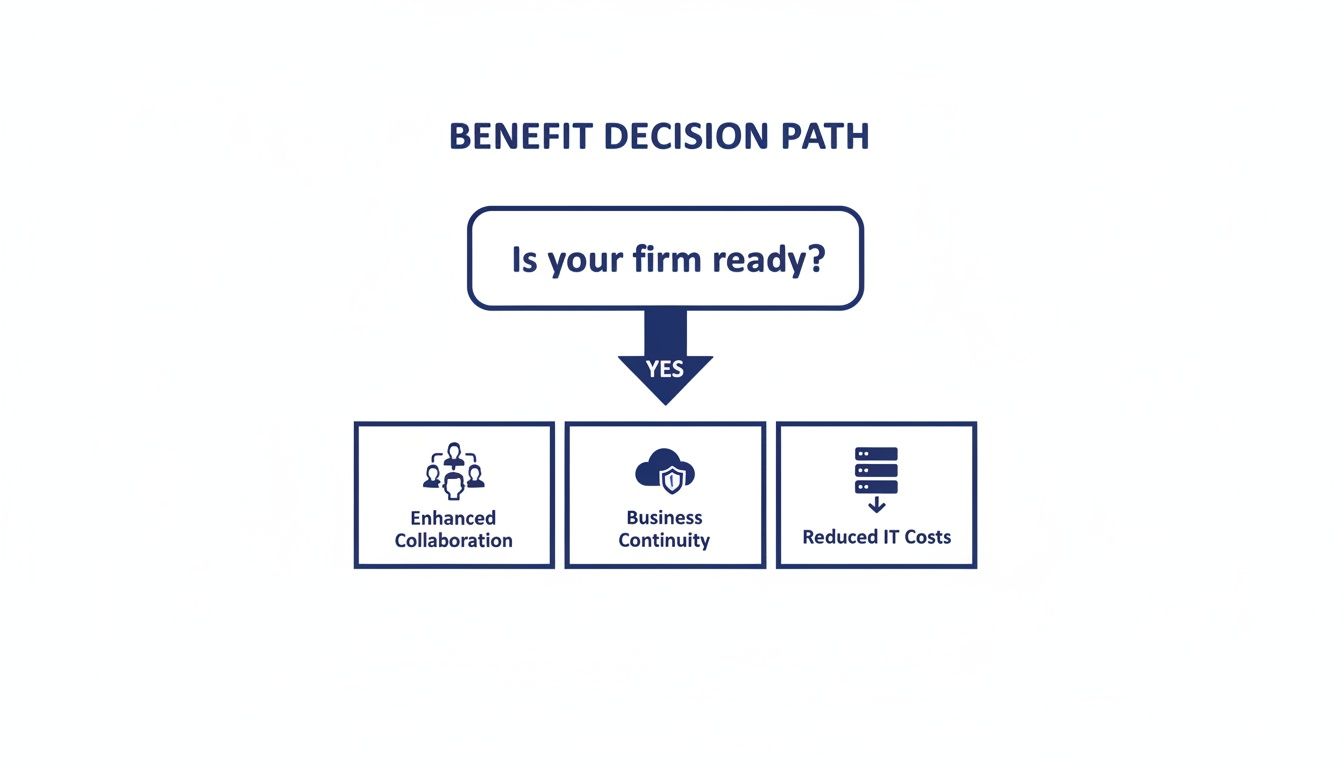
As you can see, making this move opens the door to huge operational wins in collaboration, business continuity, and cost management.
The real magic of a hosted desktop is that it modernizes your operations without disrupting them. It wraps a layer of cloud flexibility, security, and accessibility around the powerful tools you already rely on.
So, how do you decide which way to go? It all comes down to your firm's specific needs, your current software setup, and your long-term goals.
To make it clearer, here’s a side-by-side comparison of the two models.
| Feature | SaaS (Web-Based) Tax Software | Hosted Desktop (Cloudvara Model) |
|---|---|---|
| Software Familiarity | Requires learning a new application and workflow. | Uses your existing desktop software with zero learning curve. |
| Customization | Generally limited to the features offered by the provider. | Highly customizable; you control the applications installed. |
| Integration | Limited to pre-built integrations with other web apps. | Seamlessly integrates with any desktop software (e.g., QuickBooks). |
| Data Ownership | Data is stored in the vendor's application; export options vary. | You retain full control and ownership of your software and data. |
| Best For | New firms or those seeking a simple, all-in-one solution. | Established firms wanting to keep their software and create a unified workspace. |
For many accounting and law firms, the hosted desktop model, often delivered as a Desktop-as-a-Service (DaaS), strikes the perfect balance. It delivers all the powerful benefits of cloud computing—remote access, better security, and less IT overhead—without forcing you to give up the feature-rich software that your practice depends on.
Ultimately, it’s about upgrading your infrastructure, not abandoning your tools.

For any professional handling sensitive client data, security isn't just a feature—it's the bedrock of your reputation. The idea of moving decades of tax records to the cloud might feel a little unsettling at first, but it helps to see it for what it is: a major upgrade.
You’re not just moving files online. You're shifting from a self-managed system to an enterprise-grade fortress, one built to a much higher standard than most small firms can afford to build in-house.
Think of your client data like valuables inside a bank. A single lock on the front door just wouldn’t cut it. Real security demands multiple, independent layers of protection, and that’s exactly how a professional cloud based tax software environment is designed.
Your data is protected around the clock by a sophisticated, multi-layered defense system.
This combination of safeguards creates a robust defense that’s actively managed and updated by security experts—a level of protection that’s both difficult and costly for a single firm to replicate on its own.
Beyond the digital protections, your data is housed in commercial-grade data centers that are quite literally physical fortresses. These aren't just server closets; they’re facilities built for mission-critical resilience.
They feature 24/7/365 monitoring by on-site security personnel, biometric access controls, and comprehensive video surveillance. These centers are also engineered with redundant power, advanced climate control, and sophisticated fire suppression systems to guard against physical threats. That’s a level of security an on-premise server setup could never match.
As a tax professional, you’re bound by strict IRS guidelines for protecting taxpayer information. A managed cloud environment is designed from the ground up to help you meet those obligations, taking much of the compliance burden off your shoulders.
We ensure our infrastructure aligns with key industry standards. To take that a step further, an essential proactive measure is implementing regular cloud-based penetration testing. This verifies that your cloud-based tax software truly protects sensitive client data and meets regulatory mandates.
Finally, the most critical piece of your security strategy is the ability to bounce back from the unexpected. Our platform includes automated, daily backups of your entire system.
This means that no matter what happens—from an accidental file deletion to a major disaster—a recent, clean copy of your data is always available. This built-in disaster recovery is your ultimate insurance policy. It guarantees your firm can be back up and running quickly with minimal disruption, so you can keep serving clients without missing a beat.
For more details on this topic, you might be interested in our guide on cloud security solutions.

The thought of moving your entire firm's data and applications to the cloud can feel daunting. It’s easy to picture weeks of technical headaches and operational chaos. But shifting to a hosted cloud based tax software environment isn't a disruptive overhaul—it's a carefully choreographed process designed to keep your business running smoothly.
Think of it like a professional office relocation. You wouldn't just toss everything into boxes and hope for the best. You’d hire a team to label, transport, and set up your new space so you’re ready to work the moment you walk in. Our managed migration follows that same structured, white-glove approach.
Our journey starts with a simple conversation. We sit down with you to understand your firm’s unique digital ecosystem—the specific tax software you use, your go-to applications, how much data you have, and how your team gets work done. This initial deep dive is the blueprint for a custom migration roadmap built just for you.
Once the plan is set, our team handles all the technical heavy lifting. We securely transfer your data and install your applications in your new cloud environment. This is always scheduled to minimize disruption, often happening after hours or over a weekend so your team’s productivity never takes a hit.
Our goal is a seamless cutover. When your team logs in post-migration, they’ll see their familiar desktop, complete with all their software and files, ready to go. The only difference? Now they can access it from anywhere.
Migration is just step one. The real power is unlocked through integration. A hosted environment breaks down the digital walls that have always existed between your different software tools. Your tax software no longer has to live on an island, separate from your other critical applications.
Instead, programs like QuickBooks, Sage, Microsoft Office, and your document management system can all run together on the same secure cloud server. This creates a single, unified workspace where data flows freely between applications.
This tight integration puts an end to frustrating data silos and simplifies daily tasks:
To see how each stage of the process works, you can explore our detailed cloud migration checklist and get a clear picture of the steps involved.
Consider a mid-sized accounting firm that was wrestling with workflow bottlenecks. Their tax software was on one server, QuickBooks on another, and client files were scattered across individual computers. This fragmented setup created constant version control issues and wasted hours just moving data around.
By migrating to a unified hosted environment, they brought all these tools under one roof. Suddenly, preparers could work on a tax return while referencing QuickBooks data in real-time on the same screen. This immediate access to information slashed their preparation and review times, completely transforming their efficiency during the tax season crunch.
Moving your firm into a hosted environment is a huge step, and the partner you choose makes all the difference. Transitioning to cloud based tax software isn’t just a technical upgrade—it’s a strategic move to future-proof your practice. We’re here to guide you through it, every step of the way.
We specialize in cloud solutions built for the professionals we serve—accountants, CPAs, and law firms. This sharp focus means we don’t just understand the technology; we understand the unique rhythm of your workflows, the applications you can’t live without, and your strict security needs. We know tax season waits for no one.
That’s why our support goes far beyond the initial setup. You get dedicated, 24/7 US-based support from experts who are fluent in the software you use every single day. When you run into an issue, you get help immediately from a team that actually understands your world.
We believe in showing you our value, not just talking about it. We know that uncertainty can slow down progress, so we’ve made it easy to see the benefits for yourself, completely risk-free.
We offer a 15-day free trial that lets you experience the full power of our platform. This isn’t some watered-down demo. We migrate your actual software and data so you can work in a live environment and see exactly how our solution performs for your firm.
This hands-on trial is the best way to confirm that our hosted desktop is the right fit. It’s your chance to test the speed, security, and seamless workflow firsthand. We’re confident that once you see your firm running smoothly in the cloud, you won’t want to go back.
We are more than just a vendor; we are your dedicated IT partner, invested in your success. Our goal is to handle the technology so you can focus on growing your practice and serving your clients.
Ready to take the next step? You can start your free trial today or schedule a personalized consultation with one of our cloud specialists to walk through your firm's specific needs. To learn more about how we support professional firms, you might also find our guide on managed IT services for accounting firms helpful.
Moving your firm's core operations always brings up a few questions. It's only natural. Here are some of the most common ones we hear from professionals just like you, with straightforward answers to help you see the path forward clearly.
Yes, you absolutely can. In fact, that's the whole point. Our hosted cloud solution was built for firms that love the power and familiarity of their desktop software—think Drake, Lacerte, or ProSeries—but want the flexibility of the cloud.
We don't force you into a watered-down web app. Instead, we take the exact software you own and run it in a secure, high-performance cloud environment. You get the same interface, the same workflows, and the same features you've spent years mastering, just without being chained to a specific desk.
We get it—protecting client data is non-negotiable. Frankly, our security infrastructure is often far more robust than what a typical firm can maintain in-house. We treat security as a full-time job, layering defenses to protect your information around the clock.
This isn't just a simple firewall. We're talking about:
It all adds up to enterprise-grade security that meets tough compliance standards. This approach lets you offload the security burden from your team to ours, so you can focus on your clients, not on server maintenance.
This is a great question because it highlights one of the biggest advantages of a hosted cloud system. While you need the internet to log in, your software and data aren't in your office. They're running safely and continuously on our servers.
So, if the internet at your office cuts out, your business doesn't grind to a halt. Your team can simply pack up, head home, and reconnect from their home Wi-Fi or even a mobile hotspot. This built-in resilience means you keep working and serving clients, no matter what's happening at your physical address.
Ready to see how a secure, flexible cloud environment can change the way your firm operates? Cloudvara offers a no-risk, 15-day free trial so you can experience the benefits for yourself. Start your free trial today.