A business technology assessment is a strategic review of your company's entire technology ecosystem. It's designed to identify strengths, uncover weaknesses, and ensure your tech stack is actively supporting your business goals rather than creating hidden costs and inefficiencies.

When leaders hear "assessment," they often picture a pass/fail test or a dry, jargon-filled audit. But that's not what this is. A business technology assessment is more like a comprehensive health check-up for your company's operational backbone. Its real purpose is to diagnose the health of your infrastructure, software, and processes before small issues become critical failures.
This evaluation goes far beyond a simple inventory of your assets. It gives you a clear, objective view of whether your technology is a growth engine pushing you forward or a costly anchor holding you back. It’s about answering the tough questions that often go unasked until it’s far too late.
Those everyday frustrations you see around the office? They’re often symptoms of deeper technology misalignments. Slow computers, disjointed communication, and nagging cybersecurity worries aren't just minor annoyances—they're red flags signaling systemic problems that are quietly eating into your bottom line. An assessment connects these symptoms to their root causes.
For instance, if your team is struggling with slow file access, the real culprit might be an overloaded on-premise server that’s well past its prime. Likewise, employees using unauthorized apps to collaborate could be exposing the company to significant data breach risks without even realizing it.
The core function of a business technology assessment is to translate operational pain points into an actionable technology roadmap. It provides clarity on where to invest your resources for the greatest impact on efficiency, security, and profitability.
This process helps you shift from reactive firefighting to proactive, strategic decision-making. Instead of just responding to tech failures as they happen, you can build a more resilient and efficient operational environment. This kind of strategic planning is absolutely essential when considering major shifts, which is why a well-defined cloud adoption strategy almost always begins with the insights from a thorough assessment.
To show you how an assessment creates a clear path forward, let's look at some common issues businesses face. The table below illustrates how it translates these vague problems into a specific diagnosis and a tangible solution, turning ambiguity into a straightforward plan of action.
| Common Business Symptom | Underlying Technology Diagnosis | Effective Strategic Treatment |
|---|---|---|
| "Our systems are constantly slow and crashing." | Outdated servers and insufficient network capacity. | Upgrade hardware and optimize network infrastructure for better performance. |
| "We can't collaborate effectively when working remotely." | Lack of centralized communication and file-sharing tools. | Implement a unified communications platform and a secure cloud file system. |
| "I'm worried about our cybersecurity." | Inadequate firewalls, no employee security training. | Deploy advanced threat protection and establish a security awareness program. |
| "We're paying for software we barely use." | Redundant or underutilized software licenses. | Conduct a software audit to consolidate tools and eliminate wasteful spending. |
As you can see, the assessment doesn't just identify problems—it prescribes the cure, making it an indispensable tool for any leader looking to build a more competitive and future-proof business.

A worthwhile business technology assessment doesn’t just poke around in one corner of your operations; it examines the entire ecosystem. To get a complete, honest picture, the evaluation must be built on four distinct yet interconnected pillars. Each one represents a critical layer of your technology stack, and skipping even one can lead to a strategy that’s incomplete and ineffective.
Think of these pillars as the four legs of a table. If one is weak, outdated, or just doesn't fit with the others, the whole structure gets wobbly. A thorough assessment methodically inspects each leg to make sure the entire system is strong, balanced, and ready to support your business goals—today and down the road.
This is the physical foundation of your tech: the servers, computers, network gear, and other tangible assets that power your day-to-day work. It's the engine room of your business. When it runs smoothly, everything else just works better. When it sputters, the whole company feels the drag.
An assessment of this pillar digs into the tough questions:
For instance, a law firm dealing with painfully slow document retrieval might discover its on-premise server is a decade old and just can't keep up anymore. That single insight points directly to a clear solution, like a hardware upgrade or a strategic move to the cloud.
If hardware is the engine, then software and applications are the controls your team uses to steer the business. This pillar covers everything from your core accounting software and CRM to the smaller project management and communication tools your departments rely on. The goal is simple: make sure these tools are effective, integrated, and actually being used.
This evaluation is all about spotting redundancies and inefficiencies. It’s surprisingly common for businesses to pay for multiple software licenses that do the exact same thing. Or to invest a small fortune in a powerful CRM that employees were never properly trained on. A detailed business technology assessment might uncover that only 30% of a CRM's features are ever touched, meaning you're paying for potential that's locked away.
This part of the assessment isn't just about what software you have, but how you use it. It identifies opportunities to consolidate tools, improve adoption through better training, and ensure your software stack works together seamlessly.
This pillar is your digital defense system, protecting sensitive data from threats while ensuring you meet industry regulations. In a world where cyberattacks are more common and sophisticated than ever, a weak security posture isn't just a vulnerability—it's a major business risk. This part of the assessment is non-negotiable for protecting your company’s reputation and finances.
It involves a deep dive into your security measures. Are your firewalls configured correctly? Do you have solid data backup and disaster recovery plans in place? Are employees trained to spot phishing emails? Protecting your digital assets is a continuous effort, and our guide on 12 essential cloud security practices for businesses is a great place to start strengthening your defenses.
Finally, and most importantly, technology is only as good as the people using it and the processes guiding them. This pillar zeroes in on the human element. You can have the best hardware and software in the world, but if your team doesn’t know how to use it or your workflows are clunky, the investment is wasted.
This evaluation looks at how technology fits into daily work. Are there manual, repetitive tasks that could easily be automated? Does the IT department have clear, simple processes for supporting users? Understanding this interaction is the key to unlocking real productivity gains and making sure your tech investments deliver actual value.
Trying to run a business technology assessment without a framework is like building a house without a blueprint. You might end up with something standing, but it’ll probably be disorganized, unstable, and missing a few critical walls. A good framework provides the structure you need, turning a chaotic audit into a methodical, strategic review.
The right model really depends on your company's size, complexity, and what you’re trying to achieve. A small startup might just need a quick, high-level overview, while a large, regulated enterprise will require a much more rigorous and detailed approach. Let's walk through three proven frameworks that can bring some much-needed order to your assessment process.
The classic SWOT analysis—Strengths, Weaknesses, Opportunities, and Threats—is a fantastic starting point for most businesses. While it’s usually a business strategy tool, it adapts perfectly to technology. It gives you a simple yet powerful way to get a bird's-eye view of your tech ecosystem without getting completely lost in the technical weeds.
This approach is perfect for organizations that are just starting their assessment journey. It helps everyone involved quickly see what’s working well, where the obvious pain points are, and what outside factors could mess with their technology plans.
This infographic breaks down how SWOT, COBIT, and a Maturity Model each serve a different purpose.
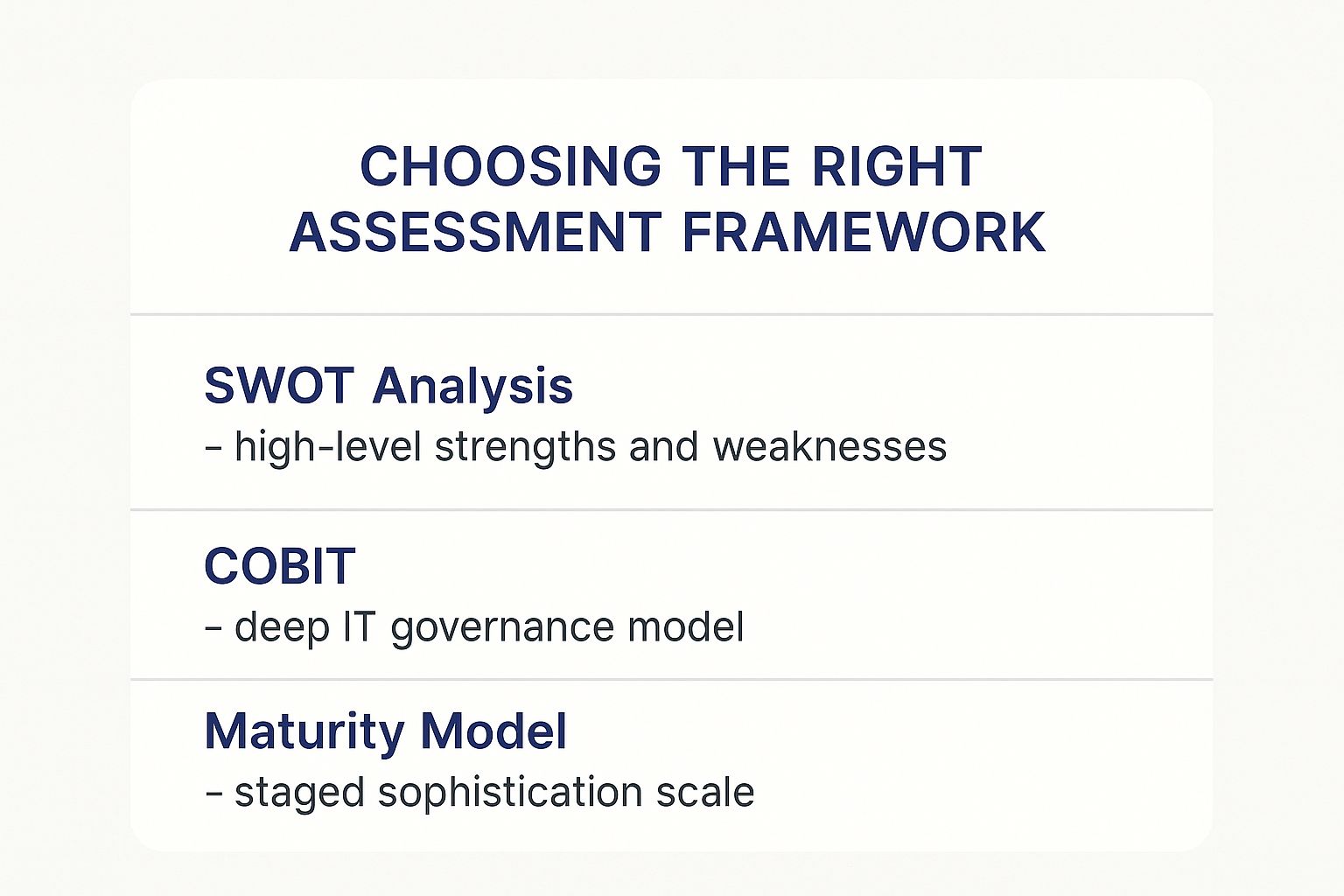
As you can see, each framework answers a different strategic question, from getting a quick lay of the land to diving deep into compliance and governance.
For larger organizations, especially those in tightly regulated fields like finance or healthcare, a more structured framework isn't just nice to have—it's essential. COBIT (Control Objectives for Information and Related Technologies) is the global standard for IT governance and management. It’s not for the faint of heart; this framework is detailed, extensive, and laser-focused on control, risk management, and making sure IT actually aligns with business goals.
COBIT gives you a complete playbook of processes, metrics, and best practices to ensure IT is managed in a disciplined, repeatable way. This is the framework you turn to when compliance, security, and auditable controls are your absolute top priorities. It helps you prove that your IT operations don’t just support the business but also stick to strict legal and regulatory rules. This level of detail is also crucial when defining internal service agreements; understanding the differences between an OLA vs SLA is key to setting clear expectations within your IT governance structure.
COBIT moves beyond a simple health check to provide a complete system for governing and managing enterprise IT. It's the gold standard for organizations that need to demonstrate due diligence and maintain strict operational controls.
A technology maturity model looks at things through a different lens. Instead of just listing what's good and bad, this framework scores your capabilities against a predefined scale. It assesses how sophisticated and optimized your technology processes are, usually rating them on a scale from chaotic and reactive to fully optimized and innovative.
This approach is incredibly useful for building a long-term strategic roadmap. By figuring out your current maturity level, you can set clear, achievable goals for getting better over time.
For instance, a maturity model might rate your data backup process like this:
A framework like this shows you exactly where you stand and what the very next step on your journey to operational excellence looks like. It’s a powerful tool for guiding gradual, sustainable progress.
Choosing the right framework can feel daunting, but it's really about matching the tool to the job. This table breaks down the three models to help you decide which one best fits your organization's needs, goals, and complexity.
| Framework | Primary Focus | Ideal For | Complexity Level |
|---|---|---|---|
| SWOT Analysis | Strategic positioning & quick insights | Small businesses or initial high-level assessments | Low |
| COBIT | IT governance, risk & compliance | Large, regulated enterprises (finance, healthcare) | High |
| Maturity Model | Process improvement & capability measurement | Organizations focused on long-term, incremental growth | Medium |
Ultimately, whether you need a simple SWOT to get the conversation started or a full-blown COBIT implementation to satisfy auditors, the goal is the same: to gain clarity and make smarter technology decisions. Selecting the right framework is the first step toward achieving that.

Once you have a framework, the real work begins. How do you actually tell if your technology is a powerhouse or just a drain on your budget? You need a clear, consistent set of criteria to move past gut feelings and dig into objective, actionable insights.
Think of these criteria as a scorecard for every single piece of tech in your company. By judging each tool against the same core principles, you’ll quickly see which ones are all-stars and which are dragging the team down. This section breaks down the five essential areas to guide your evaluation.
This yardstick answers a simple but vital question: can your tech keep up? Performance isn't just about speed—it's about reliability when you're under pressure. Scalability is its forward-looking twin, telling you if your systems can grow with you or if they’ll buckle the moment you land a big client.
To figure this out, ask some pointed questions:
A system that’s fast today but can’t scale for tomorrow is just a hidden liability waiting to happen.
In an age where a single data breach can be catastrophic, your tech’s ability to protect sensitive information is non-negotiable. This involves a thorough look at your digital defenses, from stopping unauthorized access to ensuring you can recover quickly from a disaster. It’s about patching holes before they can be exploited.
When looking at your tech stack, especially something like a CRM, articles evaluating specific CRM solutions can highlight important security benchmarks. A huge piece of this is making sure different systems can talk to each other securely, which is where understanding what is application integration becomes crucial.
A strong security posture isn't a feature; it's the foundation upon which a trustworthy business is built. The goal is to move from a reactive "hope for the best" stance to a proactive, defense-in-depth strategy.
Every piece of technology comes with a price tag, but its true cost goes far beyond the initial invoice. This criterion pushes you to calculate the total cost of ownership (TCO), which includes maintenance, licenses, training, and support. More importantly, it forces you to weigh that cost against the actual value it delivers.
Is that expensive software suite actually giving you a measurable return on investment (ROI), or is it just another line item on the budget? A cheap tool that creates hours of manual work might be far more "expensive" in the long run than a pricier, automated alternative.
The most powerful software in the world is useless if your team doesn't use it—or uses it wrong. This criterion measures the human side of your tech. It’s about figuring out if your tools are genuinely helpful or if they’re so clunky that employees have created inefficient workarounds just to avoid them.
Low user adoption is a classic red flag that a tool is a poor fit for your workflow. Tracking metrics like active usage rates or the number of support tickets for a specific app can give you hard data on where the friction is.
Finally, and most importantly, your technology has to serve your core mission. Does your tech stack directly support your main business goals, or has it become a patchwork of disconnected tools you’ve collected over time?
If your goal is to deliver world-class customer service but your CRM is slow and doesn’t connect to your support system, you have a major misalignment. This also includes being ready for what’s next. For instance, AI use has exploded, with 78% of organizations now using it in at least one business function. This rapid shift shows how quickly new tools become essential, and your assessment must determine if your current stack can keep up.
A finished business technology assessment is a mountain of raw data—a collection of scores, findings, and observations. It's incredibly valuable, but that data is useless until you shape it into a clear plan of attack. The most critical step is turning those insights into a strategic, actionable roadmap that actually moves your organization forward.
This isn't about trying to fix everything at once. A successful roadmap is all about prioritizing action, grabbing tangible wins, and building momentum. Think of it less like a massive, overwhelming blueprint and more like a turn-by-turn GPS for your company’s tech journey. It shows you where to go next, one step at a time.
First things first, you need to zoom out from the individual data points and look for the bigger picture. Go through all the assessment findings—from sluggish network speeds to software nobody uses—and start grouping them into logical themes. This is how you start seeing the forest for the trees.
For example, you might notice that poor remote collaboration, clunky file sharing, and a confusing chat app all point to a single theme: "Ineffective Communication Tools." Another group of problems, like outdated servers and slow application performance, could easily fall under "Aging Infrastructure."
Common themes often pop up, such as:
By organizing your findings this way, you shift from a long, intimidating list of problems to a handful of strategic areas that need your focus.
With your key themes identified, you now have a list of potential projects. But where do you even begin? The most effective way to prioritize is with an Impact vs. Effort matrix. This simple tool helps you make objective decisions based on value, not just which problem is screaming the loudest.
Plot each potential project on a grid with two axes:
This visualization quickly sorts your projects into four distinct buckets, revealing a clear path forward.
This matrix helps you bypass "analysis paralysis" by focusing your energy where it matters most. It forces a strategic conversation about what will deliver the best return on your investment of time and capital.
Once you have your prioritized list, it's time to build the roadmap itself. The key is to create a phased plan with realistic timelines, clear ownership, and measurable goals. Resist the urge to create a rigid, multi-year plan that will be obsolete in six months.
Instead, structure your roadmap in manageable chunks, like quarterly goals.
This phased approach makes your efforts sustainable and connects them to real business outcomes. It’s also a massive factor in success, since digital transformation projects have a notoriously mixed track record. The global success rate is only 35%, but organizations that follow a well-planned roadmap achieve success rates three times higher. A structured plan is a clear differentiator, as highlighted in these data transformation challenges on Integrate.io.
This deliberate, phased strategy is what turns your assessment from a simple report into a living guide for continuous improvement.
Diving into a business technology assessment can feel like a big step, and it's completely normal to have questions before you commit time and resources. It's a significant undertaking, after all. This section tackles the most common questions business leaders ask, giving you straight answers to clear up any confusion and help you move forward with confidence.
Getting these details right can be the difference between a smooth, insightful review and one that’s just frustrating. We'll walk through practical things like timing, who should be on the team, common pitfalls, and what kind of value you can really expect.
The right timing for a tech assessment really depends on how fast your company is growing and what industry you're in. For most stable businesses, a full review every 18 to 24 months is a great rule of thumb. That's often enough to catch problems before they spiral but gives you enough breathing room to actually implement changes and see them work.
But a fixed schedule isn't the whole story. Certain events should automatically put a tech assessment on your to-do list, no matter when the last one was.
These triggers include:
This is a classic debate, and the best answer comes down to your team's skills, your budget, and how much you value an objective opinion. Each path has clear pros and cons you'll want to think through.
Doing the assessment yourself can save money and taps into your team's deep, on-the-ground knowledge of daily operations. They know where the real pain points are. The big risk here, though, is bias. It’s incredibly hard for people to objectively critique systems they built themselves or have gotten used to over the years.
Hiring a third-party consultant brings a fresh, impartial perspective that an internal team simply cannot replicate. They’ve seen what works—and what doesn’t—across different industries and can spot opportunities your team might miss because they’re too close to the problem.
A hybrid approach often hits the sweet spot. Here, an outside expert leads the way, bringing specialized tools and frameworks, while also validating the findings of your internal team. This setup combines the consultant’s objectivity with your team’s institutional knowledge, leading to a much stronger and more credible result.
A great technology assessment is as much about dodging common traps as it is about following a checklist. Knowing these pitfalls ahead of time can keep you from wasting a ton of effort.
Here are the most common mistakes we see people make:
Pinning down the exact return on investment (ROI) of a tech assessment isn't always a simple calculation, because the benefits are both direct and indirect. The real value comes from shifting your technology from a reactive expense to a proactive tool that helps you win.
Direct returns are the easy ones to spot and measure. Think immediate cost savings from:
But it's the indirect returns that often deliver the biggest long-term punch. These benefits create ripples across your whole business, showing up as higher productivity from better tools, happier customers thanks to more reliable systems, and stronger security that prevents expensive data breaches. The end goal is to build an environment where technology is actively fueling your business goals. For companies thinking about a move to the cloud, our cloud migration checklist offers a structured path that builds on the insights from a solid assessment.