You are probably here because one of two things is happening.
Either you are staring at a pile of receipts, bank feeds, and unanswered questions, wondering which bookkeeping book will help. Or you already know the basics, but every “best books on bookkeeping” article feels shallow. It lists titles, gives a sentence or two, and leaves you alone with the harder question: Which book fits your work, your software, and the way you run a business?
That gap matters. A good bookkeeping book does more than explain debits and credits. It helps you make cleaner decisions, ask better questions, and build habits that hold up during tax season, month-end close, and growth spurts. The right book can teach you the language of finance. The wrong one can leave you more confused than when you started.
I have seen this often with small business owners, solo bookkeepers, staff accountants, and even experienced professionals moving into new tools. They do not need more titles thrown at them. They need a way to choose well, learn in the right order, and connect what they read to software and secure workflows.
A common scene in small business looks like this. Sales are coming in. Clients are paying, at least most of them. Bills get handled when someone remembers. The owner opens the bank account and knows money is moving, but cannot say with confidence which service is profitable, which expense is creeping upward, or whether cash will feel tight next month.

That stress is not just about paperwork. It is about uncertainty. When the books are messy, every decision gets harder. Hiring feels risky. Pricing feels like guessing. Tax prep becomes a scramble.
Bookkeeping changes that. It gives you a reliable map of where the business has been and what it can support next. Once you understand the basics, the numbers stop feeling like punishment and start acting like signals.
That is one reason the market for accounting books remains strong. The global accounting books segment was valued at $1.2 billion in 2023 and is projected to grow at a 5.8% CAGR to $1.8 billion by 2030, while titles like Accounting for Dummies have sold over 2.5 million copies worldwide, showing sustained demand for foundational financial knowledge, according to Rightworks’ overview of accounting books.
If you want structured study alongside reading, good online accounting courses can help turn concepts into routine practice.
For business owners trying to connect the basics to modern workflows, it also helps to understand what cloud accounting means in practical terms.
Key takeaway: Bookkeeping is not only recordkeeping. It is decision support. Clean books help owners act earlier, not just report later.
Many readers buy a bookkeeping book before they know what they are looking for. That usually leads to one of two mistakes. They choose a book that is too technical and quit after a chapter, or they buy a very basic guide and outgrow it in a week.
A little vocabulary fixes that problem.
A business creates financial activity the way a library handles books. Items come in, go out, move between sections, and must be tracked in a consistent place. If no one follows a system, the collection becomes useless.
Your chart of accounts is that library catalog. It gives every type of transaction a home. Sales might go in revenue. Rent sits in occupancy expense. Office software belongs in another category. If you want a practical refresher on this part, this guide on how to categorize business expenses is useful because category mistakes are where many beginners get stuck.
The general ledger is the shelf history. It shows what happened in each account over time.
A journal entry is the act of recording a transaction with enough detail that someone else can follow it later.
Modern double-entry bookkeeping was first documented in 1494 by Luca Pacioli in Summa de Arithmetica. The system requires every debit to have a corresponding credit, reduced accounting errors by 20 to 30% compared with single-entry methods, and still underpins over 90% of global business accounting, according to Pearson’s accounting history reference.
That sounds academic until you see it in a simple example.
If a bakery buys a mixer with cash, one account changes because equipment increased. Another changes because cash decreased. Two sides move. The books stay balanced. That balance is what helps software catch mistakes and helps humans trace what happened.
Here is where many new learners hesitate.
| Term | Plain-English meaning | Simple example |
|---|---|---|
| Debit | An entry on one side of a transaction | Recording equipment purchased |
| Credit | The matching entry on the other side | Recording cash paid out |
| Asset | What the business owns | Cash, equipment, receivables |
| Liability | What the business owes | Loans, unpaid bills |
| Equity | Owner’s stake in the business | Owner investment, retained earnings |
The words debit and credit confuse people because they do not mean “good” and “bad,” and they do not always match bank card language. In bookkeeping, they are positions in a system.
Tip: When choosing books on bookkeeping, check whether the author explains debits and credits through transactions, not memorization. Examples beat definitions.
A strong beginner text should cover:
If you are pairing reading with software selection, this guide on how to choose accounting software helps connect theory to the tool you will use.
The best bookkeeping book is not the most famous one. It is the one that matches your current skill level, your actual work, and the way you learn.
A reader who needs to run books for a landscaping business should not shop the same way as a CPA building stronger internal controls. A student preparing for exams should not judge books by the same standard as a nonprofit manager trying to keep monthly records organized.
People often buy for the person they hope to become. That sounds ambitious, but it creates friction.
If you currently need to invoice clients, record expenses, and reconcile one bank account, you need a practical book first. A deep technical handbook may be valuable later, but not yet.
Use this quick filter:
Some books on bookkeeping teach principles. Others teach action.
A theory-heavy book explains why entries work. An execution-focused book shows how to process payroll, close a month, or prepare for document requests. Neither type is better by itself. The wrong match is the problem.
A simple way to choose is to ask, “What do I need to do next week?”
If the answer is “understand the language,” buy fundamentals. If the answer is “clean up my records,” buy something practical.
Many buyers overlook format, then wonder why the book feels hard to use.
Consider these patterns:
Practical rule: Read the table of contents and one sample chapter. If the examples feel either too easy or too dense, keep looking.
Traditional reviews rarely mention operating environment. They talk about writing quality and topic coverage, but not where the work will happen. That matters.
If you use QuickBooks Desktop through remote access, collaborate with an external accountant, or need secure document access across locations, your learning material should support that reality. A book can teach good habits, but your setup must let you carry them out consistently.
That is why books on bookkeeping should be chosen alongside your workflow, not apart from it.
A beginner does not need the biggest handbook on the shelf. A beginner needs a book that removes fear quickly and builds confidence in layers.
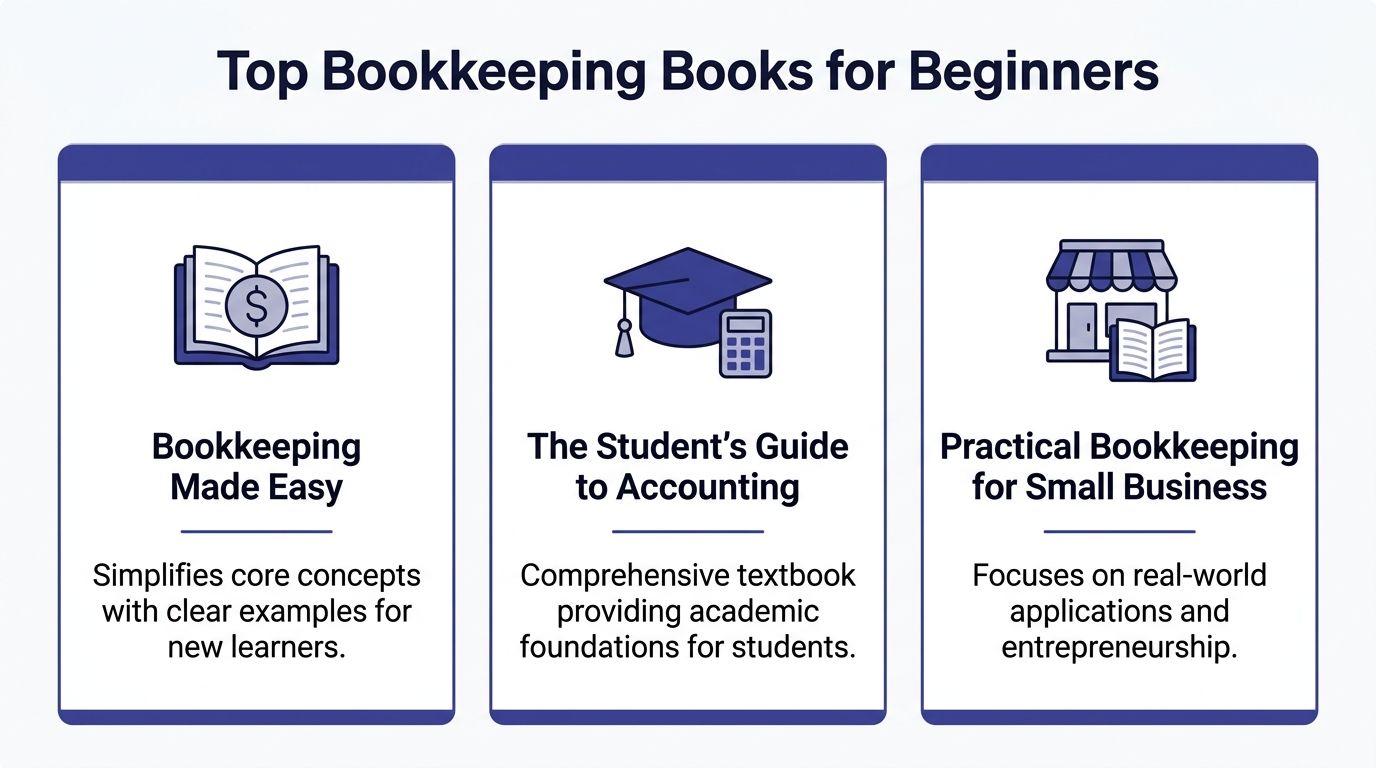
Some titles are especially useful because they meet readers where they are. Others look friendly but leave out the small examples that make bookkeeping click.
| Book Title | Best For | Key Focus |
|---|---|---|
| Accounting for Dummies | Absolute beginners | Plain-language introduction to accounting and bookkeeping ideas |
| Accounting Made Simple | Self-learners and career changers | Clear overview of accounting logic without heavy jargon |
| Practical small business bookkeeping guides | Owners managing their own books | Day-to-day transactions, categories, and records that support operations |
This is one of the most recognizable entry-level titles for a reason. It is approachable.
According to the earlier Rightworks source, Accounting for Dummies has sold over 2.5 million copies worldwide. Sales alone do not prove quality, but they do suggest that many readers have used it as a starting point.
Its strength is tone. The book tends to lower the intimidation level. If someone says, “I am smart enough to run my business, but accounting language makes me freeze,” this is the kind of book that often gets them moving again.
Best fit:
Main takeaway: a beginner book should make the system feel learnable before it makes it feel technical.
This title is a strong bridge book. It works well for people who want more structure than a very casual introduction but are not ready for a dense professional manual.
The appeal is in its clean focus. Instead of overwhelming the reader with edge cases, it usually centers the logic of financial statements and transactions. That makes it useful for learners who want to understand why the books work, not just where to click.
This is often a better pick for:
A good beginner book should leave you able to read a profit and loss statement without feeling lost. This kind of title tends to support that goal.
Many owners do not need academic coverage. They need help with common events: sales deposits, expense tracking, owner draws, vendor payments, and bank reconciliation.
That is where practical bookkeeping guides shine. These books are especially useful when they include sample workflows, forms, and month-end habits. A retail owner, consultant, or nonprofit manager often learns faster from realistic examples than from textbook-style drills.
Look for practical titles that include:
Tip: If you own a business, choose a book that spends more time on recurring transactions than on accounting theory alone. Repetition builds skill.
The most common mistake is buying based on popularity alone.
A famous title may still be wrong for you if:
The second mistake is expecting one book to do everything. Most learners need at least two layers. One for fundamentals. Another for real-world application.
That is normal. In bookkeeping, depth comes from repetition in different contexts.
Once you move beyond beginner material, the standard changes. At that level, a book is not just teaching concepts. It is helping you solve problems, reduce exposure, document decisions, and support higher-stakes work.
For small business accountants, firm owners, controllers, and CPAs, the strongest books on bookkeeping are usually not “fun reads.” They are working tools.
Barron’s Accounting Handbook is built for readers who need breadth and technical depth. It spans over 1000 pages, includes an A to Z accounting dictionary, and covers financial reporting requirements, tax forms, preparation procedures, and compliance standards, according to Uncat’s write-up on accounting books.
That scope matters in professional practice. A reference like this earns its place when you need to confirm treatment, check terminology, or review an issue without relying on scattered notes.
The compliance angle is especially important. The same source notes that non-compliance can trigger average IRS penalties of $14,000 per violation, and that best practices promoted by authoritative guides can reduce error rates by up to 40%.
This is not a first book. It is a desk-side resource for people who already speak the language and need a deeper answer.
Best use cases:
Steven Bragg’s Bookkeeping Essentials: How to Succeed as a Bookkeeper sits in a useful middle ground. It is practical, but it is not simplistic.
The value of this kind of book is its problem-solving posture. A seasoned practitioner often does not need another explanation of what accounts payable means. They need help diagnosing why routines break down, how to tighten processes, and what a healthier bookkeeping operation looks like day to day.
Bragg’s style tends to help readers who are building a service practice or improving an internal process. It is useful for independent bookkeepers, accounting managers, and professionals who need a sharper operating rhythm.
This is a good choice when your questions sound like these:
| Book | Best reader | Strongest use |
|---|---|---|
| Barron’s Accounting Handbook | CPA, controller, senior accountant | Reference, compliance, reporting depth |
| Bookkeeping Essentials | Independent bookkeeper, accounting manager, firm operator | Workflow improvement, service quality, daily issue solving |
Advanced books should not be read the way beginners read.
A beginner reads straight through. A professional reads selectively, with current work in mind. That means opening a chapter because a real issue came up. It means marking passages for month-end checklists. It means turning a paragraph into a standard operating procedure.
Key takeaway: At the professional level, a good accounting book should shorten decision time and improve consistency, not just increase knowledge.
There is also a management layer here. Many professionals are not only keeping books. They are building teams, setting review standards, and deciding how clients or staff will access applications securely. For firm owners thinking beyond technical skill into practice design, this resource on how to start a CPA firm is a helpful operational complement.
A serious professional text should do at least one of these things well:
If a book does none of those things, it may still be readable, but it is not earning shelf space in a working accounting environment.
Reading teaches recognition. Software builds muscle memory.
That is why so many people feel they “understand” bookkeeping but still hesitate when they open QuickBooks or Sage. They know the words. They have not yet turned those words into routine actions.

A better approach is to study with the software open. Read a short section. Then perform the idea.
Start with small repetitions.
Take the sample chart of accounts from your book and recreate it inside your software. Do not worry about perfection at first. The goal is to see how categories become structure.
You will learn quickly which account names make sense and which ones are too vague.
Use a fictional month of business activity. Record:
This turns abstract examples into workflow.
Reconciliation is where confidence grows. Match your software records to a bank statement or sample statement from a practice set.
Do not rush this. Reconciliation teaches you how errors appear in real life.
Generate a profit and loss statement and a balance sheet. Then explain each line in plain English, as if speaking to a client or owner.
If you cannot explain the report, go back to the transactions that created it.
A lot of frustration disappears when readers stop treating software as a final exam.
Use it as a sandbox. Test entries. Reverse mistakes. Create a customer, invoice, payment, and deposit. Run reports after each step. Watch cause and effect.
For teams that want a stable place to run those applications remotely, cloud-based accounting solutions can make practice and production more accessible across devices and locations.
A short walkthrough can also help make the jump from theory to action:
Here is a practical pattern for turning book knowledge into skill:
This method works because bookkeeping is cumulative. You are not memorizing isolated rules. You are learning how transactions flow through a system.
Tip: If a book gives examples but no practice files, create your own tiny business scenario. A made-up consulting firm is enough to learn most fundamentals.
Traditional bookkeeping books usually stop at the ledger, the report, or the software screen. They rarely spend enough time on the environment where the work happens.
That is a serious omission.
A modern accounting setup has to do more than process entries. It must support secure access, consistent backups, multi-user collaboration, and continuity when staff work from different locations. A desktop program on one office machine may work for a while, but it becomes fragile as soon as the business grows or the team spreads out.

A verified gap exists here. A 2025 AICPA survey indicates 68% of accounting firms struggle with cloud migration for bookkeeping software, yet a review of popular bookkeeping books found that none of the top titles adequately cover scalable cloud hosting, according to this referenced summary.pdf).
Books teach method. Hosting affects execution.
If staff cannot access QuickBooks reliably, month-end slows down. If backups are inconsistent, records become vulnerable. If remote accountants use improvised file-sharing habits, control weakens.
A stronger setup supports:
When evaluating a cloud-hosted accounting setup, focus on fit, not buzzwords.
A practical environment should support your accounting applications, your document flow, and your review process. It should also make ordinary tasks easier, such as retrieving files, collaborating on adjustments, and keeping access consistent across a team.
If you want a plain-English primer before comparing options, what cloud hosting is is a good place to start.
Key takeaway: The future of bookkeeping is not just better books and better software. It is a better operating environment for both.
The best books on bookkeeping still matter. They teach the logic. But the modern professional also needs infrastructure that protects that work and makes it usable in practice.
Yes. Software helps you process transactions, but it does not automatically teach judgment.
A book explains why a transaction belongs in one account and not another, when a report looks wrong, and what questions to ask before clicking save. Software speeds up bookkeeping. It does not replace understanding.
It depends on your goal.
If you want a job signal, a structured curriculum, or a formal milestone, certification can help. If you are a business owner trying to run cleaner books, self-study may be enough at first. Many people do both. They start with a practical book, practice in software, and then decide whether formal training is worth the time.
AI is becoming part of the conversation faster than most books reflect. A 2026 Deloitte report found that 72% of CPAs are actively seeking books and training on AI-enhanced bookkeeping to reduce errors, highlighting a clear gap because many current titles still focus on manual processes rather than AI inside cloud-based systems, according to this referenced report summary.
The core lesson is reassuring. You still need fundamentals. AI may suggest categories, surface anomalies, or speed review, but it works best when the user understands the bookkeeping underneath.
Usually two types are enough to start. One foundational book. One practical or professional reference that matches your role.
After that, the better investment is often repetition, practice, and a stronger system for doing the work consistently.
If you are ready to move from learning bookkeeping to running your accounting software in a more secure, scalable environment, Cloudvara is worth a look. It gives firms and businesses a way to host applications like QuickBooks, Sage, tax software, CRM tools, and document systems in one accessible cloud setup, with support for remote work, backups, and business continuity.