
Managing a law firm’s finances is far more complex than tracking simple debits and credits. From stringent IOLTA and trust accounting rules to the need for matter-centric expense tracking and billing, your firm faces unique financial challenges that a generic spreadsheet or standard business accounting software simply cannot handle effectively. Using inadequate tools not only creates administrative bottlenecks but also introduces significant compliance risks that can threaten your firm's reputation and license.
Choosing the right platform is a critical strategic decision that directly impacts profitability, operational efficiency, and client trust. This guide is designed to cut through the marketing noise and provide a clear, in-depth analysis of the best accounting software for law firms. We will move beyond surface-level feature lists to give you practical insights into how each solution performs in real-world legal scenarios.
This article reviews the top 12 legal accounting platforms, from all-in-one systems to specialized trust accounting tools. For each option, you will find screenshots, direct links, and an honest assessment of its strengths and limitations. We evaluate them based on core legal needs:
Many firms find that their accounting choice is deeply connected to their primary operational hub. When selecting accounting software, consider how it integrates with a comprehensive solution like the best legal practice management software to streamline your entire firm's operations. Our goal is to equip you with the information needed to select a system that secures your finances and supports your practice’s growth.
Actionstep Legal Accounting, the platform formerly known as Soluno, earns its top spot by offering a complete, standalone legal accounting system built from the ground up for law firms. Its key differentiator is that it doesn't require a separate general ledger like QuickBooks or Xero. This all-in-one approach simplifies the back office by integrating matter management, billing, trust accounting, and business accounting into a single, cohesive cloud-native system. This makes it an excellent choice for firms wanting to move away from generic accounting software and its associated workarounds.

The platform’s strength lies in its strict adherence to compliance standards. With features like three-way trust reconciliation and detailed audit trails, Actionstep is designed to keep firms audit-ready and compliant with IOLTA/IOLA regulations. This focus on compliance makes it a strong contender for firms prioritizing risk management. The software supports various billing methods, including hourly, fixed-fee, and contingency, along with LEDES e-billing formats, catering to diverse client needs. This built-in functionality is a core part of effective IT solutions for law firms, as it reduces errors and streamlines financial operations.
| Feature | Details |
|---|---|
| Best For | Firms that want a dedicated, all-in-one legal accounting system without needing QuickBooks. |
| Trust Accounting | Advanced three-way reconciliation, multi-account support, and robust compliance reporting. |
| Billing | Matter-centric billing with LEDES support, plus integrated accounts payable and vendor management. |
| Pricing | Quote-based. You must contact their sales team and schedule a demo for pricing information. |
| Limitations | As a newer brand identity for the accounting module, firms may face a slight learning curve or need to manage change internally. |
Website: Actionstep Legal Accounting
Tabs3 Financials provides a dedicated, law-firm-specific accounting suite that has been a trusted name in the legal industry for decades. It stands out by offering a modular approach, allowing firms to purchase only the financial components they need, such as Trust Accounting, Accounts Payable, and a General Ledger. This makes it an adaptable choice for firms that want deep, specialized accounting functions without necessarily replacing their entire practice management system. It's available as both a cloud-based and on-premise subscription, offering flexibility in deployment.

The platform’s core strength is its powerful, compliance-focused accounting workflows. The trust accounting module includes client-level ledgers, check printing, and robust three-way trust reporting, ensuring firms can meet strict regulatory requirements. The general ledger comes with a pre-configured, law-firm-specific chart of accounts, simplifying setup and financial analysis. With support for importing bank data (OFX, QFX, QBO) and generating 1099-NEC/MISC forms, Tabs3 is one of the best accounting software for law firms prioritizing traditional, in-depth financial management. For firms looking to move this powerful tool to a secure, accessible environment, exploring Tabs3 hosting options can provide added benefits.
| Feature | Details |
|---|---|
| Best For | Firms needing a powerful, specialized accounting solution with flexible deployment options (cloud or on-premise). |
| Trust Accounting | Dedicated module with three-way trust reporting, client ledgers, and bank import support. |
| Billing | Integrates with Tabs3 Billing for time tracking and invoicing, but Financials focuses on AP and GL. |
| Pricing | Quote-based. Pricing is modular, so you must contact sales for a custom quote based on your needs. |
| Limitations | The interface is accounting-centric and may require user training; the modular pricing can become complex. |
Website: Tabs3 Financials
CARET Legal, which was previously known as Zola Suite, provides a fully integrated legal practice management solution that includes native business and trust accounting. Its primary appeal is for firms seeking to consolidate their entire operations, from case management and billing to payments and accounting, into one system. This eliminates the common pain point of syncing data between separate practice management and accounting programs like QuickBooks, reducing errors and saving administrative time. For firms that want to manage everything from a single dashboard, CARET Legal is a powerful contender.

The platform stands out by building its accounting functionality directly into its core, making it a true all-in-one system. This makes it some of the best accounting software for law firms that prioritize operational simplicity. It offers compliant trust accounting, robust billing features, and integrated payment processing through CARET Payments. Higher-tier plans also introduce advanced analytics and department-based accounting, providing deeper financial insights for growing firms. With included onboarding and 24/7 support across all plans, the company ensures firms have the resources to adopt the platform successfully, although it requires more internal change management due to its broad scope.
| Feature | Details |
|---|---|
| Best For | Firms that want a single, all-in-one platform for case management, billing, and accounting. |
| Trust Accounting | Built-in trust accounting features to maintain compliance and manage client funds accurately. |
| Billing | Native billing, invoicing, and payment processing (CARET Payments) are included in the platform. |
| Pricing | Starts at $79/user/month (billed annually) for the Essentials plan. One-time implementation fees apply. |
| Limitations | The platform’s extensive scope can require significant change management for firms transitioning from multiple separate tools. |
Website: CARET Legal
CosmoLex secures its spot by offering a fully integrated, cloud-based practice management solution where legal accounting is not an afterthought but a core component. Unlike systems that require integrations with separate general ledgers, CosmoLex provides built-in business and trust accounting within a single application. This unified approach eliminates data syncing issues and simplifies back-office operations, making it a strong candidate for small to mid-size firms seeking an all-in-one system with a primary focus on trust compliance and efficiency.

The platform's main advantage is its strict adherence to IOLTA and trust accounting rules. Features like built-in three-way reconciliation, duplicate check prevention, and detailed audit trails are designed to keep firms compliant and audit-ready at all times. By combining time tracking, billing, and accounting, CosmoLex ensures that every financial transaction is correctly allocated to the right matter from the start. This design makes it one of the best accounting software for law firms that want to minimize risk and manual errors. Exploring other types of cloud-based law firm software can help firms understand how integrated solutions like this fit into a modern practice.
| Feature | Details |
|---|---|
| Best For | Small to mid-size firms wanting a single application for practice management and all accounting needs. |
| Trust Accounting | Built-in IOLTA/trust compliance with three-way reconciliation, safeguards, and compliance reporting. |
| Billing | Integrated time tracking, invoicing, and online payments linked directly to trust and operating accounts. |
| Pricing | Pricing starts at $95/month per user (billed annually). Advanced features and add-ons may require a custom quote. A free trial is available. |
| Limitations | As a comprehensive suite, the initial setup can be more involved than with simpler, standalone tools. |
Website: CosmoLex
PCLaw has been a staple in the legal industry for decades, offering a comprehensive, on-premise solution for billing, matter management, and legal accounting. Its longevity makes it a familiar choice for established firms that prefer the control and security of a server-based system. PCLaw integrates business accounting, trust accounting, and practice management into a single application, providing a mature feature set designed to meet the rigorous demands of law firm financial operations.
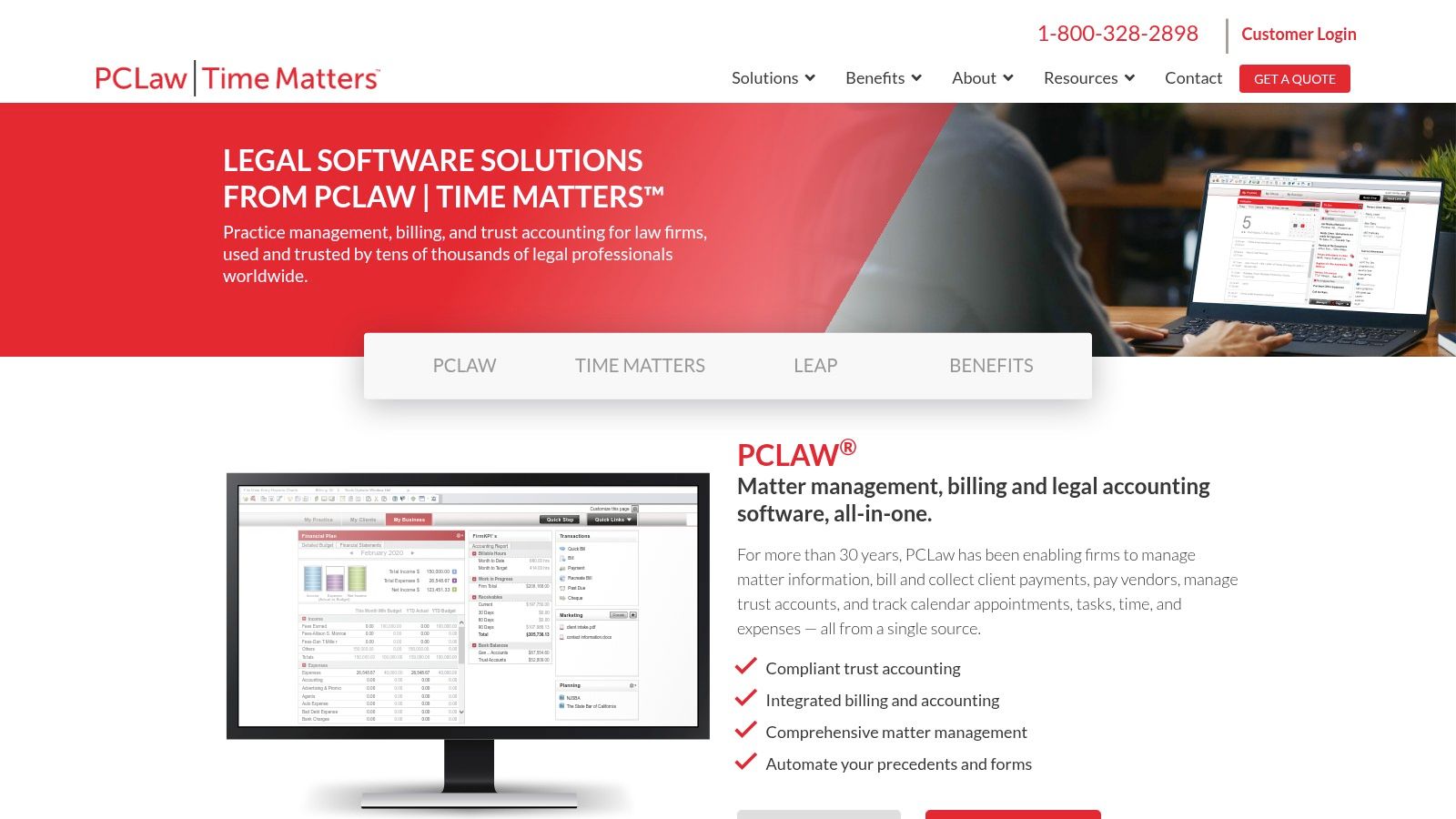
The platform’s core strength is its all-in-one, desktop-centric approach. For firms not yet ready to migrate to a fully cloud-native environment, PCLaw offers robust, compliant trust accounting and detailed financial reporting. While it is primarily a desktop application, many firms achieve modern remote access and enhanced security through specialized third-party hosting. This approach makes it some of the most versatile and best accounting software for law firms that want to maintain their existing workflows while gaining cloud flexibility. Using a dedicated private cloud for PCLaw hosting allows teams to access the software from anywhere without sacrificing performance or security.
| Feature | Details |
|---|---|
| Best For | Established firms comfortable with a server-based system or using a private cloud host. |
| Trust Accounting | Built-in IOLTA/trust management with compliance safeguards and reporting. |
| Billing | Integrated time tracking, expense management, and customizable billing formats. |
| Pricing | Quote-based. Pricing and maintenance plans are available upon request from their sales team. |
| Limitations | Primarily desktop/server-based, requiring a partner for cloud hosting. The interface can feel dated compared to newer, web-first platforms. |
Website: PCLaw | Time Matters
MyCase Accounting addresses a common pain point for solo practitioners and small firms by building its accounting features directly into its well-regarded practice management platform. Instead of forcing users to sync with external general ledgers, MyCase offers a native module that handles business and trust accounting within the same system used for case management, time tracking, and billing. This integrated approach is designed for simplicity, making it one of the best accounting software for law firms that want to consolidate their tech stack and reduce complexity.

The system’s main strength is its user-friendliness, targeting legal professionals who are not accounting experts. It provides guided workflows for complex tasks like three-way trust reconciliation and includes IOLTA safeguards to prevent common compliance mistakes. With direct bank integration via Plaid, reconciling accounts becomes a more automated and less error-prone process. Because it's part of the MyCase ecosystem, all financial data is intrinsically linked to matters, providing a clear financial picture of each case without switching between applications.
| Feature | Details |
|---|---|
| Best For | Solo and small firms already using or considering MyCase that want a simple, built-in accounting solution. |
| Trust Accounting | Built-in three-way trust reconciliation, IOLTA compliance controls, and role-based permissions to protect trust funds. |
| Billing | Fully integrated with MyCase matters, time tracking, and client billing for a unified financial workflow. |
| Pricing | Available as an add-on to a MyCase subscription plan. You must contact sales for specific pricing. |
| Limitations | Cannot be purchased as a standalone product; requires a MyCase subscription. Firms are locked into the MyCase ecosystem. |
Website: MyCase Accounting
LeanLaw carves out a unique niche by acting as a legal-specific layer on top of QuickBooks Online, rather than a full replacement. It’s designed for firms that already use and trust QuickBooks for their general ledger but need robust, matter-centric tools for billing, timekeeping, and trust accounting. The platform’s core strength is its deep, two-way sync with QBO, which ensures all invoices, expenses, payments, and trust transactions are accurately reflected in both systems. This makes it one of the best accounting software for law firms that want to add legal-specific controls without abandoning their existing accounting foundation.

As a certified QuickBooks Online Premium App Partner, LeanLaw excels at bridging the gap between standard accounting and legal compliance needs. It introduces matter-based accounting directly into the QuickBooks environment, allowing for precise financial tracking on a case-by-case basis. Features like integrated trust accounting, LEDES e-billing support, and detailed financial reporting provide the specialized functionality that general accounting platforms lack. This approach is ideal for firms whose bookkeepers or accountants are proficient in QuickBooks but who need to ensure compliance and improve billing efficiency.
| Feature | Details |
|---|---|
| Best For | Firms committed to using QuickBooks Online as their general ledger but needing legal-specific features. |
| Trust Accounting | Integrated trust accounting that syncs directly with QuickBooks Online, simplifying reconciliation. |
| Billing | Matter-centric billing with robust time tracking, expense management, and support for LEDES formats. |
| Pricing | Core Plan starts at $40/user/month; Pro Plan is $65/user/month, offering more advanced reporting and features. |
| Limitations | Fully dependent on a QuickBooks Online subscription, which is a separate cost and requirement. |
Website: LeanLaw
TrustBooks earns its place by laser-focusing on one of the most critical and high-risk areas of legal accounting: trust accounts. Unlike comprehensive practice management systems, TrustBooks is purpose-built software dedicated to simplifying IOLTA/IOLA compliance and making trust account reconciliation straightforward. It strips away the complexity of general accounting software, offering lawyer-friendly workflows that minimize accounting jargon. This specialized approach makes it some of the best accounting software for law firms that already have systems for billing and operations but need a dedicated, compliant solution for trust management.

The platform’s standout feature is its automated three-way reconciliation process. TrustBooks guides users through reconciling their trust account bank statement, checkbook register, and individual client ledgers, generating a state-bar-ready report with a single click. This significantly reduces the time and anxiety associated with month-end closing and audit preparation. While it can be paired with an optional operating account module, its primary strength is as a specialized compliance tool. Integrations with Clio, PracticePanther, and LawPay allow it to slot neatly into a firm’s existing tech stack.
| Feature | Details |
|---|---|
| Best For | Firms prioritizing simple, bulletproof trust account compliance and easy reconciliation. |
| Trust Accounting | Automated three-way reconciliation, state bar compliance safeguards, and one-click reporting. |
| Billing | Not a primary feature; it focuses on trust transactions. Integrates with billing software. |
| Pricing | Starts at $59/month for the trust accounting module. A 14-day free trial is available. |
| Limitations | Not a full practice management or general business accounting system. Its optional reconciliation service has transaction limits. |
Website: TrustBooks
Centerbase secures its position by offering a comprehensive practice management platform that includes a true general ledger. This design eliminates the need for external accounting software like QuickBooks, positioning Centerbase as an integrated solution for firms aiming to consolidate their tech stack. It combines firm and trust/retainer accounting, billing, timekeeping, and management tools into a single, cohesive system built specifically for the legal industry. This all-in-one approach is ideal for mid-sized to larger firms looking to manage complex operations without juggling multiple applications.

The platform’s major advantage is its built-in, legal-specific accounting engine. With prebuilt reports for Profit & Loss, trial balances, and budget analysis, firms can gain immediate financial insights without custom configurations. Centerbase also provides robust, matter-centric billing and timekeeping that flows directly into its accounting modules, ensuring data accuracy and reducing manual data entry. For firms prioritizing control and a single source of truth for all financial data, Centerbase presents a powerful case as one of the best accounting software for law firms that can manage the entire practice.
| Feature | Details |
|---|---|
| Best For | Mid-sized to larger firms that want a single platform with a true general ledger for both firm and trust accounting. |
| Trust Accounting | Fully integrated trust and retainer accounting connected directly to the general ledger. |
| Billing | Matter-centric timekeeping and billing are natively integrated with the platform's accounting system. |
| Pricing | Quote-based. Pricing requires scheduling a demo with their sales team to get a custom quote. |
| Limitations | The all-in-one scope can be a significant undertaking, requiring substantial process changes and team training for successful adoption. |
Website: Centerbase
Juris by LexisNexis is a mature financial management suite designed specifically for law firms, establishing its place as one of the best accounting software for law firms with a long history in the market. It combines time tracking, billing, and comprehensive accounting functionalities, including general ledger, accounts payable, and trust accounting, into a single, robust system. It is commonly adopted by mid-sized firms that require advanced financial controls, in-depth reporting, and strong audit trails to manage complex financial operations effectively.

The platform’s strength is its deep, law firm-specific financial workflows. Unlike generic accounting tools, Juris is built to handle the nuances of legal practice, from intricate billing arrangements to strict trust account management. The optional Juris Suite extends its capabilities with advanced analytics and business intelligence, giving firm partners greater insight into financial performance. Its traditional on-premise deployment model provides firms with complete control over their data, aligning with strict security policies often paired with robust document management for law firms.
| Feature | Details |
|---|---|
| Best For | Mid-sized firms needing a powerful, all-in-one financial suite with granular control. |
| Trust Accounting | Built-in trust accounting that works with accounts payable and general ledger for full compliance. |
| Billing | Includes time and expense capture, e-billing, accounts receivable, and collections management. |
| Pricing | Quote-based. Pricing is not public and requires direct contact with the Juris sales team. |
| Limitations | As a traditionally server-based solution, it often requires dedicated IT resources or private hosting for remote access. |
Website: Juris
Aderant Expert, particularly its cloud-native Expert Sierra platform, is an enterprise-grade solution built for the world's largest and most complex legal practices. It moves far beyond basic bookkeeping, functioning as a comprehensive business-of-law platform for Am Law 100/200 and Global 100 firms. Its core purpose is to manage sophisticated financial operations at scale, covering everything from time and billing to global compliance and advanced analytics. This makes it a go-to choice for large firms needing deep financial controls and the ability to manage intricate work-to-cash cycles across multiple jurisdictions.

The platform’s strength is its proven ability to handle immense scale while maintaining strict compliance. Aderant offers an entire ecosystem of tools, including iTimekeep and BillBlast, that integrate to optimize billing realization and adhere to complex Outside Counsel Guidelines (OCG). With key SaaS components boasting SOC 2 Type 2 attestations, Aderant provides the security and reliability that enterprise clients demand. As one of the best accounting software for law firms in the large-firm market, it provides the robust infrastructure needed to manage a global business, not just a local practice.
| Feature | Details |
|---|---|
| Best For | Large, enterprise-level law firms (Am Law 100/200, Global 100) that require a sophisticated, scalable financial management system. |
| Trust Accounting | Advanced compliance tooling designed for complex, multi-jurisdictional trust and general accounting requirements. |
| Billing | Enterprise-class time and billing with extensive e-billing, OCG compliance, and an AI-assisted work-to-cash process. |
| Pricing | Enterprise-level pricing requires consultation. Expect a significant investment reflecting its target market. |
| Limitations | The cost and implementation complexity make it impractical and excessive for small or mid-sized firms. |
Website: Aderant
ProLaw, a long-standing product from Elite, provides an integrated system that combines front-office practice management with back-office billing and accounting. It is designed for mid-sized firms that prefer a single, unified platform to manage everything from case files and time entry to general ledger accounting and financial reporting. By consolidating these functions, ProLaw aims to eliminate the data silos and synchronization issues that can arise from using separate software for practice management and accounting, making it a reliable option for firms seeking operational efficiency.

The platform’s core value lies in its deep integration with Microsoft Office, allowing legal professionals to work within familiar applications like Outlook and Word while seamlessly capturing time and managing documents. While its accounting module is built-in, it also connects with partner tools for functions like eBilling. Given its history, ProLaw has a substantial user base and is a mature product, but firms with legacy on-premise deployments may need to plan for modernization to take full advantage of current capabilities. It remains one of the more robust choices when considering the best accounting software for law firms that require an all-in-one solution.
| Feature | Details |
|---|---|
| Best For | Mid-sized firms that want a single, unified platform for both practice management and accounting. |
| Trust Accounting | Integrated general ledger and trust accounting capabilities are built directly into the system. |
| Billing | Features in-platform timekeeping and billing, with eBilling supported through partner integrations. |
| Pricing | Not publicly available. Firms must contact the Elite sales team for a consultation and quote. |
| Limitations | Older, on-premise deployments may require significant modernization planning to move to a hosted environment. |
Website: ProLaw
| Product | Core features | UX & support | Value proposition | Target audience | Unique selling points / Pricing & deployment |
|---|---|---|---|---|---|
| Actionstep Legal Accounting | Integrated GL, trust/IOLTA, matter-based billing, AP | Cloud-native; disclosed SOC 2 posture | Standalone legal accounting without QuickBooks/Xero | Law firms wanting a legal-specific back office | Strong compliance tooling; quote-based pricing (cloud) |
| Tabs3 Financials | Trust accounting, GL, AP, bank imports, check printing | Cloud or on‑prem; accounting-centric workflows | Deep, law-focused accounting workflows | Firms needing advanced trust and accounting processes | Three-way trust reporting; OFX/QFX support; subscription or on‑prem (quote) |
| CARET Legal (Zola Suite) | Native billing, accounting, payments, analytics | Onboarding & 24/7 support included | All-in-one practice + accounting in one system | Firms wanting consolidated case, billing & accounting | Transparent per-user pricing; one-time implementation fee; cloud tiers |
| CosmoLex | Trust & business accounting, bank feeds, reporting | U.S. hosting, extensive KB and onboarding resources | Integrated practice management + legal accounting | Small–mid firms focused on trust compliance | Fully integrated accounting + PM; free trial; cloud (pricing often sales-assisted) |
| PCLaw (PCLaw | Time Matters) | Billing, legal accounting, matter/time/expense, mobile time | Mature desktop/server workflows; familiar for legacy users | Established firms preferring server or private cloud | Feature-rich legacy tool; PCLaw Go mobile; hosted via partners or on‑prem (quote) |
| MyCase Accounting | Three-way trust reconciliation, Plaid bank sync, financials | Guided workflows for non-accountants | Accessible legal accounting tied to matters | Solos and small firms using MyCase | Native MyCase integration; add-on only; cloud add-on pricing |
| LeanLaw | Matter-based billing, trust accounting layer, two-way QBO sync | Clear published tiers; QBO-centric UX | Adds legal controls while keeping QuickBooks as GL | Firms standardized on QuickBooks Online | Certified QBO Premium App; published Core/Pro pricing; requires QBO |
| TrustBooks | IOLTA/state bar tools, auto three-way reconciliation, reporting | Lawyer-friendly UI; optional reconciliation services | Airtight trust compliance and simple reconciliations | Firms prioritizing IOLTA/trust compliance | Transparent tiered pricing, 14‑day trial, integrations (LawPay, Clio) |
| Centerbase | True GL + trust/retainer accounting, billing, time, reports | Role-based security; legal-specific reports | Reduces need for separate accounting stack | Firms seeking unified PM + accounting | Built-in GL and prebuilt legal reports; quote-based cloud plans |
| Juris (LexisNexis) | Time, billing, AR/AP, trust, strong financial reporting | Robust audit trails; mature vendor support | Advanced financial controls and reporting | Mid-sized firms needing deep financial controls | Long market history; optional extended analytics; typically on‑prem/quote |
| Aderant Expert (Expert Sierra) | Enterprise billing, financial mgmt, eBilling, analytics, AI | Cloud-first; SOC 2 attestations for components | Enterprise-scale work-to-cash and compliance automation | AmLaw / Global 100 and large complex firms | Enterprise ecosystem, compliance tooling; enterprise pricing & lengthy implementation |
| ProLaw (Elite) | Integrated timekeeping, billing, accounting; Office integrations | Unified front-to-back office; enterprise hosting options | Full front/back-office integration in one product | Midsize firms wanting unified practice & finance | Microsoft Office integrations; long product history; quote-based deployment |
Navigating the landscape of legal accounting software can feel like a significant undertaking, but it represents a foundational decision for your firm's operational health and future growth. As we've explored, the search for the single "best accounting software for law firms" is less about finding a universally perfect product and more about identifying the solution that aligns perfectly with your firm's unique size, practice areas, compliance needs, and technological maturity. The right choice is not a one-size-fits-all answer but a specific, strategic selection.
This guide has walked through a detailed analysis of the market's leading contenders, from all-in-one legal practice management systems with built-in accounting like CosmoLex and CARET Legal, to powerful QuickBooks integrations such as LeanLaw, and dedicated back-office engines like Tabs3 Financials or PCLaw. For larger, more complex organizations, enterprise-level platforms like Aderant Expert and ProLaw offer deep financial management capabilities. The key takeaway is that your evaluation must extend beyond a simple feature checklist.
Your final choice should be a balance of several critical elements. Remember to weigh these factors as you create your shortlist and begin scheduling demonstrations:
Moving from analysis to action is the most critical step. Use the information in this article to guide a structured evaluation process within your firm.
Ultimately, selecting the best accounting software for your law firm is an investment in stability, compliance, and efficiency. The right platform will not just manage your finances; it will provide the data-driven insights needed to run a more profitable and secure practice, freeing you to focus on what you do best: serving your clients.
Ready to pair your chosen software with unmatched security, reliability, and remote access? Cloudvara provides secure, private cloud hosting for the legal industry's most trusted accounting and practice management applications, ensuring your firm's sensitive data is protected and accessible from anywhere. Learn how Cloudvara can create your firm's secure virtual office.