Let's be blunt: accounting firms aren't just managing numbers; you're safeguarding the financial DNA of your clients. This makes you a digital treasure chest filled with Social Security numbers, bank details, and strategic business plans—a prime target for cybercriminals looking for a high-value score.

Think of your firm as a central bank for sensitive information. Unlike a retail store that processes one-off transactions, you collect and store a massive concentration of high-value data. While that consolidation is efficient for business, it's incredibly attractive to attackers. A single breach at an accounting firm can yield the data of hundreds or even thousands of individuals and businesses at once.
The consequences go far beyond just financial loss. A successful attack can lead to reputational ruin, costly litigation, and severe regulatory penalties. That’s why a proactive approach to accounting and cyber security is no longer optional; it's a fundamental necessity for survival and growth.
To put it in perspective, here’s a look at the kind of data you handle and the risks that come with it.
This table summarizes the types of sensitive data managed by accounting professionals and the specific cyber threats they attract, highlighting the urgency of robust security.
| Data Type | Why It's a Target | Common Cyber Threat |
|---|---|---|
| Personal Identifiable Information (PII) | Used for identity theft, fraudulent loans, and tax fraud. | Phishing, Ransomware |
| Financial Account Information | Enables direct financial theft and fraudulent transactions. | Malware, Credential Stuffing |
| Business Financial Records | Used for corporate espionage, stock manipulation, or extortion. | Business Email Compromise (BEC) |
| Tax Returns and Filings | A complete package for identity theft and financial fraud. | Ransomware, Phishing |
| Client Passwords & Credentials | Provides access to other client systems, expanding the breach. | Keyloggers, Phishing |
As you can see, the data you protect every day is the same data criminals are most eager to steal.
Cyber threats are becoming more frequent and far more complex. The global shift to remote work has expanded the potential attack surface for many firms, making traditional, office-based security measures less effective. Cybercrime has become a booming industry, with criminals constantly developing new tactics to exploit any vulnerability they can find.
The scale of this challenge is staggering. Projections show that the annual cost of cybercrime is expected to reach $10.5 trillion globally, a dramatic increase from $3 trillion just a few years ago. This explosion in malicious activity directly impacts accounting professionals, who are on the front lines of data protection.
This economic reality is forcing a major response. Worldwide spending on security and risk management is forecasted to jump by 12.2% year-over-year, driven by the need to counter these sophisticated threats. This isn't just an IT issue; it's a core business risk that demands a strategic plan.
Protecting your firm requires a structured approach that goes far beyond simple antivirus software. It involves understanding specific threats, implementing layered defenses, and ensuring strict compliance with industry regulations. Meeting standards like those required for SOC compliance is becoming a key differentiator, demonstrating a firm's commitment to security. You can read our guide to learn more about what is SOC compliance and why it matters.
This guide will cover the core pillars of a robust security strategy:
To protect your firm, you first have to understand what you're up against. Cyber threats aren't just abstract buzzwords; they're specific, calculated attacks designed to exploit the everyday routines of accounting and tax professionals. Let's move beyond generic warnings and look at what these attacks actually look like when they hit your inbox.
Imagine it’s the chaotic peak of tax season. An email lands from a major client with an urgent subject line: "Wire Transfer Needed for Tax Payment." The email address looks right, the signature is familiar, and the tone feels normal. This isn't just a random scam; it's spear-phishing, a highly targeted attack crafted just for you.
Unlike general phishing that blasts thousands of generic messages, spear-phishing uses specific details about your firm and your clients to build a convincing story. The goal is to trick you or your staff into taking one specific action, like wiring funds or handing over sensitive login credentials.
When a spear-phishing attack works, it often escalates into something far more devastating: Business Email Compromise (BEC). This is where an attacker gains full control of a legitimate business email account—either yours or a client's—and uses it to manipulate financial transactions. The FBI reported that BEC scams led to a staggering $2.9 billion in losses in 2023 alone, cementing its reputation as one of the most financially destructive online crimes.
For accountants, a typical BEC scenario plays out in a few ways:
Because these requests look like they're coming from a trusted source, they sail past technical defenses and prey directly on human trust. This is exactly why staff training and strict verification procedures are so critical.
While BEC is all about deception, ransomware is a digital sledgehammer. This malicious software spreads through your network and encrypts everything it can find—client files, tax documents, QuickBooks databases, and even your server backups. Once your data is encrypted, it’s completely inaccessible.
The attackers then demand a ransom, usually in cryptocurrency, for the decryption key. For an accounting firm, a ransomware attack during year-end closing or tax season is catastrophic. It halts all operations, paralyzes your ability to serve clients, and puts immense pressure on you to pay up, with zero guarantee you'll ever see your data again.
A Critical Insight: A recent report found that the average cost of a data breach for companies has now hit $4.45 million, a 15% jump in just three years. For smaller firms, a financial blow that big can be impossible to recover from, which makes preventative security non-negotiable.
Understanding how these attacks work is the first step toward building a defense. Our guide on how to prevent ransomware attacks offers more detailed strategies for protecting your critical data. The key takeaway is that both internal human error and external malicious attacks can jeopardize your firm’s future.
Finally, attackers are now deploying specialized malware to steal the credentials for the software you use every day. This isn't just a generic virus; it's code specifically designed to find and capture login details for accounting platforms like Sage, QuickBooks, and other financial management tools.
This kind of malware often arrives in a malicious email attachment disguised as a PDF invoice or a link to a fake software update. Once a staff member clicks it, the malware can log keystrokes, take screenshots, or scrape saved passwords from web browsers. With those credentials, an attacker has the keys to your kingdom, free to access sensitive client data or manipulate financial records without anyone noticing.
A single lock on your office door isn’t enough to protect your firm's physical assets, and a single password is a flimsy defense for your digital ones. To build strong accounting and cyber security, you need to think like a castle architect, creating multiple layers of defense that work together to repel invaders. This strategy is known as defense-in-depth.
Imagine your firm’s network is a medieval castle. It needs a moat, high walls, vigilant guards, and locked inner chambers. Each security control you implement is another one of those layers. An attacker might get past one, but the next should be waiting to stop them.
This is what those defensive layers are designed to protect against.
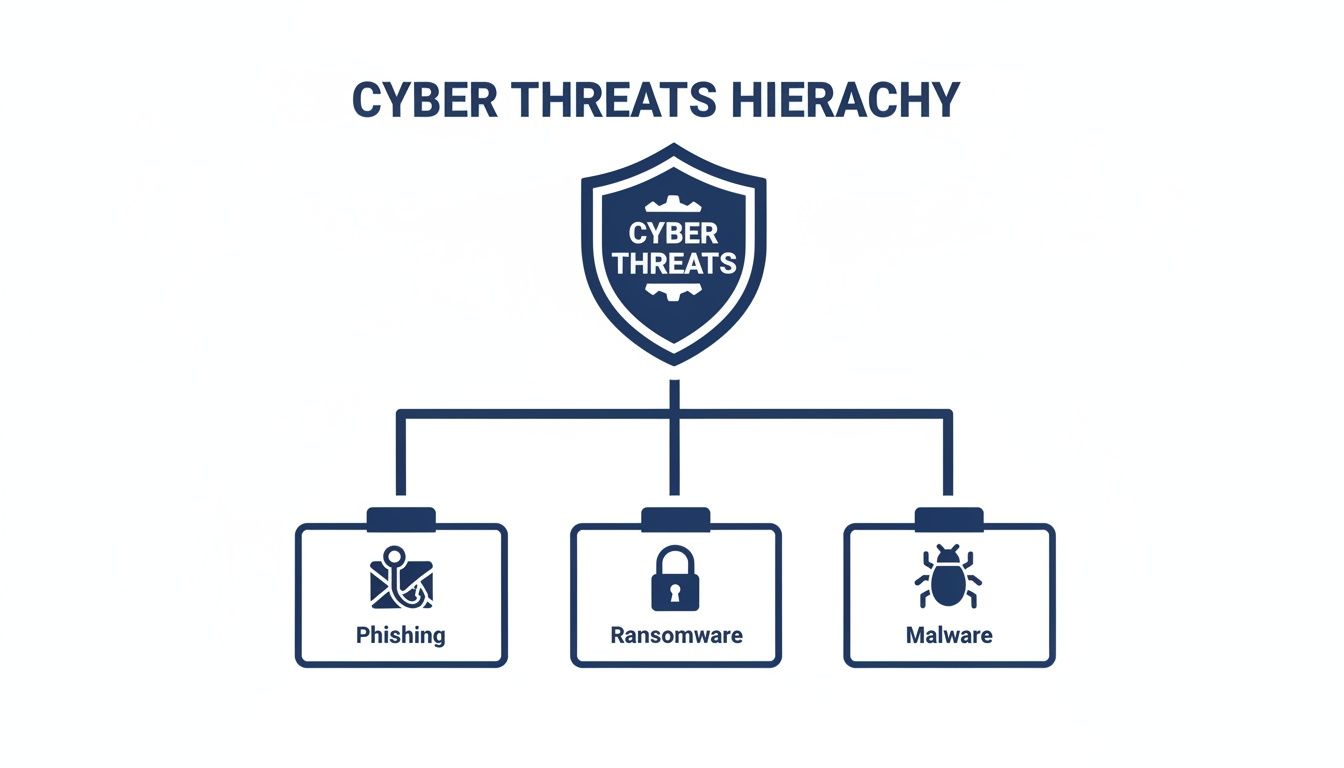
Threats like phishing, ransomware, and malware are the modern-day battering rams and siege towers aimed at your fortress. Each one requires a specific type of defense to keep them out.
The first and most critical layer is controlling who can even approach the castle gates. This is where Multi-Factor Authentication (MFA) comes in. Think of it as a secret handshake required in addition to the password.
Even if a cybercriminal steals a password, they can't get in without that second factor—like a one-time code sent to an employee's phone. Implementing MFA is one of the most effective steps you can take to immediately shut down unauthorized access from stolen credentials.
Your software and operating systems are the walls of your digital fortress. Over time, attackers discover new cracks and weaknesses—vulnerabilities they can exploit to sneak inside. Regular software patching is how you repair these cracks as soon as they’re found.
Delaying updates is like leaving a known weakness in your wall unguarded. It's an open invitation for trouble. A consistent patching schedule ensures your defenses remain strong against the latest known threats.
A Strategic Takeaway: Embrace the principle of "least privilege." This simply means giving employees access only to the data and systems they absolutely need for their jobs. A tax preparer, for instance, has no business accessing the firm's administrative payroll files. This simple step drastically minimizes potential damage if an account is ever compromised.
To effectively protect sensitive financial data and intellectual property, many firms consider leveraging specialized expertise through managed network security solutions.
Beyond technology, you need procedural controls—the human element of your security. These are the rules and policies your team follows, acting as the guards and gatekeepers of your castle.
Key procedural controls include:
In accounting and finance, solid cybersecurity isn't just good business—it's a professional and legal duty. Get this wrong, and you're looking at serious penalties, the loss of your license, and a reputation that’s nearly impossible to rebuild. Every technical control you put in place is a direct reflection of your commitment to protecting client data.
This isn't some abstract concept; it's written into specific, enforceable regulations that every accounting and tax pro needs to know inside and out. Compliance isn't optional, and you can be sure regulators are watching.
For any firm handling financial data, two regulations stand out: the FTC Safeguards Rule and IRS Publication 4557. Instead of seeing them as a burden, think of them as the official blueprints for building a secure practice.
The FTC Safeguards Rule: This rule applies to financial institutions, a category that includes most accounting and tax firms. It requires you to create and maintain a comprehensive written security plan. That means designating a qualified person to run your security program, performing regular risk assessments, and actually implementing safeguards to manage the risks you find.
IRS Publication 4557: The title says it all: "Safeguarding Taxpayer Data." This is the IRS's directive for all authorized e-file providers. It lays out the minimum security standards you must meet to protect client tax information from getting breached, reinforcing your professional responsibility as a tax preparer.
These aren't just suggestions. They're the baseline for what's considered due diligence in our industry. Ignoring them is a direct violation of your professional duties.
A huge part of compliance is managing sensitive data, especially when you're moving to new systems. If you're dealing with specific regulatory hurdles like HIPAA when migrating client information, a comprehensive HIPAA SharePoint Migration Guide can be an invaluable resource.
Beyond the black-and-white text of the law is a much deeper ethical responsibility. Clients hand over their most sensitive financial details with the unspoken trust that you will guard it fiercely. A data breach shatters that trust in an instant.
The fallout from a breach goes way beyond fines. It kicks off a chain reaction that can easily cripple a firm:
This harsh reality is forcing a major shift in how the industry thinks about security spending. Cybersecurity budgets in accounting-heavy sectors are ballooning as leaders finally grasp the danger to their financial data. A recent survey found 77% of business leaders expect their cybersecurity budgets to go up, with 30% planning increases of 6-10%.
This investment surge makes perfect sense when you see that cybercrime is projected to cost the global economy $10.5 trillion a year. Robust security is now intrinsically linked to professional diligence. Ultimately, protecting data isn't an IT task—it's a core professional responsibility. You can explore more about these trends in cybersecurity spending on Statista.com.
Even the most secure firms can't afford to be complacent. A security incident isn't a matter of 'if' but 'when,' and how you prepare for that moment makes all the difference. This is where you shift from purely defensive measures to a practiced, clear-headed response that keeps a bad situation from becoming a catastrophe.
Think of it like a fire drill. You don't just cross your fingers and hope a fire never breaks out; you practice the evacuation route so everyone knows exactly what to do. An Incident Response Plan (IRP) is your firm's fire drill for a cyberattack. It turns chaos into a controlled, manageable process.
An IRP is your step-by-step playbook for the moment a security breach is detected. A solid plan eliminates the panic and guesswork, ensuring every action your team takes is deliberate, effective, and moves you toward resolution.
The main goals are to quickly spot an attack, contain the damage before it spreads, and completely remove the threat from your systems. This structured approach is the key to minimizing financial losses and protecting the trust you've built with your clients.
A complete IRP generally breaks down into four phases:
A Critical Reminder: The first few hours after a breach are frantic. Having a plan ready ensures you meet your legal and regulatory notification deadlines without delay—a crucial part of professional diligence.
If you're looking to build out your own framework, our in-depth guide provides a comprehensive data breach response plan that covers these steps in much greater detail.
While your IRP team is busy neutralizing the threat, your firm can't just grind to a halt. This is where a Business Continuity Plan (BCP) comes in. Its job is simple: keep your business running, even if your primary systems are offline.
The absolute foundation of any good BCP is a reliable, automated backup strategy. Just having backups isn't enough. They need to be frequent, regularly tested, and stored securely offsite or in the cloud. This simple practice ensures that if ransomware encrypts your entire server, you have clean, recent copies of your data ready to go.
Make sure your backup strategy includes these non-negotiables:
By weaving together a practiced incident response with a resilient business continuity strategy, you create a powerful safety net. This preparation puts you in control of the situation, not the other way around.
Running an on-premise server is a massive distraction. It forces you to wear an IT manager hat, wrestling with everything from physical security and software patches to tricky network settings—all of which pulls you away from client work. For a modern accounting firm, this approach isn't just inefficient; it’s a serious security risk.
Migrating to a specialized cloud hosting provider is a strategic move that tackles these headaches head-on. You’re not just moving files; you’re offloading the entire IT burden to experts whose only job is to maintain a secure, high-performance environment. This one decision can strengthen your firm’s accounting and cyber security posture almost overnight.
A dedicated cloud partner gives you centralized, secure access to essential applications like QuickBooks or Sage from any device. Your team can work efficiently whether they’re at the office, a client’s site, or home, all without ever compromising data protection.
Not all cloud providers are the same, and picking the right one is critical. You need a partner who genuinely understands the unique security and compliance demands of the accounting world. Think of it like hiring a key employee—due diligence is everything.
Start by digging into the details of their security infrastructure. Do they provide enterprise-grade firewalls, intrusion detection systems, and 24/7 monitoring? These aren’t optional extras; they're the absolute baseline for protecting your clients' sensitive financial data.
Key Consideration: Your cloud provider should act as a natural extension of your firm's security team. Their infrastructure and expertise become your first line of defense, letting you focus on serving clients instead of fighting cyber threats.
Next, get serious about their backup and disaster recovery processes. A trustworthy provider should offer automated, daily backups stored in a geographically separate location. This ensures that even in a worst-case scenario, your data is safe and can be restored quickly, keeping your business running.
To make a smart, informed decision, you need a structured way to compare your options. This checklist breaks down the essential features and services an accounting firm should demand from any potential cloud hosting vendor.
| Evaluation Criteria | What to Look For | How Cloudvara Measures Up |
|---|---|---|
| Mandatory MFA | Is Multi-Factor Authentication (MFA) a standard, non-negotiable feature for all user access? It's your best defense against unauthorized logins. | We enforce MFA for all users to provide a critical layer of security, blocking unauthorized access from day one. |
| Guaranteed Uptime | Check their Service Level Agreement (SLA). You need a guarantee of 99.5% uptime or higher so your apps are always there when you need them. | Our SLA guarantees 99.9% uptime, ensuring your firm remains productive without interruption. |
| 24/7 Expert Support | When something goes wrong, can you immediately reach a real person who knows what they're doing? Test their response time before you sign. | We provide 24/7/365 US-based expert support with rapid response times, so you get help when you need it most. |
| Compliance & Certifications | Does the provider meet standards relevant to the financial industry, like SOC 2 compliance, to ensure data is handled properly? | Our infrastructure is SOC 2 compliant, meeting the rigorous security and confidentiality standards required for handling financial data. |
| Transparent Pricing | Are the costs clear and predictable? Watch out for vendors with confusing pricing models that hide extra fees. | We offer straightforward, all-inclusive pricing with no hidden fees, so you can budget with confidence. |
| Effortless Scalability | Can they easily scale your resources up or down to match your firm's growth or seasonal demands like tax season? | Our flexible plans allow you to scale resources on demand, ensuring you only pay for what you need, when you need it. |
Using a structured approach like this ensures you end up with a partner that aligns with both your security requirements and your operational goals. To explore this topic further, take a look at our detailed guide on how to choose a cloud provider for your business. Finding the right fit is the cornerstone of a modern, resilient security strategy.
Stepping into the world of cloud security can bring up a lot of questions, especially when you’re used to having a server humming away in the office closet. Let's tackle some of the most common concerns we hear from accounting professionals so you can make confident decisions for your firm.
For most small and mid-sized firms, the answer is a resounding yes. A quality cloud provider offers security that's in a completely different league.
Think of it this way: your on-premise server is like a high-quality safe in your office. It's good, but it's a single point of failure. A reputable cloud host operates more like a bank vault—complete with enterprise-grade firewalls, sophisticated intrusion detection systems, physical security, and redundant power that are simply out of reach for a single firm's budget.
Plus, these providers have teams of security experts working around the clock. Their entire job is to monitor, patch, and defend the infrastructure. That specialized, 24/7 attention dramatically cuts the risk from common issues that plague local setups, like forgotten software updates or a misconfigured firewall.
If you do only one thing, make it this: enforce mandatory Multi-Factor Authentication (MFA) on everything. Seriously. It’s the most impactful security measure you can roll out, especially for email and any remote login points. The vast majority of breaches still start with a simple stolen password.
MFA throws up a powerful roadblock that stops criminals in their tracks. Even if they have a password, they won’t have the second verification code from your phone. It’s a relatively simple, low-cost step that neutralizes the most common type of attack.
A key takeaway for any firm is that security is an ongoing process, not a one-time setup. It requires continuous vigilance, from technology to training, to build a resilient defense against ever-changing threats.
Turning your team into a "human firewall" is one of your best defenses, but it requires more than a one-off training session. It’s about building a culture of healthy skepticism.
Start with a formal training session that uses real-world examples of phishing emails that target accountants. Show them what fraudulent W-2 requests or fake IRS notices actually look like.
Then, follow up with regular, simulated phishing tests. Sending your team safe, fabricated phishing emails is the best way to see who might be vulnerable and provides an immediate, real-world learning moment. Most importantly, create an environment where employees feel comfortable reporting a suspicious email without any fear of getting in trouble. That open communication is priceless.
Ready to move beyond security questions and into a secure, fully managed cloud environment? Cloudvara provides a dedicated cloud platform that centralizes your accounting software, enforces mandatory MFA, and includes automated daily backups, all backed by 24/7 expert support. Secure your firm's future by visiting https://cloudvara.com to start your free trial.