Multi-tenancy is a cornerstone of modern cloud computing, but the term itself can sound a bit technical. At its heart, it’s an architecture where one instance of a software application serves many different customers at the same time.
Each customer, called a tenant, shares the same underlying technology and resources, but their data stays completely separate and secure from everyone else. This model is the engine behind most of the Software-as-a-Service (SaaS) tools we use every day.
Think of a modern apartment building. Everyone living there shares the same core infrastructure—the foundation, the plumbing, the main power lines. But each tenant has their own private apartment, locked with a unique key.
What happens in your apartment is your business, and your neighbors can't just walk in. This is a perfect analogy for multi-tenancy in the cloud.
The cloud provider owns and manages the entire "building"—all the servers, storage, and networking hardware. Your business, along with hundreds or thousands of others, "rents" a secure space within that building. This shared model allows countless users to use the same powerful application simultaneously, while clever design keeps each tenant's data and settings logically walled off. That separation is non-negotiable; it’s what ensures your accounting firm's sensitive client files are never, ever visible to the law firm in the "apartment" next door.
So, what exactly is a tenant in this setup? It’s simply any customer or group of users who share access to a single instance of a software application.
A tenant could be:
The application itself is built from the ground up to tell tenants apart. It uses unique identifiers, like a Tenant ID, to tag every piece of data and make sure it can only be seen and accessed by authorized users from that specific tenant.
To help clarify, here is a quick summary of the core principles that define a multi-tenant cloud environment.
| Characteristic | Description |
|---|---|
| Shared Infrastructure | A single instance of the software and its hardware serves all tenants. |
| Data Isolation | Each tenant's data is logically segregated and remains invisible to others. |
| Resource Pooling | Computing resources (CPU, memory, storage) are pooled and shared efficiently. |
| Centralized Management | The provider handles all updates, maintenance, and security for the core application. |
| Scalability | Resources can be scaled to meet the collective demand of all tenants. |
| Cost-Effectiveness | Costs are spread across multiple tenants, making it more affordable than dedicated setups. |
This architecture is what allows powerful software to be both accessible and affordable for companies of all sizes.
The core idea behind multi-tenancy is simple: shared resources, but isolated experiences. It delivers the huge economic upside of pooling resources without ever compromising the privacy and security individual businesses depend on.
This shared infrastructure is the secret to the cloud's incredible efficiency. By spreading the costs of hardware, maintenance, and software updates across many tenants, providers can offer top-tier solutions for a fraction of what a dedicated, single-tenant setup would cost. Getting a handle on how this shared environment works is the first step to seeing what a modern cloud infrastructure can really do for your business.
To really get a handle on multi-tenancy, it helps to move past the apartment building analogy and look at the different “floor plans” a cloud provider can offer. Each design strikes a different balance between sharing resources and locking down security, and the choice of architecture directly impacts cost, performance, and customization.
These models are the technical blueprints that make a shared environment feel completely private. Let's walk through the three common architectural models using an office space comparison, where each one represents a different level of separation between tenants.
The most integrated approach is like a co-working space, where multiple businesses share one large, open-plan office. In technical terms, this is a shared database with a shared schema. All tenants’ data sits in the same database and even within the same tables, distinguished only by a unique "Tenant ID" column.
This model is a champion of resource efficiency, making it the most cost-effective to maintain. Updates are simple because there's only one structure to manage. The catch? It requires incredibly careful application logic to ensure data queries for one tenant never accidentally pull information from another.
A step up in separation is the shared database with separate schemas model. Imagine an office floor where each company has its own set of dedicated cubicles. Everyone is still in the same large room (the database), but each team has its own clearly defined workspace (a schema).
This offers a much stronger layer of logical isolation than the co-working model. It simplifies data management and backup processes for each tenant and significantly cuts down the risk of data crossover. While it's slightly more complex to manage, it provides a great balance between cost-efficiency and beefed-up security.
Key Takeaway: The architectural model determines the degree of isolation. While all multi-tenant systems keep data separate, the method of separation—from a simple ID tag to a completely separate database—is what defines the security and performance profile of the service.
The diagram below visualizes the basic hierarchy of a multi-tenant environment, from the broad infrastructure down to the individual tenants it serves.
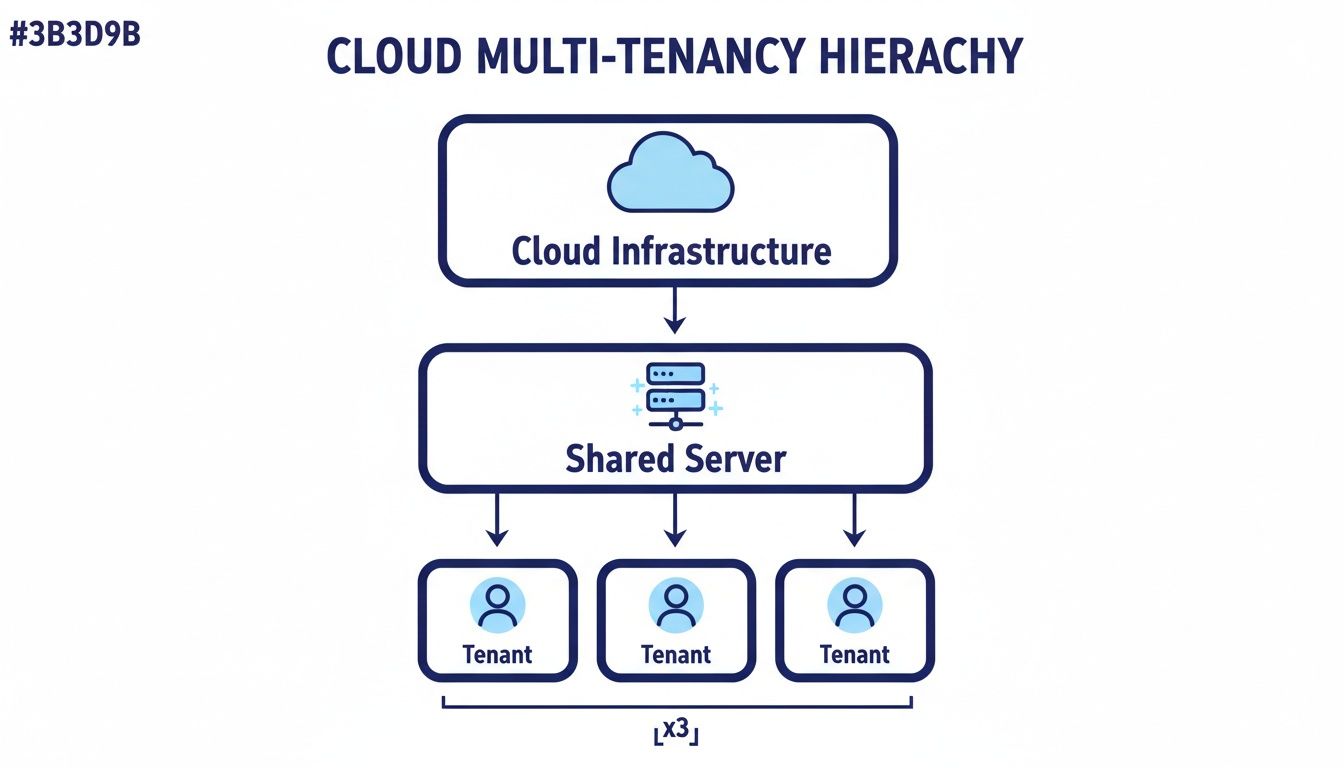
This shows how multiple tenants are supported by a single shared server, which itself is part of the larger cloud infrastructure.
The most isolated approach involves giving each tenant a separate, dedicated database. This is like having your own locked, private office suite within a larger office building. You still share the building's utilities and lobby, but your workspace is entirely your own.
This architecture offers the highest level of security and data isolation, making it a perfect fit for industries with strict compliance requirements. It also eliminates the "noisy neighbor" problem, since one tenant's heavy database usage won't slow down others. The trade-off is higher cost and more operational complexity, as the provider has to manage and maintain a separate database for every single client. This model closely aligns with the robust, dedicated resources often found in an Infrastructure as a Service (IaaS) offering.
It’s one thing to understand the architecture of multi-tenancy, but what really matters is how it translates into tangible business advantages. Why should a busy accounting practice or a growing law firm care about a shared infrastructure model? The answer lies in how it directly impacts your bottom line, efficiency, and ability to compete.
The most compelling benefit is a dramatic drop in costs. In a traditional setup, you’d have to purchase, house, and maintain your own powerful servers—a massive capital expense. With a multi-tenant approach, those costs are distributed across all users.
Think of it as splitting the bill for an enterprise-grade utility. You get access to powerful, reliable technology without the crippling upfront investment in hardware, software licensing, and the IT staff needed for ongoing maintenance. This economic model is a key driver behind the rapid growth of cloud services.
The market’s explosive growth directly reflects these savings. The global cloud computing market is projected to hit $0.86 trillion in 2025 and is on track to more than double soon after. Multi-tenant data centers are central to this expansion, with the U.S. market alone expected to surge from $12.30 billion in 2024 to $30.40 billion by 2032. This trend shows how businesses are embracing the shared model to gain a competitive edge. You can find more of these cloud computing statistics on pelanor.io.
Beyond the immediate cost savings, multi-tenancy offers incredible agility. Imagine it’s tax season, and your accounting firm needs to instantly double its user count to handle the workload. In a traditional model, this would mean buying, configuring, and deploying new hardware—a slow and expensive process that just isn't practical.
In a multi-tenant environment, scaling is as simple as adjusting your subscription. The provider already has a massive pool of resources ready to go. Adding new users or increasing storage happens on demand, allowing your firm to respond instantly to changing needs without friction.
Another huge advantage is completely offloading the burden of IT management. The cloud provider is responsible for all the behind-the-scenes work that keeps your applications running smoothly.
This includes:
By outsourcing IT management to the provider, your team can stop troubleshooting server issues and focus entirely on core business activities—serving clients, closing cases, or growing your practice. This is one of the most significant benefits cloud computing delivers to modern businesses.
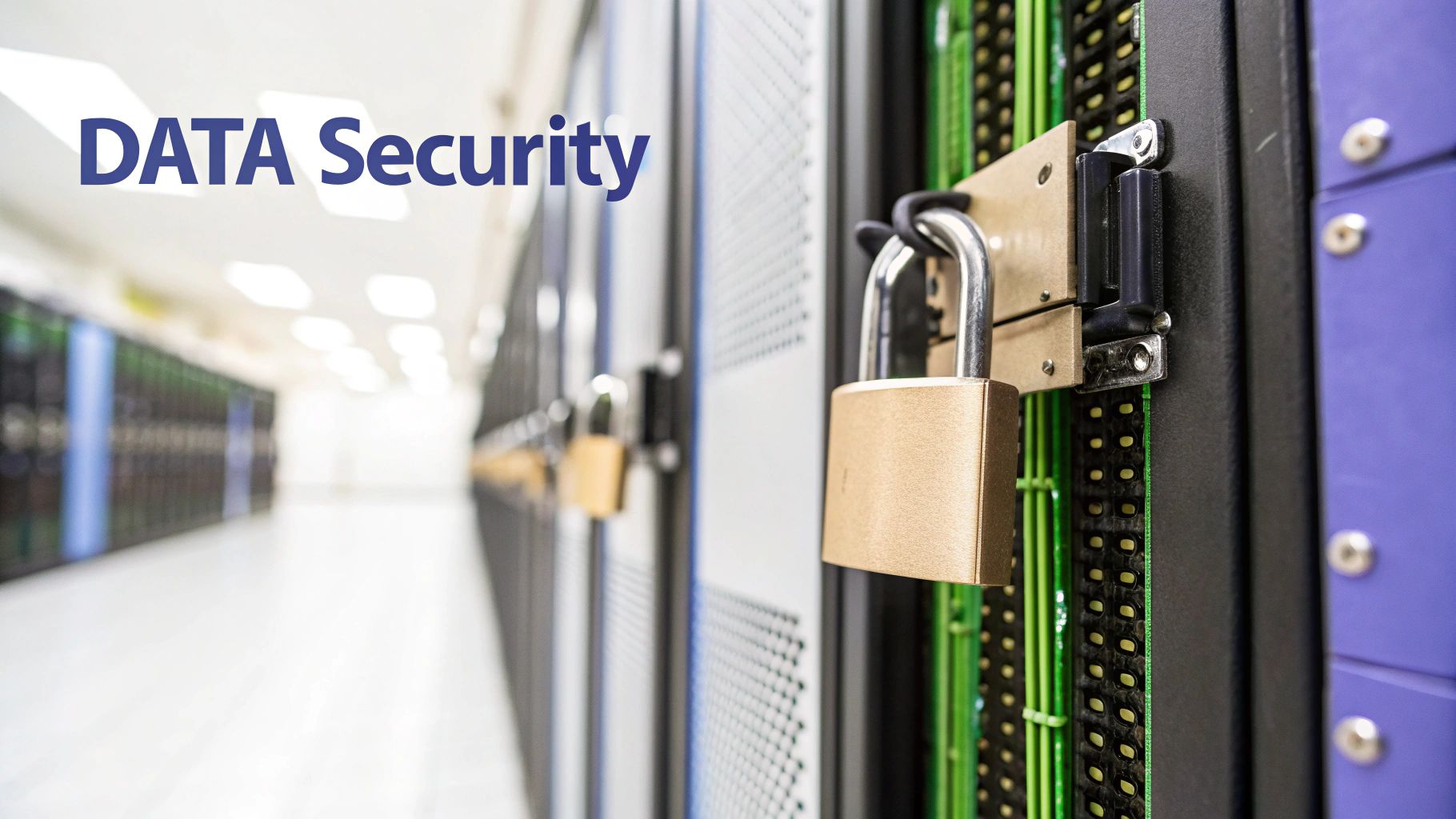
While the benefits of multi-tenancy are clear, sharing an environment naturally raises questions about security, privacy, and performance. But understanding these potential risks is the first step toward choosing a provider that has engineered its platform to eliminate them, ensuring your data is even safer than it would be on an in-house server.
A common concern is the "noisy neighbor" problem, where one tenant's heavy resource usage could slow down others. Thankfully, modern cloud providers build their systems with sophisticated resource management and load-balancing tools. Think of these systems as a building superintendent, ensuring that one tenant's high traffic doesn't hog the elevator and leave others waiting.
For professionals in accounting and legal fields, data security is non-negotiable. The idea of your sensitive client information sitting on the same physical server as another company’s data can seem unsettling at first. This is where logical data segregation becomes the most important concept to grasp.
Reputable cloud providers implement multiple layers of security to create impenetrable digital walls between tenants.
This multi-layered approach ensures that although you share infrastructure, your data remains as private as if it were in its own dedicated vault. These are just some of the fundamental essential cloud security practices for businesses that a trustworthy provider will have in place.
A provider's security measures should be a fortress, not a fence. The goal is to make a multi-tenant environment more secure than a standalone server by pooling world-class security resources that a single small business could never afford.
For industries governed by regulations like GDPR, HIPAA, or financial compliance standards, data handling is under intense scrutiny. A quality cloud provider specializing in your field will design their multi-tenant architecture to meet these stringent requirements from the ground up. They ensure their data segregation, encryption, and audit trail capabilities align perfectly with what regulators demand.
The widespread adoption of this model speaks for itself. By 2025, an estimated 60% of the world’s corporate data will be housed in cloud environments, most of which are multi-tenant. This trend allows firms to securely manage vast QuickBooks datasets on shared platforms, like Cloudvara’s remote desktop solution, with total confidence. The shift proves that with the right architecture, multi-tenancy offers enterprise-grade security for everyone.

Picking the right cloud provider is one of the most critical IT decisions your firm will make. Not all multi-tenant environments are created equal, and the partner you choose directly impacts your security, performance, and day-to-day operations. Moving to the cloud shouldn't mean compromising on service or reliability.
Your evaluation has to go way beyond the sticker price. A great place to start is the provider's Service Level Agreement (SLA). This document is more than just fine print; it's a binding promise that spells out their commitment to uptime, performance, and support response times.
A provider who’s confident in their infrastructure will back it up with a strong guarantee, like Cloudvara’s 99.5% uptime commitment, ensuring your applications are there when you and your clients need them most.
For any firm handling sensitive client information, security protocols are completely non-negotiable. A prospective provider should be transparent and ready to answer tough questions about their security measures.
Drill down with specific questions:
Just as important is the quality of their customer support. When an issue pops up, you need immediate access to an expert who can solve it, not a ticket number in an endless queue. Look for providers that offer 24/7 live support staffed by real technicians who understand your business.
The right provider acts as a true IT advocate, not just another vendor. Their expertise should go beyond basic hosting to include deep knowledge of the specific software your business relies on every day.
Does the provider actually understand your industry's essential software? For an accounting firm, that means deep experience hosting applications like QuickBooks or Sage. For a law practice, it's about mastering legal practice management tools. A partner with specialized experience guarantees a smoother migration and optimized performance for your most critical applications.
Finally, take a hard look at their pricing structure. The market for multi-tenant data centers is enormous—valued at USD 68.5 billion and projected to hit USD 185.0 billion by 2035. While all that competition can drive down prices, it also leads to some pretty complex pricing models.
Look for transparent, all-inclusive pricing to avoid surprise fees for things like support or backups. These hidden costs are why many companies overshoot their cloud budgets by an average of 17%.
To help you put all these pieces together, we've created a simple checklist.
Use this table as a guide during your conversations with potential partners. It highlights what to look for and, more importantly, why it matters for a professional services firm like yours.
| Evaluation Criteria | What to Look For | Why It Matters for Your Firm |
|---|---|---|
| Service Level Agreement (SLA) | A clear, guaranteed uptime of 99.5% or higher. Specifics on performance metrics and support response times. | Your firm can't afford downtime. A strong SLA ensures your applications are consistently available for your team and clients. |
| Security & Compliance | Proof of industry-specific compliance (HIPAA, FINRA, etc.), robust data segregation methods, and multi-factor authentication. | Protecting sensitive client data isn't just good practice—it's a legal and ethical requirement. Weak security puts your firm's reputation at risk. |
| Customer Support | 24/7 access to live, knowledgeable technicians via phone or chat. Avoid providers that only offer email or ticket-based support. | When a critical application goes down, you need a resolution in minutes, not days. Instant access to expert help is non-negotiable. |
| Industry Specialization | Demonstrated experience hosting the exact software your firm uses daily (e.g., QuickBooks, Sage, legal practice management tools). | A provider who knows your software can optimize its performance, troubleshoot issues faster, and ensure a seamless user experience. |
| Transparent Pricing | An all-inclusive pricing model with no hidden fees for support, backups, or routine maintenance. | Predictable costs are essential for budgeting. Transparent pricing prevents the budget overruns that plague many cloud migrations. |
| Free Trial Option | A no-obligation trial period that allows you to test the platform's performance, support, and ease of use. | A trial lets you experience the service firsthand, ensuring it meets your expectations before you sign a long-term contract. |
This checklist is a starting point. Our detailed guide offers even more advice on how to choose a cloud provider that truly fits your needs.
Ultimately, the best way to vet a provider is to try them out. A free trial is the final, essential step, letting you test the platform’s performance, usability, and support quality firsthand before making a commitment. Any provider confident in the value they deliver will be happy to offer one.
Moving to a shared cloud environment naturally brings up a few questions. How does this actually work day-to-day? What does it mean for my data? Getting clear, straightforward answers to these concerns is the key to moving forward with confidence.
Let's break down the most common questions professionals ask when they're considering a multi-tenant cloud solution.
Yes, absolutely. In any professionally managed multi-tenant environment, your data is completely walled off and secure from everyone else. Reputable providers use sophisticated logical segregation techniques to build strict, impenetrable boundaries between each client.
Think of it like a bank vault filled with individual, locked safe deposit boxes. While all the boxes are stored in the same secure room (the server), only you have the key to your specific box. In the cloud, this separation is enforced with a powerful combination of security measures:
This multi-layered defense ensures that even though you share the hardware, your confidential information stays that way.
This is a great question. It gets at the heart of the "noisy neighbor" fear—the idea that a spike in activity from one tenant could slow things down for everyone else. Fortunately, modern multi-tenant platforms are specifically engineered to prevent this from happening.
Cloud providers use smart resource governance and load-balancing systems. These tools act like an expert traffic controller, intelligently allocating computing power, memory, and bandwidth across all tenants. This system guarantees that a surge in one client’s usage is contained and doesn't degrade the experience for others. A quality provider’s infrastructure is built for high-demand moments, ensuring your critical applications run smoothly and efficiently, always.
Key Insight: A well-managed multi-tenant environment doesn't just prevent performance issues; it often improves them. By pooling vast resources, providers can handle unexpected spikes in demand far better than a typical on-premise server could.
Yes, a multi-tenant environment can be fully compliant with strict industry regulations like HIPAA for healthcare or GDPR for data privacy. The key thing to remember is that compliance isn't automatic; it depends entirely on the provider's architecture and their operational discipline.
A provider that takes compliance seriously builds its platform from day one with the necessary controls to meet these high standards. This means implementing features like detailed audit trails, robust data encryption (both at rest and in transit), and strict access management protocols. When you're evaluating a provider, always ask for their compliance certifications and dig into how their security measures align with your industry's specific legal and ethical requirements.
It's easy to mix these two up because they are often used together to create efficient cloud setups, but they are fundamentally different concepts. Getting the distinction clear helps you understand what multi-tenancy in cloud computing really is.
Virtualization is a technology that carves up a single physical server into multiple virtual machines (VMs). Each VM can run its own operating system and applications. In short, virtualization divides the hardware.
Multi-tenancy, on the other hand, is an architectural approach where a single instance of a software application serves many different customers, or tenants. In this model, multi-tenancy divides access to the software.
Cloud providers often use both. They might use virtualization to create isolated hardware environments and then run a multi-tenant application within one of those environments to serve hundreds of different customers securely and cost-effectively.
Answering these questions is the first step toward finding a cloud partner you can trust. At Cloudvara, we specialize in creating secure, high-performance multi-tenant environments designed for the specific needs of accounting firms, law practices, and small businesses. Our platform ensures your data is protected, your applications run smoothly, and you meet your compliance obligations without the IT headache.
Ready to see how a dedicated cloud advocate can make a difference? Start your free 15-day trial with Cloudvara today and experience the benefits firsthand.