
Let's break down cloud scalability. In the simplest terms, it’s the ability for your IT environment to automatically add or remove computing resources to match demand. Think of a popular online store. It can instantly spin up more power to handle the holiday shopping rush and then scale back down when things quiet down in January. That’s cloud scalability in action for your digital operations.
At its heart, understanding cloud scalability means getting comfortable with a dynamic, flexible infrastructure. It’s a complete departure from the old way of doing things—buying and maintaining racks of physical servers. In the past, a business had to guess its busiest day of the year and purchase enough expensive hardware to handle that peak, even if that surge only happened once or twice.
This old approach was incredibly inefficient. Most of the time, all that expensive, powerful hardware just sat there, idle and costing money. Cloud scalability flips that model on its head. Instead of overspending for a potential "what if" scenario, you get an environment that adapts moment by moment.
A scalable cloud infrastructure is designed to give you exactly what you need, right when you need it. It ensures you have the muscle for a big product launch or seasonal spike, then dials back to save money during lulls.
To give you a clearer picture, here’s a quick breakdown of the core concepts.
| Concept | Description | Business Impact |
|---|---|---|
| Elasticity | The ability to automatically add or remove resources (like CPU, RAM) in real time based on current demand. | Prevents system crashes during traffic spikes and avoids paying for idle resources during quiet periods. |
| On-Demand Resources | Computing power, storage, and other services are available instantly, without lengthy procurement processes. | Enables rapid innovation and lets you respond to market opportunities faster than competitors. |
| Pay-As-You-Go Model | You are only billed for the resources you actually consume, turning a large capital expense into a manageable operational cost. | Drastically improves cost efficiency and eliminates wasted spending on over-provisioned hardware. |
| Resource Pooling | A cloud provider’s resources are shared among multiple customers, creating a massive pool of power that any one user can tap into. | Gives even small businesses access to enterprise-grade power and resilience without the enterprise-level price tag. |
These principles work together to create a system that’s both powerful and lean.
This ability to grow or shrink on demand isn't just a neat technical trick; it's a massive strategic advantage. It’s all built on a sophisticated cloud infrastructure that makes resources like processing power, memory, and storage available whenever you need them. This foundational design is exactly why modern businesses can move so much faster and more efficiently.
Here’s what that looks like in practice:
When we talk about making the cloud flexible, the conversation almost always lands on two core ideas: vertical scaling and horizontal scaling. Each one is a different tool for adjusting your system's capacity, and the right choice depends entirely on how your application is built and the kind of work it does. Getting a handle on these two models is the first real step toward creating a cloud environment that can bend without breaking.
Think of vertical scaling (also known as "scaling up") like upgrading your home computer. When it starts to feel sluggish, you might pop in more RAM or swap out the CPU for a faster one. In the cloud, this translates to beefing up a single server—giving it more processing power, memory, or storage to handle a bigger workload. It's often the simpler route because it usually doesn’t require you to rewrite your application's code.
In contrast, horizontal scaling ("scaling out") is more like adding a bunch of new computers to a network to share the load. Instead of making one server a powerhouse, you just add more servers to the group. When a new request comes in, it can be sent to any of the available machines, spreading the work out so no single server gets bogged down.
Vertical scaling is a great fit for applications that are tricky to split across multiple machines, like some databases or older legacy systems. Its main advantage is that it’s straightforward to implement.
But it comes with two major catches:
This diagram nails the core concept of scalability—the power to grow or shrink your resources right when you need to.
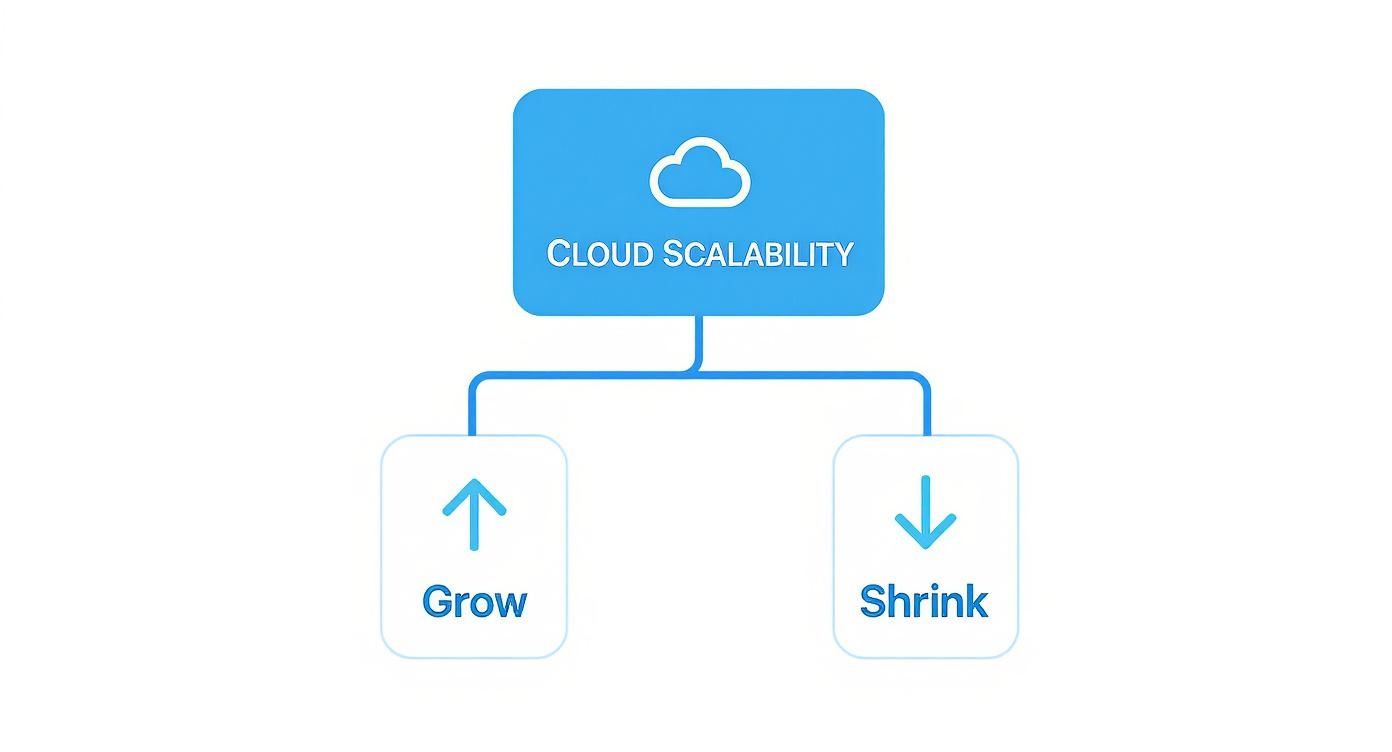
It boils the whole idea down to two simple actions: adding muscle for busy times and trimming down to save money when things are quiet.
Horizontal scaling is really the engine behind most modern, cloud-native applications. It shines with stateless apps, like web servers or microservices, where it doesn't matter which server handles a request.
By spreading traffic across many different instances, horizontal scaling gets rid of single points of failure, which makes your whole system much more reliable. This distributed approach is a hallmark of strong Infrastructure as a Service (IaaS) platforms.
The biggest plus here is its nearly endless potential; you could theoretically add thousands of instances to handle a massive surge in traffic. The trade-off, however, is complexity. It demands a smarter architecture built from the ground up for distribution, complete with load balancers to direct traffic where it needs to go.
If you want to dig deeper into how these platforms work, check out our guide on what is Infrastructure as a Service. For most businesses today that are aiming for high availability and resilience, getting horizontal scaling right is non-negotiable for long-term growth.
Beyond the technical nuts and bolts, the real magic of cloud scalability is what it does for your bottom line. Switching to a scalable infrastructure isn’t just an IT upgrade; it’s a strategic pivot that gives you a tangible competitive advantage. It completely changes how you manage resources, react to the market, and ultimately, serve your customers.
The most immediate change is a major shift in how you pay for technology. Gone are the days of buying oversized, expensive servers just to handle your busiest days. Instead, you move to a flexible pay-as-you-go model. This means you stop paying for idle capacity and tie your expenses directly to actual usage—a core principle of effective cloud cost optimization.
Scalability transforms IT from a rigid capital expense into a flexible operational expense. This financial agility allows businesses to redirect funds from maintaining hardware to driving innovation and growth.
A scalable cloud also has a direct line to performance and reliability, which are critical for keeping customers happy. Imagine your website gets a huge, unexpected flood of visitors after a marketing campaign goes viral. With a scalable system, more resources are added automatically.
This keeps your service fast and responsive, preventing the slowdowns or crashes that frustrate users and kill sales. By maintaining a smooth, high-quality experience even during peak demand, you build trust and loyalty with your customer base.
This dynamic resource management is a huge reason why cloud adoption is skyrocketing. Global spending on public cloud services keeps climbing as more businesses use cloud scalability to get the best of both worlds: lower costs and better performance. For example, Amazon S3 holds about 24% of the enterprise cloud storage market because organizations need solutions that expand seamlessly as their data grows.
Perhaps the most powerful advantage of a scalable cloud is sheer business agility. It gives you the freedom to experiment, innovate, and grow without being held back by fixed infrastructure. You can test a new idea or launch a new feature without having to risk a massive upfront investment in hardware.
If a new service takes off, the infrastructure scales right along with it. If it doesn’t, you can just scale the resources back down without being stuck with expensive, unused equipment. This nimbleness is essential for modern business. For instance, implementing solutions like Intelligent Document Processing (IDP) depends on a scalable cloud to handle fluctuating data volumes efficiently.
Ultimately, this ability to adapt quickly empowers businesses to enter new markets and jump on opportunities faster than competitors who are still tied to rigid, on-premise systems. So, what’s cloud scalability’s biggest business benefit? It’s the power to move at the speed of your ambition.
A truly scalable cloud environment doesn’t just happen—it’s built with purpose. Getting from theory to practice means digging into your real-world needs, picking the right tools, and designing your applications for growth from day one. It's all about creating a resilient foundation that can handle anything you throw at it, from a slow Tuesday to a viral product launch.
The first step is to get honest about your application's workload patterns. Do you see predictable daily peaks, or is your traffic a total wild card? Understanding these trends helps you anticipate what’s coming next and choose the cloud services that make sense. For a deeper look at this initial planning phase, our guide on creating a cloud adoption strategy provides a complete roadmap.
Once you know your patterns, you can select a cloud provider and specific services that offer robust, automated scaling features. The goal is to find options that let you set intelligent triggers for scaling up or down without manual intervention.

Modern cloud scalability leans heavily on how your application is built. Older, monolithic systems, where every component is tightly interconnected, are notoriously difficult to scale. When one part of the system gets overloaded, the entire application grinds to a halt.
A core principle of a scalable cloud strategy is to design for flexibility. This means breaking large applications into smaller, independent components that can be managed and scaled separately.
This is where architectures like microservices have become so popular. By building your application as a collection of small, focused services, you gain incredible flexibility. If your user authentication service is getting hammered with traffic, you can scale just that one component without touching the rest of the application.
This approach requires careful planning upfront but pays off big time in resilience and efficiency. A few key elements of a scalable architecture include:
Finally, no scalable strategy is complete without rigorous monitoring and testing. You have to track key performance metrics to understand how your system behaves under pressure. Set up automated alerts based on thresholds like CPU utilization or response times. For example, a common trigger is to automatically add a new server when average CPU usage climbs above 75% for five minutes.
And don't wait for a real-world traffic spike to find the weak spots. Regularly run load tests to simulate high-demand scenarios. This proactive approach makes sure your scaling mechanisms actually work as expected, confirming your setup is ready for whatever comes its way.
Putting a scalable cloud system in place is a great start, but how do you know if it’s actually working? True success comes from keeping a constant eye on its performance. If you can't measure your system, you can’t manage its growth, keep costs in check, or guarantee a great user experience.

This all starts with tracking key performance indicators (KPIs) that act like a health check for your application. These aren't just abstract numbers; they’re direct signals from your users and your infrastructure, telling you what’s working and what needs a closer look.
Monitoring is the nervous system of your scalable architecture. It translates raw data into actionable insights, allowing you to proactively solve problems before they ever impact your customers.
To get the full picture, you need to track both application performance and resource consumption. Tying these two views together helps you connect the technical dots directly to business outcomes. A deep dive into these operational efficiency metrics can uncover some powerful ways to optimize your setup.
Here are the essential KPIs to keep on your dashboard:
While user-facing KPIs are vital, you also need to look under the hood at the health of your infrastructure.
By setting up alerts for these metrics, you can automate your response, ensuring your system scales up and down smoothly and efficiently. This proactive approach keeps costs optimized and helps you plan for whatever growth comes next.
Building a scalable cloud strategy is complex, but you don't have to go it alone. Partnering with a managed cloud expert like Cloudvara takes the guesswork and operational heavy lifting off your plate, letting you scale smoothly without friction. Instead of tying up your internal team with infrastructure management, you get a dedicated IT advocate focused on engineering your environment for high availability and elasticity.
A managed partner brings the expertise needed to handle high-stakes situations. Think about an e-commerce platform during a massive holiday sale or a SaaS company that suddenly goes viral. Cloudvara’s managed hosting ensures your application has the resources it needs right when it needs them, preventing slowdowns and delivering a consistently smooth user experience.
Partnering with a managed cloud provider frees your team to focus on innovation and core business goals, while experts handle the complexities of proactive monitoring, performance optimization, and infrastructure scaling.
This kind of hands-on support is invaluable in a rapidly growing market. The global cloud computing market is projected to grow immensely, fueled by scalable architectures that support modern technologies. Infrastructure as a Service (IaaS) is the fastest-growing segment, which just goes to show the demand for on-demand virtualized resources. A managed partner helps you navigate this landscape, implementing best practices for hybrid cloud models to strike the right balance between cost, performance, and reliability. You can dive deeper into these cloud computing trends on Dataversity.
Ultimately, a managed partnership is about more than just servers; it's about gaining a strategic ally. With Cloudvara, you benefit from:
By offloading the technical heavy lifting, you empower your team to focus on what truly matters—driving your business forward. Ready to build a scalable foundation for your success? Contact Cloudvara’s experts today to discuss a custom-tailored hosting solution.
Even after getting the basics down, a few practical questions always pop up when businesses try to figure out what cloud scalability really means for them. Let's tackle the most common ones to clear up any confusion with some straightforward answers.
People often use these terms interchangeably, but they solve different problems.
Scalability is all about planning for long-term growth. It’s designing your system to handle a steadily increasing workload over time—like preparing your app to support double the user base by next year. It's proactive and strategic.
Elasticity, on the other hand, is about reacting to short-term, unpredictable spikes in demand. It's your system’s ability to automatically add or remove resources in real-time to handle a sudden flood of traffic and then scale back down just as quickly when things quiet down. It's reactive and tactical.
Think of scalability as building a highway with extra lanes to handle a city's future growth. Elasticity is the automated system that opens or closes those lanes right now based on rush hour traffic.
Not right out of the box. An application’s architecture plays a massive role in how well it can scale. Older, monolithic applications—built as a single, tightly-connected unit—are notoriously difficult to scale efficiently in the cloud. They simply weren't designed for it.
True cloud scalability shines with modern architectures like microservices, where an app is broken down into many small, independent services. This design lets you scale only the specific parts of the application under heavy load, which is far more efficient. While you can get some benefits from moving a legacy app to the cloud, you often need to re-architect it to unlock the full power of scalability.
This is where things get really interesting. Cloud scalability can have a huge positive impact on your budget by moving you from a fixed-cost model to a "pay-for-what-you-use" model.
Instead of buying and maintaining massive servers just to handle your peak demand (which might sit idle 95% of the time), you only pay for the computing resources you actually consume. When demand drops, your resource usage—and your bill—automatically shrink with it. This approach eliminates the wasted spend on over-provisioned hardware and makes your IT costs far more predictable and lean.
Ready to stop overpaying for idle resources and build a truly scalable foundation for your business? At Cloudvara, we act as your dedicated cloud IT advocate, providing managed hosting solutions engineered for seamless growth. Explore our reliable, secure, and scalable cloud services at https://cloudvara.com.