So, what exactly is Sage 50 cloud hosting?
In simple terms, it's a service that takes your dependable Sage 50 desktop software and moves it onto a secure, remote server. You get the full, feature-rich version you already know how to use, but with a game-changing bonus: you can access it from any device, anywhere with an internet connection. This isn't a different product; it's just a smarter, more flexible way to run your existing Sage application.
Think of your traditional Sage 50 setup like a physical ledger book locked away in your office. The only way to see or update it is to be physically present. Cloud hosting transforms that book into a secure digital file stored in a high-tech vault (a data center), which your authorized team members can view and edit in real-time, no matter where they are.
The concept is straightforward. Instead of installing Sage 50 on a local computer or an in-house server that you have to maintain, a specialized hosting provider installs it on their powerful cloud infrastructure. You and your team then log in through a secure remote desktop connection. Easy.
To give you a clearer picture, let's compare the two approaches side-by-side.
| Feature | Traditional On-Premise Setup | Sage 50 Cloud Hosting |
|---|---|---|
| Accessibility | Limited to specific office computers. | Access from anywhere with an internet connection. |
| Upfront Costs | High initial investment in servers and hardware. | Low to no upfront costs; pay-as-you-go subscription. |
| IT Maintenance | Your team is responsible for all updates and security. | The provider manages all server maintenance and security. |
| Data Backups | Requires manual or locally configured backup plans. | Automated, managed backups are typically included. |
| Collaboration | Difficult for remote teams or external accountants. | All users work on the same live data simultaneously. |
| Scalability | Scaling requires buying and installing new hardware. | Resources can be adjusted quickly based on demand. |
This table shows the fundamental shift: cloud hosting handles the IT heavy lifting so you can focus purely on your accounting.
With its robust features, Sage 50 is a major player in accounting software, holding roughly a 6.8% market share in the global market and supporting thousands of businesses. Moving this trusted platform to the cloud modernizes its capabilities without forcing your team to learn a completely new system.
A hosted environment essentially future-proofs your investment in Sage 50. It bridges the gap between a reliable desktop application and the demands of a modern, distributed workforce.
This model is a strategic move away from location-bound accounting toward a more flexible and collaborative financial operation. You can learn more about the application's specifics in our detailed guide on Sage 50 accounting software.

Shifting your accounting to a hosted environment delivers some serious advantages that hit your bottom line and make day-to-day work smoother. The benefits of Sage 50 cloud hosting aren't just about remote access; they fundamentally change how your business manages its financial core for the better.
One of the biggest wins is a massive upgrade in data security. Let's be honest, most small businesses don't have the budget or staff to build a fortress around their data like enterprise-grade data centers do. Hosting providers invest millions in safeguards like advanced firewalls, intrusion detection, and 24/7 monitoring—a level of protection that’s nearly impossible to replicate with a server in the office closet.
This move also transforms how your team works together. Picture this: your accountant, the business owner, and your bookkeeper are all working in the same live Sage 50 company file at the same time, from completely different places. No more emailing bulky files back and forth, a clumsy process that’s notorious for causing version-control headaches and delays.
When access is in real-time, every decision is based on the most current financial data. There’s no more waiting for someone to send you an updated report. Everyone with permission sees the same numbers, at the same moment. This simple change speeds up everything from closing the books each month to making strategic growth plans.
This collaborative approach is a common thread among hosted accounting platforms. To see this concept in another context, you can check out our guide on the benefits of QuickBooks cloud hosting. The core idea is the same: get your whole team rallied around a single source of financial truth.
By centralizing your Sage 50 data in the cloud, you create a dynamic and accessible financial hub. This isn't just about convenience; it's about making your entire financial workflow more agile and responsive to business needs.
The advantages of this synchronized approach really shine when you look at the details:
Beyond teamwork, hosting Sage 50 brings significant financial and operational perks. Moving away from an in-house server means you can say goodbye to a whole range of expenses.
Just think about the typical costs you get to avoid:
But maybe the most important benefit is the built-in business continuity. A good hosting provider runs automated, daily backups of your data and stores them securely offsite. So, if a disaster ever hits your office—like a fire, flood, or even theft—your financial data is safe and sound. It can be restored quickly, ensuring your business keeps running with minimal disruption.
Once you've decided to move Sage 50 to the cloud, the next big question is: where will it "live"? Not all cloud environments are built the same, and your choice will directly impact performance, security, and your monthly bill. The two main paths are shared hosting and dedicated hosting. Getting this right is crucial for tailoring the service to your company's actual needs.
Think of it like leasing office space. Shared hosting is like getting an office in a busy, multi-tenant building. You have your own secure, locked space, but you share the building's main resources—the lobby, elevators, and utilities—with other companies. It's a smart, cost-effective way to operate because the building's maintenance costs are spread across all the tenants.
A dedicated server, on the other hand, is like leasing your own private, standalone building. You have exclusive control over the entire property. Every room, every resource, and every security system is yours and yours alone. This setup gives you maximum control and performance, but it naturally comes at a higher price since you're covering the full cost of the facility.
For most small to mid-sized businesses, a shared environment strikes the perfect balance between performance and affordability. It’s an excellent, accessible way to start using cloud accounting without a huge upfront investment.
This visual shows how your computer connects to the cloud server, which in turn keeps all your team's data perfectly synchronized.
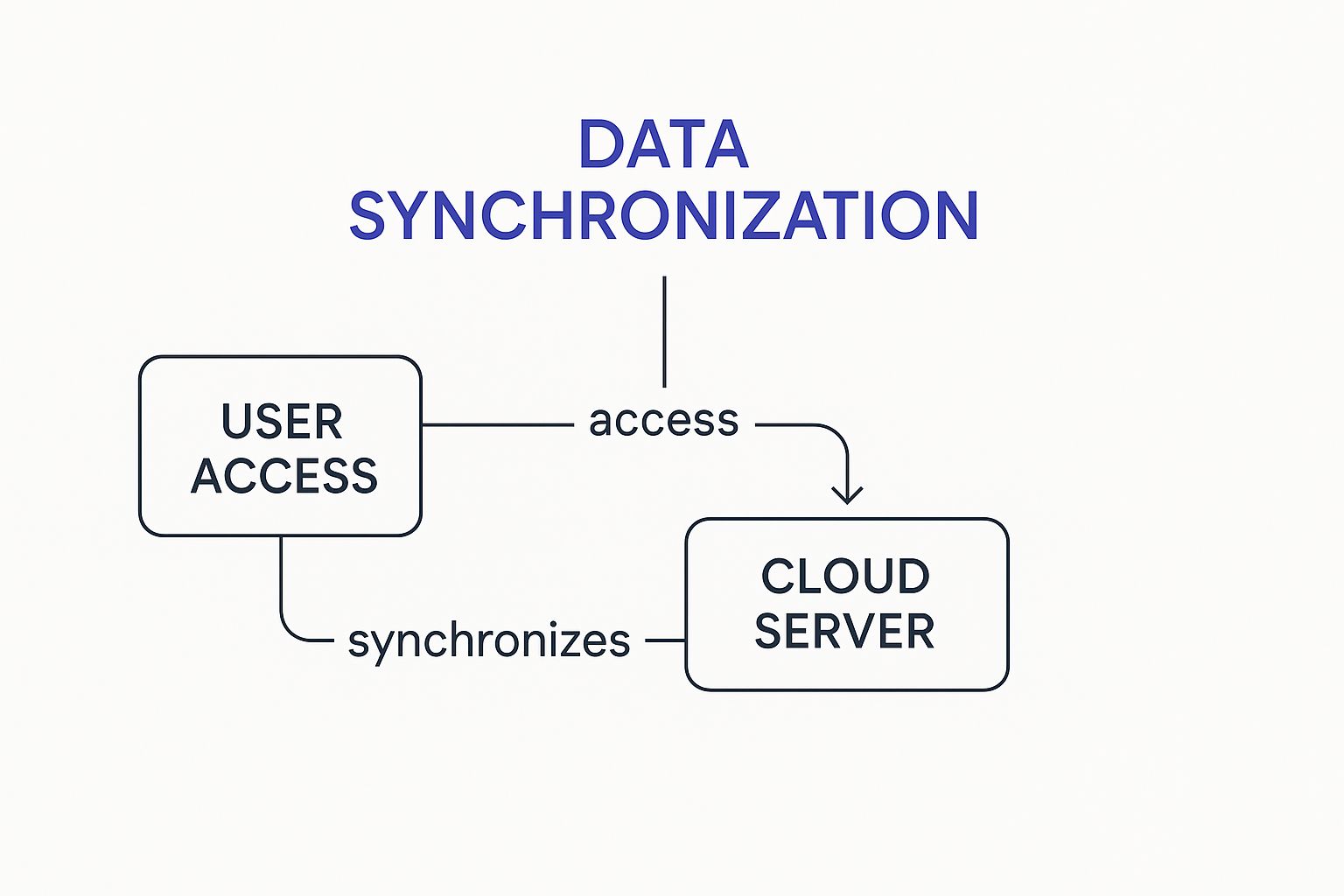
This workflow is the core of any cloud setup. It ensures that every entry you make on your device is instantly updated in the central company file for everyone else to see.
A dedicated server is the premium option, designed for businesses that need guaranteed performance, heightened security, and complete control over their environment. It’s an isolated space built just for you.
A dedicated server ensures that 100% of the server's resources—its processing power, memory, and storage—are allocated exclusively to your business. This gets rid of performance swings and creates a stable, predictable environment for your Sage 50 application.
Here’s what to consider with this model:
So, how do you choose? It really comes down to your specific situation. Think about how many users you have, how sensitive your data is, your performance expectations, and what your budget looks like. That will tell you whether the shared efficiency of a co-working space or the private control of your own building is the best home for your company's finances.
Choosing a partner for your Sage 50 cloud hosting is a big deal. You aren't just buying a service; you're handing over the keys to a critical part of your business. The right provider should feel like an extension of your own team, making sure your financial data is always safe, accessible, and running without a hitch.
The decision goes way beyond a simple price comparison. You need a partner with proven, hands-on experience specifically with Sage software. A generic cloud host might not get the unique quirks of accounting applications, which can lead to frustrating performance issues or support headaches later on. Look for providers who aren't shy about showcasing their expertise with accounting software.
A provider's reliability is only as good as its infrastructure. Start by asking about their data centers. Are they spread out geographically to protect against regional outages? Do they hold key certifications like SOC 2? That isn't just jargon; it's independent proof that they have strict internal controls for security and availability.
Next, it’s time to dig into the fine print of their Service Level Agreement (SLA). This document contains the promises that protect your business.
The Cloud Accounting Software market is growing fast—it's projected to hit nearly $9.9 billion by 2033. That means more providers are jumping in, making it even more important to tell the seasoned experts from the newcomers.
Even the most advanced technology is useless without good people behind it. Before you sign anything, test their customer service. Can you get a real person on the phone easily? Do they know what they're talking about, or are they just reading from a script? This support team will be your lifeline when something goes wrong, so make sure they’re available 24/7.
The migration process itself is another huge test. A top-tier provider will lay out a clear, transparent plan for moving your company's data. For a better sense of what a professional move looks like, you can explore expert guidance on professional cloud migration services. A smooth, well-managed transition is the first sign of a healthy long-term partnership.
Before you even think about signing a contract, make sure you have solid answers to these questions:
- What specific experience do you have hosting Sage 50 for businesses my size and in my industry?
- Can you walk me through your security measures, from firewalls and encryption to the physical security at your data centers?
- What is your exact process for data backups, and what would a full restoration actually look and feel like for us?
- Who will be my point of contact for technical support, and what are your guaranteed response times?
Asking these tough questions upfront helps you choose a partner based on trust and reliability, not just the number at the bottom of a quote. It's the best way to protect your company's financial core.
The thought of moving your company’s entire financial history can feel a bit overwhelming. But a good migration plan breaks the project down into a series of small, manageable steps. Shifting your Sage 50 cloud hosting isn't a technical puzzle you have to solve on your own; it’s a partnership. Your provider is there to guide you, making sure the journey from your local server to their secure data center is a smooth one.
It all starts with a simple conversation. This initial consultation is where the hosting partner learns about your specific setup—how many users you have, the size of your company file, and any other apps you rely on. Think of it like drawing up a blueprint before building a house. It guarantees the final environment is a perfect fit for your business and helps avoid any surprises down the road.
Once the blueprint is set, the actual move follows a clear, four-stage path. This methodical approach is designed to keep your business running with minimal disruption while protecting your financial data every step of the way.
A well-planned migration should feel almost invisible to your daily operations. The goal is simple: finish your workday on your local desktop and start the next morning in the cloud, without missing a beat.
This kind of seamless transition is a perfect example of what makes cloud services so powerful. To see how this fits into a bigger picture of growth and efficiency, you can explore the benefits of cloud hosting for small businesses. When you team up with the right provider, the migration isn't a disruption—it's an upgrade.
Moving Sage 50 to the cloud does a lot more than just let you work from anywhere. It turns the software into the command center for your entire business ecosystem. In a hosted environment, Sage 50 stops being an isolated island of financial data and starts talking to all your other critical tools.
This connectivity is one of the biggest wins you get with Sage 50 cloud hosting. Imagine your e-commerce store automatically pushing daily sales straight into your general ledger, or your CRM updating customer records without anyone having to lift a finger. Hosting makes these connections happen, creating smooth, automated workflows that slash time spent on data entry and wipe out costly errors.
That kind of integration is no longer a "nice-to-have"—it's essential for staying efficient. Take Sage Intacct, a mid-market solution in the Sage family. It holds a 17% market share among fast-growing SaaS companies, and a big reason for that is its deep integration capabilities. Its power to manage complex billing and provide real-time forecasts is a perfect example of what a connected financial system can do.
A hosted setup gives you the perfect launchpad to build your own integrated system with other platforms, like:
A good hosting provider won't just give you a server; they'll bundle in services that strengthen your entire operation. Think of things like automatic software updates, managed security, and daily backups—all handled for you behind the scenes. This approach also makes scaling a breeze, letting you add or remove users whenever your team changes.
You can learn more about all the benefits in our complete guide to Sage 50 hosting solutions.
Moving your company’s financial hub to a new platform is a big decision, and it’s natural to have questions. When it comes to something as important as your accounting data, you need clear answers. Let's walk through some of the most common concerns businesses have about switching to Sage 50 cloud hosting.
First up is the big one: Is my financial data really safe in the cloud? Absolutely. Reputable hosting providers operate out of enterprise-grade data centers with layers of security—both physical and digital—that most small businesses could never afford on their own. We're talking 24/7 monitoring, advanced firewalls, and data encryption that’s far stronger than what you can manage in-house.
Another question we hear all the time is about software licensing. Business owners often worry they'll have to buy a brand-new version of Sage. Good news: in almost every case, you can bring your existing, valid Sage 50 license with you. The provider simply installs your licensed copy on their secure server, saving you from a needless expense.
"How will a hosted version perform compared to my desktop?" It's a fair question—nobody wants to deal with a slow, laggy accounting system. With a top-tier provider, the performance is often faster and more reliable than a typical office computer. These companies use high-performance servers built for heavy lifting, so your software runs smoothly. The only thing you need on your end is a stable internet connection.
The biggest mental shift is realizing that in the cloud, your data is completely decoupled from your physical office. A local server makes you vulnerable to office-specific disasters, but hosting severs that tie.
So, what happens if your office internet goes out? While you won’t be able to connect from that location for a bit, your Sage 50 application and all your data are still safe and running smoothly in the data center. Anyone on your team with an internet connection somewhere else—at home, on a mobile hotspot—can log in and keep working without a hitch. This built-in resilience is one of the most powerful perks of a hosted environment, ensuring your financial operations never have to grind to a halt.
Ready to see what the security and flexibility of the cloud can do for you? Cloudvara makes the transition to a hosted environment seamless, all backed by 24/7 support and a 99.5% uptime guarantee. Explore our Sage 50 hosting solutions and start your free trial today.