Managed IT services offer a completely different way of thinking about your firm’s technology.Managed IT services offer a completely different way of thinking about your firm’s technology. It’s a proactive partnership focused on cybersecurity, compliance, and keeping your operations humming—especially during the chaos of tax season. Instead of just fixing things when they break, the goal is to prevent problems from ever happening in the first place.
This ensures your firm’s sensitive data stays locked down and your systems are always ready when you need them most.
The accounting world has changed. Gone are the days of paper ledgers and filing cabinets. Today’s firms are high-stakes digital operations where client data is your most valuable—and most vulnerable—asset.
This massive shift means the old "break-fix" IT model simply doesn't cut it anymore. Calling for help only after a server crashes or data goes missing is a reactive stance in a world that demands proactive protection. Your clients expect more than just compliance; they want real-time financial insights, secure portals for collaboration, and absolute confidence that their information is safe from cyber threats. All of that puts immense pressure on your technology.
A general IT provider might know their way around servers and software, but do they understand the unique pressures of an accounting firm? Probably not. You’re dealing with challenges that require deep industry knowledge.
Investing in specialized IT isn’t just an operational expense. It’s a foundational investment in your firm’s security, efficiency, and the trust you’ve built with your clients. It’s what separates a modern, growing firm from one that’s just struggling to keep up.
This is exactly why managed IT services for accounting firms have become so critical. They provide a strategic partnership designed to solve these specific challenges head-on. A dedicated IT support for accounting firms can build the resilient technology foundation your practice needs to thrive.
The proof is in the numbers. The accounting services market is exploding, projected to jump from $544.06 billion in 2020 to $735.94 billion by 2025. This growth is being captured by firms that embrace technology, and a specialized IT partner is the key to adopting it securely and efficiently. You can find more insights on the accounting industry’s tech-driven growth on linkmybooks.com.

Let's cut through the jargon. What does "managed IT services" really mean in the world of accounting? Think of your firm’s most sensitive information—client financials, tax records, and internal files—as being stored in a high-security digital vault. A Managed Service Provider (MSP) is the expert crew you hire to guard and maintain that vault 24/7.
Instead of your own team worrying about changing the locks, monitoring security cameras, or reinforcing the walls, the MSP handles everything. They are always on guard, making sure the vault is impenetrable while ensuring your staff can get in and out smoothly and securely whenever they need to.
This proactive, subscription-based model is the heart of managed IT services for accounting firms. It’s all about stopping problems before they can disrupt your business, especially during a crunch time like tax season.
For years, the standard IT approach was the "break-fix" model. When a computer crashed or a server went down, you'd call for help, pay a steep one-time fee, and just hope the issue was truly fixed. This is like calling a locksmith only after your vault has been broken into—the damage is already done.
This reactive method is a huge risk for any modern accounting firm. Even a single hour of downtime during tax season can cause missed deadlines and serious financial fallout. Simply waiting for something to break isn't a viable strategy when you're dealing with sensitive client data and strict compliance rules.
Managed IT services flip this entire model on its head. An MSP’s primary goal is to make sure nothing breaks in the first place.
By constantly monitoring your systems, an MSP spots and resolves potential issues before they can escalate. This preventative maintenance is the key to maximizing uptime, protecting data, and creating a stable, predictable IT environment.
It’s best to think of an MSP as more than just a repair service; they are a strategic partner invested in your firm's long-term technological health. Their duties extend far beyond just fixing hardware. To get a better sense of this, it's helpful to see what a website maintenance service entails, as many of these principles apply to the broader scope of managed IT.
This partnership covers a wide range of essential functions:
Ultimately, this comprehensive oversight frees you up to focus entirely on serving your clients, giving you the confidence that the technology powering your firm is secure, efficient, and always ready to go.
Let’s move past the buzzwords. Partnering with a Managed Service Provider (MSP) delivers real, measurable results for your accounting firm. These aren't just minor conveniences; they directly strengthen your bottom line, build client trust, and help you handle the unique pressures of the accounting world.
The most critical benefit? Ironclad cybersecurity. Accounting firms are a goldmine for cybercriminals, holding vast amounts of valuable client financial data. A single breach can be catastrophic, leading to huge financial losses, a ruined reputation, and serious regulatory trouble. This is why one of the biggest wins of having a strategic IT partner is their deep expertise in modern data breach prevention strategies, which is non-negotiable for protecting the sensitive information you manage.
This goes way beyond simply installing antivirus software. A good MSP builds a multi-layered defense system designed specifically around your firm’s unique risks.
Another massive advantage is guaranteed uptime, especially when you need it most. Picture your server crashing on April 14th. The fallout from blown deadlines and lost data would be a nightmare. With managed IT services for accounting firms, you get proactive system monitoring that spots and fixes potential problems before they ever take you down.
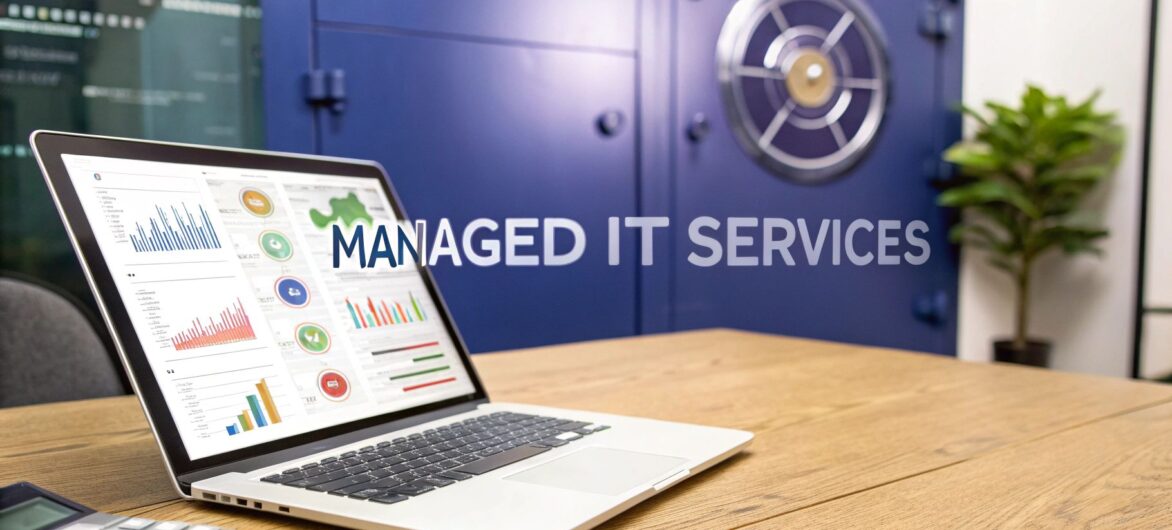
This image shows how an MSP's constant watchfulness acts as a guardian over your firm's most important systems.

It perfectly illustrates the core idea of managed IT: stopping disasters before they happen, not just reacting to them. This ensures your firm stays productive even during the most intense times of the year.
This proactive mindset also completely changes how you budget for IT. Instead of getting hit with massive, unexpected repair bills, you operate on a simple, fixed monthly fee. This predictable spending model makes budgeting a breeze and eliminates financial surprises, which helps with long-term financial planning. You get an entire team of experts and enterprise-level technology for a fraction of what it would cost to build an in-house department. For many firms, exploring the benefits of cloud computing is a great first step toward understanding this smarter, cost-effective model.
Before we dive into compliance and growth, let's break down how a managed approach compares to traditional IT support models. The table below highlights the key differences you'll experience day-to-day.
| Feature | Managed IT Services (MSP) | Traditional In-House/Break-Fix IT |
|---|---|---|
| Cost Structure | Predictable monthly fee | Unpredictable, hourly, or project-based |
| Approach to Issues | Proactive; prevents problems before they occur | Reactive; fixes problems after they happen |
| Cybersecurity | Multi-layered, ongoing security management | Basic protection, often updated inconsistently |
| Strategic Focus | Aligns technology with business growth goals | Focuses on immediate technical fixes |
| Team Access | Access to a full team of specialized experts | Relies on one or a few generalists |
| Uptime | High; focused on maximizing availability | Variable; downtime is common before a fix |
As you can see, the shift to managed IT isn't just a technical upgrade—it's a fundamental change in how technology supports your firm's stability and success.
Trying to navigate the complex web of regulations like the Gramm-Leach-Bliley Act (GLBA) and IRS security standards can feel like a full-time job. An MSP that specializes in the accounting industry cuts through that complexity.
They make sure your IT infrastructure is not just secure but also fully compliant. They document processes and put the right controls in place to help you pass audits and protect your firm from penalties. That peace of mind is priceless.
Finally, a true IT partner is invested in your firm's growth. They don't just fix things; they provide strategic advice on new technology, helping you adopt tools that boost efficiency and even create new services for your clients. This kind of partnership turns IT from a necessary expense into a real competitive advantage, ensuring your technology grows right alongside your ambitions.
Choosing a managed service provider (MSP) can feel overwhelming, but it really just boils down to making sure they cover a few non-negotiable services. Think of this as your core checklist for vetting any potential IT partner. A quality provider of managed IT services for accounting firms won’t just fix computers—they’ll deliver a specific set of protections and strategic advantages built for your industry’s unique demands.
This is about more than just IT support. It's about building a resilient, secure, and future-proof technology foundation for your firm. Each service is a critical pillar supporting your operations, client trust, and long-term growth.
The first and most critical service is 24/7 proactive network monitoring and advanced endpoint security. This is the digital equivalent of having a security guard watching over your office around the clock. Instead of waiting for something to break, they’re constantly looking for suspicious activity, potential system failures, and security weak spots before they can cause any real damage.
This constant vigilance is what separates true managed services from reactive, break-fix support. It means finding and patching a software vulnerability before a cybercriminal can exploit it. It means detecting a failing hard drive before it crashes in the middle of tax season. This proactive stance is essential for maintaining uptime and defending against today’s relentless cyber threats.
A top-tier MSP doesn’t just respond to problems—they prevent them. Their goal is to create an environment so stable and secure that you rarely have to think about your IT at all.
For any firm serious about protecting client data, this approach is table stakes.
Next up is comprehensive disaster recovery planning, which provides a robust strategy to protect your firm's data from literally anything that could go wrong. This is your ultimate safety net. It’s not a matter of if you’ll face a data-loss event—whether from a cyberattack, hardware failure, or simple human error—but when.
A solid plan must include:
This service isn’t just about data; it’s about business continuity.
Modern accounting firms run on the cloud. It’s no longer a trend but a necessity for the real-time data access and collaboration required to manage sensitive financial information securely. Your MSP needs to be an expert in this space, ensuring your cloud tools are always up-to-date, compliant, and locked down.
They must know platforms like QuickBooks and Xero inside and out. This includes optimizing performance, ensuring seamless integrations with your other tools, and securing your data across all these essential applications. Proper management of cloud hosting for QuickBooks and similar software is fundamental to your firm's efficiency and security.
Finally, a great IT partner does more than just maintain your systems—they act as your Virtual Chief Information Officer (vCIO). They provide the strategic guidance that helps your firm grow.
A vCIO helps you budget for future technology needs, navigate complex compliance requirements, and find new tools that can boost efficiency and profitability. This turns your IT from a simple cost center into a powerful strategic asset that gives you a competitive edge.

Picking a managed IT service provider for your accounting firm isn't just about outsourcing tech support—it's about finding a strategic partner. Not all Managed Service Providers (MSPs) are built the same, and a generic IT company simply won’t get the unique pressures you face.
The right partner becomes an extension of your firm, someone who safeguards your data and clears the path for growth.
The most critical factor? Industry-specific experience. A provider who lives and breathes the accounting world knows your software, workflows, and compliance burdens from day one. You won't have to waste time explaining the difference between Thomson Reuters and Wolters Kluwer or the security standards mandated by the IRS and the Gramm-Leach-Bliley Act (GLBA). They just get it.
When you're vetting a potential MSP, your questions need to cut straight to what matters for an accounting firm. Vague, generic answers are a major red flag.
A true IT partner does more than just fix what's broken. They bring strategic value by aligning technology with your firm’s goals, making sure your IT infrastructure is a secure asset that can adapt to whatever comes next.
Look past their technical skills and evaluate how they approach the partnership itself. Do they offer proactive strategic reviews? A good MSP should help you budget for future technology needs and recommend tools that will actually make your team more efficient.
For instance, they might show you how leveraging secure QuickBooks cloud hosting could streamline remote work for your accountants, making them more productive and secure no matter where they are.
Ultimately, you're looking for a provider who can prove they have a deep understanding of your operational realities. Their ability to speak your language—on software, compliance, and the seasonal crunch—is the clearest sign you’ve found a partner who will help your firm thrive.
Making a move to managed IT is a big decision, and it’s natural for firm partners to have questions about the practical side of things—cost, data security, and what the transition actually looks like. Let's tackle some of the most common concerns to give you the clarity you need.
One of the biggest myths is that managed IT costs more than keeping an IT expert on payroll or calling for help when something breaks. While an in-house team racks up expenses for salaries, benefits, and ongoing training, managed services run on a predictable, fixed monthly fee.
This model almost always leads to a lower Total Cost of Ownership (TCO). Why? Because it gets rid of surprise repair bills and the massive financial hit that comes with unexpected downtime.
By proactively managing your systems, an MSP prevents costly emergencies. This transforms IT from a volatile, unpredictable expense into a stable, budget-friendly operational cost.
Protecting your firm’s sensitive client data is priority number one during any IT transition. Any reputable provider of managed IT services for accounting firms will walk you through a meticulous onboarding process.
This isn’t a rushed job. It includes creating full, encrypted backups of all your data before a single file is moved. They’ll also set up secure access protocols and schedule the migration during off-peak hours to guarantee zero data loss and keep disruptions to your daily operations at an absolute minimum.
The onboarding process is a carefully planned project, not just a quick flip of a switch. It kicks off with a deep-dive assessment of your current setup, moves into strategic planning, and then follows a phased rollout to make sure everything goes smoothly.
Your team will get all the training they need on any new systems or procedures. For a closer look at what to expect, check out our comprehensive FAQ page, which answers many common questions in detail.
Ready to secure your firm's future with a reliable IT partner? Cloudvara provides secure, scalable, and fully managed cloud solutions designed specifically for accounting professionals. Get started with a free 15-day trial today!