
Stripped down to its core, cloud based document management is about moving your company's files from overflowing physical cabinets and local servers into a single, secure digital library. The best part? You can get to it from anywhere with an internet connection. But it's so much more than just online storage—it’s an intelligent system built to manage how your documents live and breathe.
Think about the traditional office file cabinet for a second. It's probably stuffed, a bit disorganized, and you have to be physically in the room to find anything. Now, imagine that same cabinet became a smart, self-organizing digital hub. That’s the big idea behind a cloud based document management system (DMS).
It’s a fundamental shift from treating documents as static files to seeing them as a dynamic information source. Instead of just saving a file, you’re giving it a backstory. The system knows who created it, who touched it last, and its entire history. This creates a single source of truth, finally ending the chaos of tracking down the real final version of a file saved across five different computers.
It's easy to mistake a cloud DMS for basic storage services like Dropbox or Google Drive. While those tools are great for stashing and sharing individual files, a true DMS is engineered for business processes. The real difference comes down to control, automation, and compliance.
A DMS delivers powerful features designed to manage a document’s entire lifecycle, from creation to archive:
This infographic lays out the core advantages of ditching a local system for the cloud.
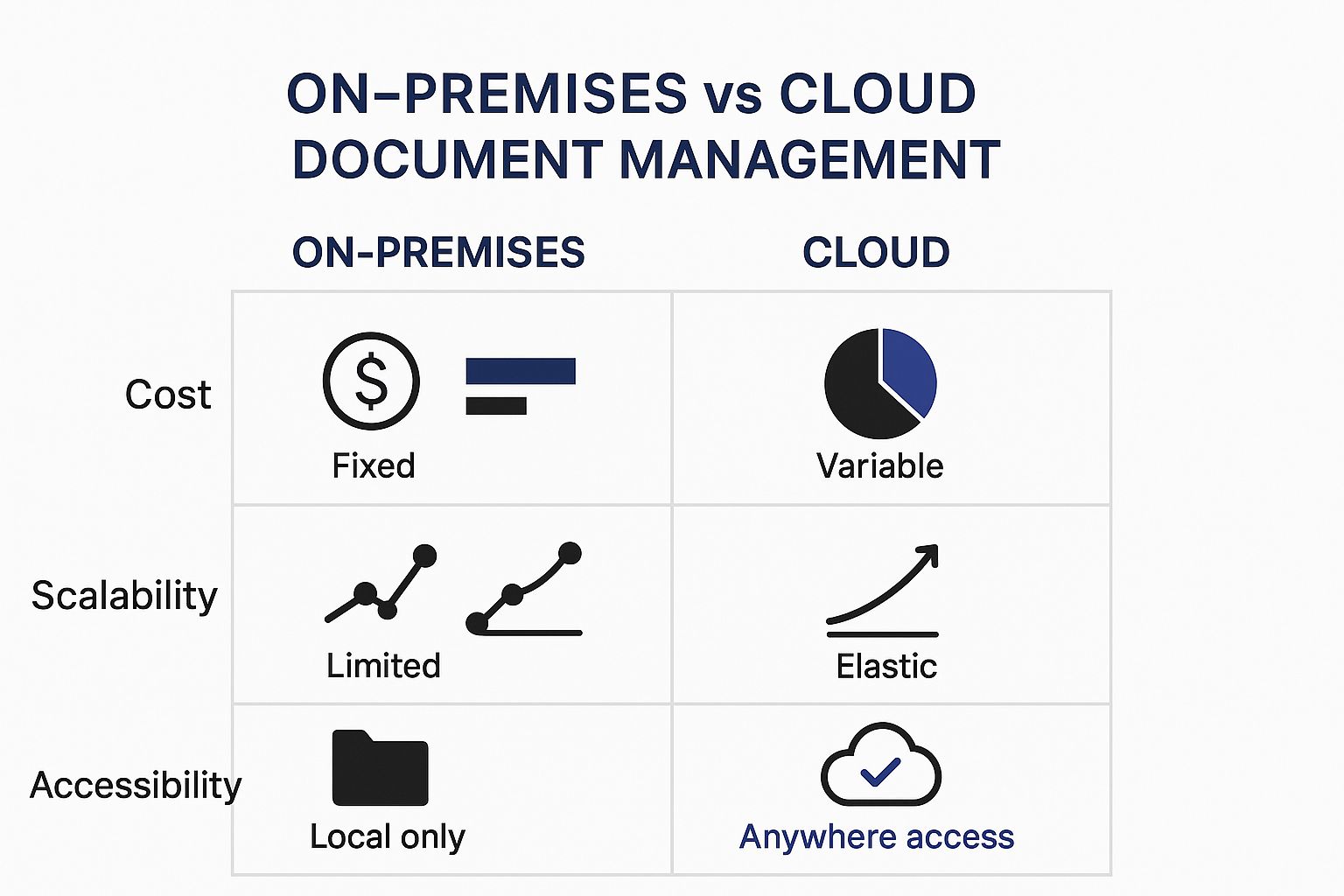
As the visual makes clear, the cloud model gives you far more flexibility and accessibility with costs that scale with you, unlike the rigid and limiting nature of on-premise setups. For any business that wants to grow and adapt, these differences are a game-changer. It's worth taking a look at a document management cloud solution that aligns with these modern needs.
To really grasp the shift, it helps to see a direct comparison. Here’s a breakdown of how traditional on-premise systems stack up against their cloud-based counterparts across the areas that matter most to your daily operations.
| Feature | On-Premise System | Cloud Based System |
|---|---|---|
| Initial Cost | High (servers, software licenses, IT staff) | Low (subscription-based, no hardware) |
| Accessibility | Limited to office network or VPN | Anywhere with an internet connection |
| Scalability | Difficult and expensive to scale | Easy to scale resources up or down |
| Maintenance | Managed internally by your IT team | Handled by the provider (updates, security) |
| Security | Responsibility falls entirely on you | Shared responsibility with provider |
| Collaboration | Clunky; often requires emailing files | Seamless real-time collaboration |
The table highlights a clear trend: on-premise systems lock you into a cycle of heavy investment and hands-on maintenance, while cloud systems free you up to focus on your actual work.
The market is certainly taking notice. It was recently valued at around USD 7.7 billion and is on track to rocket past USD 18 billion by 2030, according to 360iResearch. This explosive growth isn’t just a fad; it’s a sign of a major shift in how modern businesses get things done.

A powerful cloud based document management system is so much more than a digital filing cabinet. It’s an active partner in your workflow, armed with smart features that go beyond simple storage to deliver real, measurable gains in productivity. These tools work in concert to smooth out friction, handle repetitive tasks, and give your team back its most precious resource—time.
At the center of it all is version control. Think of it as a time machine for your documents. Instead of wrestling with confusing filenames like "Contract_v2_FINAL_revised.docx," the system keeps a single, authoritative file. Every change is tracked and saved as a new version, creating a perfect history of who changed what and when. This guarantees everyone is working from the same page, preventing costly mistakes caused by using outdated information.
Traditional file searches are often stuck at the surface, limited to just the filename. A modern DMS, on the other hand, digs much deeper. Using a mix of metadata (think descriptive tags like a client's name, an invoice number, or a project code) and Optical Character Recognition (OCR), the system can actually read the content inside every document, including scanned PDFs and images.
This means you can find a specific contract by searching for a single clause within the document itself. A task that once took hours of manual sifting now takes seconds, completely changing how you find and use information.
“The ability to instantly locate any document, regardless of where it’s stored or what it’s named, is a foundational benefit of a true cloud based document management platform. It transforms information retrieval from a roadblock into an asset.”
Beyond just finding files, these systems streamline how work actually gets done. You can build automated workflows for routine processes like invoice approvals, contract reviews, or expense reporting. A document can be automatically sent from one person to the next, with the system managing all the notifications and deadlines.
This level of automation is a cornerstone of the best document management practices for small businesses, as it eliminates manual bottlenecks and helps your team make decisions faster.
A great system also gives your team powerful tools to work together. Centralized access and real-time co-editing are key features, letting multiple people work on the same document at the same time. By offering one unified platform with clear version histories and task assignments, these systems are built to significantly improve team collaboration, whether your team is in one office or spread across the globe.
Finally, granular access controls let you decide exactly who can view, edit, share, or delete documents. This keeps sensitive information locked down without getting in the way of productivity.
A cloud based document management system isn't a one-size-fits-all solution; its real power shines when you see how it solves the unique headaches of specific industries. For any professional who juggles sensitive information, strict regulations, and tangled workflows, this technology is more than just a tool—it’s a genuine strategic asset.
The impact is impossible to ignore, and it’s fueling massive market growth. The global document management system market, already valued at around USD 8.96 billion, is on track to hit over USD 10.15 billion with a compound annual growth rate of 13.3%. That momentum is expected to push the market to nearly USD 17 billion by 2029, a trend driven by industries realizing just how valuable these systems are. You can dig into the numbers in this market overview report.
For accountants, data security and a clean audit trail are absolutely non-negotiable. A cloud DMS acts as a fortified digital vault for client financials, tax returns, and corporate records. Instead of tossing vulnerable files back and forth over email, accountants can give clients access to a secure, controlled portal.
Even more importantly, the system creates a flawless audit trail. Every single action—every view, edit, and share—is logged automatically. This makes responding to an audit request infinitely faster and less stressful because the entire history of a document is right there at your fingertips.
Law firms have traditionally run on paper, mountains of it. Managing case files, discovery documents, and client contracts is a monumental task. A cloud based document management system finally brings order to that chaos with features that are essential for legal work.
For a law firm, a misplaced document isn't just an inconvenience; it can be a critical failure with serious legal consequences. A cloud DMS provides the structure and security needed to manage high-stakes information with confidence.
Nonprofits often have to do more with less, working with tight resources and distributed teams of staff and volunteers. A cloud DMS can be a powerful equalizer, helping them operate with the efficiency of a much larger corporation.
It provides a single, central hub for managing grant applications, tracking donor records securely, and organizing program documentation. This level of accessibility empowers remote teams and volunteers to collaborate effectively, no matter where they are. By automating tedious administrative work, the system frees up valuable time, allowing the organization to focus its energy where it matters most: its core mission.
Entrusting your most critical files to a third party can feel like a big leap. But the truth is, a modern cloud based document management system is often far more secure than that old server humming away in the office closet. The best providers build their platforms on a foundation of multi-layered, enterprise-grade defenses designed to protect your data from every conceivable angle.
It all starts with end-to-end encryption, which essentially scrambles your data while it's in transit and while it's sitting on a server. Think of it like putting your documents inside a digital armored truck that only you have the key to open. This baseline protection is then layered with advanced measures like two-factor authentication, routine security audits by independent experts, and Fort Knox-level physical security at the data centers themselves.
For professionals in fields like law or accounting, compliance isn't just a good idea—it's a legal mandate. Cloud DMS platforms are engineered with these high stakes in mind, giving you the specific tools needed to satisfy stringent standards like HIPAA, GDPR, and SOC 2.
These systems make compliance straightforward with powerful, built-in features:
This deep focus on security and compliance is a major reason for the technology's explosive growth. Early adoption in North America has made it the dominant region, accounting for roughly 44.4% of the market share. The U.S. market alone is on track to blow past USD 5.76 billion by 2032, a surge driven by these very security needs.
The old-school thinking that keeping data on-site is automatically safer is quickly becoming a myth. An on-premise server is a single point of failure, vulnerable to everything from fires and floods to simple theft. It also requires constant, expert-level maintenance to fend off the latest cyberattacks. For a deeper look at this, check out these cloud or local cybersecurity insights.
A high-quality cloud DMS provider employs teams of dedicated security experts whose entire job is to monitor threats and maintain defenses—a level of focus most small or mid-sized businesses simply can't afford to replicate in-house.
In the end, it all comes down to picking the right partner. Your decision on how to choose a cloud provider should be heavily influenced by their security certifications, disaster recovery plans, and uptime guarantees. A reputable provider offloads the immense weight of IT security, letting you get back to work with complete peace of mind.

Getting a cloud based document management system up and running isn't as simple as flipping a switch. It’s a full-blown strategic project. If you treat it like a journey with a clear map, you can turn a potentially disruptive process into a smooth and rewarding one for your entire team.
With a bit of careful planning, you'll sidestep the common pitfalls and see your new system deliver value from day one.
The journey doesn't start with picking software—it starts with your own team. Before you even look at a platform, you need to conduct a thorough needs assessment. Get key people from different departments in a room and ask the tough questions. Where are our biggest document-related headaches? What repetitive tasks are eating up our time? Pinpointing these specific frustrations is the only way to start.
Once you know what you need, the next phase is designing the architecture of your new digital workspace. This is where so many businesses stumble. It’s tempting to just dump all your old files into the new system, but that’s like moving into a new house without deciding which room is which. You’ll just end up with the same old chaos in a new, more expensive location.
Instead, take the time to map out your folder structure and—most importantly—your metadata strategy. Metadata, the tags and labels you add to documents, is what gives a cloud DMS its search superpowers. Agree on a consistent naming convention and a standard set of tags (like client name, project number, or document type) that everyone will use. Of course, a critical step is making sure you have the right infrastructure, including a solid internet connection from one of the best reliable business internet providers to support your new setup.
A well-planned metadata strategy is the difference between a simple digital storage folder and an intelligent, searchable information hub. Investing time here pays massive dividends in long-term efficiency and user adoption.
With your digital blueprint ready, fight the urge to do a company-wide "big bang" launch. A much safer and smarter approach is a phased rollout. Start with a small, tech-savvy pilot group from a single department. Let them kick the tires for a few weeks and give you their honest feedback. Their experience will expose any hiccups and help you fine-tune the setup before everyone else joins.
This pilot phase also underscores the need for real employee training. Don't just show them how to log in. Demonstrate how the new system solves the very frustrations you identified at the start. Show them how an automated workflow can kill off manual approvals or how advanced search can find that one specific document in seconds.
The final step is the data migration itself. This can feel like a huge task, but with a solid plan, it's completely manageable. Here are a few tips we've seen work time and again:
Pulling this off requires careful coordination. For a more detailed guide, our cloud migration checklist gives you the structure you need to manage the entire process. By following a clear roadmap, you ensure your investment in a cloud based document management system drives real benefits, right from the start.
Making any significant change in your business operations brings up questions, and switching to a cloud-based document management system is no different. Moving from familiar on-premise servers or even simple cloud storage to a more intelligent platform is a big step.
Let's walk through some of the most common questions we hear to help clarify the process and show you the real-world value.
This is a great question, and an important one. The short answer is no—a true DMS is a major upgrade. While platforms like Dropbox and Google Drive are fantastic for basic file storage and sharing, a dedicated cloud-based document management system brings a layer of business intelligence to the table.
Here's an analogy: think of Google Drive as a self-storage unit where you can stash your boxes. A DMS is more like a modern library with a smart librarian. It doesn't just store your information; it organizes it, makes it instantly searchable, and carefully controls who gets to see what.
A true DMS offers critical functions that basic storage just can't match:
Handing over your company's data can feel like a leap of faith. The reality is that top-tier cloud DMS providers deliver enterprise-grade security that often far exceeds what a small or mid-sized business can realistically achieve on its own. These platforms are built with security woven into every layer.
This includes end-to-end encryption for data both while it's moving (in transit) and while it's stored (at rest), multi-factor authentication to block unauthorized access, and regular, independent security audits. Plus, they're housed in data centers with intense physical security and disaster recovery plans, ensuring your business can keep running no matter what. Understanding your provider’s security posture is a key part of good data governance best practices.
Pricing for a cloud-based document management system usually follows a subscription model, most often billed per user, per month. The cost can vary quite a bit depending on a few key factors:
Basic plans can be very affordable for small teams, while enterprise-level plans with deep compliance and integration features will come with a higher price tag. When you're evaluating the cost, it's vital to think about the return on investment. The time saved, errors prevented, and security gained often deliver value that makes the monthly fee look like a bargain.
A common mistake is to only focus on the sticker price. The real value of a cloud DMS lies in its ability to streamline operations, reduce administrative burden, and secure your most critical business information.
Ready to see how a dedicated cloud environment can centralize your essential applications and secure your documents? Cloudvara offers a secure, scalable, and fully supported cloud hosting solution that puts your entire office at your fingertips, accessible from anywhere. Start your free 15-day trial and experience the difference today at https://cloudvara.com.