
At its core, the appeal of cloud hosting boils down to a few powerful ideas: significant cost savings, on-demand scalability, and far superior reliability. It lets businesses sidestep the heavy costs of downtime tied to single-server setups, handle unexpected traffic surges with ease, and pay only for the resources they actually use.
Let's cut through the technical jargon for a minute.
Think of traditional hosting like owning a single, standalone house. You're on the hook for all the maintenance and security, and when it comes to space, what you have is what you get. If you decide to throw a big party, you can't just magically add another room on the fly.
Cloud hosting, on the other hand, is more like plugging into a high-tech, city-wide utility grid. You get exactly the power you need, precisely when you need it, and you never have to think about the power plant. It works by pooling resources from many interconnected servers to create one giant, resilient, and incredibly flexible environment for your website or applications.
This fundamental shift—from owning physical hardware to tapping into a distributed service—is a strategic game-changer. It gives businesses a level of agility and efficiency that was once unthinkable, which is exactly why the market is exploding.
The global cloud computing market is on track to grow from $912.77 billion in 2025 to a staggering $1.614 trillion by 2030, all driven by the relentless need for scalable infrastructure.
This simple graphic breaks down the core benefits into three pillars that support modern business: scalability, cost-efficiency, and reliability.
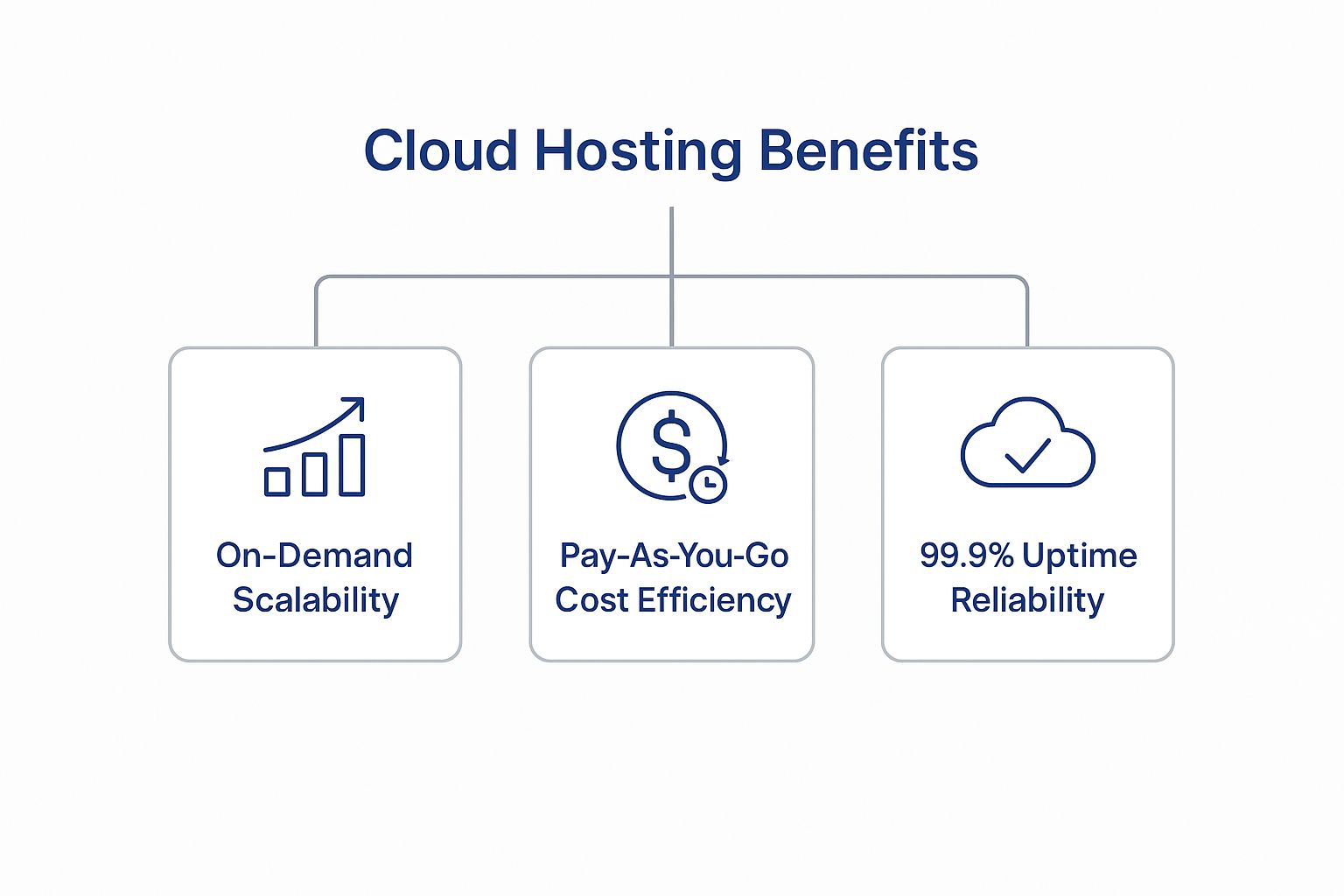
As you can see, these advantages don't work in isolation. They reinforce each other to create a powerful foundation for just about any digital operation.
For a modern business, this isn't just some IT decision; it's a core business strategy. For a deeper look at how this technology creates a competitive edge, you can explore these key cloud computing benefits for businesses.
Making the move to the cloud allows you to:
The big idea is simple: instead of being limited by one machine, your entire digital operation is supported by a vast, interconnected network. This distributed model is the secret to its strength, offering a level of resilience and flexibility a single server just can't touch.
To put it all into perspective, here’s a quick comparison of how cloud hosting stacks up against the old-school approach across the areas that matter most to a business.
| Feature | Traditional Hosting | Cloud Hosting |
|---|---|---|
| Scalability | Fixed resources; scaling requires new hardware and downtime. | Elastic; resources scale up or down automatically on demand. |
| Cost Structure | High upfront capital expense (CapEx) for hardware. | Pay-as-you-go operating expense (OpEx); no upfront costs. |
| Reliability | Single point of failure; if the server goes down, so does your site. | High availability with built-in redundancy across multiple servers. |
| Performance | Limited to the capacity of a single server. | Consistent performance with load balancing across the network. |
| Maintenance | Your team is responsible for all hardware and software updates. | The provider manages all hardware, security, and maintenance. |
This table highlights the clear shift from a rigid, ownership-based model to a flexible, service-based one. For most growing businesses today, the agility and efficiency of the cloud model make it the obvious strategic choice.
One of the most powerful arguments for cloud hosting is its direct impact on your bottom line. It fundamentally changes how you approach IT spending, steering your business away from big, risky capital investments and toward a more flexible, predictable financial model.

Traditionally, businesses ran on a Capital Expenditure (CapEx) model. This meant shelling out thousands for physical servers, networking gear, and software licenses before you even got started. It was a massive upfront investment in hardware that would inevitably age, break, and need constant upkeep.
Cloud hosting flips that model completely. Instead, it operates on an Operational Expenditure (OpEx) basis, which feels a lot more like a utility bill. You simply pay a predictable monthly fee for the computing resources you actually use.
Think of it this way: instead of buying a massive, expensive power generator for your office (CapEx), you just pay the electric company for the kilowatt-hours you use each month (OpEx). This approach completely removes the financial weight of owning and maintaining assets that lose value over time.
This "pay-as-you-go" structure delivers some serious financial perks:
This financial shift is the main reason so many companies are moving to the cloud. By 2025, it's estimated that 95% of all IT workloads will be cloud-based, a trend backed by 74% of global IT decision-makers. This move lets organizations ditch the need for pricey on-site data centers, cutting both capital and operational spending in a big way.
The core financial benefit is clear: you convert a large, unpredictable capital expense into a manageable and scalable operational expense. This frees up cash that can be reinvested into core business activities like marketing, product development, and customer support.
Imagine you run an online store. With a traditional server setup, you'd have to buy enough hardware to handle your single busiest day of the year, like Black Friday. For the other 364 days, most of that expensive capacity would just sit there, collecting dust while still chewing up power and needing maintenance.
With cloud hosting, your environment automatically scales up to meet the holiday rush. Once the sale ends, it scales right back down. You only pay for the extra resources when you actually need them, turning a huge capital risk into a temporary, controlled operational cost. Understanding these principles is central to effective cloud cost optimization. This smart allocation ensures you never overpay for capacity you aren't using.
How well does your business handle a sudden change in pace? One of the biggest wins with cloud hosting is its on-demand scalability. It basically turns your rigid infrastructure into an elastic waistband—it stretches effortlessly when traffic surges and shrinks back down when things get quiet.

This isn’t just a nice-to-have feature. It’s a complete shift in how you plan for growth, seasonal rushes, or unexpected market swings. Instead of guessing your resource needs months in advance and hoping for the best, you can react in real time without any service interruptions.
At its core, scalability comes in two main flavors. Getting a handle on both is key to seeing how the cloud adapts to pretty much any situation you throw at it.
Vertical Scaling (Scaling Up): Think of this like giving an existing server a power boost. You can add more RAM, CPU, or processing power to a single virtual server to chew through heavier workloads. It’s the perfect solution when your applications just need more raw horsepower to perform intensive tasks.
Horizontal Scaling (Scaling Out): Instead of making one server more powerful, you simply add more servers to your network to share the load. This is ideal for managing a massive increase in the number of users, ensuring no single server gets overwhelmed.
With Cloudvara, this all happens seamlessly. The platform is designed to dish out resources precisely when they’re needed, keeping your operations smooth whether you’re seeing a slow-and-steady increase in users or a sudden, massive traffic spike.
The real magic is in the automation. A cloud environment can be set up to automatically scale resources by monitoring traffic in real-time. That means you don’t need an engineer glued to a screen 24/7; the system intelligently responds to demand all on its own.
Imagine a small media site publishes a story that unexpectedly goes viral. On a traditional, fixed server, that sudden flood of millions of visitors would almost certainly cause a crash. The result? A frustrating "site unavailable" error for tons of potential new readers. It’s a huge missed opportunity.
Now, let's replay that in a cloud hosting environment. The system would instantly detect the traffic spike and automatically trigger its scaling protocols—maybe by adding more server instances (horizontal scaling) to distribute all the incoming requests. Because of this, the site stays fast and responsive for every single visitor.
Once the hype dies down, the cloud environment automatically scales back down, releasing those extra resources. And that’s where the cost savings kick in: you only paid for that peak capacity for the few hours you actually needed it. This elastic capability is also a lifesaver for businesses with fluctuating data needs, like firms using specialized cloud accounting solutions that get hammered during tax season. This adaptability means you’re always prepared without ever overspending on idle hardware.
Downtime isn’t just an inconvenience—it's a direct threat to your revenue and reputation. Every minute your site is offline, you're losing potential sales and chipping away at customer trust. One of the biggest wins with cloud hosting is how it’s engineered from the ground up to fight this exact risk, delivering exceptional reliability.
With traditional hosting, your entire online presence often lives on a single physical server. If that one machine fails from a hardware glitch, a power outage, or anything else, your business goes dark with it. That creates a dangerous single point of failure that modern businesses simply can’t afford.
Cloud hosting completely dismantles that weak spot. Instead of putting all your eggs in one server-basket, your website and apps are supported by a huge, distributed network of interconnected servers.
Think of it like a pit crew in a high-stakes race. If one crew member stumbles, another one instantly steps in to take their place, and the car never even slows down. The cloud works on a similar principle of automatic failover. When one server in the network hits a snag, your traffic is seamlessly rerouted to a healthy one, often with zero noticeable downtime for your users.
This built-in redundancy is the very heart of high availability. Here are the key features that make it all possible:
With a 99.5% uptime guarantee, Cloudvara gives you the peace of mind that comes from knowing your business is protected by an infrastructure designed for resilience. You can finally shift your focus from worrying about hardware failures to confidently serving your customers.
Ultimately, this robust architecture means you and your customers can depend on consistent, reliable access to your services. It’s a foundational benefit that protects your operations and supports sustained growth, ensuring you’re always online when it matters most.
In the digital world, security isn't just a feature; it's the foundation of trust. One of the biggest wins with cloud hosting is getting access to enterprise-grade protection that most small or mid-sized businesses could never afford to build on their own. Top-tier providers invest millions into sophisticated, multi-layered security protocols that create a serious defense for your data.

It’s like the difference between locking your files in a simple office safe and storing them inside a fortified bank vault. This isn't just about a single firewall; it’s a complete security ecosystem designed to shut down modern threats.
With a provider like Cloudvara, you also get a dedicated team of cybersecurity experts monitoring for threats 24/7. This constant vigilance means potential issues get spotted and neutralized before they can ever impact your business—a level of active defense that’s nearly impossible to replicate with a small IT team.
Good cloud security is built in layers, creating multiple barriers an attacker would have to breach. This depth adds a powerful level of resilience to your operations, making sure your critical information stays protected from every angle.
Key security measures often include:
This proactive approach to security is a game-changer for preventing data breaches. You can dive deeper into how a structured strategy protects your information by exploring our guide on cloud data loss prevention.
For any business in a regulated field like healthcare, finance, or legal services, compliance isn't optional. Meeting complex standards like HIPAA for patient data or PCI DSS for credit card information can be a huge operational and financial burden. Trying to manage this in-house requires deep expertise and constant attention.
By partnering with a compliant cloud provider, you effectively offload a significant portion of this regulatory headache. These providers build their infrastructure to meet stringent industry standards, giving you a compliant foundation to build upon.
This partnership simplifies your audit processes and dramatically reduces the risk of costly penalties for non-compliance. Instead of spending your time and resources becoming a regulatory expert, you can focus on running your business, confident that your data handling meets all the necessary legal and industry requirements.
One of the biggest perks of cloud hosting isn't just the infrastructure itself—it’s the freedom that comes with managed cloud services. This is what truly changes the game for your team's day-to-day work. Instead of getting bogged down in server maintenance, your people are freed up to focus on what actually grows the business.
Think of it like hiring an expert property manager for a rental building. You stop worrying about fixing leaky pipes or patching the roof yourself. The manager handles all the backend work—server patching, software updates, and technical support—so you can focus on the bigger picture.
This simple shift lets your team stop putting out IT fires and start driving real, meaningful growth.
Beyond just making life easier, the cloud gives your applications a serious performance boost. Cloud providers invest in top-tier hardware that would be incredibly expensive for a single business to buy and maintain. This means your apps run on the fastest, most reliable technology out there, giving your users a smooth, frustration-free experience.
Another key tool in the performance arsenal is the Content Delivery Network (CDN). A CDN is a network of servers spread across the globe that stores copies of your content closer to where your users are.
So, if a customer in London visits your website, the CDN delivers images and files from a nearby server in Europe instead of pulling them all the way from your main server in New York. This simple change dramatically cuts down loading times, which is critical for keeping users engaged and improving your site's search engine ranking.
With a provider like Cloudvara, you get more than just server space. You get a complete service designed to make your business run faster and more efficiently, with expert support ready to assist 24/7.
When you offload all those complex IT tasks, your business gains a powerful strategic advantage. You can redirect your budget and your team’s brainpower toward innovation, customer service, and product development—the activities that actually generate revenue.
This operational freedom is a core benefit for growing companies. If you're planning a move to the cloud, understanding the process is the first step. For a detailed walkthrough, explore our guide on cloud migration for small business, which breaks down how to make the transition smooth and effective.
Ultimately, managed cloud hosting lets you do what you do best, leaving all the technical heavy lifting to the experts.
As you start to weigh the pros and cons of cloud hosting, a few key questions almost always pop up. Getting clear, practical answers to these is the best way to feel confident about making a move.
Let’s walk through some of the most common concerns we hear from businesses just like yours.
For most businesses, the answer is a resounding yes. Think about it this way: a reputable cloud provider invests millions into enterprise-grade security that’s simply not feasible for an individual company to build on its own. We’re talking about advanced firewalls, 24/7 active monitoring, and entire teams of cybersecurity experts whose only job is to protect the infrastructure.
This isn’t just an add-on; it’s a core part of their service. They also take care of all the security patches and infrastructure updates behind the scenes, closing vulnerabilities before you even know they exist.
The security model of a top-tier cloud provider is like trading a simple home safe for a fortified bank vault. The investment in technology, expertise, and constant vigilance provides a level of protection that’s difficult to replicate in-house.
The biggest differences here come down to resources and reliability. On a shared hosting plan, your website is essentially a tenant in an apartment building, sharing things like power and plumbing with everyone else. If another site on that same server gets a massive traffic spike, your site can slow down—a "noisy neighbor" problem.
Cloud hosting, on the other hand, pulls resources from a massive, distributed pool of virtual servers. This design gives you true isolation and scalability. Your website’s performance isn’t dragged down by what others are doing, and you can scale your resources up or down almost instantly when you need to.
The difficulty really depends on your setup, but a good managed cloud provider makes it their mission to simplify the process. Many, including us, offer free or assisted migration services where an expert team handles the entire transfer for you.
This usually involves moving all your files, databases, and critical settings to make sure everything works perfectly from day one, with little to no downtime. Digging into the benefits of cloud migration shows just how much this strategic move can pay off down the road. The best first step is always to talk with a provider to understand their specific migration process and what kind of support you can expect.
Ready to experience the reliability, security, and performance of the cloud for yourself? Cloudvara offers a free 15-day trial to let you see the benefits firsthand, with no contract or credit card required. Start your free trial today.