Application cloud hosting is a simple idea with huge implications: instead of running your software on servers tucked away in a closet at your office, you run it on a network of powerful, remote servers managed by someone else. This approach gives you on-demand access to computing resources, letting you scale your application’s power up or down whenever you need to, and you only pay for what you actually use.

Think of it like this. Imagine your business relies on a private power generator humming away in the basement. You’re responsible for everything—buying it, maintaining it, fueling it, and fixing it when it breaks down. That’s the old-school, on-premise hosting model in a nutshell.
Now, what if you just plugged into the national power grid instead? You get all the electricity you need, on-demand, without ever worrying about the machinery behind the wall. That’s the core concept of application cloud hosting. It’s a service where your applications live and run on a massive network of remote servers handled by a specialized provider.
This model marks a major shift away from the headaches of owning and managing physical hardware. Instead of sinking money into expensive servers, cooling systems, and emergency repairs, you’re essentially renting computing power from a cloud provider.
This frees up your team from the endless cycle of server maintenance and lets them focus on what really moves the needle: improving your software and growing the business.
The move from on-premise to cloud isn't just a small trend; it's a massive economic shift. The global cloud computing market is projected to explode from $738.2 billion to $1.6 trillion between 2025 and 2030, growing at a 17.2% compound annual rate. This growth is fueled by businesses chasing efficiency and adopting new technologies like AI and IoT. By ditching heavy upfront hardware costs, cloud hosting puts powerful computing within reach for companies of all sizes.
At its heart, application cloud hosting is built on a few key principles that set it apart from older methods. Getting these concepts is key to understanding its real value.
The real magic of application cloud hosting is turning IT infrastructure from a capital-intensive burden into a flexible, operational service. This empowers companies to be more agile, innovative, and resilient.
Ultimately, this model is all about outsourcing the "how" of running your application so you can pour all your energy into the "what." To see this distinction even more clearly, it helps to compare the differences between cloud and on-premise solutions side-by-side.

When you start looking into application cloud hosting, you'll run into three core service models: IaaS, PaaS, and SaaS. These aren't just technical acronyms—they represent different levels of management and control, shaping how you build, deploy, and use your software.
Getting a handle on their differences is key to picking the right foundation for your needs.
A simple pizza analogy makes these concepts easy to digest.
Infrastructure as a Service (IaaS) is like being handed raw pizza ingredients—dough, sauce, cheese, and toppings—along with full access to a professional kitchen. You get the fundamental building blocks (servers, storage, networking) but you’re in charge of putting everything together. You have to manage the operating system, install the right software, and handle the application's runtime.
This model gives you the maximum level of control and flexibility. It’s perfect for organizations with complex, custom IT needs or those that require direct access to the underlying hardware. A development team building a highly specialized application from scratch would feel right at home with IaaS. To get into the weeds, check out our detailed guide on what Infrastructure as a Service truly entails.
Platform as a Service (PaaS) is more like ordering a pizza for delivery. The pizza place takes care of the kitchen, the oven, and the entire cooking process. Your only job is to add your favorite toppings and serve it. In the cloud world, the provider manages the servers, networking, and operating system for you.
Your team gets to focus entirely on developing and running the application, without ever worrying about hardware maintenance or software patches. This is a great middle ground for developers who want to build and deploy applications quickly, minus the headaches of managing infrastructure.
Software as a Service (SaaS) is the most straightforward model, just like dining out at a restaurant. You don't have to cook or clean up; you just sit down and enjoy the finished meal. SaaS applications are ready-to-use software delivered over the internet, usually on a subscription basis. Think of tools like Microsoft 365, Salesforce, or QuickBooks Online.
SaaS represents the ultimate form of managed service, where the provider handles everything from the infrastructure to the application itself. The user simply logs in and gets to work, making it the most popular model for end-users.
This popularity is backed by some serious numbers. SaaS is on track to generate $390.5 billion in global revenue in 2025, easily outpacing PaaS ($208.64 billion) and IaaS ($180 billion).
However, IaaS is the fastest-growing segment, expanding at a 26.2% CAGR, fueled by the intense demands of AI and big data. Each model serves a distinct purpose, from the foundational control of IaaS to the turn-key convenience of SaaS.
To make the differences even clearer, let's break down who manages what in each model. The table below shows how responsibility shifts from you to the provider as you move from IaaS to SaaS.
| Feature | IaaS (Infrastructure) | PaaS (Platform) | SaaS (Software) |
|---|---|---|---|
| Applications | You manage | You manage | Provider manages |
| Data | You manage | You manage | Provider manages |
| Runtime | You manage | Provider manages | Provider manages |
| Middleware | You manage | Provider manages | Provider manages |
| Operating System | You manage | Provider manages | Provider manages |
| Virtualization | Provider manages | Provider manages | Provider manages |
| Servers | Provider manages | Provider manages | Provider manages |
| Storage | Provider manages | Provider manages | Provider manages |
| Networking | Provider manages | Provider manages | Provider manages |
As you can see, IaaS puts you in the driver's seat for everything above the core infrastructure. PaaS abstracts away the operating system and middleware, freeing you to focus on your code and data. And with SaaS, you're free to just use the software, as everything else is handled for you. Choosing the right one depends entirely on how much control you want versus how much you want to offload.

It’s easy to get lost in the technical jargon, but the true value of application cloud hosting shows up in tangible, real-world results. These aren't just abstract concepts—they translate directly into better efficiency, tighter security, and stronger performance that you can see on your bottom line.
Let's break down the practical advantages of moving your applications to the cloud. One of the first things you'll notice is a complete shift in how you handle IT finances.
Traditionally, launching an application meant a massive upfront investment in physical servers, networking gear, and storage. That’s a huge capital expense (CapEx) before you’ve even made your first dollar. Application cloud hosting completely flips this model on its head.
Instead of big, unpredictable purchases, you move to a consistent and manageable operating expense (OpEx). This pay-as-you-go approach frees up an enormous amount of cash. You can redirect that capital from depreciating hardware into growth initiatives like product development, marketing, or hiring key people. It gives you access to enterprise-grade infrastructure without the enterprise-level price tag.
You can take a deeper dive into the many benefits of cloud hosting to see just how much this financial flexibility can drive business agility.
Picture an e-commerce app on Black Friday. With on-premise servers, a sudden traffic surge could easily crash the system, leading to lost sales and angry customers. Cloud hosting all but eliminates this risk with something called elastic scalability.
This means your application’s resources automatically expand to handle a flood of users and then shrink back down when traffic returns to normal. You only pay for the extra horsepower when you need it, ensuring flawless performance during peak times without wasting money on idle capacity the rest of the year.
The core promise of application cloud hosting is turning IT infrastructure from a rigid liability into a flexible asset. It allows businesses to respond to market demands in real-time, not in months-long hardware procurement cycles.
Most small to medium-sized businesses simply can't afford the multi-billion-dollar security operations that major cloud providers run. When you host your application in the cloud, you're essentially piggybacking on their massive investment in security.
This includes state-of-the-art physical security at data centers, dedicated teams of cybersecurity experts, and advanced threat detection systems running 24/7. Beyond that, these providers build in robust disaster recovery mechanisms from the ground up.
This built-in resilience provides a level of business continuity that's just out of reach for most companies trying to manage their own hardware. To see how this plays out in practice, you can explore some real-world system design examples leveraging cloud computing.
Choosing a partner for your application cloud hosting is a monumental decision, one that will shape your company's technical capabilities for years to come. With a crowded market, the goal isn’t to find the "best" provider overall, but the one that fits your specific needs like a glove.
This means looking past the marketing hype and focusing on a practical framework. A provider that’s perfect for a massive e-commerce giant might be a terrible choice for a specialized accounting firm. Your evaluation should be a tailored process, not a one-size-fits-all comparison.
The market for these services is enormous and still growing at a blistering pace. In the second quarter of 2025 alone, global spending on cloud infrastructure hit a staggering $99 billion—a 25% jump from the previous year. While giants like Amazon Web Services (30% market share), Microsoft Azure (20%), and Google Cloud (13%) dominate this space, their scale doesn't automatically make them the right choice for everyone.
Before you even glance at a provider's website, you need to get crystal clear on what your application truly requires to succeed. This internal audit is the most critical step in the entire process.
Start by asking these fundamental questions:
Answering these questions first gives you a scorecard to measure each potential partner against what actually matters to your business.
While AWS, Azure, and GCP offer an incredible breadth of services, don't overlook niche providers. Sometimes, a smaller, more focused company can offer superior support, simpler pricing, or deep expertise in a specific industry. Exploring options like top cloud-based development services can help clarify what different providers bring to the table.
To give you a starting point, here’s a quick look at how the big three stack up against some common decision-making criteria.
| Criteria | Amazon Web Services (AWS) | Microsoft Azure | Google Cloud Platform (GCP) |
|---|---|---|---|
| Market Position | The long-standing market leader with the most extensive service portfolio and global reach. | Strong second-place position, with deep integration into Microsoft's enterprise ecosystem. | A fast-growing contender known for its strengths in data analytics, AI/ML, and containerization. |
| Ideal For | Businesses of all sizes needing a massive, mature ecosystem and a wide array of specialized services. | Enterprises already heavily invested in Microsoft products (Windows Server, Office 365) looking for seamless hybrid cloud solutions. | Tech-forward companies and startups focused on data-intensive applications, Kubernetes, and open-source technologies. |
| Key Strengths | Unmatched breadth of services, mature platform, large community, and extensive documentation. | Excellent hybrid cloud capabilities, strong enterprise support, and seamless integration with existing Microsoft software. | Premier data analytics and machine learning services, leading Kubernetes engine, and strong networking capabilities. |
| Pricing Model | Highly flexible with pay-as-you-go, reserved instances, and savings plans. Can be complex to optimize. | Offers pay-as-you-go and reserved pricing, with discounts for existing Microsoft customers through programs like Azure Hybrid Benefit. | Known for competitive pricing, per-second billing, and sustained use discounts that are applied automatically. |
While this table offers a high-level overview, the real decision comes down to how each provider’s specific offerings align with your application’s needs.
A successful cloud partnership is built on alignment. The provider's strengths must directly map to your application's unique technical, security, and financial requirements.
For a deeper dive into the selection process, our guide on how to choose a cloud provider offers an expanded checklist to ensure you cover all your bases. Making a thoughtful, informed decision here prevents costly migrations and technical debt down the line, setting your application up for long-term success.
Moving an application to the cloud isn't just a technical swap—it's a major business decision. If you jump in without a clear plan, you're setting yourself up for blown budgets, surprise downtime, and performance headaches. A solid migration strategy is your roadmap to a smooth transition with the least possible disruption.
The go-to framework for this is the "6 Rs of Cloud Migration." Think of it as a menu of options. It gives you six distinct paths for every application in your portfolio, so you can match the right approach to the right piece of software. It’s like deciding how you’ll handle each room when moving into a new house.
Each of the "Rs" comes with a different price tag in terms of effort and investment. You can do anything from a simple move to a complete renovation. Getting these options straight is the first step to building a plan that actually works.
Rehost (Lift-and-Shift): This is the most straightforward path. You’re essentially picking up your application and dropping it onto a cloud server with almost no changes. It’s like moving all your furniture into the new house exactly as it is. You get the immediate benefits of better infrastructure without a massive project.
Replatform (Lift-and-Tinker): Here, you make a few smart, minor tweaks to take advantage of the cloud. You might switch to a managed database service to boost performance, for example. It's like upgrading an old appliance for a more efficient model in your new home—a small change for a noticeable improvement.
Refactor/Re-architect: This is the big one. You're rebuilding parts of your application to fully tap into cloud-native features like auto-scaling and serverless functions. This is like completely redesigning your furniture to perfectly fit the new space. It’s a lot of work, but the payoff in efficiency and scalability can be huge.
Choosing the right migration path is all about balancing effort against reward. A quick "lift-and-shift" might be perfect for a legacy system, while a mission-critical application could justify a full "refactor" to unlock its true potential.
The final three "Rs" are less about the how and more about the if. They cover the bigger strategic decisions you'll make about your software lineup.
By thoughtfully running each application through this checklist, you can build a detailed and effective roadmap. Crafting a comprehensive cloud adoption strategy is the key to making sure your migration project delivers on its promises and aligns with your long-term business goals.
Making the jump to the cloud naturally brings up a few questions. Getting clear, straightforward answers is the best way to make a confident decision and steer clear of common roadblocks.
It's easy to mix these two up, but they're built for entirely different jobs.
Think of traditional web hosting like renting a small apartment in a big building—it’s perfect for a single website, but it has its limits. Application cloud hosting, on the other hand, is like having access to an entire power grid. It draws from a whole network of servers to deliver scalable, resilient resources built for complex applications, not just simple web pages.
Absolutely. Cloud hosting is exceptionally secure—often much more so than a typical on-premise setup.
Major providers like AWS and Azure invest billions into their security infrastructure, compliance certifications, and expert teams. This creates a level of protection most individual businesses could never realistically match on their own.
The financial model is one of the biggest draws. Instead of a massive upfront investment in hardware, most providers use a pay-as-you-go model. You’re only billed for the compute power, storage, and data transfer you actually use, which makes IT spending far more predictable and efficient.
This decision tree shows how you might approach different migration strategies based on how complex your applications are.
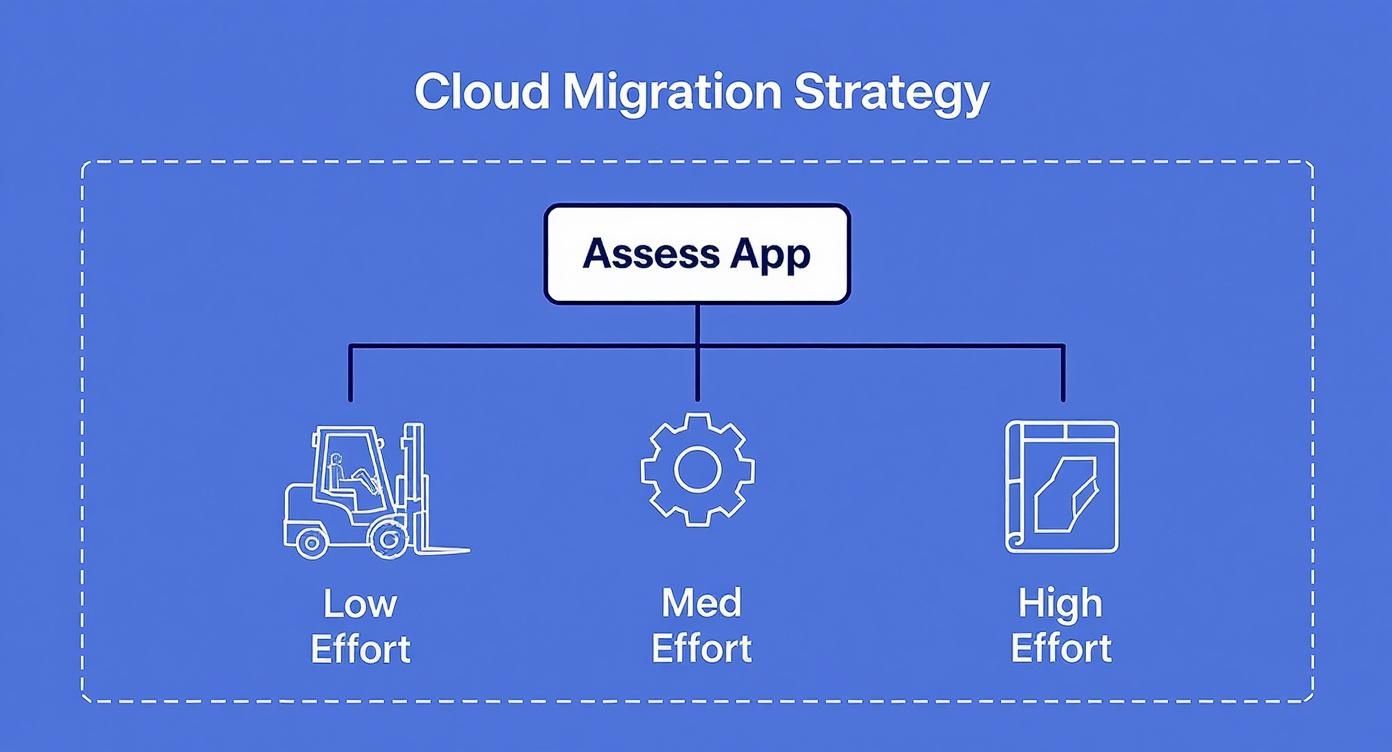
As the graphic shows, not every application needs a complete, ground-up rebuild. Many can be moved with low or medium effort, unlocking immediate benefits for your business.
Ready to centralize your applications on a secure, high-performance platform? Cloudvara provides dedicated servers, 24×7 support, and a 99.5% uptime guarantee to keep your business running smoothly. Start your free 15-day trial and experience the difference.