The fundamental trade-off with cloud hosting is simple: you gain incredible convenience and scalability, but you give up direct control over your infrastructure. It's a bit like switching from owning a house to renting an apartment. You no longer have to worry about the roof leaking or the plumbing failing—the landlord handles that—but you can't just knock down a wall whenever you feel like it. Cloud services give you immense power, but they come with shared responsibilities.

Deciding to move to the cloud is much more of a business strategy decision than a technical one. At its core, you're weighing operational agility against reliance on a third-party provider. The biggest win for most businesses is converting large, upfront capital expenses (CapEx) for hardware into predictable operational expenses (OpEx). This move frees up cash flow and completely eliminates the headache of buying, housing, and maintaining physical servers.
Of course, this convenience introduces its own set of challenges. When you hand over your infrastructure, you're placing a great deal of trust in your provider's security measures, uptime guarantees, and support team. You're also exposed to risks like vendor lock-in, where proprietary technology can make it painfully difficult and expensive to switch to another provider down the line. Getting a firm grip on the difference between cloud and on-premise solutions is the essential first step.
To really see the trade-offs clearly, it helps to put them side-by-side. The cloud shines brightest when it comes to providing scalable resources on demand—a feat that’s nearly impossible to replicate with in-house servers without a massive investment. For example, a business can tap into a huge ecosystem of integrated applications; to get a sense of how powerful these tools are, check out what Microsoft Dynamics 365 offers as a complete business management suite.
The table below breaks down the main advantages and disadvantages of adopting cloud services. Think of it as a quick reference point as we dive deeper into each of these areas.
| Aspect | Advantages (Pros) | Disadvantages (Cons) |
|---|---|---|
| Cost Structure | Pay-as-you-go model reduces upfront investment and converts CapEx to OpEx. | Can lead to unpredictable monthly bills and "cloud waste" if not managed. |
| Scalability | Instantly scale resources up or down to meet fluctuating demand. | Over-provisioning is common, leading to paying for unused capacity. |
| Accessibility | Access data and applications from any device with an internet connection. | Performance can be affected by internet connectivity issues (latency). |
| Security | Providers invest heavily in security, often exceeding on-premise capabilities. | Security is a shared responsibility; misconfigurations can lead to breaches. |
| Maintenance | The provider handles all hardware maintenance, updates, and replacements. | Limited control over the underlying infrastructure and update schedules. |
Ultimately, this isn't a simple "good vs. bad" comparison. It's about finding the right balance for your specific business needs, budget, and risk tolerance. Understanding both sides of the coin is the key to making a smart, strategic decision.

The widespread move to the cloud isn't just a trend—it's a smart business decision driven by tangible benefits that fundamentally change how companies operate. The biggest advantage? It lets you swap massive, risky capital investments for predictable monthly operational costs.
Instead of buying expensive servers that start aging the moment you plug them in, you’re essentially renting computing power. This pay-as-you-go model frees up cash you can pour back into growing your business, whether through marketing, R&D, or hiring top talent. It's a game-changer for businesses of all sizes.
Think about an e-commerce store gearing up for the holiday shopping frenzy. With old-school, on-premise servers, they’d have to purchase enough hardware to handle traffic on their busiest day of the year. For the other eleven months, most of that costly equipment would just sit there, gathering dust while eating up power and space.
The cloud flips that model completely on its head. It delivers elasticity—the ability to scale your resources up or down in an instant, reacting to real-time demand.
This kind of agility used to be a luxury reserved for huge enterprises with deep pockets. Now, it's accessible to any organization, leveling the playing field and sparking innovation.
The cloud doesn't just save you money on hardware. It cuts costs in many other ways, which becomes clear when you look at the Total Cost of Ownership (TCO). TCO includes not just the server price tag but all the "hidden" expenses of running your own data center.
The real win in cloud economics comes from wiping out indirect costs. You're no longer on the hook for the physical space, the hefty electricity bills for power and cooling, or the specialized staff needed to maintain and swap out aging hardware.
This smarter financial model has fueled a massive global shift. By 2025, an astonishing 94% of enterprises worldwide will be using cloud services, with 72% of all global workloads already hosted in the cloud. This isn't just about saving money; it's about growth, with 65% of leaders reporting that the cloud shortened their time-to-market for new products.
Disaster recovery is another area where the cloud shines. For most businesses, building a truly redundant on-premise backup system is just too expensive. It would mean setting up a whole second location with duplicate hardware, which is often out of the question.
Cloud providers, on the other hand, build their infrastructure across geographically separate data centers from the start. This makes creating a bulletproof disaster recovery plan both affordable and surprisingly simple.
Key Recovery Benefits:
This built-in resilience offers incredible peace of mind, knowing your critical data and applications are safe. To get a more complete picture, you can learn about all the benefits of cloud computing for businesses in our detailed guide. This advantage is central to understanding the true value you get when weighing the pros and cons of cloud adoption.
While the cloud offers a powerful suite of advantages, it's not a perfect solution. Ignoring its potential drawbacks can lead to costly surprises, frustrating limitations, and serious operational headaches. A balanced view of the advantages and disadvantages of cloud computing requires an honest look at the risks involved.
Think of it like leasing a state-of-the-art apartment in a luxury high-rise. You get access to a world-class gym, a rooftop pool, and a 24/7 concierge—amenities you could never afford on your own. But you can't renovate the kitchen, you're bound by the building's rules, and if the rent skyrockets, moving out is a massive undertaking.
One of the most common and damaging misconceptions about the cloud is that it’s always cheaper. While the pay-as-you-go model eliminates upfront hardware costs, it can just as easily lead to unpredictable monthly bills if not managed with extreme care. This is where the concept of "cloud waste" becomes a major headache for businesses.
This problem often stems from a lack of visibility. When teams can spin up new resources with a few clicks, it's easy to lose track of what's running. Before you know it, you’re paying for over-provisioned servers and idle services you forgot existed. According to recent analysis, managing cloud spend is now the top challenge for 82% of decision-makers. The situation is compounded by a startling lack of oversight, as over 20% of organizations admit they have little to no idea what their cloud services actually cost. Discover more insights about these cloud computing statistics on cloudzero.com.
Imagine your business is thriving on a specific cloud provider's unique database service or machine learning tool. It’s deeply woven into your applications and workflows. Now, what happens if that provider raises its prices dramatically or changes its terms of service? You're stuck.
This scenario is known as vendor lock-in. It happens when moving your data and applications to another provider becomes so technically complex and expensive that it's practically impossible. You become dependent on a single company's ecosystem, losing your leverage to negotiate and your freedom to choose the best tools for the job.
Vendor lock-in is the digital equivalent of building your house on rented land. You can build something amazing, but you never truly own the foundation it rests on.
While cloud providers offer powerful security tools, the ultimate responsibility for protecting your data still rests on your shoulders. This is called the shared responsibility model. The provider secures the cloud infrastructure itself, but you are responsible for securing everything you put in the cloud.
This shared duty introduces a lot of complexity. A single misconfiguration in your security settings can expose sensitive data to the entire internet. On top of that, businesses in regulated industries like healthcare or finance must navigate a maze of compliance rules.
Failing to manage these responsibilities can lead to devastating data breaches and severe financial penalties. Proactively implementing essential cloud security practices for businesses isn't just a good idea—it's a critical requirement for survival.
Finally, performance isn't always guaranteed. Because your data has to travel over the internet to and from the cloud data center, latency—or delay—is an inherent factor. For many applications like email or file storage, a few milliseconds of delay is unnoticeable.
However, for applications that require real-time data processing, such as high-frequency trading platforms or live video streaming, even minor latency can be crippling. The physical distance between your users and the provider’s data center can become a significant performance bottleneck, hurting the user experience and even the viability of your business.
Knowing the potential downsides of the cloud is one thing; actively managing them is what separates the successful from the frustrated. Instead of seeing risks like runaway costs and vendor lock-in as deal-breakers, it's better to treat them as manageable challenges. With the right strategies in place, you can turn those potential weaknesses into strengths, making sure your move to the cloud is both secure and cost-effective.
This takes a proactive mindset. You have to shift from just using cloud services to strategically governing them. By adopting a few key practices, you can get a firm handle on spending, keep your operational freedom, and build a stronger security foundation. This approach transforms the cloud from a potential headache into a predictable and powerful asset for your business.
This graphic breaks down the main risks that businesses run into when navigating the cloud.
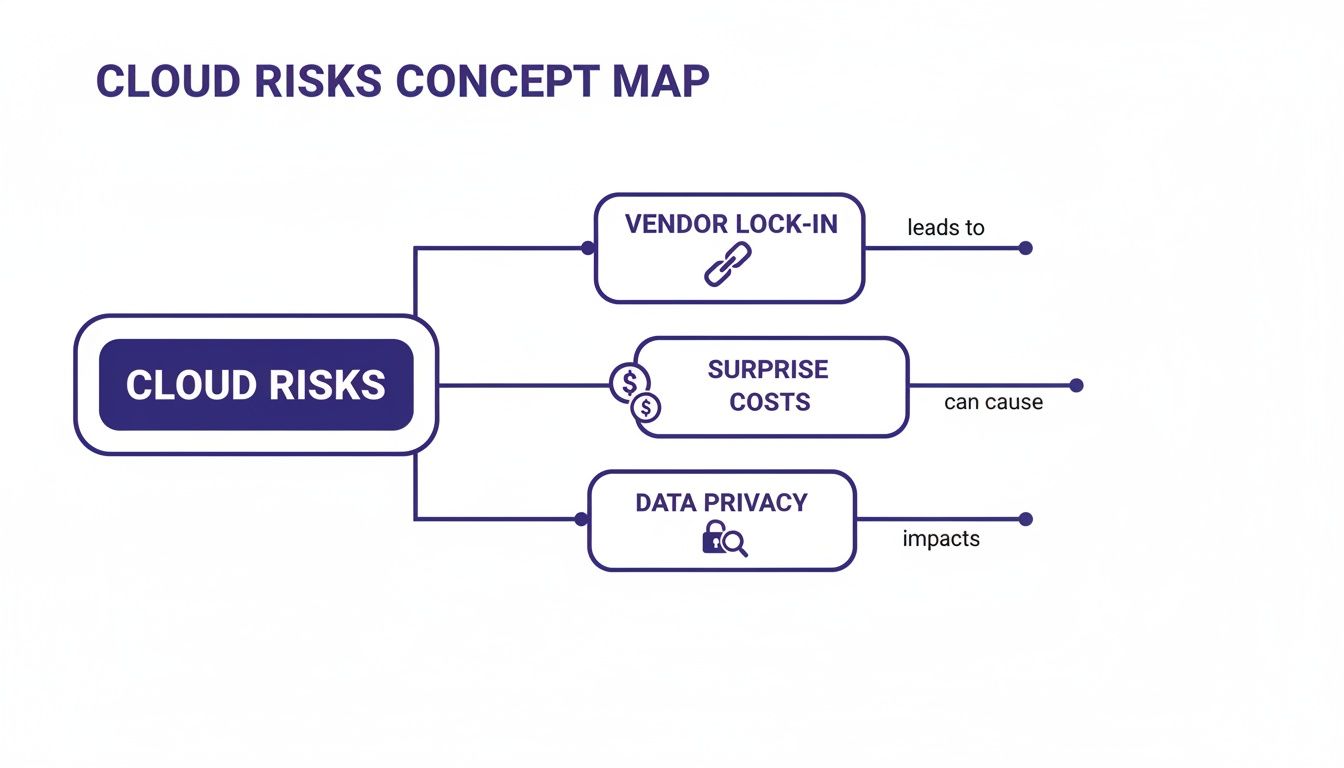
It shows how issues like getting stuck with one vendor, surprise bills, and data privacy are all connected, demanding a unified strategy to tackle them effectively.
The number one complaint I hear about the cloud is getting hit with an unexpectedly high bill. The answer is to build a culture of financial accountability, often called FinOps. This isn't just about cutting costs—it's about making sure every dollar you spend in the cloud delivers real business value.
Start with rigorous monitoring and tagging. By giving every cloud resource a specific tag—like "Marketing-Campaign-X" or "Development-Project-Z"—you get a crystal-clear view of exactly where your money is going. This lets you track spending by department, project, or even individual employee.
Once you have that data, you can set up automated alerts and budgets to stop overspending before it even happens. It turns financial chaos into clear, actionable intelligence and makes every team accountable for what they use.
Leaning too heavily on a single provider's proprietary tools is a huge risk. The best way to sidestep this is to adopt a multi-cloud or hybrid-cloud strategy. This simply means you intentionally use services from more than one cloud provider or mix public cloud services with your own private infrastructure.
A multi-cloud setup gives you the freedom to pick the best tool for each job, rather than being stuck with a one-size-fits-all solution. For instance, you might use one provider for its top-notch machine learning tools and another for its cheap data storage.
On top of that, it's critical to build your applications on open-source, portable technologies.
This strategy ensures you always have options and can shift workloads without having to rebuild everything from scratch. A smooth transition hinges on following proven guidelines, and you can learn more by exploring some established cloud migration best practices to guide your process.
Security in the cloud is a shared responsibility. The provider secures the underlying hardware and network, but you're responsible for protecting your data and applications running on top of it. A strong security posture always starts with tight access controls.
Implement the principle of least privilege, which means users and applications only get the absolute minimum permissions they need to do their jobs. This drastically shrinks your attack surface.
Make a habit of running regular security audits and use automated tools to scan for misconfigurations—a leading cause of data breaches. When it comes to compliance, vet your provider carefully to make sure their data centers meet your industry's specific rules, like HIPAA or GDPR. This due diligence should be a non-negotiable part of your vendor selection and contract talks.
Deciding whether to move to the cloud isn’t a simple yes or no. The whole discussion around the advantages and disadvantages of cloud isn’t about finding a perfect, one-size-fits-all answer. It’s about finding the right strategic fit for your business.
That means looking past a generic pro-and-con list and doing a clear-eyed evaluation of your specific needs. You have to be honest about your budget, the technical skills on your team, and your security requirements, then weigh them against your long-term goals.
The cloud is a powerful tool, no doubt. But its real value only shines through when it aligns with your operational reality. For one company, the cost savings might be the main draw. For another, the risk of getting locked in with a single vendor could be a deal-breaker.
To make a smart choice, you need a structured way to think through the trade-offs. The right path forward comes from asking the right questions and understanding what truly matters to your operations. A little strategic thinking now will save you a lot of headaches later.
Answering these questions will give you a solid foundation to build on:
This quick checklist can help you pull your thoughts together and see if you’re truly ready for a migration. Think through each point as you weigh the benefits against the potential hurdles.
Starting with a focused pilot project is the best way to gain invaluable hands-on experience. This practical approach takes the mystery out of the cloud and builds the confidence your team needs for a bigger commitment, making sure your first step is a successful one.
When you start digging into cloud hosting, a few practical questions always come up. Getting straight answers is key before you make a big move. Here are some of the most common queries we hear from business owners weighing their options.
Think of this as cutting through the noise to get to the real-world trade-offs.
For most small businesses, it boils down to one thing: escaping massive upfront hardware costs. In the past, getting serious about your IT meant shelling out thousands for physical servers—a huge capital expense that could really drain your cash flow.
The cloud completely flips that script. With its pay-as-you-go model, that giant capital expense (CapEx) turns into a predictable monthly operating expense (OpEx). This frees up cash that you can pour back into what actually grows your business, like marketing, hiring new talent, or developing your next great product.
Vendor lock-in is absolutely a real risk, and you should take it seriously. It’s what happens when you become so dependent on one cloud provider's specific tools that switching to another becomes a technical nightmare and a financial black hole.
The best defense against vendor lock-in is strategic diversification. Avoid putting all your digital eggs in one basket by designing your architecture to be as provider-agnostic as possible.
To sidestep this, many smart businesses now use a multi-cloud strategy, picking and choosing services from different providers. Another crucial move is building your applications with open-source tools and portable platforms like Docker and Kubernetes. These technologies let you pack up your work and move it between clouds with far less friction, keeping you in control.
Here’s the deal: the cloud can be much more secure, but it all comes down to how you manage it. Big players like Amazon Web Services and Microsoft Azure spend billions a year on security—way more than any single company could ever afford. They have teams of elite experts and cutting-edge tools protecting their infrastructure around the clock.
However, their security works on a shared responsibility model. The provider secures the cloud itself (the hardware, the data centers), but you are responsible for securing whatever you put inside the cloud. Simple misconfigurations are one of the top causes of data breaches. So, to actually get the benefit of the cloud’s powerful security, you need to set things up correctly, stay vigilant, and be proactive about your own security settings.
Ready to explore the advantages of a secure, managed cloud without the common disadvantages? Cloudvara offers a streamlined cloud hosting solution with 24×7 support and a 99.5% uptime guarantee. Start your free 15-day trial today and see how easy the cloud can be.